The best workout program is the one that fits your goal, your starting point, your equipment and the number of days you can really train, and that you enjoy enough to repeat. If you have two or three days a week, a full-body plan with simple sets and reps is the easiest place to start. Below, we walk you through how to pick one, how to spot a good plan, and how to progress without burning out.
Scrolling through programs is like standing at a buffet with no plate. Everything looks good, and you leave with a bit of everything and no real meal. The fix is to answer a few questions first.
Northwell Health’s The Well suggests choosing a workout that meets your current fitness level and priorities, and gives a checklist: fitness level, goals, injury adaptability, schedule, equipment, safe instructions, personality and long-term engagement.
Here is a quick version you can answer in two minutes:
A lot of trending programs are made for people who already train. Dr. Russell Frederick Camhi, writing for Northwell’s The Well, notes that many online programs don’t account for your personal starting point, past injuries, or time away from a routine, and that jumping into an advanced program raises injury risk.
That’s not a reason to hold back. It’s a reason to start where you are. A beginner plan that feels a little easy in week one is doing its job: it builds the habit and the technique that make the harder weeks possible.
Your weekly schedule is the quickest way to narrow the options. Healthline says full-body splits work well for 2 to 3 training days a week and suit people new to weightlifting. Upper/lower splits suit 4 to 6 days. The same article notes research suggesting 2 to 5 training days a week can produce similar strength gains when total weekly volume stays consistent.
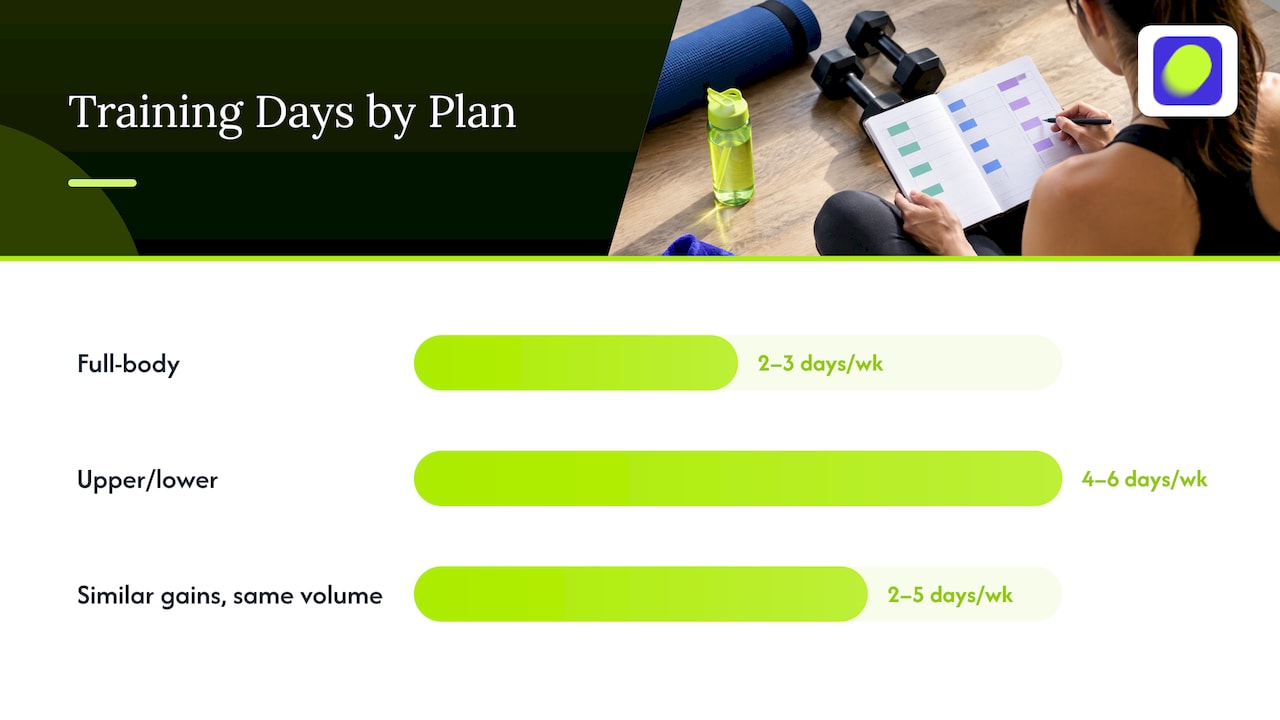
So if you train twice or three times a week, you aren’t behind. You’re in the sweet spot for a beginner.
The National Strength and Conditioning Association says most beginners can see the benefits of resistance training with as few as two or three days a week, on non-consecutive days so you can recover. The American Council on Exercise agrees that a full-body workout can be done up to three non-consecutive days each week.
Here is how common plan types fit:
Not sure whether intervals or lifting suits you better? Our guide on picking HIIT or strength based on what you’ll actually do can help you decide.
Once you’ve found a plan that fits your week, look under the hood. A good beginner program usually has these features:
If sets and reps still feel like a foreign language, our sets and reps explainer for new lifters breaks it down. For the warm-up, try a 5–10 minute dynamic warm-up, and finish with a simple post-workout cooldown.
What does this look like in real life? Here is one example of a three-day week, which you can shrink to two.
Cleveland Clinic’s beginner plan, for comparison, uses three days of resistance training, two days of cardio and two rest days. If that’s more than you can do right now, take the strength days and leave the rest for later.
Training at home? Our 2x or 3x a week dumbbell plan needs no gym. If you’re thinking about buying gear, it can help to know the best time to buy fitness equipment before you spend. Prefer the gym? Try our simple 4-week beginner gym workout.
Shorter than you think. Cleveland Clinic suggests starting with three workouts a week of 30 minutes each, or even just 15 minutes, then building up gradually, especially if you haven’t been active lately. Our breakdown of ideal workout duration by goal shows how to scale up when you’re ready.
Progress is allowed to be boring. Cleveland Clinic’s Kuharik advises doing 11 reps instead of 10, then 12 instead of 11, or using slightly heavier weights, and keeping a couple of reps in reserve during sets.
Mayo Clinic suggests increasing your activity by no more than 10% a week and planning time to recover between sessions.
A simple rule: when every set feels manageable at the top of the rep range, add a rep next time. When you reach the top of the range on every set, add a little weight.
We all miss workouts. A rough week doesn’t erase your progress, and you don’t need to double up to “make up” for it. Just show up for the next planned session.
Cleveland Clinic’s Kuharik points out that consistency comes easier when you enjoy what you’re doing, and encourages choosing workouts you genuinely like. So if the plan you picked feels like a chore, swap an exercise or try another style. Coming back after a long break? Our 4–8 week plan to get back into working out is built for exactly that. If you’re brand new to lifting, start strength training with 2–3 coach-led sessions.
Before you begin, talk with a doctor if you have a chronic health condition such as heart disease, diabetes or arthritis, if you have an injury, or if you feel chest pain, dizziness or unusual shortness of breath when you move. Mayo Clinic’s guide to getting started with a fitness program covers when a check-up makes sense. If you’re unsure how to do an exercise safely, a qualified coach or certified trainer can show you the form in person.

Picking a program is half the battle. Following it is the other half. Onemor is built for Gen Z beginners who want structure without spending hours planning: coach-led workouts, guided sessions with sets, reps and rest timers, plus streaks, XP and tribe challenges to keep you coming back. You train at the gym or at home, in plans designed to fit 2–3 sessions a week.
You can start on the free plan and see how it feels, or explore what Pro adds. Ready to take the guesswork out? Your next workout is already waiting.
Choose a full-body plan and train on non-consecutive days, for example Tuesday and Friday. Research summarized by Healthline suggests similar strength gains across 2 to 5 days when total weekly volume is consistent. Focus on doing both sessions every week.
Either can work. Strength training builds a base of technique and muscle, and HIIT is time-efficient. The better pick is the one you’ll repeat, so choose the style you enjoy and mix in the other once you’re consistent.
The American Council on Exercise recommends one to four sets of eight to 15 reps per exercise, with about two to three minutes of rest between sets. Start at the low end of the sets and build up as the movements feel easier.
When you can finish every set with good form and still have a couple of reps left, add a rep or a slightly heavier weight. Keep increases small and give yourself rest days between sessions.