The simplest, safest way to start is a full-body dumbbell program you do 2 to 3 times a week, built around compound-first exercises like squats, presses, and rows. Stick to 2 to 3 sets of 8 to 12 reps per move, add a little weight or a rep whenever it feels too easy, and give it 6 to 8 weeks of consistency. That’s it. You’ll feel the difference in how you move before you ever see it in the mirror.
TL;DR:
You don’t need a garage full of gear to start a beginner dumbbell program. You need a pair of dumbbells you can grow into, a little floor space, and five minutes before you lift.
Here’s the honest minimum kit:
For weight ranges, most beginners land somewhere around 5 to 10 pounds per dumbbell for isolation work like lateral raises, and 10 to 20 pounds per dumbbell for compound lifts like goblet squats or rows, according to the American College of Sports Medicine. Your numbers might land higher or lower. That’s normal.
Before you touch a dumbbell, spend two minutes waking your body up. Try 10 bodyweight hip hinges to prime your hamstrings and glutes, 10 glute bridges to activate the muscles your squats and deadlifts depend on, and 15 band pull-aparts (or arm circles if you don’t have a band) to open up your shoulders before pressing overhead.
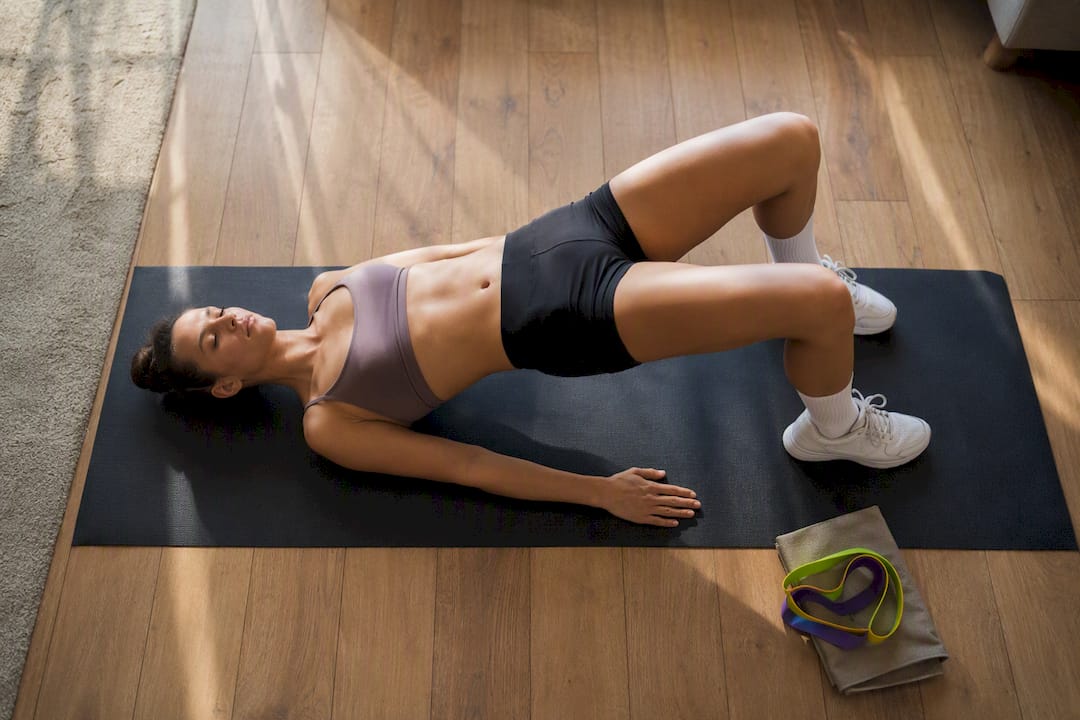
Pro Tip: Do your warm-up in the same order every session. Your body starts to recognize the pattern as “time to work,” and that mental cue alone makes the first working set feel more controlled.
Once your warm-up is dialed in, you need an actual plan, not a random pile of exercises; see this step-by-step strength training guide for beginners for practical routines and advice. Below are two complete options. Pick the one that fits your schedule, not the one you think sounds more impressive.
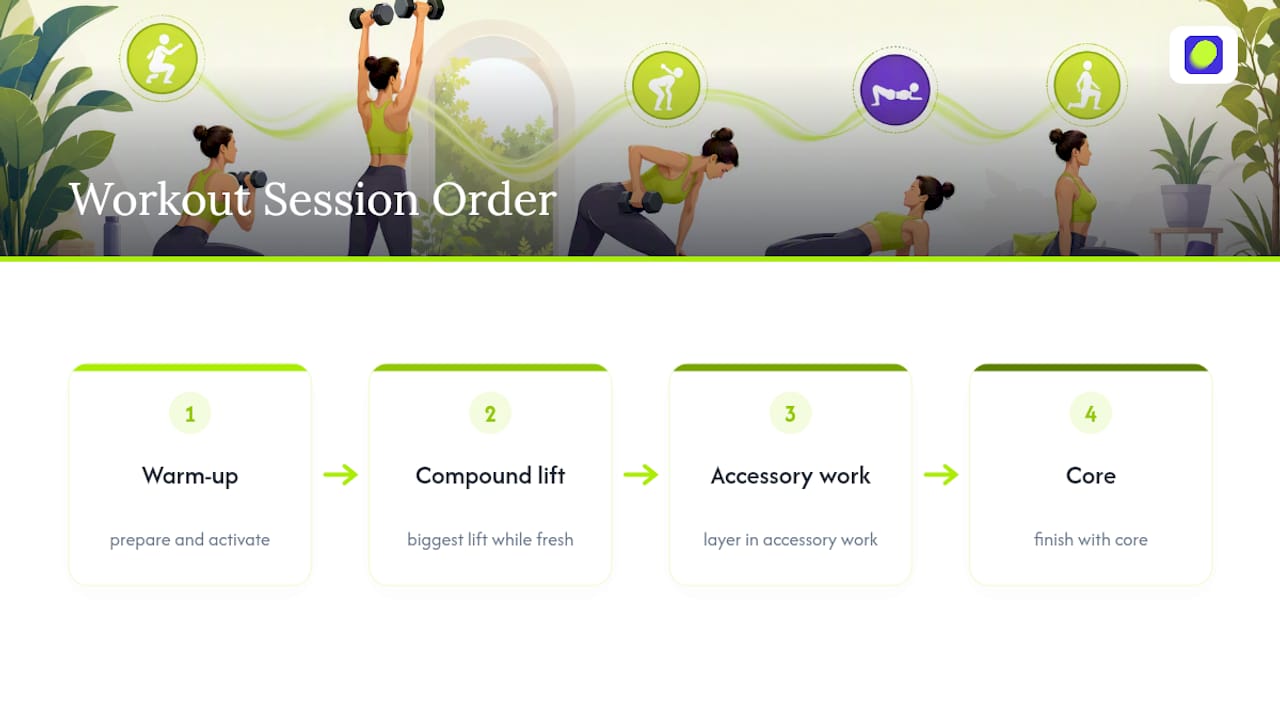
Both plans follow the same logic: warm up, hit your biggest compound lift first while you’re fresh, layer in accessory work, then finish with core. That order matters more than most beginners realize, because your central nervous system and coordination are sharpest at the start of a session, per exercise-selection expert consensus that flags this kind of sequencing as ideal for novices.
This is the right call if your week is unpredictable, or if twice a week is genuinely all you can commit to right now. Two focused, full-body sessions beat four sessions you keep skipping.
Workout A
Workout B
Alternate A and B across your two weekly sessions, resting at least one day between them.
Choose this if you can realistically train three separate days a week. It spreads the same total volume across more sessions, which for most beginners means fresher joints and better technique per set.
Workout A (Squat Emphasis)
Workout B (Hinge Emphasis)
Workout C (Full-Body Finisher)
Both structures line up with published guidance recommending 2 to 3 sessions per week for novices, with 2 to 3 sets per exercise in the 8 to 12 rep range, according to Harvard Health.
How you know it’s time to progress:
Give either plan 8 to 12 weeks before you judge it. Strength adaptations from a new program often show up faster than muscle gain does, largely because your nervous system is learning the movement patterns before your muscles have to do much extra work.
Knowing the exercise names on a program is one thing. Doing them well is another. Here’s what actually matters for each move in your beginner dumbbell program.
Hold one dumbbell vertically against your chest, elbows tucked, and squat between your knees rather than straight down. Keep your chest tall, push your knees out slightly as you descend, and drive through your whole foot to stand.
Press dumbbells up over your chest, elbows at roughly 45 degrees from your torso, not flared straight out. Lower under control until your upper arms touch the floor or reach bench-level depth.
Hinge forward with a flat back, row the dumbbell toward your hip rather than your shoulder, and squeeze your shoulder blade at the top.
Push your hips back first, keep the dumbbells close to your shins or thighs, and keep your spine neutral, not rounded.
Press straight up, letting the dumbbells finish just outside your ears, and avoid arching your lower back to compensate.
Step back rather than forward. This move is easier to control for most beginners and puts less shear stress on the front knee.
Walk tall with dumbbells at your sides for the carry, or hold a rigid line from shoulders to heels for the plank.
Across every move, breathe out on the effort phase, brace your core like you’re about to be tapped in the stomach, and control the lowering portion of the lift. That eccentric phase, the “lowering” half of a rep, is where a lot of real strength gets built and where most beginners rush.
Pro Tip: Film yourself from the side on your phone for one set each week. You’ll catch form issues in ten seconds of playback that you’d never notice mid-set.
Most beginners either grab dumbbells that are way too light because they’re nervous, or too heavy because they want to “feel it.” Neither approach builds strength efficiently. The better method: pick a weight where you can complete 8 to 12 reps, and the last two of those reps feel genuinely hard while your form stays intact.
That’s the 2-rep test, and it works because it doesn’t require you to know your one-rep max or do any math. You simply ask: could I do two more reps with good form? If yes, the weight’s too light. If you’re grinding and your form is falling apart before rep 8, it’s too heavy.
As a starting anchor, isolation moves like lateral raises or bicep curls often start around 5 to 10 pounds per dumbbell, while compound lifts like goblet squats, rows, and deadlifts often start around 10 to 20 pounds or more, per ACSM guidelines. Your actual starting point depends heavily on your existing activity level, so treat these as a launchpad, not a rule.
A rep-based test beats guesswork. Research on strength training methodology backs the idea that taking a set close to failure within an 8 to 12 rep window reliably signals whether a load is appropriate, without needing any 1RM testing, according to strength coaching insight published in The Independent.
Once you’ve found your working weight, here’s how to keep moving forward without guessing:
Small, boring increments beat dramatic jumps. A 5-pound jump on a dumbbell you were barely finishing sets with can wreck your form on the very next session.
Some soreness after your first few sessions is normal and expected. It usually peaks around 24 to 48 hours after training and fades within a few days on its own. Sharp pain during a movement, pain that lingers past a week, or joint pain (as opposed to muscle soreness) is different, and it’s worth backing off and checking in with a physical therapist or doctor rather than pushing through it.
Recovery isn’t complicated for a beginner dumbbell program. Give the same muscle groups roughly 48 to 72 hours before training them hard again, which is one reason full-body sessions on non-consecutive days work so well for novices. Sleep and eating enough protein and overall calories matter more for recovery than any recovery gadget or supplement you could buy. If you’re constantly sore, sleeping poorly, and dreading your sessions, that’s your body asking for a deload week, meaning lighter weights or fewer sets for 5 to 7 days.
A few common beginner snags and how to fix them:
Pro Tip: Keep a simple note in your phone with the date, exercise, weight, and reps completed. Two months from now, that scribbled log will show you progress your memory alone never would have caught.
Following a plan on paper is one thing. Actually knowing if your form is right, whether today’s the day to add weight, and staying consistent when motivation dips, that’s where most beginners quietly fall off. Technical uncertainty and inconsistent progression are the two biggest reasons a solid program on paper never turns into real results.
This is exactly the gap guided coaching closes. Onemor pairs beginner-friendly dumbbell programs with built-in sets, reps, and rest timers so you’re never guessing what comes next, plus streaks and XP that make consistency feel like progress you can actually see. Coach-led sessions walk you through form cues in real time, the same cues covered above, but demonstrated instead of just described.
If you want this beginner dumbbell program handed to you as a guided plan instead of a page you have to reread before every workout, Onemor’s beginner tribe programs are built for exactly that starting point.
Strength and mobility aren’t competing priorities. Tight hips and stiff shoulders are often what turn a clean goblet squat or overhead press into a form breakdown, so a few minutes of mobility work pays off directly in your lifting.
Before you touch dumbbells, a 90/90 hip stretch (sitting with one leg bent in front, one bent to the side, rotating gently between sides) opens up the hip rotation your squats and lunges depend on. A doorway shoulder stretch, standing in a doorframe with your arm bent at 90 degrees and leaning gently forward, helps counter the rounded-shoulder posture most of us carry from sitting at desks all day.
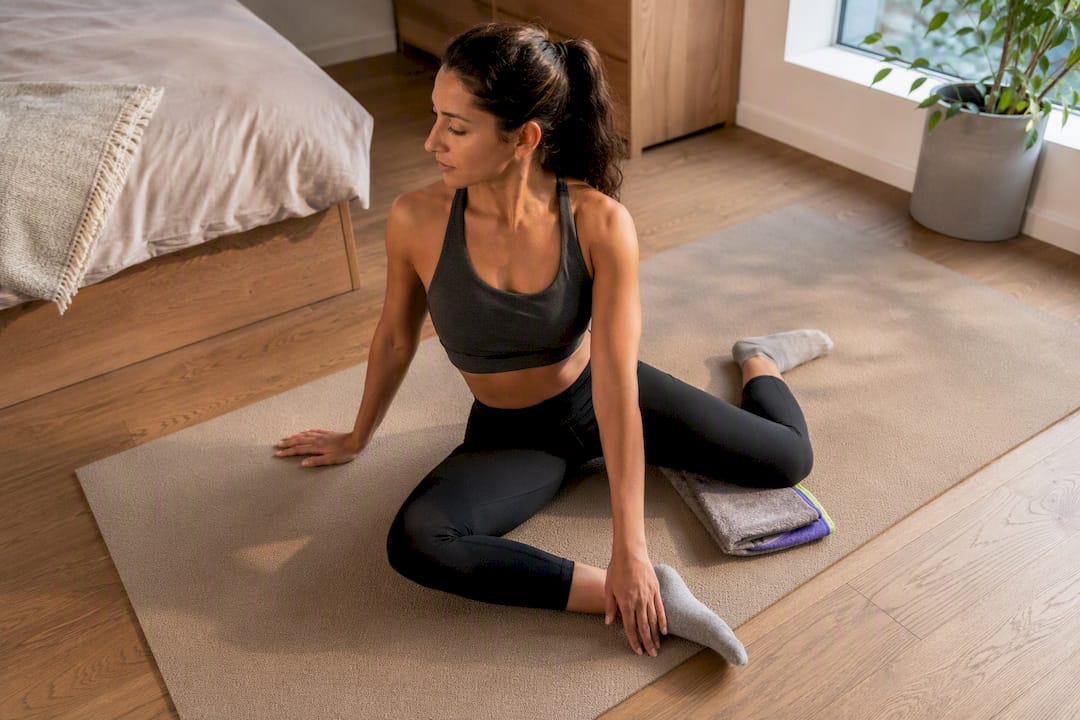
After training, spend a few minutes on static stretches instead: a standing hamstring stretch for your Romanian deadlifts, a couch stretch or kneeling hip flexor stretch for your lunges, and a cross-body shoulder stretch for your presses and rows. Hold each for 20 to 30 seconds, breathing normally rather than holding your breath.
You don’t need a separate 45-minute mobility routine bolted onto your training days. Ten minutes total, split before and after your dumbbell workout, is enough to keep your joints moving through full range and your form clean session after session. Think of mobility work less as a separate task and more as the maintenance that lets your strength training actually work the way it’s supposed to.
A beginner dumbbell program doesn’t have to live in isolation from the rest of your week. The question is sequencing, not choosing one over the other.
If you’re doing cardio and dumbbell training on the same day, lift first while your muscles are fresh and your coordination is sharp, then do your cardio afterward. Heavy cardio before lifting can leave your legs shaky for squats and lunges, which undercuts the exact form cues you’re trying to build. If you’re training on the 2-day split, adding two light to moderate cardio sessions on your off days (a brisk walk, a bike ride, an easy jog) rounds out your week without interfering with recovery.
Stretching fits differently depending on when you do it. Save deep static stretching for after your dumbbell session or for a separate day entirely; stretching a muscle deeply right before you load it with weight can temporarily reduce its power output. Dynamic movement, the kind covered in your warm-up, is the right call before lifting.
For most beginners juggling a job, a life, and a new dumbbell habit, three strength sessions plus two light cardio days is a sustainable weekly rhythm that doesn’t require living at the gym.
Everything in this program works. The exercises, the sets and reps, the progression rules, all of it is built on real training principles. What trips most beginners up isn’t the plan itself, it’s remembering what comes next, knowing when to add weight, and staying consistent past week three when motivation naturally dips.
Onemor takes that entire program and turns it into something you actually follow: guided sessions that walk you through sets, reps, and rest timers in real time, streaks and XP that make showing up feel rewarding, and coach-led beginner plans built by people who know exactly what a first-time lifter needs. You’re not rebuilding this program from a page every session. You’re just showing up and training.
If you’re ready to stop reading about a beginner dumbbell program and start one that tracks your progress for you, Onemor’s coach-led beginner programs are built for exactly this starting point, or explore the free and premium options on the Onemor app and pick your first tribe today.