Here’s a ready-to-use beginner gym workout you can start today. Training several days per week with a structured split, plus some short cardio sessions, is enough for most beginners to build real strength and fitness from scratch.
TL;DR:
Your 3-day starter plan (copy this for your first gym visit):
Use RPE (rating of perceived exertion) as your intensity guide: a 6–8 out of 10 means the set feels moderately hard but you could do 2–3 more reps if you had to. The FITT-VP framework (Frequency, Intensity, Time, Type, Volume, Progression) is the standard model coaches use to build programs exactly like this one. Onemor’s guided sessions have all of this built in, so you never have to calculate it yourself.
A short, consistent program produces the majority of early strength and fitness gains. That’s not a motivational claim — it’s how your body actually adapts.

When you first start lifting, most of your strength improvements come from neural adaptation: your nervous system gets better at recruiting muscle fibers and coordinating movement patterns. Visible muscle changes typically follow at the 4–8 week mark. This means the first month of training is less about building a bigger body and more about teaching your body how to move well under load.
Moderate-load, lower-frequency training twice per week captures most early strength and hypertrophy benefits for untrained individuals. That’s a liberating fact. You don’t need to train six days a week or follow a complicated split to make real progress in your first month.
Complexity is actually a risk for beginners. Too many exercises, too many days, and too many variables make it harder to track what’s working and easier to burn out or get hurt. A simple, repeatable structure keeps you progressing without overwhelming you.
Start with 2–4 gym sessions per week depending on your schedule. Two sessions still captures large benefits; three is the sweet spot for most people.
Here's how to structure your weekly schedule:
For session length, aim for 40–60 minutes on full sessions. Express templates of 20–30 minutes work well when you’re short on time, as long as you keep the main compound lifts and maintain enough intensity.
Intensity guidance is simple: use RPE 6–8 out of 10 for your strength sets. At RPE 6, the set feels moderate and you could definitely do more. At RPE 8, it’s genuinely hard but your form is still clean. Avoid training to complete failure in your first month — it spikes soreness and slows recovery without adding meaningful benefit.
Always start with a 5–8 minute dynamic warm-up and finish with a 3–6 minute cool-down. Skipping either one is the fastest way to feel stiff, perform poorly, or pick up a nagging injury.
A good warm-up moves through three stages. Start with 3–5 minutes of light general cardio: a brisk walk on the treadmill, easy cycling, or a few minutes on the rowing machine. This raises your core temperature and gets blood moving. From there, move into movement prep: 10 leg swings per side, 10 hip circles, 10 arm circles, and 10 bodyweight squats. These drills wake up the joints and muscles you’re about to use. Finally, do an exercise-specific warm-up for your first big lift of the day.
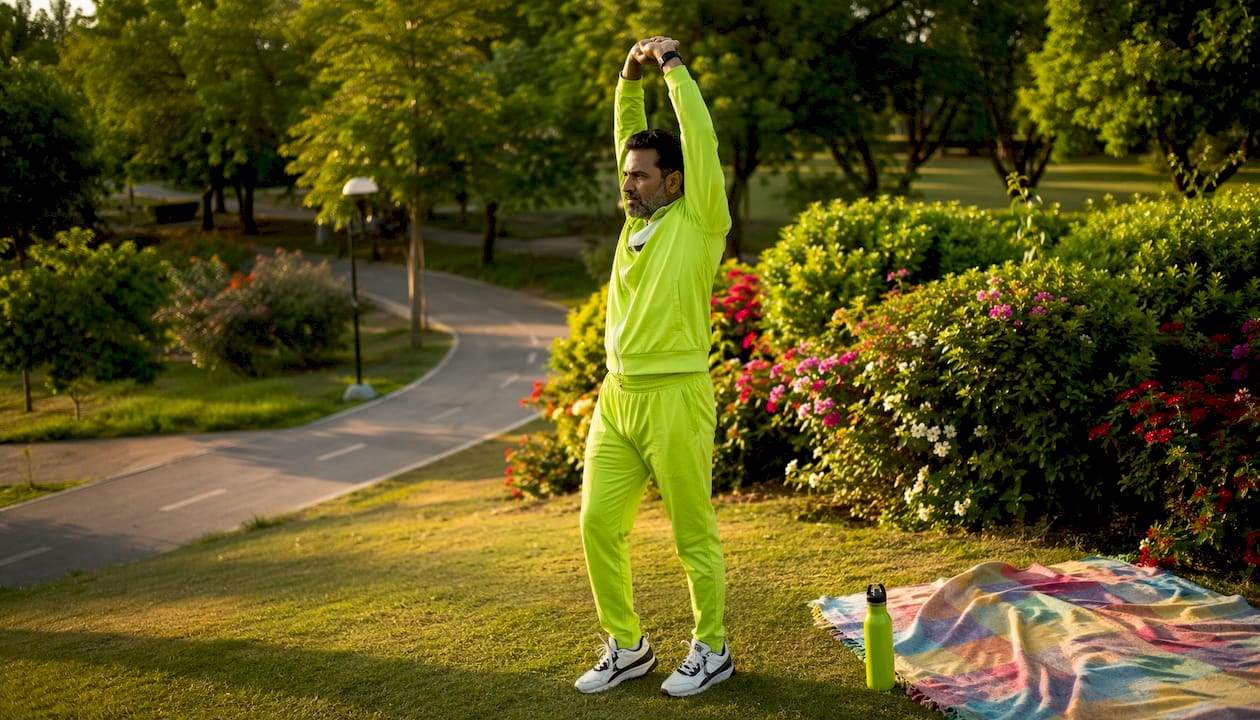
Pro Tip: If you’re short on time, skip the long full-body warm-up and do 1–2 lighter warm-up sets of your first compound exercise instead. For example, before your goblet squats at working weight, do one set with just the dumbbell and one set at half your working load. Research supports that a short, exercise-specific warm-up is enough to prepare you for the session.
For your cool-down, spend 3–6 minutes on static stretches targeting the muscles you just worked. A simple sequence: 30-second hip flexor stretch per side, 30-second hamstring stretch per side, 30-second chest opener, and 30-second lat stretch. Hold each stretch gently — you’re not trying to force range of motion, just letting the muscles relax.
Focus on compound movements that cover squat, hinge, push, and pull patterns. These four categories drive the majority of progress for beginners and give you the most return on your time.
Here's your core exercise bank with technique cues and starter prescriptions:
Pro Tip: For absolute beginners, machine-based and dumbbell exercises provide a faster, safer skill on-ramp than barbell work and still generate near-maximal early strength gains at moderate loads. Start on machines and dumbbells for your first 4–6 weeks, then add barbells once your movement patterns feel solid.
Multiple sets per exercise (3–4 sets) outperform single-set protocols for strength and mobility in untrained individuals. Prescribing 3 sets per exercise isn’t arbitrary — it’s the minimum effective dose for real adaptation.
Progression rule: Once you can complete all prescribed reps with clean form and at RPE 7 or below, add 2.5–5 lbs at your next session. If you can’t add weight yet, add 1 rep per set instead. When you consistently hit the top of the rep range (e.g., 12 reps when the target is 8–12), that’s your signal to increase the load.
There are three templates to choose from: a 2-day express plan, a 3-day balanced plan, and a 4-day split. Pick the one that fits your schedule right now, not the one you think you should be doing.
This is your starting point if you’re brand new or have a packed schedule. Each session hits the whole body with three compound movements. Day 1: goblet squat 3×10, seated row 3×10, incline push-up 3×12. Day 2: Romanian deadlift 3×10, machine chest press 3×10, glute bridge 3×12. Rest 60 seconds between sets. Always include your dynamic warm-up and a brief cool-down stretch.
This is the sweet spot for most beginners. Day 1 (Push): goblet squat 3×10, machine chest press 3×10, overhead dumbbell press 3×10, plank 3×20 seconds. Day 2 (Pull + Legs): Romanian deadlift 3×10, seated cable row 3×10, banded lat pulldown 3×12, glute bridge 3×12. Day 3 (Full-body): bodyweight squat 2×15, dumbbell row 3×10 per side, machine chest press 3×10, farmer carry 3×20 meters. Rest 60–90 seconds between sets.

Move here after 4–6 weeks on the 3-day plan. Upper A: machine chest press 3×10, seated row 3×10, overhead press 3×10, banded lat pulldown 3×12. Lower A: goblet squat 3×10, Romanian deadlift 3×10, glute bridge 3×12, farmer carry 3×20 meters. Repeat with Upper B and Lower B using slight exercise variations such as different presses or leg movements.
First-week note: In week 1, use weights that feel easy. You’re learning movement patterns, not testing your limits. Expect some muscle soreness 24–48 hours after your first session — that’s normal. It fades by week 2.
First-month progression: In weeks 1–2, focus on form and hitting all prescribed reps. In weeks 3–4, start adding small loads (2.5–5 lbs) or 1 extra rep per set where you feel ready. By the end of week 4, you should be lifting noticeably more than you started with.
If you don’t have access to cables or machines, swap the seated row for a dumbbell row, the lat pulldown for a resistance band pulldown anchored to a door, and the machine chest press for a dumbbell floor press. The movement patterns stay the same.
Follow simple, measurable progression rules. Add small loads or extra reps when you complete all prescribed sets with solid form. That's the whole system.
Here's a simple 4-week on-ramp:
A deload isn’t failure. Persistent fatigue, stalled lifts, or poor sleep are all signals your body needs a lighter week. One deload week every 4–8 weeks is a normal part of any well-designed program.
Pack a small, dedicated gym bag and follow a few simple etiquette rules. You’ll feel more confident on the gym floor from day one.
Gym bag essentials:
A pre-packed gym bag reduces the friction that leads to skipped sessions. Keep it ready by your door so the only decision you need to make is showing up.
Safety red flags to know: Sharp joint pain (not muscle burn) during a movement means stop and reassess your form or load. Dizziness or lightheadedness during a set means rest immediately and hydrate. Uncontrolled breathlessness that doesn’t ease within a minute of stopping is a signal to end the session and speak with a healthcare provider before returning.
Book a session with a certified personal trainer if you experience persistent joint pain, feel genuinely unsure about your form on a compound lift, or want to set a new heavy lift safely. One or two sessions with a trainer early on can save months of bad habits.
Most setbacks come from a handful of repeatable mistakes. Here's what to watch for and what to do instead:
Pro Tip: Keep your gym bag packed and ready the night before. The psychological barrier to skipping a session drops significantly when the only thing standing between you and the gym is putting on your shoes. Small logistics wins compound over time.
Structured, coach-led programs reduce guesswork and improve adherence compared with casual, unplanned workouts. That’s not just a coaching opinion — it’s backed by how progression and habit formation actually work.
Here's what the evidence supports:
Coach-led apps like Onemor deliver these benefits directly. Guided sessions come with built-in sets, reps, and rest timers so you’re never guessing what to do next. Progression is tracked automatically, and certified coaches inside the app provide cues and structure that mirror working with a trainer in person. If you want to remove the guesswork entirely, try one of Onemor’s beginner templates as your starting program.
A 3-day-per-week beginner gym workout built around compound movements, progressive overload, and consistent recovery is the most effective and sustainable way to build strength in your first month.
You will improve if you show up consistently and follow the basic rules. That’s the honest truth, and it’s more encouraging than it sounds.
Most beginners walk into the gym expecting it to take months before anything changes. The neural adaptations that make you feel stronger and more coordinated happen within the first 2–4 weeks. Visible changes follow. The curve is steep early on precisely because your body has so much room to adapt.
Set small, measurable goals for your first month: add 1–2 reps to one exercise per week, or increase one lift by 5 lbs. These micro-wins are what build the habit. The fear of looking lost or doing something wrong is real, but it fades fast once you have a plan in your hand and a warm-up under your belt. Every person you see moving confidently in the gym was once exactly where you are now.
If you want guided structure from day one, Onemor’s beginner programs give you exactly that, with real coaches and a community to train alongside.
Starting a gym routine is genuinely hard when you don’t know what to do next. Onemor is built for exactly that moment. It’s a guided workout app designed for Gen-Z and young adults who want real results without spending hours planning their own programs.
With Onemor, every session comes with built-in sets, reps, and rest timers led by top trainers. Beginner-friendly templates are ready to follow from day one, covering strength training, HIIT, and bodyweight work for both gym and home. You track your progress automatically, earn XP, build streaks, and train alongside a community through tribe-based challenges that make consistency feel less like discipline and more like something you actually want to do. Free templates are available on iOS, with premium options for full coach access and advanced programming. Head to Onemor and start your first guided session today.
The following sources back the article's recommendations and are worth reading if you want to go deeper.
This article is general fitness information, not medical or professional advice. Confirm any exercise program with a qualified healthcare or fitness professional before starting, especially if you have an existing health condition or injury.