A rep is one complete movement of an exercise, like one squat. A set is a group of reps done back to back without resting. "3 sets of 12 reps" (3x12) means doing 12 reps, resting, then repeating twice more. Most beginners do well with 8–12 reps per set and 2–3 sets per exercise.
TL;DR:
3 sets of 12 reps means you do an exercise 12 times in a row, rest, then repeat that twice more, for 36 reps total. Rest 60–90 seconds between sets. Choose a weight where the 12th rep is hard but still clean, with about two reps left in the tank.
For 3 × 12 goblet squats: 12 squats, rest 90 seconds, 12 squats, rest, 12 squats. You'll also see it written 3x12. Once all three sets feel easy, add weight.
One push-up is one rep. Ten push-ups in a row, then a pause, is one set of ten. Do that block three separate times with rest in between, and you’ve completed 3 sets of 10 reps, or “3x10” in gym shorthand.
Workout instructions often get compressed into strings like “3x12, 60s.” That reads as three sets of twelve reps, resting sixty seconds between each set. Once you can decode that format, you can follow almost any workout plan, app, or trainer’s notes without a second thought.
You’ll also hear about 1RM, or one-rep max, which is the heaviest weight you can lift for a single rep of an exercise. It’s a real measurement, but it’s not one beginners need. Testing a true 1RM requires near-maximal effort and solid technique under load, and the injury risk usually outweighs the information it gives a new lifter.
A few quick reference points worth memorizing:
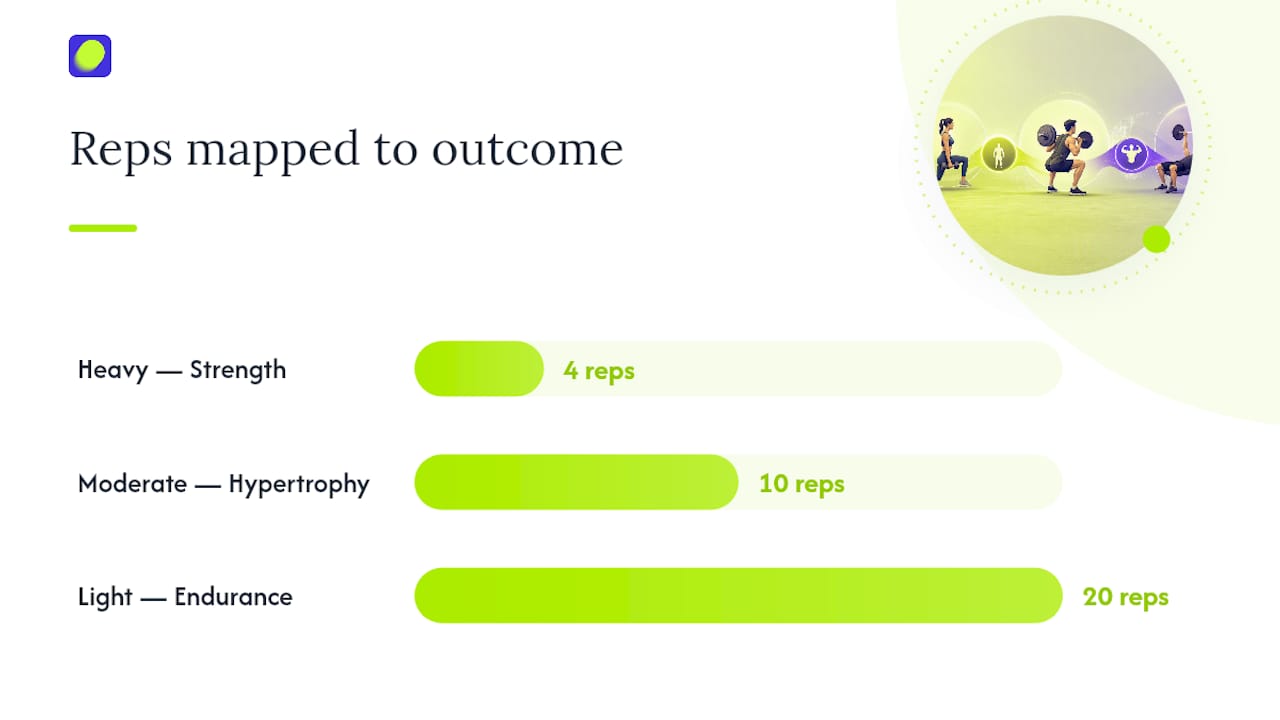
Reps and sets don’t just fill a page in a workout log. They’re the dial that decides whether your training builds raw strength, visible muscle, or staying power. This mapping is called the repetition continuum, and it holds up across a wide body of exercise science.
A detailed review of the repetition continuum breaks it down clearly:
A moderate 8 to 12 rep range is repeatedly flagged as the most practical zone for building muscle without pushing beginners into risky, near-maximal loads, according to that same PMC review. Research shows a wider range builds similar muscle when sets are taken close to failure; see rep ranges for hypertrophy once you’ve got the basics down.
Take one exercise, the goblet squat, as an example. Load it heavy for 4 reps and you’re training strength. Drop the weight and do 10 reps and you’re training size. Grab a light dumbbell and knock out 20 reps and you’re training endurance. Same movement, three completely different outcomes, depending entirely on the rep count and load.
Skip the complicated periodization charts for now. A default of 8 to 12 reps for 2 to 3 sets per exercise covers strength, muscle, and confidence building all at once, and it’s backed by real research, not guesswork.
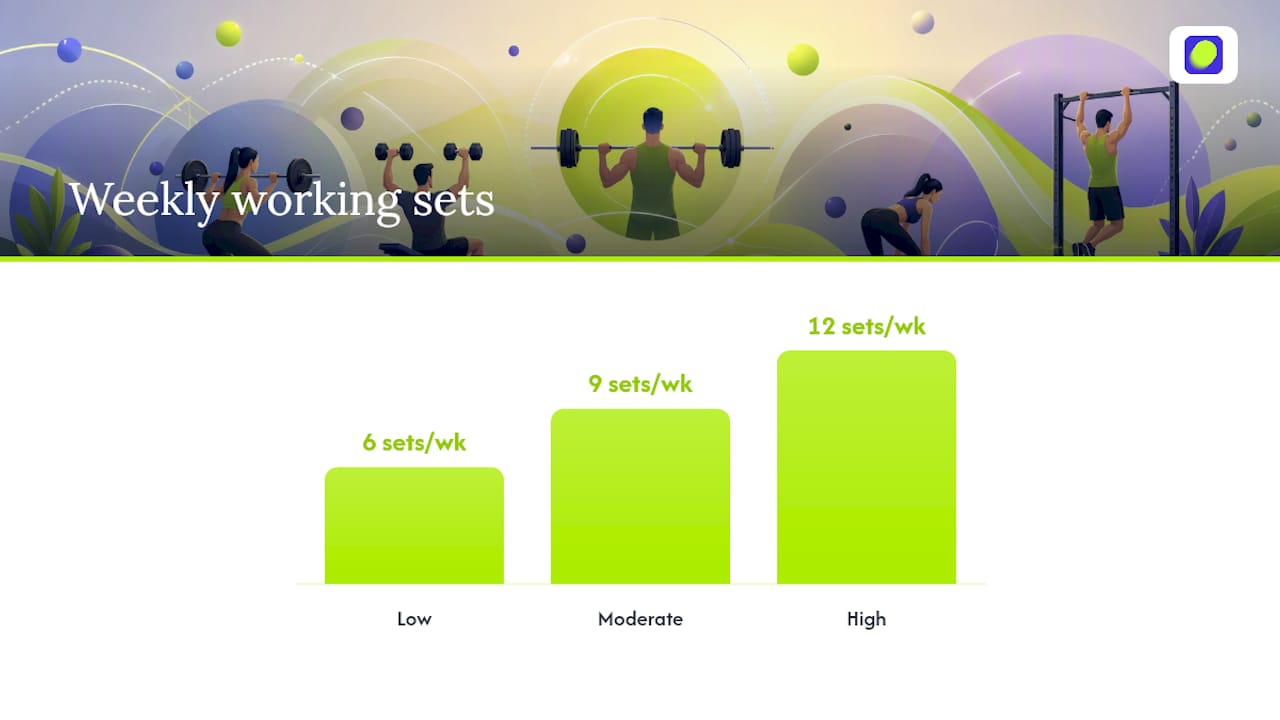
The ACSM position stand on resistance training progression notes that beginners see substantial strength and muscle gains from surprisingly modest volume, often just 1 to 3 sets per exercise. Stack a few exercises per muscle group across a week and you land in the range most reviews point to: roughly 6 to 12 working sets per muscle group per week. That’s plenty of stimulus without burying yourself in soreness or fatigue.
To keep planning simple, try this approach:
This mirrors what’s sometimes called the 3–5 rule: train 3 to 5 days a week, with 3 to 5 exercises per session and 3 to 5 sets each. It’s not a rigid law, just a practical frame that removes the guesswork from “how much is enough.”
Pro Tip: If you’re torn between adding a fourth exercise or a third set to an existing one, choose the third set. More total volume on fewer movements builds skill faster than spreading effort thin across too many exercises.
Rest time isn’t dead time. It’s part of the program, and how long you rest changes what your training actually accomplishes. Heavy strength work near your limit needs longer recovery between sets than lighter, high-rep endurance work does.
The NSCA’s guidance on rest interval management recommends a wide range depending on your goal:
Recommended rest periods across strength training research span roughly 20 seconds to 5 minutes, scaled to intensity and goal.
Effort matters just as much as rest. Reps in Reserve, or RIR, describes how many more reps you could squeeze out before hitting failure. For most beginner sets, aim to finish with about 2 reps left in the tank. That’s enough intensity to drive progress without wrecking your form on the last rep. As for tempo, controlling the lowering (eccentric) phase of a lift matters more than rushing the lifting (concentric) phase, especially on movements like squats and rows where control keeps your joints safe.
Progression should follow a simple ladder, not a hunch. When you can complete the top of your rep range, say 12 reps, across every set with clean form for a couple of workouts in a row, it’s time to add a small amount of weight, often 2.5 to 5 pounds for upper-body movements and 5 to 10 pounds for lower-body barbell lifts, then drop back to the bottom of your rep range.
Watch for signs you need to pull back instead of push forward:
Training to failure on every set isn’t necessary and often works against beginners. Stopping with 2 to 3 reps in reserve typically builds similar muscle while protecting your joints and your motivation to show up next session.
Pro Tip: Keep a simple log of weight, sets, and reps for every workout. Progression becomes obvious when you can see the numbers instead of relying on memory.
Here’s a full-body template you can start this week, no complicated split needed:
If you train at home without equipment, this bodyweight-only calisthenics plan covers the same movement patterns. Progress by adding one rep per set until you hit 12 across the board, then add a small amount of weight and drop back to 8 reps. Once 2 sets feel too easy for a full week, add a third. When that template starts feeling too simple, follow this three-day workout plan, which adds a hinge day and a progression schedule.
Reading the theory is one thing. Applying it mid-workout, while you’re tired and second-guessing your form, is another. Some fitness apps build the 8 to 12 rep, 2 to 3 set structure directly into every workout, with built-in rest timers to help guide rest periods between sets. Progress tracking flags when you’re consistently hitting the top of your rep range, which takes the 1RM-testing guesswork out of knowing when to add weight. Certain blogs, including guidance on rep ranges and weekly set volume, back the same evidence this article draws from.
You don’t have to build your own spreadsheet or guess your way through rest timers to put any of this into practice. Some fitness apps are built specifically for people starting out, featuring coach-led sessions that apply the 8 to 12 rep, 2 to 3 set structure, built-in rest timers, and progress tracking to help determine when to add weight. Users may get free workouts to start, with additional coaching and community challenges available for more structured training.
If you want a coach’s perspective behind your program, profiles like Coach Wilbert and Coach Kayla show the range of guided sessions available inside the app. Or browse Onemor’s tribes to train alongside people at a similar starting point. Either way, the fastest way to see how this all comes together is to open the app and start your first guided workout.
It means you perform the exercise 15 times in a row, rest, then repeat that full block two more times, for 45 total reps split across 3 sets.
Not inherently. It’s a common structure for muscular endurance work, though beginners often get more balanced results starting closer to 8 to 12 reps per set for most exercises.
Twelve reps per set, done three times, sits in the range most coaches start beginners in for building muscle size, making it one of the most common beginner prescriptions.
There’s no single agreed definition of a “3-3-3 rule” in strength training literature. A related and better-supported framework is the 3 to 5 rule: 3 to 5 training days per week, 3 to 5 exercises per session, and 3 to 5 sets per exercise.
One to two light warm-up sets per exercise, using a lighter weight than your working sets, is typically enough to prepare joints and muscles before your first working set.