Hypertrophy happens across a wide rep range. What matters most is how close you push each set to failure and how many hard sets you rack up per week, not the number stamped on your program. Use a moderate rep range as your everyday default, add some heavier low-rep sets on your main lifts, and include higher-rep sets for isolation work. The rep number is a tool, not a rulebook.
TL;DR:
For years, the fitness world treated 8 to 12 reps like scripture. Anything heavier was “for strength,” anything lighter was “for endurance,” and the muscle growth zone sat right in the middle. That belief is outdated.
A re-examination of the repetition continuum found similar whole-muscle hypertrophy across a wide spectrum of loading ranges, as long as trainees used at least roughly 30% of their one-rep max and pushed sets close to failure. Eight to twelve reps was never a magic zone. It was just a convenient training tradition.
A separate review on resistance training volume and hypertrophy backs this up with longitudinal data. Sets performed across a wide rep range, from low to high, produced comparable muscle growth when effort was matched between groups. The muscle does not know or care whether the bar moved for six reps or twenty two. It responds to tension, fatigue, and how close you got to your limit.
Here is where study design actually matters, because it explains why some older research looked like it contradicted this:
That third bullet point about effort matching deserves its own callout, because it explains most of the confusion trainees run into at the gym.
The floor that actually matters: A Frontiers review on load, reps, and hypertrophy puts the practical minimum around 30% of your one-rep max. Below that threshold, results start to slip even with high effort, likely because the load gets too light to generate meaningful mechanical tension no matter how many reps you grind out.
The takeaway from the research isn’t “any rep range works equally in every situation.” It’s that the old 8 to 12 dogma was too narrow, and effort plus consistent weekly volume explain far more of your results than the specific number on the rep counter.
Two main pathways drive hypertrophy: mechanical tension and metabolic stress. Heavy, lower-rep sets lean harder on mechanical tension, the sheer force your muscle fibers have to resist. Lighter, higher-rep sets closer to failure lean more on metabolic stress, that burning, pump-heavy feeling from accumulated fatigue byproducts.
Here’s the part that surprises most trainees: both pathways can produce similar overall growth when a set is taken close to failure. The reason comes down to motor unit recruitment. Your body doesn’t call in its biggest, most growth-responsive muscle fibers (the high-threshold motor units) until a set gets hard. Whether that difficulty comes from a heavy weight at rep 5 or a light weight at rep 25, once you’re grinding, your nervous system taps the same reserves.
There’s a fiber-type nuance worth knowing, too. Some mechanistic research on optimal rep ranges suggests high-rep training may bias growth slightly toward Type I (endurance) fibers, while heavy low-rep work biases Type II (power) fibers. The differences in total muscle size, though, tend to be small and inconsistent across studies. Practically speaking, this is a reason to include variety, not a reason to fear any one range.
Pro Tip: If a rep range “isn’t working” for you, check your effort level before you blame the number. A set of 12 stopped five reps shy of failure will almost always underperform a set of 12 taken to real muscular fatigue.
Translating the science into a real workout comes down to matching rep range to the exercise, your joints, and your schedule. Here’s how to split it up.
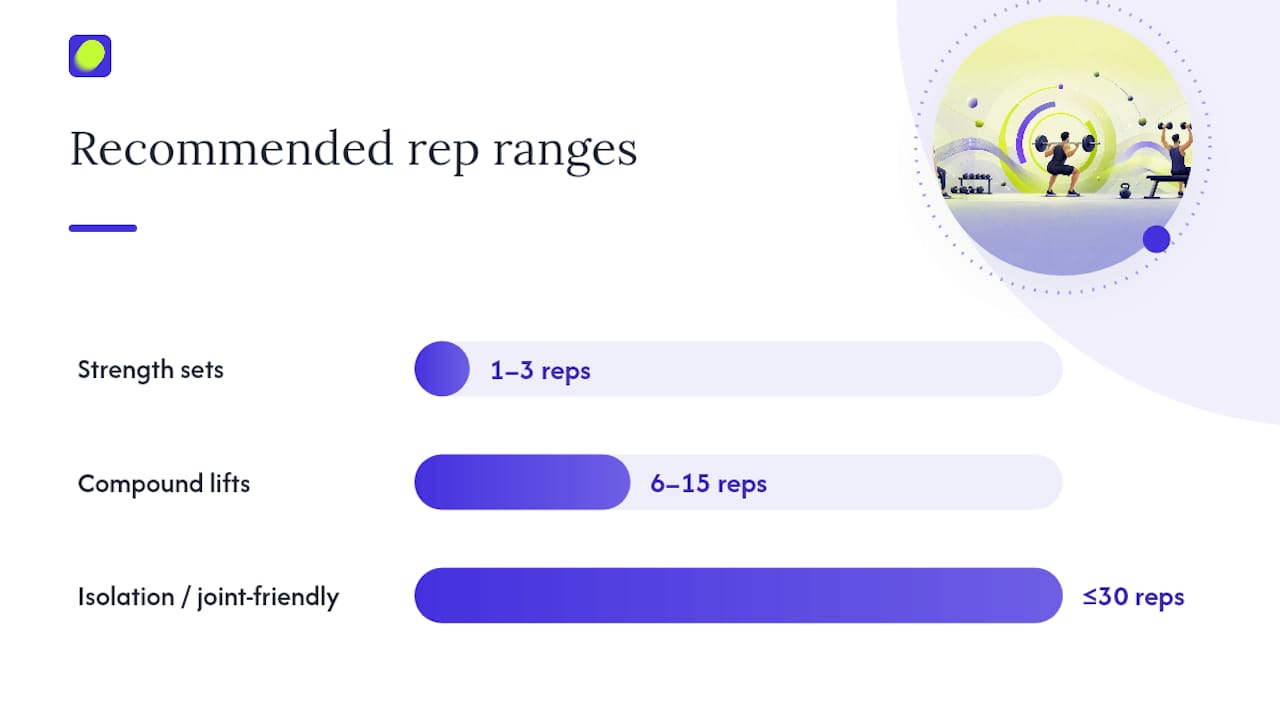
Compound lifts (squats, bench press, rows, deadlifts): Use 6 to 15 reps as your bread and butter. This range lets you accumulate volume efficiently while keeping technique clean, since compound movements get riskier the longer a set drags on under heavy fatigue.

Heavy strength-building sets: Reserve low single-digit to moderate reps for main compound lifts once or twice a week. These sets build the raw strength that lets you handle more weight in your moderate-rep work later, and they still deliver a real hypertrophy stimulus of their own, according to Stronger by Science’s analysis of the rep range research.
Isolation and joint-friendly work (curls, leg extensions, lateral raises, cable work): Use higher rep ranges for isolation work to accommodate safer fatigue accumulation. These movements are safer to grind close to failure because a slower failure point on a single-joint exercise carries far less injury risk than grinding out rep 20 on a heavy squat.
Here’s a simple decision process to apply at the gym:
One practical lower bound is worth committing to memory: don’t build your hypertrophy program around 1 to 3 rep sets. Research on the repetition continuum points to a likely breakpoint around three reps, below which time under tension gets too short to reliably drive growth for most muscles. Very low reps have their place in strength and power training, but they’re a poor primary tool for building size.
Ultra-high reps carry their own catch. Sets of 40, 50, or more become more about pain tolerance and cardiovascular fatigue than muscle-building stimulus, and they eat into your recovery for the next exercise. Somewhere around 30 reps is a sensible ceiling for most hypertrophy-focused sets.
Once you’ve picked your rep ranges, the next question is volume. How many hard sets per muscle, per week, actually move the needle?
The research points to roughly 10 weekly sets per muscle as a reasonable floor for meaningful growth, according to the Frontiers review on load, reps, and hypertrophy. More advanced lifters, whose muscles have adapted to lower volumes, often need to progress toward 12 to 20 weekly sets to keep seeing results. This is a dose-response relationship: more quality volume tends to produce more growth, up to a point where recovery capacity caps the benefit.

Here’s the piece that ties directly back to rep ranges: load and volume trade off against each other. Lighter-load, higher-rep sets taken to true failure can match heavier sets for hypertrophy, but only when effort is matched, according to that same repetition continuum research. If you’re not willing to grind a light set to genuine failure, you’ll likely need more sets of it to match what fewer heavy sets accomplish.
A sensible weekly split across rep ranges, once you’re managing 10 to 20 sets per muscle, looks something like this:
Recovery capacity should steer how you adjust that split week to week. If you’re sleeping poorly, juggling a stressful stretch at work, or coming back from a light illness, shifting more of your volume into the moderate and high-rep camp and trimming the heaviest sets is often the smarter call than forcing a max-effort session your body isn’t ready for. Recovery quality, including sleep, has a real influence on how much of that weekly volume you can actually turn into muscle growth.
Theory is only useful once it turns into a plan you can actually run this week. Here are two templates that put the rep-range guidance into practice.
Beginner: 3 days per week, total body
If you’re new to structuring these sessions yourself, a beginner back workout or beginner shoulder workout template gives you exercise selection to slot straight into this framework.
Intermediate: 4 day upper/lower split, hypertrophy microcycle
Autoregulation ties this all together. Rate your sets using RPE (Rate of Perceived Exertion) or RIR (Reps in Reserve), and let that number, not the calendar, tell you when to push and when to back off. If your heavy lifts have felt like a 9 or 10 out of 10 for two straight weeks, that’s your signal to deload before performance and joints start to suffer.
Pro Tip: Keep a running RIR estimate on every working set in your log. If you’re consistently guessing “3 reps in reserve” but actually stopping with 5 or 6 left, you’re leaving hypertrophy on the table regardless of which rep range you picked.
We built Onemor’s guided sessions around exactly the principles above, because reading the research is one thing and actually applying it set after set is another. Every workout in the app encodes specific reps, sets, and rest periods, along with RPE or RIR cues so you know how hard a set is supposed to feel, not just how many reps to count.
Our coach-led programs vary rep ranges deliberately across a training week instead of parking you in one zone forever. A heavy compound day might sit at 5 reps with longer rest timers built in, while your next session shifts into 12 to 20 reps for isolation work with shorter rest between sets. That variety isn’t random. It mirrors the undulating approach the research supports for balancing fatigue and stimulus.
A few ways this shows up inside the app:
If you’re still building comfort with the basics, resources like our guide on training to failure walk through what real effort should feel like on a working set.
Here’s what I’ve noticed working with trainees who obsess over rep ranges: the ones who stall aren’t training in the “wrong” range. They’re training too heavy, too often, and calling it dedication. Grinding 4 to 6 rep sets to true failure four times a week wrecks recovery fast, and most people don’t have the sleep or nutrition to support it.
The bigger mistake I see is ignoring weekly volume entirely. Someone will do three brutal sets of one exercise and call the muscle “done,” when the research points to needing something closer to 10 sets a week to see real progress. My fix is almost always the same: pull back the heaviest work to once or twice weekly, spread volume across a few well-placed moderate and high-rep sessions, and stop treating any single number as sacred.
Try running a structured microcycle for four to six weeks before you decide a rep range “isn’t working” for you. Consistency in the system beats chasing the perfect number every time.
— Alb
Reading about mechanical tension and weekly set targets is one thing. Actually loading a bar, tracking your reps, and knowing when to push closer to failure is another challenge entirely, and it’s the exact gap Onemor was built to close. Instead of building spreadsheets or guessing your way through rep ranges, Onemor hands you coach-led sessions with the sets, reps, rest timers, and effort cues already programmed in, so every workout matches the science in this article without you having to plan a thing.
Want structure without the planning headache? Start with free workouts built around exactly this kind of rep-range variety, or find a coach who fits your goals, like Coach Wilbert or Coach Kayla. Prefer training with people around you? Check out Onemor’s tribe challenges for accountability that keeps your weekly volume consistent, week after week.