4–8 Week Beginner Plan to Get Back Into Working Out Without Burnout
Add Onemor as a preferred source on Google
Start with short, low-intensity sessions for the first two weeks, then build structured strength work gradually over the next four to six. That’s the safest path back, and it lines up with what the Physical Activity Guidelines for Americans recommend as a long-term target once you’re past the restart phase. If you have any health concerns, check with a doctor before you push the pace. Some beginner programs are built around this kind of gradual return.
TL;DR:
Starting with gentle movement and gradually progressing over two months minimizes injury risk and aligns with long-term activity guidelines.
Incorporating regular warm-ups, cool-downs, and moderate sessions is more effective than high-intensity efforts early in the restart phase.
Using perceived exertion and planning workouts in advance helps prevent overloading and supports consistent progression.
Avoid jumping immediately back to pre-break weights; instead, reduce loads and focus on form during the first four weeks.
Structured programs with coaching and accountability tools significantly increase the likelihood of maintaining long-term exercise habits.
Onemor
Build Your Way Back With Structure
Onemor offers guided beginner-friendly workouts with sets, reps, and rest timers for training at home or in the gym.
What’s the Fastest Safe Way to Restart Fitness Over 4 to 8 Weeks?
You don’t need a perfect plan. You need a plan that doesn’t wreck your motivation or your joints in week one. The biggest mistake people make when they get back into working out is training like no time has passed. Your brain remembers the old weights. Your tissues do not.
Here’s a week-by-week structure that respects both.
Weeks 1 to 2: Reintroduce movement. Walk, do light mobility work, or try a gentle bike ride for 10 to 20 minutes a day. The goal is showing up, not sweating buckets. This phase rebuilds the habit before it rebuilds the muscle.
Weeks 3 to 4: Add structure. Bring in two strength sessions per week using bodyweight movements or light loads. Keep every set at around 4 to 5 Reps in Reserve (RIR), meaning you stop well before failure. This is where a program like Onemor’s beginner gym workout can take the guesswork out of exactly what to do.
Weeks 5 to 6: Build volume. Add sets gradually and consider a third weekly session if your body is recovering well between workouts. Soreness should be fading faster than it did in week one.
Weeks 7 to 8: Approach your old baseline, carefully. This is not the week to hit your pre-break numbers. Research on detraining suggests cutting your previous training loads by a moderate amount after a short break, and starting substantially lighter after a longer layoff, letting form and tissue tolerance catch up before intensity does, according to Stronger by Science.
A reliable rule of thumb: a full return to your prior strength level after several months off typically takes a conservative two to three months of consistent, gradual progression, with volume increasing before intensity does. Rushing that timeline is the single most common reason people quit again.
To self-regulate without a coach standing next to you, use RPE (Rate of Perceived Exertion) alongside RIR. If a set feels like a 7 or 8 out of 10, that’s plenty for weeks one through four. And if you’re ever unsure whether to attempt one more rep, apply the five-minute rule: if you’d still feel good about that choice five minutes later, go for it. If you’re hesitating, that’s your answer.
Pro Tip:Write your planned sets and reps into your phone’s notes app before you walk into the gym. Deciding on the fly is how most people either underload or overdo it.
Which Habits Actually Help You Ease Back Into Exercise?
Restarting fitness isn’t really a fitness problem. It’s a consistency problem wearing a fitness costume. These tips address both sides.
Start with walking or low-impact cardio. A 15-minute walk counts as real progress in week one. It rebuilds cardiovascular tolerance without loading joints that haven’t moved much lately.
Never skip the warm-up. A 5 to 10 minute dynamic warm-up increases blood flow and joint mobility, which lowers injury risk and makes the actual workout feel easier.
Cool down on purpose. A few minutes of walking or static stretching after training helps your body shift out of exercise mode instead of crashing straight into the couch.
Chase consistency, not intensity. Frequent, moderate sessions produce better long-term markers, like blood pressure and blood sugar control, than sporadic all-out efforts, according to University of Guelph research. Four easy sessions beat one brutal one almost every time.
Leave your ego at the door. Your muscles remember the old weights faster than your joints and connective tissue do. Scale the load down and prioritize form. The Cleveland Clinic is blunt about this: pushing too hard, too soon, is the fastest route back to the couch, this time with an injury attached.
Treat recovery as part of training. Sleep, food, and rest days aren’t the boring part of a fitness routine, they’re what make the active part work.
Pick something you actually enjoy. If the gym feels like punishment, you won’t stay. Training with a friend, a group, or a Onemor tribe adds a social reason to show up even on the days motivation is low.
Use simple habit tools. Put workouts on your calendar like you would a meeting. Stack them onto an existing habit, like training right after your morning coffee.
Avoid sudden spikes in volume. Jumping from zero sessions to five in one week is how people talk themselves out of ever trying week two.
Know the difference between soreness and pain. Dull, achy muscle fatigue is normal. Sharp, joint-centered, or one-sided pain is a stop signal, not something to push through.
What Do Beginner-Friendly Workouts Actually Look Like?
Vague advice like “just move more” doesn’t help anyone on a Tuesday morning staring at their sneakers. Here are three templates you can copy directly.
Walk or light cardio session (Weeks 1 to 2):
5 minutes easy pace to warm up.
10 to 15 minutes at a pace where you could hold a conversation but would rather not (RPE 4 to 5 out of 10).
5 minutes slowing back down.
20-minute bodyweight full-body session (Weeks 3 to 4):
Bodyweight squats: 2 sets of 10 to 12 reps, RIR 4 to 5.
Push-ups (knees down if needed): 2 sets of 6 to 10 reps.
Glute bridges: 2 sets of 12 reps.
Plank: 2 sets of 20 to 30 seconds.
Rest 60 to 90 seconds between sets.
30-minute gym session using machines or light free weights (Weeks 5 to 8):
Leg press: 3 sets of 10 reps, starting at a weight that feels like RIR 5.
Chest press machine: 3 sets of 10 reps.
Seated row: 3 sets of 10 reps.
Lat pulldown: 2 sets of 12 reps.
Finish with 5 minutes on a bike or treadmill to cool down.
For starting loads on machines, Onemor’s guide to gym machines for beginners walks through how to pick a weight that challenges you without wrecking your next three days. If soreness from a session lingers past 48 to 72 hours, repeat that week’s volume before adding more. If a movement bothers a joint, swap it out. A goblet squat instead of a barbell squat, an incline push-up instead of a flat one. Nobody hands out medals for stubbornness in week three.
How Do You Set Goals That Keep You Coming Back?
Outcome goals (“lose 15 pounds,” “run a 5K”) feel motivating on day one and demoralizing on day twelve, because they’re slow to show progress. Process goals fix that by measuring what you actually control.
Outcome goal: Get stronger.
Process goal: Complete three 20-minute sessions this week, regardless of how they feel.
Outcome goal: Lose weight.
Process goal: Hit 8,000 steps four days this week and eat protein at breakfast.
Process goals win during a restart because they reward the behavior that actually builds the habit, not a number that takes months to move. Research on returning to exercise consistently points to discipline and repeatable small actions, according to Houston Methodist, as the real driver of long-term success, not waiting around for motivation to strike.
A few tactics make this stick:
Calendar block your sessions like you would a doctor’s appointment. Treat it as fixed, not flexible.
Stack the habit onto something you already do daily, like laying out gym clothes the night before.
Join a group or accountability tribe. Training alongside others makes skipping a session feel like letting people down, not just yourself.
Track small wins, like a completed session streak, instead of only tracking the scale or your one-rep max.
Pro Tip:Celebrate the third week back more than the first. Week one runs on excitement. Week three runs on habit, and that’s the one that actually predicts whether you’ll still be training in month three.
Why Am I So Sore, and When Should I Worry?
That deep, achy soreness two days after your first session back has a name: Delayed Onset Muscle Soreness, or DOMS. It happens because your muscle fibers experience small amounts of damage when they’re asked to do something unfamiliar, and after a break, almost everything qualifies as unfamiliar again.
The good news is your body adapts fast. This is called the Repeated Bout Effect: your second and third sessions targeting the same muscles cause noticeably less soreness than the first, according to Stronger by Science. That first-week soreness isn’t a sign you’re doing something wrong. It’s a sign your body is recalibrating.
So how do you tell normal soreness from a problem? Dull, symmetrical soreness that peaks around 24 to 48 hours and fades on its own is expected. Sharp pain, swelling, or soreness that’s worse on one side only are signs to back off and regress your load for a session or two.
A few things speed recovery along:
Protein intake spread through the day supports the muscle repair that reduces next time’s soreness.
Hydration, since dehydrated tissue recovers more slowly and feels stiffer.
Sleep, which is when most of the actual repair work happens. Onemor’s guide to sleep and muscle recovery breaks down why this matters more than most people realize.
Light active recovery, like an easy walk or gentle stretching, which some physical therapy guidance suggests can ease stiffness better than sitting completely still.
A simple post-workout breakfast with protein and carbs supports the same repair process, especially on morning training days.
When Should You Check With a Doctor Before Restarting?
Most healthy adults can start walking and light strength work without a medical visit first. But a few situations call for a check-in before you lace up.
You have a chronic condition like heart disease, diabetes, or a respiratory issue that affects exercise tolerance.
You’re returning after a serious illness or surgery, where your body’s baseline capacity has genuinely changed.
You’re postpartum, since your body has gone through significant structural changes that affect how you should reload.
You’ve noticed unexplained symptoms like chest pain, dizziness, or shortness of breath disproportionate to effort.
If you’re returning after a symptomatic illness like COVID-19, clinical guidance recommends waiting at least seven days fully symptom-free before resuming activity, then progressing through phases of at least seven days each rather than jumping back to full intensity, according to BMJ.
Stop immediately and seek care for chest pain, sudden severe shortness of breath, dizziness, or joint pain that’s sharp rather than dull. If you do see a provider, bring notes on when symptoms occur, what triggers them, and how long they last. That detail helps far more than a vague description.
How Does Onemor Support a Restart Like This?
Everything in this plan works better with structure, and structure is where most people restarting on their own lose steam by week three. That’s a gap some fitness apps are built to close.
Guided beginner programs remove the guesswork of what to do in weeks one through eight, with progressive templates that increase load the way this plan describes.
Coach-led sessions with built-in sets, reps, and rest timers mean you’re never standing in the gym trying to remember what came next.
Streaks and XP turn the consistency piece, arguably the hardest part of any restart, into something visible and rewarding.
Tribe-based challenges give you the group accountability that makes skipping a session feel like letting someone else down too.
For the strength sessions in weeks three through eight specifically, a structured app-guided session takes the RIR and progression math off your plate so you can just show up and follow it. If you want that structure from day one, Onemor’s programs are built around this exact kind of beginner-friendly return.
Ready to Make This Restart Stick?
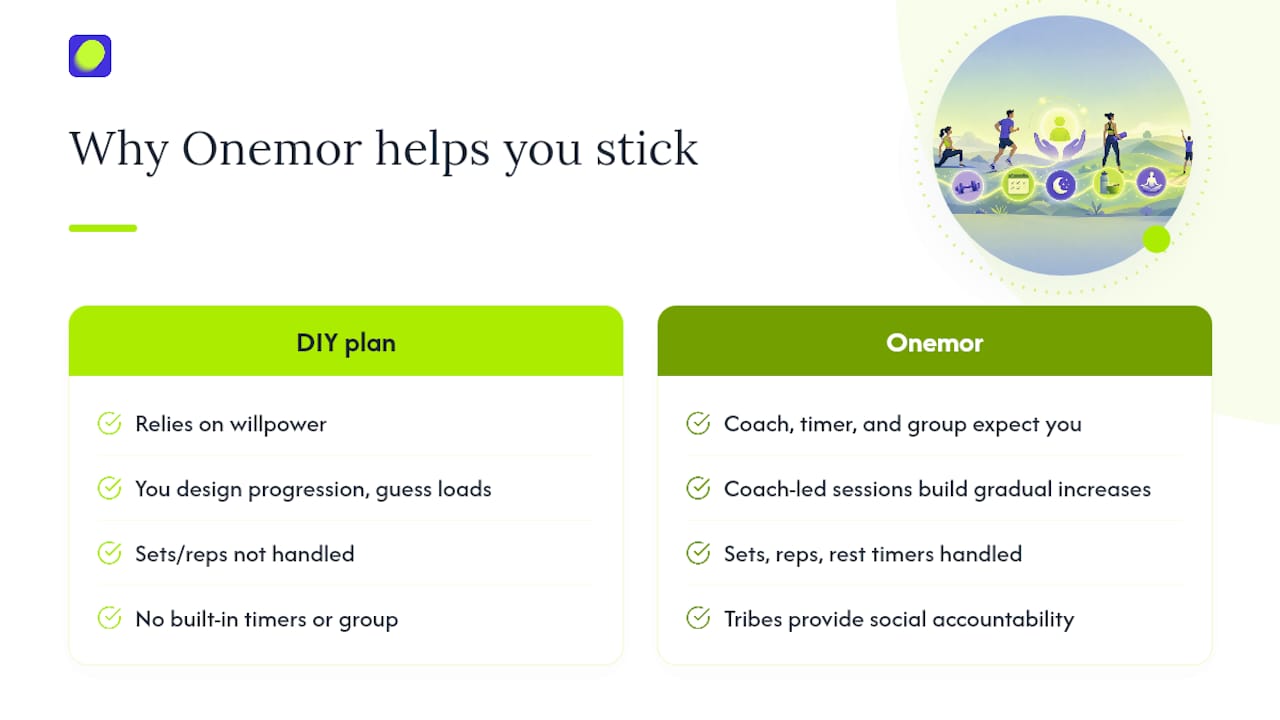
A written plan is useful. A plan with a coach, a timer, and a group of people expecting you to show up is what actually gets followed through week eight. That’s the gap between reading this article and living it, and it’s the exact gap Onemor was built to close for people getting back into working out after time away.
Instead of designing your own progression and hoping you guessed the loads right, Onemor gives you coach-led sessions from trainers like Coach Branden or Coach Kayla that already build in the gradual increases this article walks through, with sets, reps, and rest timers handled for you. If accountability is your bigger obstacle than knowledge, the app’s Tribes feature puts you in a group working toward the same kind of restart, so the habit has social weight behind it instead of relying on willpower alone.
This type of app is often free to start, with premium coaching options once you know the structure fits how you train. If the four to eight week plan above sounds right for you, you can find your program and let the app handle the week-by-week math while you focus on just showing up.