Gym Machines for Beginners: Your 30-Minute Starter Plan
Add Onemor as a preferred source on Google
Your first gym session does not need to be complicated. The best gym machines for beginners are the treadmill or stationary bike, leg press, chest press, lat pulldown or seated row, leg curl or extension, cable/functional trainer, and an ab or core machine. Those seven cover every major muscle group, and you can work through all of them in 30 minutes. Experts at Time confirm that starting on machines reduces the coordination demand and lowers early injury risk compared with jumping straight to free weights.
Here is your ready-to-run 30-minute session:
Warm-up — 5 minutes on the treadmill or bike at an easy pace
Leg press — 2 sets of 10 reps, 60 seconds rest
Chest press — 2 sets of 10 reps, 60 seconds rest
Lat pulldown — 2 sets of 10 reps, 60 seconds rest
Leg curl or leg extension — 2 sets of 10 reps, 60 seconds rest
Cable row or cable press — 2 sets of 10 reps, 60 seconds rest
Ab/core machine or crunch machine — 2 sets of 12 reps, 45 seconds rest
Cool-down — 3–5 minutes walking and light stretching
For starting weight, Harvard Health recommends picking a load where the final 2 reps of each set feel genuinely challenging but your form stays clean. If rep 10 feels easy, go heavier next set. If your form breaks down at rep 7, go lighter. Onemor’s guided beginner programs walk you through this same logic with built-in rest timers and logging so you never have to guess.
Pro Tip:Write down the weight you use for each machine on your first visit. That single habit makes every future session faster and more focused.
Why gym machines are a smart starting place for beginners
Machines are safer and teach movement patterns more reliably than free weights for someone who is brand new to strength training. That is not an opinion; it is the practical reason trainers recommend them first.
Here is what machines actually give you:
Guided range of motion — the machine controls the path of movement, so you cannot accidentally drift into a risky position
Easier setup — adjust a seat pin and a weight pin, and you are ready; no loading plates or balancing a barbell
Muscle isolation — machines let you target one muscle group at a time, which is useful when you are still learning which muscles are supposed to fire
Lower immediate injury risk — because you are not stabilizing a free weight, your nervous system can focus on the primary movement
Women’s Health notes that trainers consider machines underrated tools, particularly for isolating muscles and correcting side-to-side imbalances that beginners often do not even know they have.
Pro Tip:Once you can complete 3 sets of 12 reps on a machine with solid form, that is a good signal to try the free-weight version of the same movement. A goblet squat after the leg press, for example, builds on the same pattern.
The U.S. Department of Health and Human Services recommends at least two days of muscle-strengthening activity per week for adults. Starting on machines is one of the most practical ways to meet that baseline without needing a coach standing next to you every rep.
How should you warm up before using gym machines?
Always warm up for 5–10 minutes before touching a weight stack. Cold muscles move less freely and fatigue faster, which is where most beginner injuries actually start.
Your warm-up checklist:
5–7 minutes on the treadmill, stationary bike, or elliptical at a conversational pace
10 hip circles each direction (stand and draw big circles with your hips)
10 arm circles each direction (forward and backward)
10 bodyweight squats, slow and controlled
10 shoulder rolls, then reach both arms overhead and hold for 5 seconds
Those five steps take about 8 minutes and prepare your hips, shoulders, and spine for every machine on the floor.
Equipment and hygiene reminders before you start:
Wear flat-soled athletic shoes with good grip; avoid running shoes with thick cushioning for pressing movements
Bring a small towel and wipe down each machine before and after use
Keep a water bottle nearby; sip between sets, not mid-rep
Three easy warm-up movements you can do anywhere on the gym floor, no equipment needed:
Leg swings — hold a wall or machine frame for balance, swing one leg forward and back 10 times each side
Cat-cow stretch — on hands and knees, alternate arching and rounding your spine for 8 slow reps
Inchworm — stand, hinge forward, walk your hands out to a plank, walk them back, and stand; repeat 5 times
How do you set up and use gym machines safely?
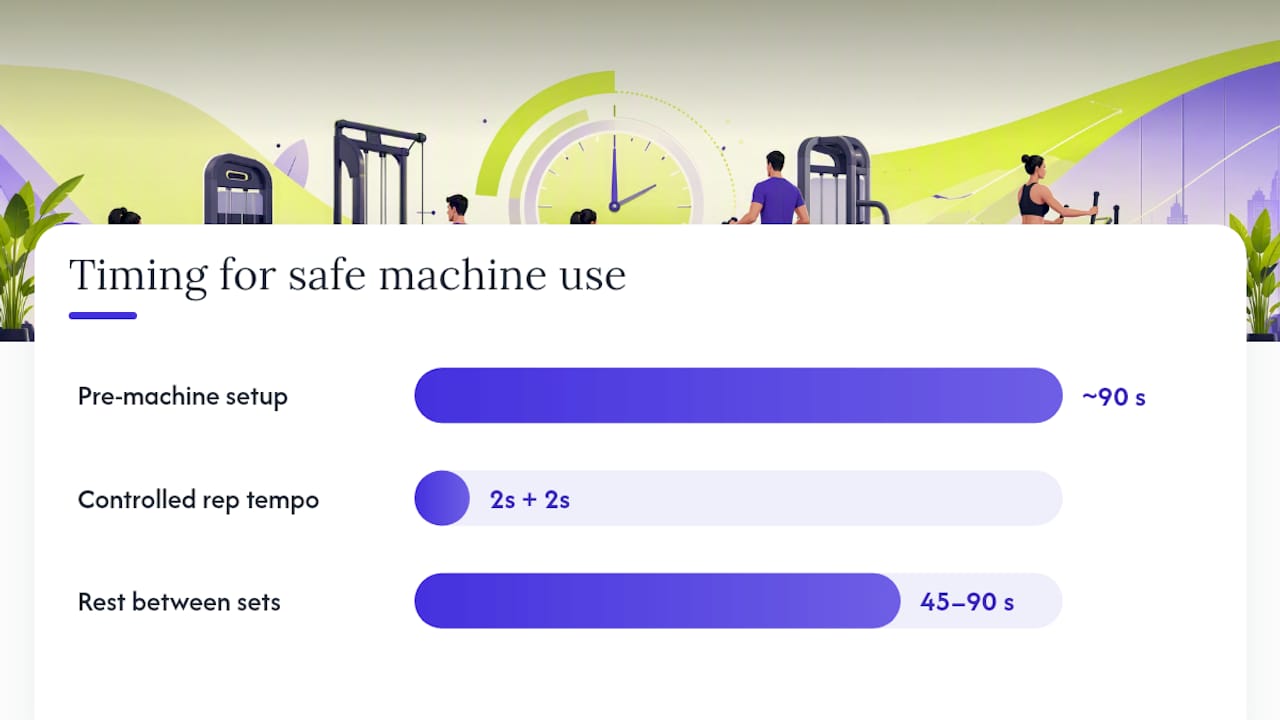
Follow this five-step checklist before every machine, every session. It takes about 90 seconds and prevents the most common setup mistakes.
Read the diagram. Every selectorized machine has a label showing the target muscle and the correct body position. Verywell Fit recommends reading this diagram before adjusting anything.
Set the seat. Adjust height so your working joint (knee, hip, or shoulder) aligns with the machine's pivot point. A misaligned joint puts stress on tendons, not muscles.
Set the range of motion. Many machines have range limiters. Start with a conservative range and expand it as your flexibility improves.
Choose a test weight. Start light, always. Do 2–3 slow test reps to confirm the movement feels natural and pain-free.
Perform a controlled rep. Count 2 seconds on the push or pull (concentric), pause briefly, then 2 seconds on the return (eccentric). Mayo Clinic confirms that controlled tempo and proper breathing reduce injury risk significantly.
Machine-specific setup notes:
Leg press — seat back reclined so knees bend to roughly 90 degrees; feet hip-width on the platform; do not lock knees at the top
Chest press — handles at mid-chest height; back flat against the pad; exhale on the push
Lat pulldown — thighs secured under the pad; grip just outside shoulder-width; pull bar to upper chest, not behind the neck
Seated row — chest against the pad; pull handles to lower ribs; squeeze shoulder blades together at the end
Leg curl/extension — pad rests just above the ankle; move through full range without jerking
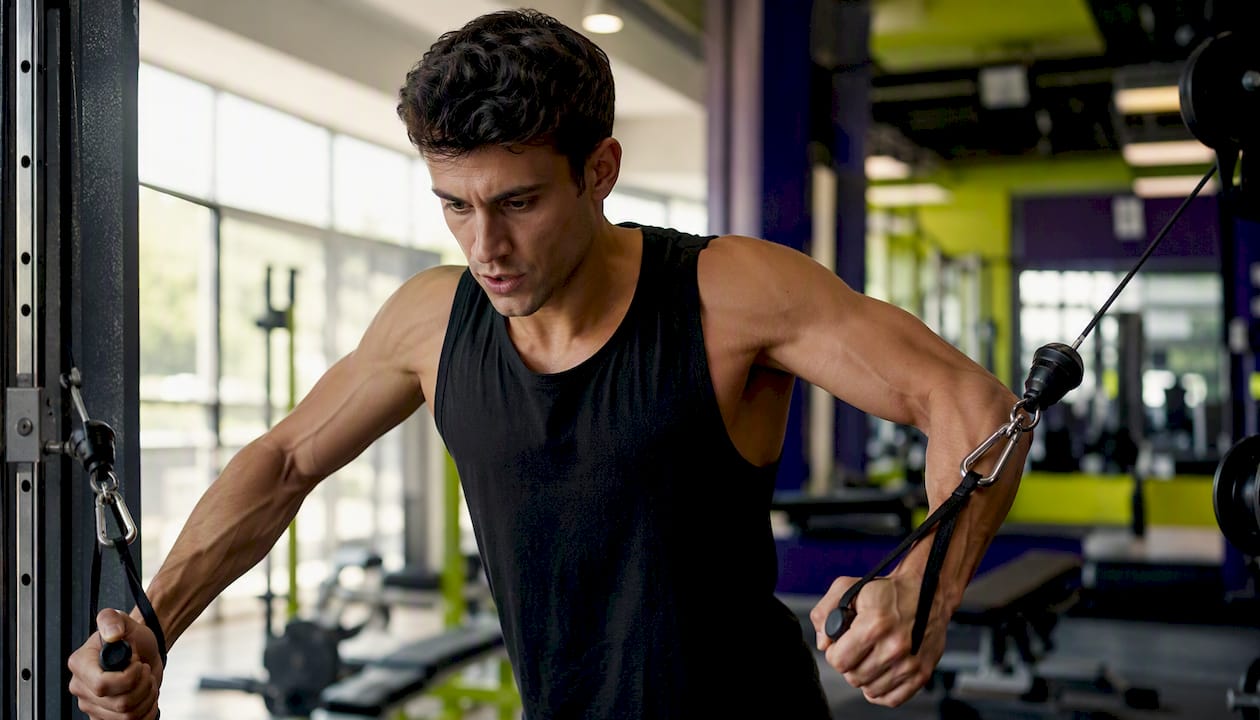
Cable trainer — set pulley height for the movement; keep core braced throughout
Safety checklist for every set:
Breathe out on the effort (the push or pull), breathe in on the return
Stop immediately if you feel sharp joint pain, dizziness, or sudden shortness of breath
Rest 45–90 seconds between sets; do not rush
Ask a gym staff member for a quick demo if a machine feels awkward after your test reps
Pro Tip:A quick visual cue that a machine fits you correctly: your knee should track over your second toe on leg machines, and your elbow should stay slightly below shoulder height on pressing machines. If either looks off, re-adjust the seat before adding weight.
What does a full beginner 30-minute gym-machine workout look like?
A complete 30-minute session works every major muscle group, leaves you feeling accomplished rather than wrecked, and takes about 4–6 weeks to outgrow. Here is the full plan with timing built in.
The 30-minute full-body machine workout:
Treadmill or bike warm-up — 5 minutes, easy pace (minutes 0–5)
Leg press — 2 sets of 10 reps, 60 seconds rest (minutes 5–10)
Cool-down walk and stretch — 3 minutes (minutes 29–32)
For each exercise, aim for 8–12 reps where the final 2 reps feel genuinely hard. That rep range, paired with 2–3 sets and 45–90 seconds of rest, is the standard beginner prescription backed by Harvard Health’s strength training guide.
Two weekly schedule options:
Full-body 2x/week — Monday and Thursday, or Tuesday and Friday; rest or light cardio on other days; ideal for the first 4 weeks
3-day split — Monday (push: chest press, cable press, shoulder press), Wednesday (pull: lat pulldown, seated row, cable curl), Friday (legs: leg press, leg curl, leg extension); add this structure once 2x/week feels manageable
4-week progression summary:
Week 1–2 — 2 sets of 10 reps; focus on setup and tempo; keep weight conservative
Week 3 — add a third set to your two strongest exercises
Week 4 — if you complete all sets at 12 reps with clean form, increase weight by the smallest available increment (usually 5 lbs) on those exercises
Pro Tip:Keep sessions within 30 minutes by moving directly from the rest period to your next set. Set a phone timer for 60 seconds so you are not guessing. Shorter, consistent sessions beat long, sporadic ones every time.
For a structured 4-week plan that builds on this foundation, the Onemor beginner gym workout guide maps out exactly how to progress week by week.
What can you do when a machine is busy or unavailable?
You can almost always substitute safely. The goal is to preserve the movement pattern and the muscle group, not the specific piece of equipment.
Common substitution pairs:
Leg press is taken — goblet squat with a dumbbell (same quad and glute pattern), or split squat using a bench; keep the same rep range and controlled tempo
Chest press is taken — incline push-up on a bench (easier) or cable chest press at mid-height (nearly identical movement); both preserve the horizontal push pattern
Lat pulldown is taken — seated cable row (shifts emphasis slightly to mid-back but still trains the lats), or resistance-band pull-down anchored overhead
Leg curl is taken — Romanian deadlift with light dumbbells (hip hinge with hamstring focus), or stability ball leg curl if your gym has one
Cable trainer is taken — resistance bands anchored to a rack or door; the tension curve differs but the movement pattern holds
For home-friendly alternatives and a full fitness essentials checklist, Gripnatic covers practical equipment options that pair well with machine-based gym days.
When substitution is not ideal:
If you are new to a movement and have never done the substitute before, do not attempt it without a quick form check from gym staff
If the substitute requires significantly more balance or coordination (like a barbell Romanian deadlift vs. a leg curl machine), wait for the machine or choose a simpler option
If you feel any joint discomfort during a substitute movement, stop and choose something else; discomfort is a signal, not a challenge to push through
How do you progress safely as you get stronger?
The rule is simple: increase weight when you can complete all sets at 12 reps with clean form. Do not add weight and reps at the same time.
Progression checklist:
Log every session: machine name, weight used, sets completed, reps per set
When you hit 12 clean reps across all sets for two consecutive sessions, increase weight by the smallest available increment
If the gym only has large jumps (10 lbs instead of 5), add a set instead of jumping weight
Rest at least 48 hours before training the same muscle group again; clinical reviews support this window for recovery and adaptation
Reassess every 3–4 weeks: are you progressing on at least 2–3 exercises? If not, check sleep, nutrition, and session consistency before adding volume
Micro-progressions are useful when standard weight jumps feel too large. Slow your tempo to 3 seconds eccentric instead of 2. Add one rep per set rather than a full set. These small changes increase the training stimulus without requiring heavier plates.
Two to three strength sessions per week is the right frequency for most beginners. More is not better when your body is still adapting to the movements.
Pro Tip:Use an RPE (Rate of Perceived Exertion) scale of 7–8 out of 10 as your effort guide. A 7 means you could do 2–3 more reps but chose not to. That zone builds strength without grinding your joints. Onemor’s app includes session logging and rest timers that make tracking this effortless, so you can focus on the work instead of the math.
Tracking progress beyond the weight stack is just as motivating. The Onemor guide on measuring real gains covers exactly how to do that without obsessing over a number on a scale.
What mistakes do beginners most often make on gym machines?
The top five mistakes are poor setup, too-heavy loads, rushing reps, skipping the warm-up, and ignoring pain. All five are easy to fix once you know what to watch for.
Mistake list with one-line fixes:
Wrong seat height — fix: align your working joint with the machine's pivot point before every set
Too much weight, too soon — fix: start lighter than you think you need; the final 2 reps should be hard, not impossible
Rushing through reps — fix: count 2 seconds up, 2 seconds down; momentum does the work instead of your muscles when you go fast
Skipping the warm-up — fix: 5 minutes of light cardio is non-negotiable; cold muscles fatigue faster and strain more easily
Ignoring discomfort — fix: distinguish between muscle burn (normal) and sharp joint pain (stop immediately)
Holding your breath — fix: exhale on the push or pull, inhale on the return; breath-holding spikes blood pressure unnecessarily
Skipping machine hygiene — fix: wipe down the seat and handles before and after every set; it takes 10 seconds
Red-flag signs to stop and get help:
Sharp or shooting pain in any joint
Dizziness or lightheadedness during or after a set
Sudden shortness of breath unrelated to effort level
Numbness or tingling in hands, feet, or face
If any of those occur, stop the session, sit down, and speak to gym staff. These are not signs to push through.
What does the research say about machines for beginners?
Evidence and trainer guidance point in the same direction: machines reduce early injury risk while teaching targeted movement patterns, making them the most practical starting point for someone new to strength training.
Key research-backed points:
Harvard Health's strength training guide recommends 8–12 reps per set, starting with two sets, training two days per week, and expecting measurable strength gains in 4–6 weeks
Mayo Clinic's weight training guide emphasizes controlled tempo, full range of motion, correct breathing, and lowering weight if form breaks down
Time's strength training guide notes that experts advise beginners to start with machines specifically because they reduce coordination demands and lower injury risk
Women's Health reports that trainers view machines as tools that guide movement, boost confidence, and help correct muscle imbalances
A systematic review published in PMC confirms that structured resistance training with progressive overload improves muscle strength and function when performed with proper technique
Practitioners also recommend one to three supervised sessions when starting a machine-based program. A single 15-minute orientation with a gym staff member or certified trainer can reduce early technical errors significantly.
A note on professional guidance: If you have any pre-existing joint issues, cardiovascular conditions, or have been inactive for an extended period, check with your doctor before starting a strength training program. This article provides general information, not medical advice. Onemor’s coached beginner programs offer a structured, trainer-led alternative for anyone who wants personalized guidance from day one.
What should you actually expect in your first few weeks?
Feeling unsure on your first day is completely normal. Every person who looks confident in the gym was once standing exactly where you are, staring at a machine and wondering which pin to pull.
Here is what you can realistically expect: the first two sessions will feel awkward, and that is fine. You are learning movement patterns, not just lifting weight. By week 3, the setup routine starts to feel automatic. By week 4–6, with two consistent sessions per week, you will likely notice measurable strength gains, which Harvard Health confirms is the typical timeline for beginners.
My honest advice: ask a gym staff member for a 10–15 minute walkthrough on your first visit. After that, log every session. Weight used, reps completed, how it felt. That log becomes your most motivating tool because progress that is invisible in the moment becomes obvious when you look back three weeks later.
Set a 4-week checkpoint. On that day, compare your logged weights to week one. The numbers will almost certainly be higher, and that concrete evidence is what keeps you coming back.
Onemor makes your first gym sessions feel guided, not guesswork
Walking into a gym with a plan already loaded on your phone changes everything. Onemor gives you exactly that: structured, trainer-led beginner programs built for the gym, with set and rep timers, rest countdowns, and session logging built in so you can focus on the work instead of managing a spreadsheet.
Every session in Onemor is led by a real coach. You get the movement cues, the progression logic, and the community push from tribe-based challenges that make showing up twice a week feel less like a chore and more like something you actually want to do. For beginners who want a coach in their corner from session one, Coach Kayla’s beginner program is a strong starting point.
Ready to stop guessing and start training with a plan? Download Onemor and run your first guided session today.
Key Takeaways
The most effective approach to gym machines for beginners is to start with 7 core machines, follow the 8–12 rep rule, and train twice a week for 4–6 weeks before adding weight or volume.
Start with 7 machines. Treadmill/bike, leg press, chest press, lat pulldown, leg curl, cable trainer, and ab machine cover every major muscle group.
Use the final-2-reps rule. Pick a weight where the last 2 reps feel challenging but your form stays clean; adjust every session.Train 2x per week. Two full-body sessions weekly produces measurable strength gains in 4–6 weeks for most beginners.
Progress slowly and log everything. Increase weight only after completing all sets at 12 clean reps for two consecutive sessions.
Onemor guides the process. Onemor’s coached beginner programs include timers, logging, and trainer-led sessions to keep you consistent and progressing.
Sources
These are the sources behind the guidance in this article, plus a few extras worth bookmarking.