Yes, yoga can build measurable functional strength when you practice vigorous styles with long holds, slow eccentric transitions, and enough weekly frequency to matter. The prescription is straightforward: 20 to 60 minute strength focused sessions, at least three times a week, with progressively harder holds and variations. Expect real gains in core, shoulder, and hip strength within 6 to 8 weeks, backed by randomized controlled trial evidence, though maximal hypertrophy usually needs added external load.
TL;DR:
Your body doesn’t know the difference between a barbell and your own bodyweight held at a hard angle. Yoga builds strength through three mechanical pathways, and once you can name them, you start choosing poses on purpose instead of just flowing through a sequence someone handed you.
The first is isometric loading. Holding Plank, Chair, or Warrior II for 30 to 60 seconds asks your muscles to generate continuous tension without moving, which is the same stimulus a wall sit or a weighted static hold delivers in a strength program. The second is eccentric control, the slow lowering phase you get in a controlled Chaturanga or the descent into Crow. Slowing that movement down forces your muscles to resist gravity instead of just catching your fall. The third driver is repetition volume: a 60 minute Vinyasa class might ask you to move through 15 to 20 Chaturanga transitions, which starts to look a lot like a high-rep bodyweight circuit.
The clinical evidence backs this up more than most people expect. An 8-week randomized controlled trial in sedentary older adults found Hatha yoga produced strength, balance, flexibility, and mobility outcomes similar to or better than conventional stretching-and-strengthening exercise, practicing three times weekly. A separate 8-week intervention measured actual increases in trunk lean mass alongside upper-body performance gains. And in resistance-trained young adults, a 6-week Hatha yoga program improved squat 1-RM, which tells you yoga isn’t just for beginners rebuilding a base.
What should you realistically expect?
Strength research snapshot: a 2001 controlled study found 8 weeks of regular Hatha practice significantly increased isokinetic strength across several joint actions plus VO2max, in largely young female participants. That’s a fitness win across multiple systems from one consistent habit.
What yoga alone won’t do well is build the kind of maximal strength or muscle size you’d get from heavy barbell work. Harvard Health notes that yoga improves functional strength and mobility but usually doesn’t replace resistance training for hypertrophy or 1-RM gains at the top end. Know that going in, and you’ll never feel like yoga let you down.
Not every yoga class is built to make you stronger, and that’s not a knock on the ones that aren’t. Restorative and Yin classes are designed for recovery and range of motion, and they’re genuinely valuable for that. But if strength is your target, you want to walk into a room built for it.
Vigorous styles like Power Yoga, Ashtanga, and Rocket Yoga provide the strongest stimulus because they stack frequent arm balances, slow controlled transitions, and physically demanding sequences back to back. Here’s how the common styles line up for pure strength output:
How do you know a class will actually challenge you before you book it? Look for cues in the class description: “long holds,” “arm balances,” “tempo,” or “power.” If the description leans on words like “gentle flow” or “relaxation,” you’re booking a recovery day, not a strength day.
Pro Tip: Text the studio or check the app description for hold times. A class that mentions holding poses for 5 to 10 breaths is training strength; one that flows continuously without pausing is training mobility and cardio.
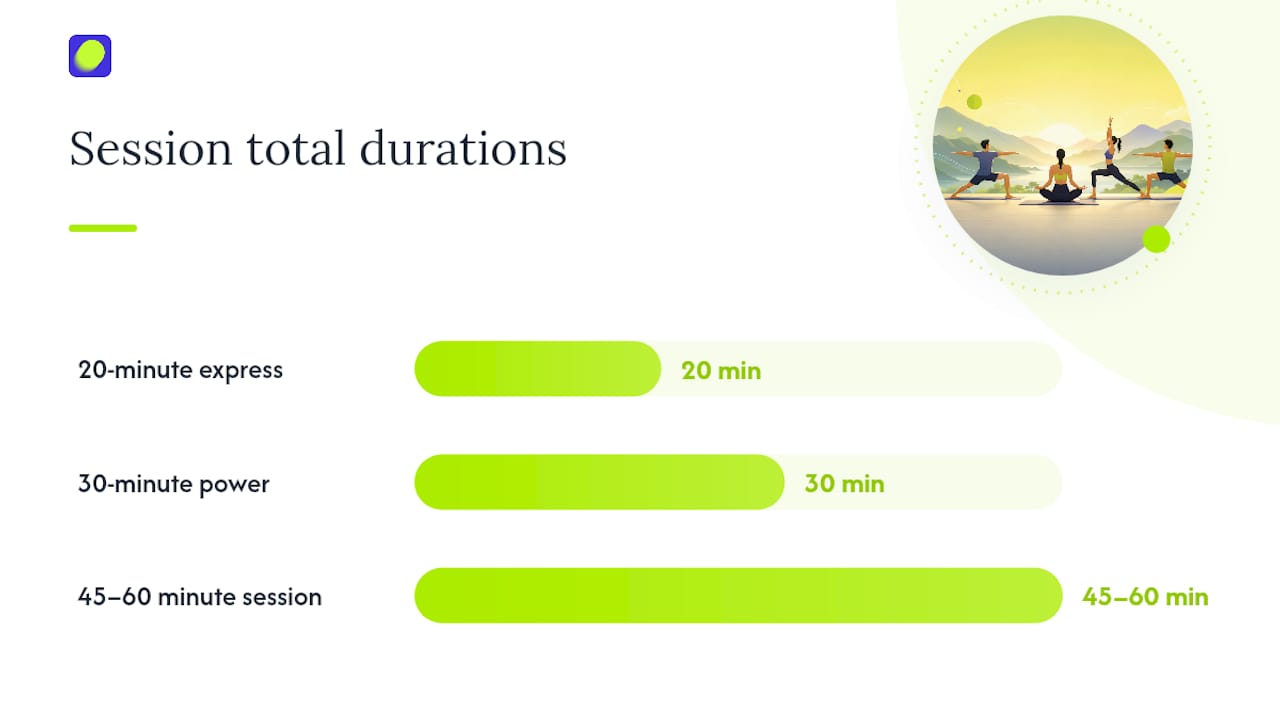
For session templates by time: a 20 minute session should hit 4 to 5 poses at 45 to 60 second holds; a 30 minute session can add a Chaturanga tempo round; a 60 minute class should include a dedicated arm balance block plus a standing strength sequence like Warrior II holds and Chair pose ladders.
The pose itself rarely determines whether you get stronger. How long you hold it, how slowly you move through it, and whether you add resistance to the transition does. Here’s how to turn familiar poses into genuine strength work.
A few practical notes make all the difference here. Muscles targeted matter less than tempo: any pose becomes a strength pose once you slow the entry, extend the hold, or add a pulse. If you want to convert a purely mobility-focused pose like Low Lunge into a strength stimulus, hold it for 45 seconds instead of 10, or add small pulses at the bottom range. That single adjustment changes the entire physiological demand.
Time budget shouldn’t be an excuse to skip a session. Here’s how to structure four different durations so every minute is doing something.
Breathing sets the pace more than most people realize. Inhale on the setup or the easier phase of a movement, exhale on the effort. If you’re gasping through holds, that’s your signal to shorten the block by 10 to 15 seconds rather than pushing through with broken form.
Pro Tip: If a hold feels stable at the bottom of your time range with two breaths to spare, add 10 seconds next session. That’s progressive overload, yoga style.
Pair a short warm-up like this 5 to 10 minute dynamic routine before any of these flows, especially the 20 and 30 minute versions where you don’t have much runway to prepare your joints.
Strength gains from yoga follow the same rule that governs every other form of training: your body only adapts when you keep asking it to do something slightly harder than last time. A 6 to 12 week framework makes that progression visible instead of accidental.
Start by increasing session frequency from two to three or four times weekly over the first few weeks. Once frequency is consistent, increase hold times in 10 to 15 second increments every one to two weeks. After hold time plateaus, add tempo difficulty: slower Chaturanga descents, pulsing Warrior II holds, or paused Chair Pose reps. Finally, layer in pose complexity, moving from knee-supported Crow to full arm balance, or from wall-supported Handstand to freestanding attempts.
Track progress with metrics you can actually measure session to session:
If your goal shifts toward serious hypertrophy or a bigger 1-RM number, yoga alone has a ceiling. The 6-week Hatha study on resistance-trained adults improved squat 1-RM, but that gain came from combining yoga with an already active lifting habit, not from yoga in isolation. At that point, consider adding two weekly resistance sessions, or introduce a weighted vest during Chair Pose and lunges to raise the demand without changing the pose. A structured bodyweight strength program pairs well here if you want a complementary track that doesn’t require a gym membership.
Most strength loss in yoga practice doesn’t come from the wrong pose. It comes from rushing through the right one. Speeding through Chaturanga transitions or cutting holds short at 10 to 15 seconds when you could sustain 30 robs you of the exact stimulus you came for.
Common mistakes worth fixing immediately:
If you’re dealing with physical limitations, regressions exist for nearly every common issue. Wrist pain in Plank or Crow responds well to fist-support or a wedge to reduce extension angle. Shoulder weakness in Chaturanga improves faster from a bent-knee, half-depth version than from forcing full range too early. Low back sensitivity in Boat Pose or Warrior III calls for keeping the knee bent and shortening the hold until core control catches up.
Pro Tip: Sharp, localized joint pain is never a “push through it” signal in yoga. Muscle fatigue burns; joint pain warns.
Stop and consult a clinician if you notice numbness, tingling, sharp joint pain, or pain that persists after a session ends rather than fading within a day.
Reading about tempo cues and hold times is one thing. Actually having someone count the seconds with you while you’re shaking through Chair Pose is another. That’s the gap Onemor’s coach-led flows are built to close.
Strength-focused yoga sessions can come with timed holds, tempo cues, and progressive variations already built into the workout, so you’re not guessing whether 30 seconds has passed or whether your Chaturanga is actually slow enough to count. Sessions are structured for both short, express sessions and longer full-length practices, depending on what your day allows.
A few resources worth pairing with your strength practice:
Streaks, XP, and progression tracking replace the guesswork of unstructured home practice, where it’s easy to skip the hard hold on a tired day and never notice the pattern.
Strength adaptations from yoga, just like from any resistance work, need protein to actually repair and build the tissue you’re working. Aim for a steady intake spread across your day rather than one large meal, since muscle protein synthesis responds better to regular dosing than to a single spike.
Hydration matters more in yoga than most people expect, especially in vigorous Power or Ashtanga classes where sweat loss is high and long holds demand stable blood pressure and muscle function. Being underhydrated shows up as shakier holds and earlier fatigue, which can look like a strength plateau when it’s really a fluid problem.
Carbohydrates fuel the isometric and repetitive-movement demands of a strength-focused flow, particularly in longer 45 to 60 minute sessions where you’re holding multiple blocks back to back. A light carbohydrate-containing snack an hour or so before a demanding class can noticeably improve your hold times compared to practicing on an empty tank.
Recovery nutrition after a hard session, some protein and carbohydrates within a couple of hours, supports the same muscle repair process that a lifter relies on after a heavy set. Yoga taxes muscle tissue in a real, measurable way when you’re holding Chair Pose for 90 seconds or grinding through slow Chaturanga rounds, and your nutrition should treat that effort with the same respect you’d give a weight room session.
Yoga and traditional resistance training aren’t competing for your time. They’re solving different parts of the same problem, and combining them tends to produce better results than either alone.
Bodyweight strength circuits, like squats, push-ups, and rows, target the same muscle groups yoga poses do but let you control load and volume more precisely. Adding two sessions a week of this kind of work alongside three yoga sessions covers the intensity gap that yoga alone sometimes leaves for readers chasing bigger strength numbers.
Resistance bands are an easy cross-training add-on because they integrate directly into yoga poses without requiring separate equipment or a gym trip. Looping a band around your thighs during Chair Pose or around your wrists during Plank raises the resistance demand on the exact muscles those poses already target.
Light dumbbell work, two or three sets of presses, rows, or squats twice weekly, fills the hypertrophy gap that bodyweight yoga poses have trouble reaching once your strength surpasses what your own bodyweight can challenge. This is where the 6-week Hatha yoga study on resistance-trained adults becomes relevant again: the biggest 1-RM gains showed up in people who were already combining yoga with lifting, not in yoga alone.
If you’re new to structured resistance work, a simple 2 to 3 session weekly strength program is a low-friction way to start layering it in without overloading your schedule.
Onemor is the alternative to piecing together random yoga videos and guessing whether you’re actually building strength or just moving through poses. Every coach-led flow on the app comes with the timed holds, tempo cues, and progression tracking this guide has walked through, so you’re not stopping mid-Chaturanga to check a stopwatch.
You get short express sessions for busy mornings and longer full-body flows for when you have the time, plus streaks and XP that make consistency feel like progress instead of a chore. If you’re rebuilding strength after time off, Coach Kayla’s sessions are a solid starting point, and if you want a more athletic power-style push, Coach Denis leans into that intensity.
This approach fits best if you’re a young adult who wants real structure without spending your evenings planning your own routine, whether you’re brand new to yoga or already lifting and looking to add a strength-focused flow between sessions. Start with the free plan to try a guided session this week, or check the Pro plan comparison if you want the full library of coach-led programs and tracking tools unlocked from day one.
Power Yoga, Ashtanga, and Rocket Yoga produce the strongest strength stimulus because they combine frequent arm balances, slow transitions, and demanding sequences. Hatha yoga also has solid clinical backing, with an 8-week RCT showing real strength gains, so it’s a strong choice if you prefer a moderate pace.
Yes, yoga can increase functional strength through isometric holds, slow eccentric control, and high repetition volume. Studies show measurable gains in trunk lean mass and upper-body performance within 8 weeks, though maximal hypertrophy typically needs added external resistance.
A 30 minute vigorous yoga session can meet strength-training guidelines if it includes sufficient intensity across major muscle groups, in line with health guidance recommending muscle-strengthening work at least twice weekly. For most people, 3 to 5 sessions of 30 minutes or more work well as a primary form of exercise.
Vigorous, strength-focused styles like Power Yoga and Ashtanga build the most muscle because they load muscles through long holds and slow transitions rather than passive stretching. Onemor’s coach-led flows apply this same principle, structuring sessions around timed holds and progressive variations so each practice builds on the last.