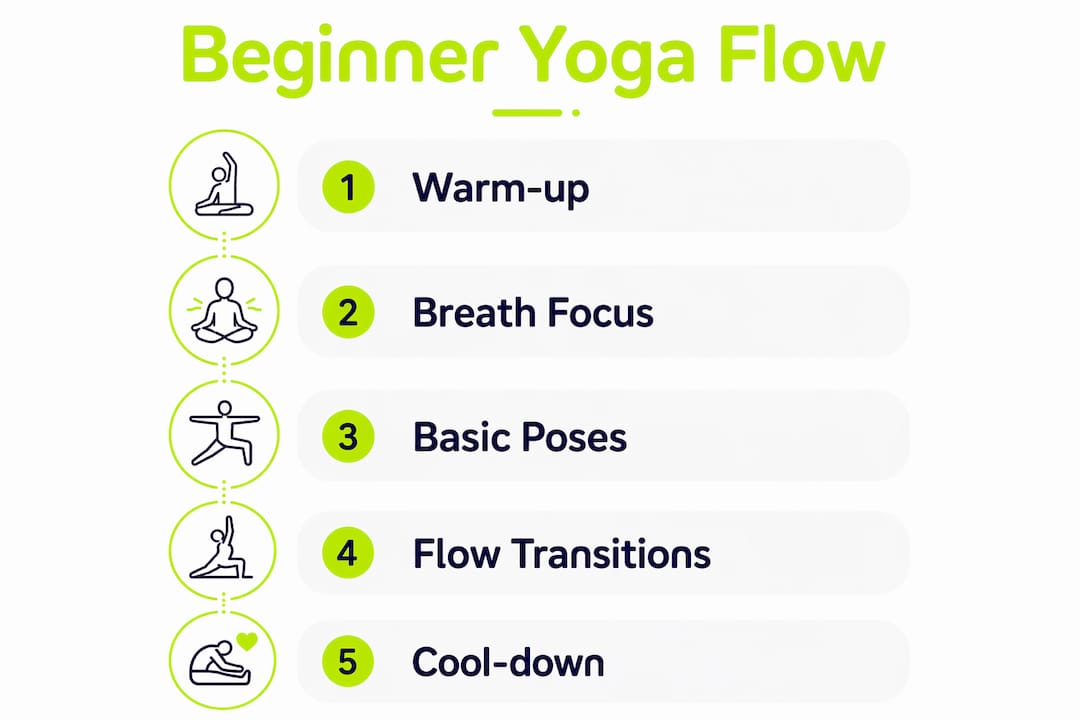
A beginner yoga flow is a sequence of postures linked to breath, designed to ease newcomers into yoga through gentle, accessible movements. You don’t need flexibility to start. Flexibility is what you build along the way, not a requirement you have to meet first. Research from the NCCIH confirms that yoga supports stress management, better balance, improved sleep, and relief from neck and back pain, making it one of the most well-rounded practices a beginner can pick up.
Here's what a solid starting point looks like:
Breath awareness — Sync every movement to an inhale or exhale; this is what separates flow yoga from static stretching.
Foundational poses — Mountain Pose, Downward Dog, Child's Pose, and Warrior I cover most of what beginners need.
Short sessions — Aim for 20–30 minutes per session. This is ideal for new practitioners and helps maintain engagement without causing fatigue before you build experience.
Props — A yoga block and strap remove the pressure of reaching poses you're not ready for yet.
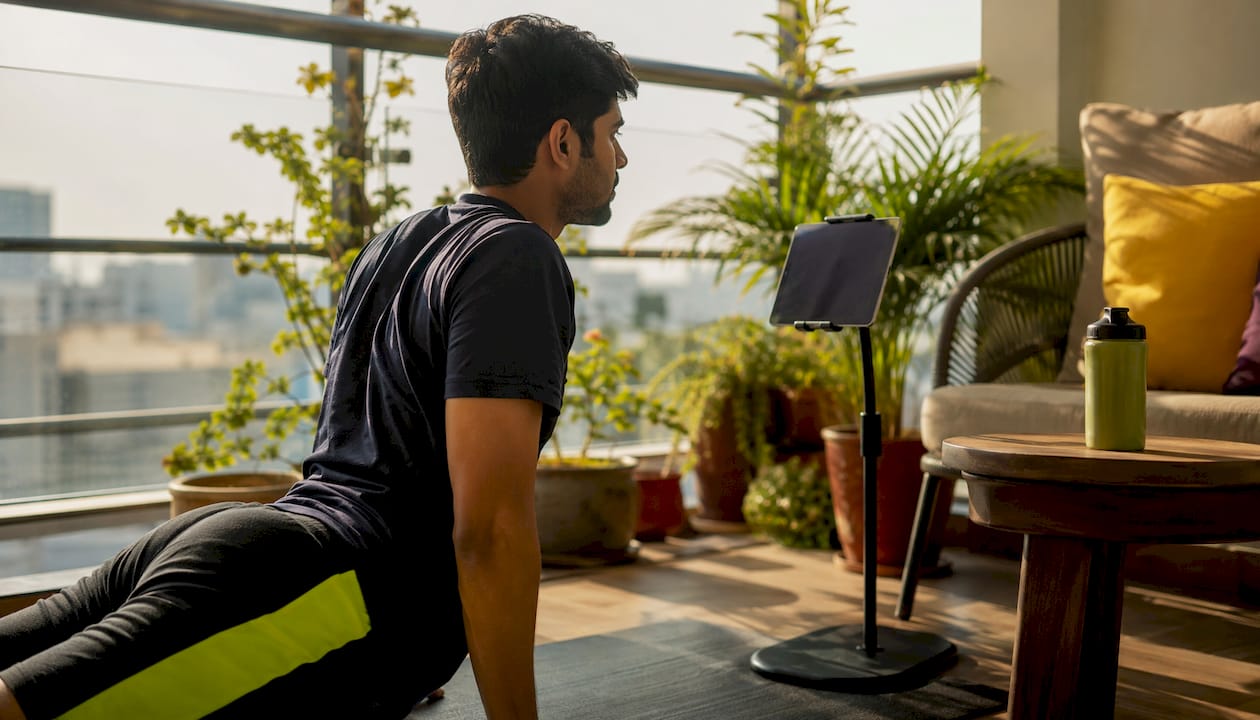
Comfortable space — A non-slip mat, loose clothing, and a quiet corner are genuinely all you need to start at home.
Safety first — Avoid wrist-heavy poses until your shoulder stability develops, and skip extreme positions like headstands or forced breathing entirely.
The NCCIH also recommends practicing under a qualified instructor, especially early on, since self-taught beginners face a higher risk of injury.
What does a beginner yoga flow routine look like at home?
Sun Salutation A (Surya Namaskar A) is the most practical starting point for a home practice. It builds coordination, teaches breath-to-movement rhythm, and covers the full body in under ten minutes. Repeat it multiple times, then add a few standing and floor poses to round out a complete session.
Here's a simple sequence to try:
Mountain Pose (Tadasana) — Stand tall, feet together, arms at your sides. Inhale deeply and feel your spine lengthen.
Forward Fold (Uttanasana) — Exhale and hinge at the hips, letting your head hang. Bend your knees as much as needed.
Half Lift (Ardha Uttanasana) — Inhale, lift your chest halfway, and flatten your back. Fingertips rest on shins.
Plank Pose — Exhale and step or jump back. Keep your hips level with your shoulders.
Low Cobra (Bhujangasana) — Inhale and press the tops of your feet down, lifting your chest with elbows slightly bent.
Downward Facing Dog (Adho Mukha Svanasana) — Exhale, press back, and hold for five breaths. Use a wall for support if balance is tricky.
Warrior I (Virabhadrasana I) — Step your right foot forward on an inhale, bend the front knee, and reach both arms overhead.
Child's Pose (Balasana) — Exhale and sink back to rest. Stay here for five slow breaths before switching sides.
Pro Tip:If a pose creates sharp or shooting pain, that’s your signal to stop. Intensity, the sensation of a deep stretch, is normal. Pain is not. Understanding that difference early keeps your practice safe and consistent.
A few things to keep in mind as you build this routine:
Move at your own pace; there's no timer pushing you through transitions.
Use a block under your hands in Forward Fold if the floor feels far away.
End every session with two to three minutes lying flat in Savasana (Corpse Pose) to let your nervous system settle.
Top beginner-friendly yoga studios in Florida
Florida has a genuinely strong yoga scene for beginners, with studios ranging from donation-based community spaces to specialty alignment schools. Below are the top options, organized by what makes each one worth your time.
Bikram Yoga Delray Beach — Location: Delray Beach | Styles: Bikram (heated) | Rating: 4.9★ (370 reviews) | Specialization: Authentic Bikram practice with 32 weekly classes and live stream via Zoom | Best for: Practitioners who want a structured, heat-based format with flexible scheduling.
Savage Yoga Studios — Location: Florida | Styles: Hot, Power, Yin, Pilates, Nidra, Restore and Recover | Rating: 5★ (197 reviews) | Specialization: Home-style studio with sauna and cold plunge recovery | Best for: Beginners who want variety and wellness amenities under one roof.
Beach Town Yoga - St. Petersburg — Location: St. Petersburg | Styles: Heated yoga | Rating: 4.9★ (192 reviews) | Pricing: Donation-based classes, $88/month unlimited | Specialization: Teacher training and workshops | Best for: Budget-conscious beginners and those curious about teacher training.
The Yoga Direction | Pembroke Pines, FL — Location: Pembroke Pines | Styles: Vinyasa Krama, heated and non-heated | Rating: 5★ (178 reviews) | Specialization: Spiritual growth, ice bath therapy, specialty workshops | Best for: Beginners drawn to holistic wellness and spiritual development.
Winter Park Yoga — Location: Winter Park | Styles: Non-heated and infrared heated | Rating: 5★ (137 reviews) | Pricing: 2 weeks unlimited for $39 (local residents) | Best for: Locals who want an affordable trial before committing.
Inspirit Yoga Studio — Location: Florida | Styles: Heart-centered Vinyasa Flow | Rating: 5★ (112 reviews) | Specialization: Beginner-friendly classes with meditation, massage therapy, and paddleboard yoga | Best for: Beginners who want yoga and healing arts in one place.
Open Door Yoga — Location: Miami | Styles: Yin, Restorative, Vinyasa | Rating: 5★ (95 reviews) | Specialization: Yoga Alliance Certified Teacher Training | Best for: Students who prioritize certified instruction and a boutique environment.
Wildflowers Yoga + Healing Collective — Location: Florida | Styles: Traditional yogic paths, breathwork | Rating: 5★ (92 reviews) | Pricing: $30 for 3 weeks unlimited | Specialization: Live stream classes and community-oriented healing | Best for: Beginners who want flexibility between in-person and online.
Soul Moves Yoga Studio — Location: Florida | Styles: Aerial, Restorative, Yin, beginner classes | Rating: 4.7★ (83 reviews) | Pricing: 21 days unlimited for $59 | Best for: Newcomers who want to sample a wide range of styles before settling on one.
Peaceful Peacock Orlando — Location: Orlando | Styles: Sound healing, meditation, yoga | Rating: 5★ (67 reviews) | Pricing: Donation-based with membership options | Best for: Beginners who want a joyful, low-pressure community setting.
A Little Twisted Yoga Studio — Location: Florida | Styles: Varied, all levels | Rating: 5★ (44 reviews) | Best for: Local beginners seeking a community-focused studio with class variety.
Flow Yoga Studio — Location: Florida | Styles: Flow-focused, beginner-oriented | Rating: 5★ (32 reviews) | Best for: Beginners who want steady-paced flow classes without added complexity.
Iyengar Yoga Sarasota @Rosemary Court Yoga — Location: Sarasota | Styles: Iyengar (alignment-focused) | Rating: 4.8★ (17 reviews) | Specialization: Certified Iyengar teaching with emphasis on posture precision | Best for: Beginners who want detailed alignment correction from the very first class.
How do you choose the right beginner yoga studio?
The studio that fits you best isn't always the one closest to your house. A few key factors make the difference between a practice that sticks and one you abandon after two weeks.
Location and schedule — A studio 30 minutes away with inconvenient class times will lose to a decent one five minutes from home. Consistency beats perfection.
Instructor credentials — Look for Yoga Alliance certification as a baseline. It signals that the teacher completed a recognized training program, not just a weekend workshop.
Beginner-specific classes — General "all levels" classes can feel intimidating. Studios like Inspirit Yoga Studio and Soul Moves Yoga Studio offer classes built specifically for newcomers, with slower pacing and more verbal cuing.
Intro pricing — Winter Park Yoga's two-week unlimited pass for $39 and Wildflowers Yoga's three-week unlimited offer for $30 let you test a studio without a long-term financial commitment.
Class size and atmosphere — Smaller classes mean more instructor attention. A boutique studio like Open Door Yoga in Miami tends to offer that more naturally than a large gym-based program.
Online options — If your schedule is unpredictable, studios like Bikram Yoga Delray Beach and Wildflowers Yoga + Healing Collective offer live stream classes so you don't lose momentum on busy days.
Pro Tip:Try at least two different studios before deciding. Many offer free or discounted first classes. The teaching style, room energy, and instructor personality matter more than you’d expect, and you won’t know until you’re in the room.
Common beginner mistakes worth avoiding: skipping the intro class to jump straight into a regular session, pushing through sharp pain to “keep up,” and choosing a studio based on price alone without checking instructor qualifications.
Onemor fits where studio schedules don’t
If you’re drawn to yoga but studio schedules, commute times, or class costs are getting in the way, Onemor offers a genuinely different path. It’s a fitness app built for Gen-Z and young adults who want real structure without the friction of planning everything themselves.
Onemor’s beginner-friendly programs include guided sessions with sets, reps, and rest timers, led by real coaches like Coach Kayla and Coach Branden who specialize in building consistency from day one. You train on your schedule, track progress through streaks and XP, and stay motivated through tribe-based challenges with people working toward the same goals. It’s free to start on iOS, with premium options for those who want full coaching access.
Key Takeaways
The most effective way to start a beginner yoga flow is with short, breath-linked sessions built around foundational poses, supported by a qualified instructor and a studio culture that genuinely welcomes newcomers.
Start with short sessions. Aim for 20–30 minutes per session; this length builds habit without overwhelming your body. Sessions for beginner yoga typically last 20-30 minutes focusing on simple poses and steady breathing rather than advanced contortions.
Sun Salutation A is your foundation. It teaches breath-to-movement rhythm and covers the full body in one repeatable sequence.
Avoid wrist-heavy poses early. Build shoulder stability first; skipping these poses prevents the most common beginner injuries.
Try intro pricing before committing. Offers like $30 for 3 weeks (Wildflowers) or $39 for 2 weeks (Winter Park Yoga) let you test fit first.
Onemor for home practice. Onemor’s coached beginner programs give structure and accountability when studio schedules don’t work.