Yoga for Mobility: 3 Coach-Led Flows to Build Range
Add Onemor as a preferred source on Google
Yes, yoga can improve mobility when you train active control alongside range of motion. The key is pairing dynamic movement with intentional breath and progressive loading, not just holding deeper stretches. Start with a 10-minute daily flow every morning and add two 20-minute targeted sessions per week. That structure, held consistently over a couple of months, is where real change happens. No equipment needed. You can try the first sequence of this article right now.
What does yoga for mobility actually train?
Most people use “flexibility” and “mobility” as if they mean the same thing. They don’t, and that gap explains why some people stretch for months without moving better.
Flexibility is passive — it describes how far a muscle can lengthen when an external force is applied. Mobility is active. It’s your ability to move a joint through its range under your own muscular control, with strength, coordination, and balance working together. A simple test: you might be able to pull your leg into a high hamstring stretch with your hands, but can you raise it there on your own? That gap between passive and active range is exactly what mobility training closes.
Why does this matter for how you practice? Because if you only stretch passively, you gain tissue length without gaining control. The result is range you can’t actually use when you’re moving, lifting, or just walking up stairs. Mobility-focused yoga trains both.
The components that create usable mobility:
Tissue extensibility — the passive length of muscles and connective tissue
Neuromuscular coordination — your nervous system's ability to recruit the right muscles at the right time
Strength through range — the capacity to produce force at end-range positions
Balance and stability — the ability to hold and control positions without compensation
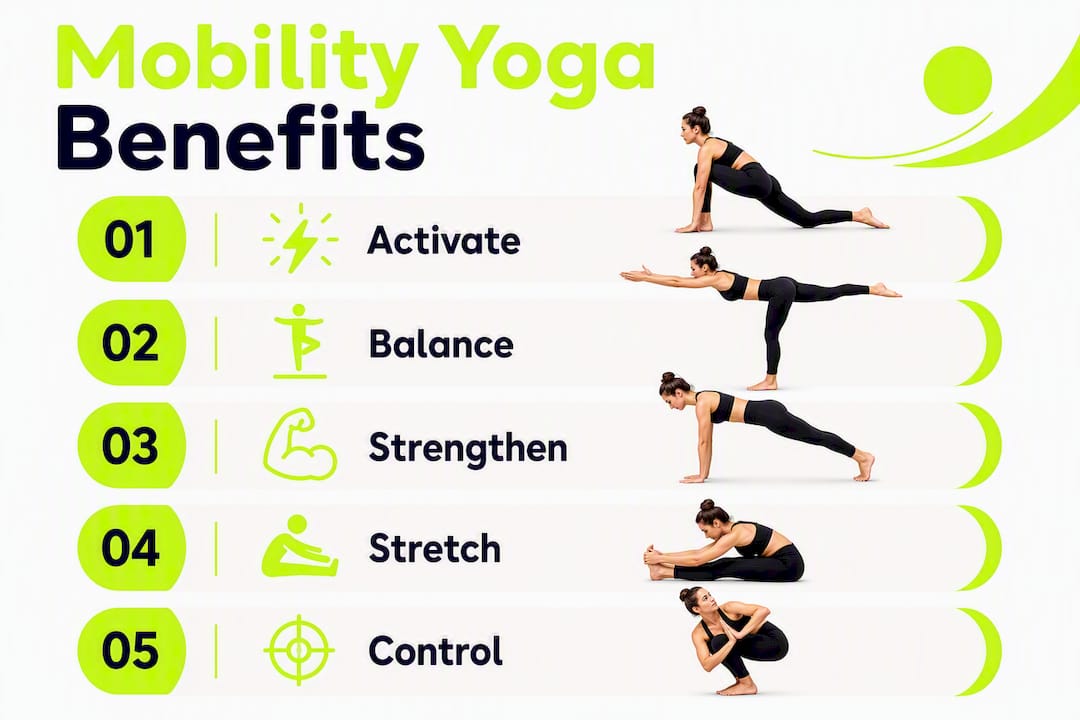
What are the real benefits of mobility-focused yoga?
The payoffs go well beyond touching your toes. When you train mobility through yoga, you’re building a body that moves with less effort and recovers faster.
Primary benefits you can expect:
Improved active range of motion — you gain range you can actually use under load, not just in a stretch
Better balance and stability — single-leg work and transitions train the stabilizers that protect joints
Reduced stiffness — regular movement keeps connective tissue hydrated and pliable
Faster recovery — gentle flows increase circulation to sore muscles without adding training stress, making yoga ideal as rest day yoga or yoga for sore muscles
Easier daily tasks — squatting, reaching overhead, and rotating become less effortful
Mental health and sleep gains — a systematic review and meta-analysis found small-to-moderate improvements in depression, sleep quality, and vitality alongside physical outcomes
Stat to know: That same meta-analysis reported effect sizes of approximately 0.7 for balance, 0.5 for lower-body flexibility, and 0.45 for lower-limb strength in yoga practitioners compared to inactive controls.
Yoga’s edge over single-method stretching is that it’s multimodal. One session can address tissue length, balance, strength, and breath control simultaneously. That’s a lot of return on a 20-minute investment.
Why does yoga work, and when will you see results?
The science behind yoga’s mobility benefits comes down to how it trains the body on multiple levels at once. Rather than isolating one variable like a static stretch does, yoga combines tissue work with neuromuscular training, balance challenges, and controlled loading. ACE’s movement research describes this as the core reason mobility training produces functional change where passive stretching alone often falls short.
The mechanisms working in your favor:
Neural adaptation — your nervous system learns to allow greater range and reduces its protective guarding response
Tissue remodeling — connective tissue gradually adapts to new length and load demands
Motor pattern reinforcement — repeated transitions teach your body to move efficiently through full range
Strength at end-range — holding and moving through challenging positions builds the control that makes range usable
A randomized controlled trial published in PMC found that an 8-week Hatha yoga program produced significant improvements in balance, flexibility, strength, and mobility measures, with effect sizes similar to those reported in systematic reviews: approximately 0.7 for balance, 0.5 for lower-body flexibility, and 0.45 for lower-limb strength versus inactive controls. Yoga was as effective as conventional stretching and strengthening exercises across every functional fitness category tested.
Realistic timeline: Most people notice easier movement and reduced stiffness within 3–4 weeks. Clinically measurable changes in range, balance, and strength typically emerge after 8–12 weeks of consistent practice. The first few weeks are largely neural; tissue changes follow.
Pro Tip:Don’t judge progress by how deep a pose looks. Track whether you can hold a position with control, whether compensations (like a collapsing arch or a hiking hip) are decreasing, and whether daily movements feel easier.
How should you structure a mobility yoga session?
A well-built session has four phases. Skip any one of them and you either miss adaptation or risk injury.
Session architecture:
Dynamic warm-up (3–5 minutes) — cat-cow, hip circles, thoracic rotations, ankle rocks. The goal is to raise tissue temperature and prepare the nervous system, not stretch cold muscles.
Main mobility work (10–15 minutes) — dynamic drills and controlled transitions rather than long passive holds. Move into range, pause briefly with muscular engagement, move back out. Repeat 5–8 times per drill.
Integration (3–5 minutes) — apply the range you just trained to a functional movement pattern. A hip mobility drill becomes a lunge. A thoracic rotation drill becomes a high-plank rotation.
Cool-down (optional, 3–5 minutes) — static holds of 30–60 seconds for areas that need passive tissue work. This is the right time for passive stretching, not before movement.
Dose guidelines:
Frequency — daily 5–15 minute flows plus 2–3 focused 20–30 minute sessions per week
Reps per drill — 5–8 controlled repetitions, moving slowly and with breath
Tempo — inhale to prepare, exhale to move into range; never force at end-range
Progression — floor-based patterns first, then standing, then loaded or single-leg variations
Pro Tip:The most common mistake is treating yoga poses as destinations. The real training happens in the transition — moving in and out of a position with control builds far more motor skill than sitting in a pose for two minutes.
Pairing mobility sessions with bodyweight strength work helps you retain new ranges under load. Many people gain range in a yoga session and lose it the moment they add resistance, because the muscles controlling that range aren’t strong enough yet.
Three ready-to-follow mobility sequences
Sequence 1: Quick daily 10-minute flow
This is your everyday baseline. Do it in the morning or before any workout.
Cat-cow — 1 minute, 5-count inhale/exhale, full spinal wave
Hip circles in tabletop — 45 seconds each side, slow and controlled
Low lunge with thoracic rotation — 45 seconds each side, reach top arm to ceiling on exhale
Downward dog to plank transitions — 1 minute, 5 reps, engage glutes at the top
Supine figure-four stretch — 1 minute each side, flex the top foot to protect the knee
Seated forward fold with active engagement — 1 minute, press heels away and flex quads rather than pulling with hands
Target outcome: Reduced morning stiffness, improved hip and spinal mobility, nervous system activation.
Sequence 2: Morning 20-minute full-body session
This sequence works well as yoga for athletes recovery or on a rest day.
Child's pose with side reach — 1 minute each side
Thread-the-needle — 45 seconds each side, 5 reps dynamic then hold
World's greatest stretch — 1 minute each side (lunge, elbow to floor, thoracic rotation)
Downward dog with alternating heel presses — 1 minute
Warrior I to Warrior II transitions — 1 minute each side, 5 slow transitions
Lizard pose with hip circles — 1 minute each side
Bridge pose, 3-second hold at top — 1 minute, 8 reps
Supine spinal twist — 1 minute each side
Legs-up-the-wall or happy baby — 2 minutes to close
Modification note: For tight hips in lunge positions, place the back knee on a folded blanket and keep the front shin vertical.
Sequence 3: Hip and shoulder focus
This is your go-to for the two most commonly restricted areas. It doubles as the best yoga for tight hips and a shoulder opener in one session.
90/90 hip switches — 2 minutes, 10 slow transitions, sit tall
Pigeon pose (active) — 1 minute each side, press the front shin into the floor rather than relaxing into it
Deep squat with thoracic rotation — 1 minute, hold a doorframe or strap if needed
Thread-the-needle to open rotation — 45 seconds each side
Wall shoulder flexion slides — 1 minute, arms slide up the wall with ribs down
Eagle arms seated — 45 seconds each side, breathe into the upper back
Doorway chest opener — 1 minute, two arm positions (90 degrees and 135 degrees)
Pro Tip:In 90/90 hip work, the goal isn’t to get your hips flat to the floor. It’s to feel both sit bones weighted and your spine tall. That’s the active control that transfers to squats and single-leg movements.
Key poses and drills by joint area
Hips
Low lunge (Anjaneyasana) — feel a stretch in the front hip flexor; common error is letting the front knee cave inward; regression is back knee on the floor
Pigeon pose — targets external hip rotation; common error is collapsing into the hip rather than actively pressing the shin down; progression is adding a forward fold
90/90 hip switches — trains both internal and external rotation actively; common error is leaning to one side; keep the spine vertical throughout
Standing hip CARs (controlled articular rotations) — slow full-circle hip rotations while standing; builds active range in all planes; regression is holding a wall for balance
Thoracic spine
Thread-the-needle — opens thoracic rotation; common error is rotating from the lower back; keep the hips square
Cat-cow — segmental spinal mobility; common error is moving only at the lumbar spine; focus on moving each vertebra sequentially
Quadruped thoracic rotation — hand behind head, rotate elbow toward the ceiling; progression is adding a hip shift to increase range
Shoulders
Wall slides — trains scapular upward rotation and shoulder flexion; common error is letting the ribs flare; keep the core engaged
Eagle arms — stretches the posterior shoulder and upper back; regression is crossing arms at the elbows only
Doorway chest opener — targets the pectorals and anterior shoulder; vary arm height to hit different portions of the muscle
Ankles
Ankle rocks (dorsiflexion drill) — knee tracks over the pinky toe; common error is letting the arch collapse; progression is adding load with a goblet squat
Downward dog with alternating heel presses — builds calf length and ankle range simultaneously; hold each press for 3 seconds
Squat-to-stand — integrates ankle dorsiflexion with hip and spinal mobility; regression is heels elevated on a rolled mat
For a deeper look at how mobility connects to athletic longevity, the principles above apply across every sport and training style.
Safety, modifications, and when to see a professional
Mobility training should feel like productive challenge, not pain. Knowing the difference keeps you progressing safely.
Core safety rules:
Discomfort is okay; sharp or shooting pain is not — a deep muscular stretch sensation is normal; joint pain, nerve pain, or any sharp sensation means stop
Never force end-range — if you can only get there by holding your breath or gripping with your hands, you're past your usable range
Respect recent injuries and surgeries — wait for medical clearance before loading an injured joint through full range
Warm up before deep work — cold tissue is less pliable and more prone to strain
Common modifications:
Knee pain in lunges — place the back knee down, reduce the depth of the lunge, and check that the front knee stays stacked over the ankle
Wrist pain in weight-bearing poses — shift to fists or forearms, or use yoga blocks to reduce wrist extension
Tight hamstrings in forward folds — bend the knees generously and focus on hinging from the hips rather than rounding the spine
Shoulder impingement — avoid overhead positions that cause pinching; substitute thread-the-needle or eagle arms instead
See a physical therapist or doctor if you experience:
Persistent sharp pain that doesn't resolve between sessions
Recent trauma, fracture, or post-surgical recovery
Supporting your practice with joint health nutrition can also help, particularly if stiffness is a recurring issue between sessions.
This article is general information, not medical or professional advice. Confirm any exercise program with a qualified healthcare provider if you have an existing condition.
How often should you practice, and what does progress look like?
Consistency beats intensity every time with mobility work. Short daily sessions combined with two or three longer weekly sessions are generally more effective for adaptation and habit-building than occasional long stretching marathons.
Practical schedule:
Daily — 5–15 minutes of the quick flow sequence (Sequence 1 above)
2x per week — 20–30 minute focused sessions targeting your priority areas (hips, shoulders, or full-body)
Rest days — the 10-minute flow counts as rest day yoga; it promotes recovery without adding training load
Progress markers to watch for:
Movements that felt stiff now feel fluid and require less warm-up time
Compensations (hip hiking, knee caving, lower-back rounding) are decreasing
Single-leg balance holds are longer and steadier
Active range of motion is visibly deeper than passive range was when you started
Daily tasks like squatting, reaching, and rotating feel noticeably easier
When progress stalls:
Check three things. First, are you actually training active control, or just sitting in passive holds? Second, are you pairing mobility work with strength training? Strength alongside mobility is often what’s missing when range gains don’t stick. Third, is your dose sufficient? If you’re only doing one session per week, doubling frequency often restarts progress immediately.
Pro Tip:Take a short video of a key movement (like a deep squat or a single-leg balance) at the start of your 8-week plan. Rewatch it at week 8. Visual feedback is far more motivating than trying to remember how you felt.
Key Takeaways
Yoga improves usable mobility when you train active control and progressive range together, with consistent practice over 8–12 weeks producing measurable gains in balance, flexibility, and strength.
Mobility vs. flexibility. Mobility requires active control through range; flexibility alone doesn’t guarantee usable movement.
Multimodal training. Yoga trains tissue length, balance, strength, and neuromuscular coordination in a single session.
8–12 week timeline. Measurable changes in range, balance, and strength typically emerge after 8–12 weeks of consistent practice.
Frequency that works. Daily 5–15 min flows plus 2–3 focused weekly sessions outperform infrequent long stretching sessions.
Onemor for guided sessions. Onemor delivers coach-led mobility flows with structured progressions, timers, and tribe accountability to keep your 8–12 week plan on track.
The part most people skip
Here’s what I keep coming back to after working through the research and the programming: most people approach yoga for mobility the same way they approach a diet. They do it intensely for two weeks, feel some improvement, then stop when life gets busy. And then they wonder why nothing changed.
The sessions in this article are short on purpose. Ten minutes is not a compromise; it’s the actual prescription. The research backs brief, frequent practice over long, infrequent sessions, and the neural adaptation that drives early progress happens through repetition, not duration. You don’t need a 60-minute class three times a week to move better. You need five minutes every morning and two honest focused sessions per week, done consistently for two months.
The other thing worth saying: mobility work tends to feel unproductive because it doesn’t leave you sore or breathless. That’s the point. You’re training your nervous system to allow range it currently guards against. That process is quiet. It shows up six weeks later when you squat without thinking about it, or when you reach overhead without your shoulder hiking up. Trust the process even when the sessions feel easy.
Start with Sequence 1 today. That’s it. One 10-minute flow, done well, is a better first step than planning the perfect 12-week program you never start.
Onemor brings coach-led mobility to your daily routine
Knowing what to do is one thing. Having a coach cue you through it, with the right sequence, the right timing, and a community keeping you accountable, is what actually makes the 8–12 week plan stick.
Onemor delivers exactly that. The app’s coach-led sessions include structured mobility flows built by real trainers, with in-app timers, set and rep guidance, and progressive programming that advances as you do. You’re not guessing what comes next or pausing to reread instructions. You follow the session, the coach keeps you moving, and the app tracks your consistency through streaks and XP so you can actually see your progress build.
The tribe system adds the accountability layer that solo practice often lacks. Join a tribe on Onemor and your consistency becomes part of something bigger than a personal goal. That social layer is one of the strongest predictors of long-term habit formation. Ready to put the 8–12 week plan into action with a coach in your corner? Start your free trial on Onemor today.
Useful sources and further reading
These are the primary sources behind this article's claims. Each one is worth bookmarking if you want to go deeper.
ACE: Mobility vs. Flexibility — the clearest professional explanation of how mobility and flexibility differ, why the distinction shapes program design, and how to prioritize joints for training. Directly supports the what_is_mobility and how_to_structure sections.
Springer Nature systematic review and meta-analysis — a rigorous review of yoga's effects on physical function and quality of life, including the effect size data for balance, flexibility, and strength cited in the benefits and research_backing sections.
PMC randomized controlled trial: Yoga vs. stretching-strengthening — an 8-week RCT showing Hatha yoga is as effective as conventional exercise for functional fitness outcomes; supports the timeline and expected results sections.
Hinge Health: Mobility vs. Flexibility — a practical, clinician-written guide to mobility drills, frequency recommendations, and the case for dynamic over passive work. Supports the how_to_structure and frequency_timeline sections.
NCBI Bookshelf: Yoga for musculoskeletal conditions — a systematic review and meta-analysis covering yoga's effects on pain and functional ability across low back pain, osteoarthritis, and other musculoskeletal conditions; useful for safety_modifications context.