July 26, 2026
7 min read

Best Calisthenics Apps for 2026: Free vs Paid Compared

Add Onemor as a preferred
source on Google

For young adults who want real structure without the guesswork, Onemor is the best calisthenics app to start with. It delivers coach-led guided sessions with sets, reps, and rest timers built in, so you never have to figure out what comes next. Whether you're training at home in your Florida apartment or hitting the gym three times a week, Onemor adapts to your environment and keeps you moving forward.

Calisthenics apps compared: free vs paid at a glance

Thenx is the only calisthenics-only app here; the other four include bodyweight programming alongside other training styles. The comparison shows what you get free, what you pay, and how much structure each one gives you.

App
What's permanently free
What requires payment
Price (US)
Devices
Equipment needed
Progression & coaching
Main limitation
Onemor
Free plan: daily workouts, no card required
Pro: new workout daily, chat with your coach, streaks/community/leaderboard, switch coaches and styles anytime
$24.99/mo or $179.99/yr ($14.99/mo) · 7-day free trial
iOS
None required; every plan adapts to home or gym
Real human coach builds a daily plan refreshed weekly; rest timers and cues on every rep; streaks, XP and tribe challenges; switch coaches anytime
Newer app with a smaller coach roster; fewer dedicated skill-work programs (planche, front lever)
Ladder
Nothing permanent; 7-day free trial, no card required
Everything after the trial
$29.99/mo or $179.99/yr ($14.99/mo)
iOS and Apple Watch
Mostly dumbbells/barbell; home, gym or outdoor teams
Real coach, team-based daily plan refreshed weekly; team chat; coach switching limited to 2 per month
No free tier; strength-focused rather than bodyweight-first; sessions often 40–60+ min
BetterMe
Nothing permanent; short trials (3–7 days) on some offers
Everything after the trial; coach chat is an extra ~$29.99 per 12 weeks
Widely varying, roughly $9.99–$49.99/mo depending on the offer shown
iOS, Android, Apple Watch
None required; bodyweight and Pilates-style sessions, 10–30 min
AI-generated plan and meal plan; goal-based rewards; plan is locked once chosen
No human coach by default; no permanent free tier; pricing is hard to pin down before you subscribe
Peloton App
App Free: limited number of classes per month
App One ($12.99/mo) and App+ ($24/mo) unlock the full class library
$12.99–$24/mo
iOS, Android, web, TV apps
None for bodyweight/strength classes; equipment classes optional
Large on-demand class library with pre-recorded instructors; badges and streak tracking; you pick each class yourself
No coach, no personalized plan, no community chat; you decide what to do every day
Thenx
Free version: a limited set of workouts and exercise library
Pro: full workout library, skill progression programs, technique videos
$9.99–$19.99/mo or $89.99–$119.99/yr depending on plan; trial on some offers
iOS and Android
Pull-up bar; dip bars or parallettes for most programs
Calisthenics-only skill progressions (muscle-up, handstand, planche, front lever) with video tutorials; self-paced, no human coach, no personalized daily plan
No coaching or community accountability; you choose and schedule your own workouts; needs bars to get full value

Free trial vs free plan: a free trial gives temporary access to paid features and then charges you unless you cancel. A free plan is a permanently free tier with limited features. The table separates the two; "start free" in an app's marketing can mean either.

How we evaluated these apps

We compared each app on the same six criteria, using information from the app's official website, its App Store listing, and Onemor's own feature comparison page (onemor.com/fitness-app-comparison):

  1. Free access — what you can do without ever paying, as distinct from a time-limited trial.
  2. Paid requirements and price — what's behind the paywall and what it costs monthly and yearly.
  3. Supported devices — iOS, Android, and wearable integration.
  4. Equipment — whether programs work with no equipment, and whether substitutions are built in.
  5. Progression features — structured plans, coach-led progressions, rest timers, tracking, and motivation tools.
  6. Limitations — the biggest reason the app might not suit you.

Where this article makes a claim about an app's experience, it's based on the app's documented features and publicly available user reviews, not on a formal lab test. We have not run side-by-side performance testing, and we don't include screenshots of apps we haven't used.

Here's what makes Onemor stand out from the crowd:

  • Structured programming — Expert coaches design every session with clear progressions, not random workouts.
  • Flexible training modes — Strength, HIIT, and bodyweight programs that work with or without equipment.
  • Motivational tools — Streaks, XP, and tribe-based challenges that make consistency feel rewarding.
  • Beginner-friendly entry points — Programs built for people training a few times per week who want results, not overwhelm.
  • Free plan and Pro subscription — Train on the free plan indefinitely, or take the Pro trial and upgrade when you're ready.

What are the key features of the best calisthenics apps?

Not every bodyweight training app is built the same. The difference between one you open for a week and one you actually stick with usually comes down to a handful of features.

  • Structured coaching with progressions — The app should tell you what to do, in what order, and when to level up. Vague exercise libraries don't cut it.
  • Personalized training plans — Look for apps that adapt to your current skill level and goals, not a one-size-fits-all template.
  • Multiple training styles — Strength, HIIT, and pure bodyweight work should all be on the menu. You'll want variety as you grow.
  • Equipment flexibility — Equipment substitutions like resistance bands or pull-up bars should be built into the programming, so a missed gym day doesn't derail your week.
  • Motivational social features — Tribe challenges, streak tracking, and XP systems keep you accountable when motivation dips.
  • Device compatibility and wearable integration — Apps supporting iOS and fitness wearables give you better feedback and make tracking effortless.
  • Clear session tracking — Sets, reps, rest timers, and skill milestones should all be visible in real time.

Pro Tip: If an app doesn't show you a rest timer and a next-set cue, you'll spend more time guessing than training. That friction adds up.

Why coach-led programs make a real difference in calisthenics

Self-guided training sounds freeing until you hit a wall and have no idea why. Structured, coach-led progressions solve that problem before it starts.
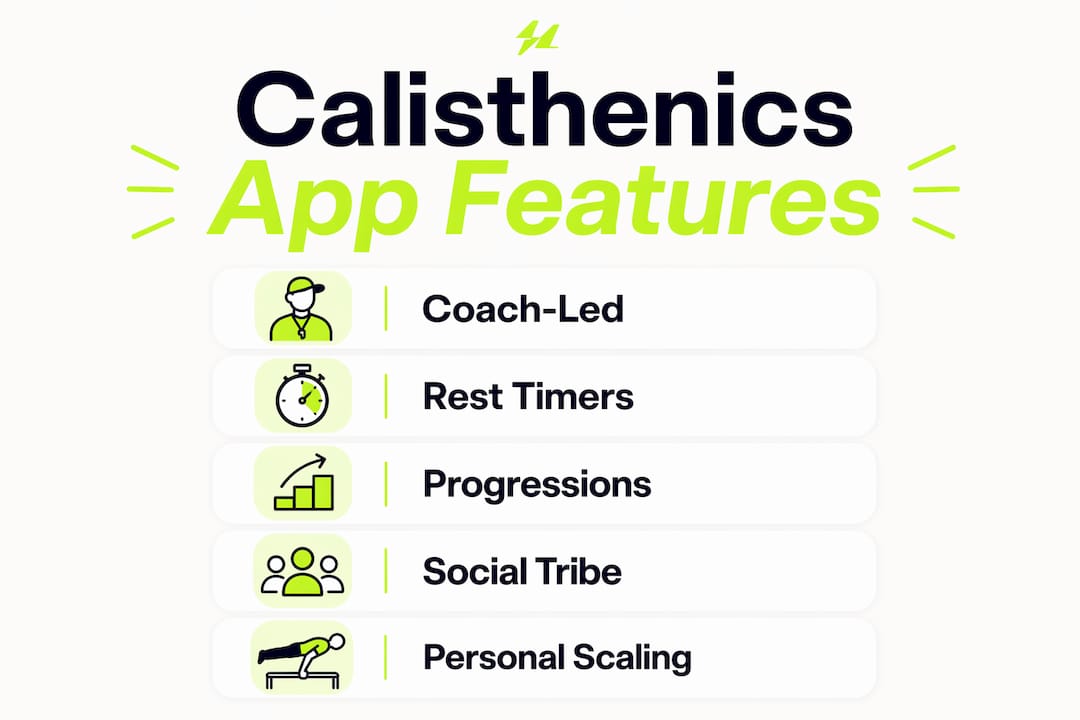
Infographic illustrating key features of top calisthenics apps

Intentional progression prevents the two most common calisthenics mistakes: doing too much too soon and stalling because you never increase the challenge. A good coach-designed plan builds difficulty gradually, keeping your joints healthy and your skill development on track. Proper form cues reduce the kind of joint stress that sidelines people for weeks.

Personalized scaling matters just as much. When a session adapts to how you actually performed, not how you planned to perform, you stay in the right training zone. That's what separates a program that produces results from one that just produces soreness.

Consistency is the other piece. Structured sessions give you a clear reason to show up on Tuesday and Thursday, not just when you feel inspired. Coach-led plans also set realistic skill milestones, so you can measure progress in something concrete, like your first clean push-up or your first dead hang hold.

How to choose the right calisthenics app for your training style

Picking the right app comes down to knowing yourself honestly. Here's a practical way to think through it:

  • Define your primary goal — Are you chasing strength, skill work like muscle-ups, HIIT conditioning, or general fitness? Different apps prioritize different outcomes.
  • Assess your training environment — Home, gym, or outdoor park? Make sure the app's programming matches what you actually have access to.
  • Look for regression and progression options — Beginner-friendly programming starts with fundamental moves and scales up over time, which is exactly what you need if you're training 2–3 times per week.
  • Match motivational features to your personality — If you thrive on competition, tribe challenges and leaderboards will keep you coming back. If you prefer solo focus, streak tracking and XP might be enough.
  • Evaluate pricing honestly — Free plans are great for testing, but premium subscriptions usually unlock the coaching depth that actually drives progress. Check what's behind the paywall before committing, and check whether "free" means a permanent free plan or a trial that converts to a paid subscription.
  • Confirm device compatibility — iOS availability and wearable integration matter if you want your training data in one place.

What do user reviews actually tell you about calisthenics apps?

App store ratings give you a signal, but the comments tell the real story. The most consistent praise across top-rated bodyweight training apps centers on three things: clear structure, coach personality, and how the app handles beginners.

Group enjoying social fitness app features outdoors

Apps that earn sustained high ratings tend to have coaches who feel like real people, not automated voice-overs. Users also consistently flag rest timers and guided cues as the features they'd miss most if removed. On the flip side, the most common complaints involve paywalls that hide core programming and apps that feel like video libraries with no actual plan behind them.

For young adults specifically, social features show up repeatedly in positive reviews. Knowing that a tribe challenge is waiting or that a streak is on the line changes the calculus on a low-motivation day. That community layer is what separates apps people recommend to friends from apps they quietly delete after a month.

Why Onemor fits young adults training at home or the gym

Onemor was built specifically for Gen-Z and young millennials, and that focus shows in every design decision. The coaches are real, credentialed trainers. Coach Geraldine, for example, brings structured progressions and beginner-friendly guidance that make the first few weeks feel manageable rather than intimidating.

Every session comes with sets, reps, and rest timers already built in. You open the app, follow the cues, and train. No planning, no second-guessing. The programming covers strength, HIIT, and bodyweight work, and it adapts whether you have a full gym or just your living room floor.

The tribe and challenge features are where Onemor really separates itself. Streaks and XP create a feedback loop that makes showing up feel rewarding, not obligatory. The social layer adds accountability without pressure, which is exactly the balance most young adults need to stay consistent past the first month.

Pricing includes a permanently free plan and a Pro subscription with a free trial, so you can get a feel for the app before committing. The UX is clean, energetic, and built for people who want results, not content.

Key Takeaways

Onemor is the top calisthenics app for young adults who want structured, coach-led training that works at home or the gym, with motivational social features that sustain long-term consistency.

  • Structured coaching wins. Coach-led progressions prevent plateaus and reduce injury risk better than self-guided training.
  • Equipment flexibility matters. The best apps adapt to home, gym, or park environments with built-in substitutions.
  • Social features drive consistency. Tribe challenges, streaks, and XP keep young adults engaged past the first month.
  • Match the app to your goal. Define whether you want strength, HIIT, or skill work before choosing a subscription.
  • Onemor leads for Gen-Z. Onemor offers guided sessions, expert coaches, and tribe features built specifically for young adults.

What sets Onemor apart from other fitness apps

If you've read this far, you already know what to look for in a top calisthenics workout app. Onemor delivers on every point: real coaches, guided sessions, flexible programming, and a community that keeps you accountable.

What makes Onemor different from a generic workout library is the combination of structure and energy. You get a coach who knows your level, a session that tells you exactly what to do, and a tribe that notices when you show up. That's a setup most young adults in Florida and beyond have never had access to without paying for a personal trainer.

The free plan lets you experience the app before spending a dollar. When you're ready to go deeper, the Pro subscription unlocks the full coaching roster, including specialists like Coach Branden for HIIT and bodyweight work and Coach Kayla for beginner-friendly strength sessions.

Ready to train with a real plan behind you? Join your tribe and start your first coached session today.

A perspective on what actually keeps young adults training

The fitness app market is full of products that look great in screenshots and disappear from your phone by week three. The reason isn't motivation. It's structure, or the lack of it.

Most apps hand you a library and call it a program. That's like giving someone a cookbook and calling it a meal. What young adults actually need is someone telling them what to do today, why it matters, and what comes next. That's what coach-led programming does, and it's why the apps with real coaching depth consistently outperform the ones built around content volume.

The social layer is underrated in a specific way. Tribe challenges and streak systems aren't gimmicks. They replicate the accountability that used to require a gym buddy or a paid trainer. For someone training alone in a Florida apartment at 7 AM, knowing a challenge is active changes the decision to skip. That's not psychology fluff. It's how habits actually form.

The apps worth your time are the ones that make showing up feel like the obvious choice, not the hard one. Build your training around structure and community, and consistency takes care of itself.

Recommended

FIND YOUR FREE PLAN
Make Fitness a Lifestyle
You’ll always know exactly what to do, when to do it, and you’ll have friends and coaches pushing you along the way.
Designed and built by Onemor Inc.
Copyright © 2026
Onemor green/yellow icon
Designed and built by Onemor Inc.
Copyright © 2025