Pilates typically wins for building core strength, spinal alignment, and muscular endurance, while yoga typically wins for flexibility, mobility, balance, and stress reduction through breath and mindfulness. If you want both, that’s not indecision, it’s smart programming. The 4-week sampler plan below will help you figure out which one your body actually asks for.
TL;DR:
Pilates trains your body through controlled, high-repetition movements built around your core, spine, and pelvis. Joseph Pilates originally called his method “Contrology” because the entire point is control, not momentum. You’re not swinging weights or chasing a burn. You’re holding a plank with your ribs stacked over your hips while a teacher calls out breath cues in a steady cadence.
Two formats dominate:
Pilates suits people rehabbing an injury, athletes chasing hip and shoulder stability, and anyone who wants functional core strength without joint stress. An 8-week Pilates mat program significantly increased back muscle strength and sit-up performance in study participants, which tells you the effect shows up fast, not just after months of practice. If you’re starting from zero, a short guided session like a beginner core workout is a realistic entry point.
Yoga pairs physical poses, called asanas, with breathwork and often meditation. That combination is what separates it from almost every other form of exercise: the mental practice isn’t an add-on, it’s baked into the class structure.
Styles vary widely:
A typical class alternates between holding a pose and flowing into the next one, with your breath setting the pace rather than a rep count. Yoga suits people chasing flexibility, stress relief, or a workout that doubles as a mental reset. Research on core muscle activation across yoga postures shows specific poses recruit meaningful glute and core engagement, so yoga isn’t just stretching, it can build real strength when poses are chosen well. Want a low-pressure starting point? A beginner yoga flow is designed for exactly that.
Both practices are low-impact, both put breath at the center of the work, and both can be done with zero equipment. That’s the overlap. The split shows up in movement style, intensity, and intent.
The difference between yoga and Pilates matters most when you apply it to a specific need. If your lower back aches from sitting all day, Pilates’ focus on spinal alignment and deep core activation addresses the structural issue directly. If your hips feel locked and your shoulders won’t rotate overhead, yoga’s longer holds and joint-specific stretching close that gap faster.
Pro Tip: Ask any instructor how they’d modify a move for someone with a stiff lower back or tight hamstrings before you book a class. If they can’t answer specifically, they’re teaching one script to everyone, not tailoring it to you.
Matching the practice to the goal beats guessing. Here’s how the evidence breaks down by outcome.
If chronic stress is your main driver, a resource like Yoga Nidra for stress and anxiety breaks down exactly how the relaxation response works.
Picking the wrong class isn’t just a wasted hour, it can slow your progress or aggravate an old injury. Run through this before you commit:
Red flags are easy to spot once you know them: an instructor who pushes through visible pain, a class that never shows a modification, or a program that jumps you into advanced moves in week one. Walk away from all three.
You don’t need to pick a side before you try either one. Run this instead:
If you’re managing chronic pain, cut every session in half and skip anything that increases discomfort rather than easing it. Check with a healthcare provider before starting either practice if you have an existing injury or condition, per standard medical guidance on exercise safety.
Pro Tip: Consistency beats intensity here. Three short 20-minute sessions a week will move your mobility and core endurance further than one exhausting 90-minute class every other Sunday.
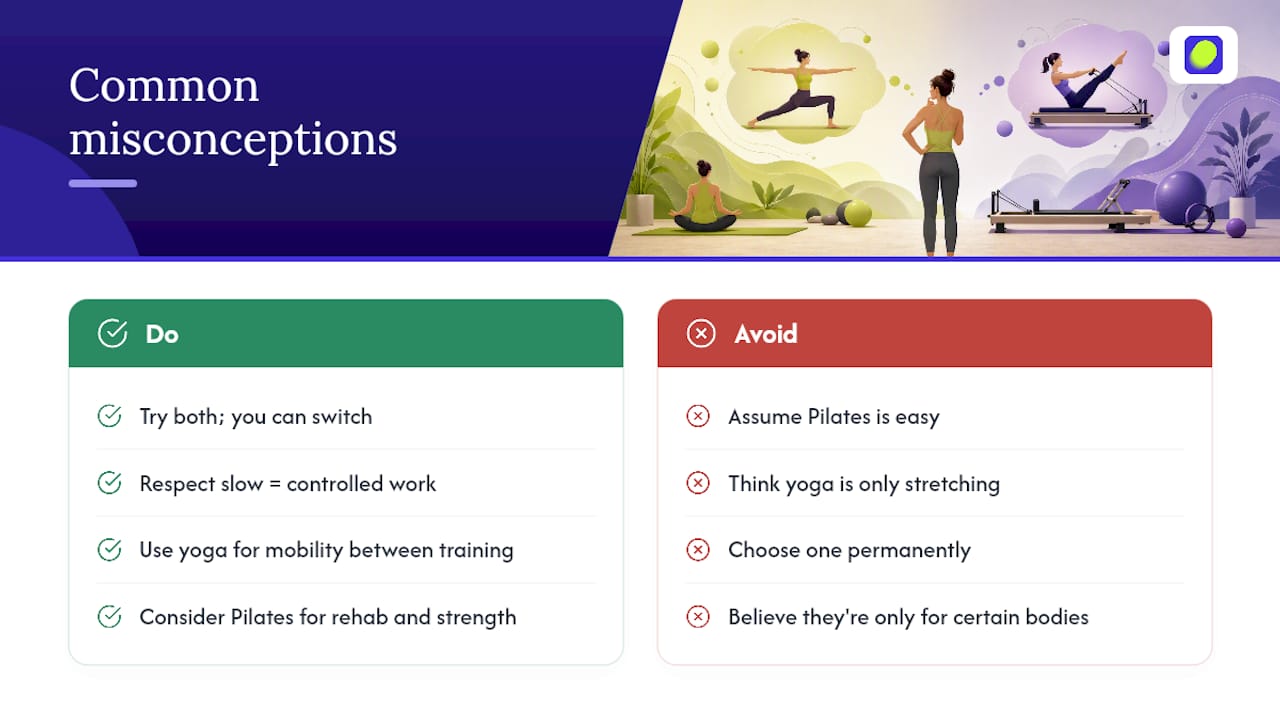
The biggest myth about Pilates is that it’s “easy” because it looks slow. Anyone who has held a Pilates hundred or a teaser knows the burn sets in within seconds, not minutes. Slow doesn’t mean gentle. It means controlled, and controlled is often harder than fast.
The biggest myth about yoga is that it’s only stretching. Power yoga and Vinyasa flows can spike your heart rate as much as a moderate cardio session, and certain standing poses demand serious leg and core strength to hold with proper form.
Another common mix-up: people assume you have to choose one permanently. Nothing about starting Pilates locks you out of yoga, and plenty of strength athletes use yoga purely as a mobility tool between heavy training days. There’s also a lingering idea that both practices are exclusively for flexible, thin, or female bodies. Neither has a body type requirement. Pilates was originally developed for injury rehabilitation, and yoga’s earliest practitioners were building physical discipline, not aesthetics.
Yoga’s roots stretch back thousands of years in India, originating as a spiritual and philosophical practice long before it became a fitness trend. The physical poses, or asanas, were historically one piece of a larger discipline that included breath control and meditation. The version most Western studios teach today, heavy on physical postures, is a relatively modern adaptation of a much older tradition.
Pilates has a far more recent and specific origin story. Joseph Pilates developed the method in the early 20th century, initially to rehabilitate injured soldiers and dancers. He built much of his equipment, including precursors to the modern reformer, using bed springs and hospital frames. That rehab-first design is still visible in how Pilates prioritizes controlled movement and injury prevention over raw output.
Both practices improve physical and mental health, just through slightly different mechanisms. Physically, Pilates tends to build measurable strength and functional movement faster in short programs, while yoga tends to build range of motion and balance through sustained, held stretches.
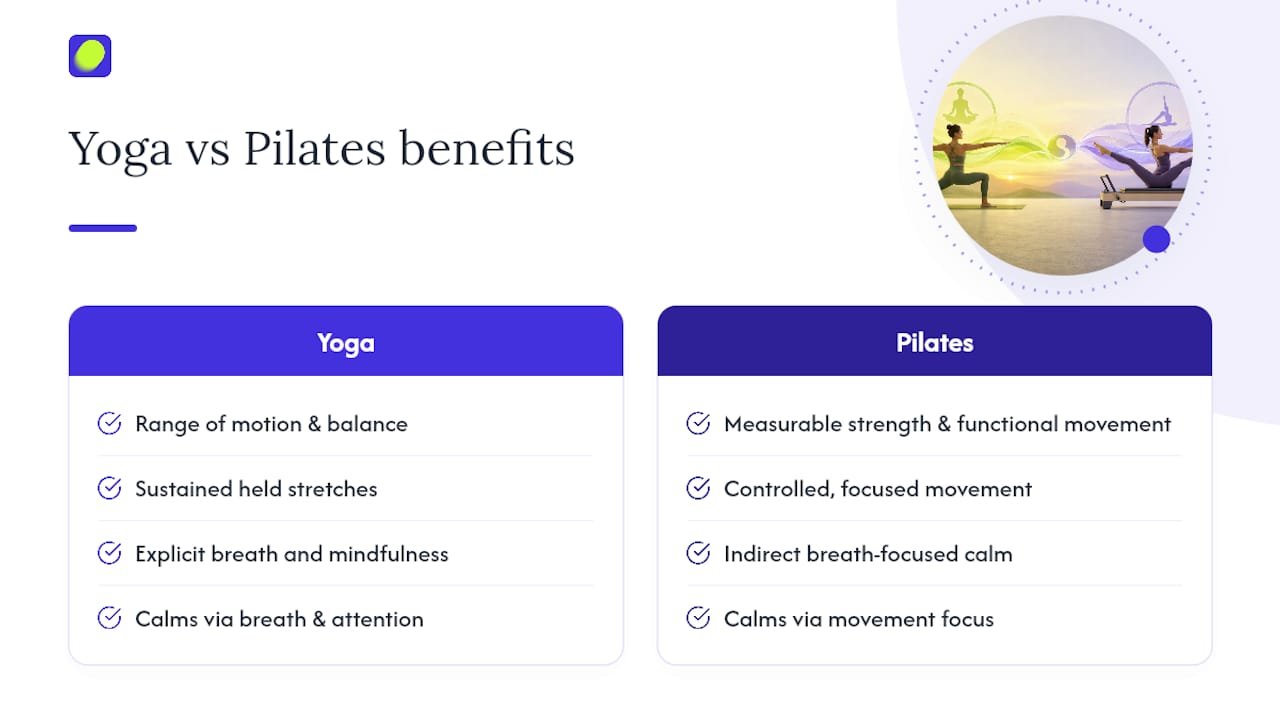
Mentally, the payoff comes largely from the same source in both practices: diaphragmatic breathing and focused attention, which calm your nervous system regardless of which mat you’re on. Yoga usually makes this explicit, structuring breath and mindfulness into the class itself, while Pilates achieves a similar calming effect indirectly through focused, controlled movement. Neither one is the clear winner for mental health. They just get there differently.
A standard Pilates class runs 45 to 60 minutes, opening with a short warmup, moving through a sequence of core-focused exercises, and closing with a brief stretch. Reformer classes often run slightly shorter, around 45 minutes, since the equipment adds intensity faster than mat work alone.
Yoga classes typically run about an hour, but durations vary depending on style and intensity. Structure usually follows a predictable arc: a grounding warmup, a sequence of standing and seated poses, and a final relaxation pose, often Savasana, to close. Both formats are highly adaptable to shorter windows, which is exactly why short, consistent sessions tend to outperform occasional long ones for building a habit.
Testing yoga against Pilates for four weeks only works if you can actually find the sessions and stick with them, which is where most people quietly fall off. Onemor is built for that exact problem: short, coach-led sessions with sets, reps, and rest timers already built in, so you’re not stuck designing your own routine before you’ve even decided which practice you like.
Inside the app, a beginner core workout gives you the Pilates side of the sampler, while a beginner yoga flow covers the mobility and mindfulness side, both led by real trainers instead of a generic script. Streaks and XP keep you honest about showing up three times a week, and joining a tribe adds the kind of light social pressure that turns “I should probably stretch today” into something you actually do. If you’re ready to run your own version of the 4-week plan, start by browsing the tribe page to find a coach-led path that matches your goal, or head to Onemor to explore free workouts and see which style clicks first.