Dynamic stretching goes before your workout, and static stretching goes after it. Dynamic means moving through a stretch. Static means holding one. Once you know which job each one does, your 2-3 sessions a week get smoother, and you stop wondering whether you’re stretching “right.” In Onemor, our coach-led guided sessions are built around that same flow: move first, train, then slow down.
The difference comes down to movement. Cleveland Clinic describes static stretching as holding a pose while you stretch a muscle, like reaching toward your toes for a hamstring stretch. Dynamic stretching actively moves your joints and muscles through motions that match your activity, like leg pendulums or walking lunges, often for around 10-12 repetitions.
Here are a few everyday examples of each, drawn from Cleveland Clinic’s stretching guide:
Hospital for Special Surgery adds a useful way to picture it: static stretches are held still for up to about 45 seconds, while dynamic stretches are controlled movements that prepare your muscles and soft tissues for what’s coming.
So it isn’t really a contest. It’s two tools with two different jobs.
Use dynamic stretching right before you train. The idea is to rehearse what you’re about to do. Sports medicine physician Dr. Roxanne Rex explains in the Cleveland Clinic piece that dynamic stretches practice activity-specific movement patterns, which may help your muscles activate sooner and your coordination improve.
There’s an order that works well:
A good warm-up should leave you feeling ready, not winded. Mayo Clinic notes that mild sweating is fine as your pace builds gradually, but you shouldn’t end up tired.
Keep the movements controlled. The American Orthopaedic Society for Sports Medicine points out that dynamic stretches typically use 5-10 repetitions for up to 60 seconds, and that excessively fast or large-amplitude movements may raise injury risk. Smooth and steady wins.
Want a ready-made sequence? Our 5-10 minute dynamic warm-up is written for busy lifters, and the glute activation warm-up suits runners.
Static stretching shines after your workout, when your muscles are already warm. Mayo Clinic says to stretch after exercise or after 5-10 minutes of light walking, jogging or biking. It also stresses that a cold static stretch isn’t a warm-up. Warm up first, then stretch.
How long should you hold? Experts give a few close ranges:
A simple beginner rule: hold each stretch about 30 seconds, repeat once or twice, and breathe slowly. Stretch to the point of tension, not pain. If it hurts, ease off.
Want to build a full finish to your session? Here’s what we’d do in our post-workout cooldown.
It’s one of the most common questions: why not do static stretching before a workout? According to Cleveland Clinic, longer static holds may reduce maximal strength, power and performance, which is why dynamic stretching is the better addition to a warm-up. Mayo Clinic also reports that stretching right before a sprint may slightly worsen performance, and suggests considering skipping it before intense sprinting or track-and-field events.
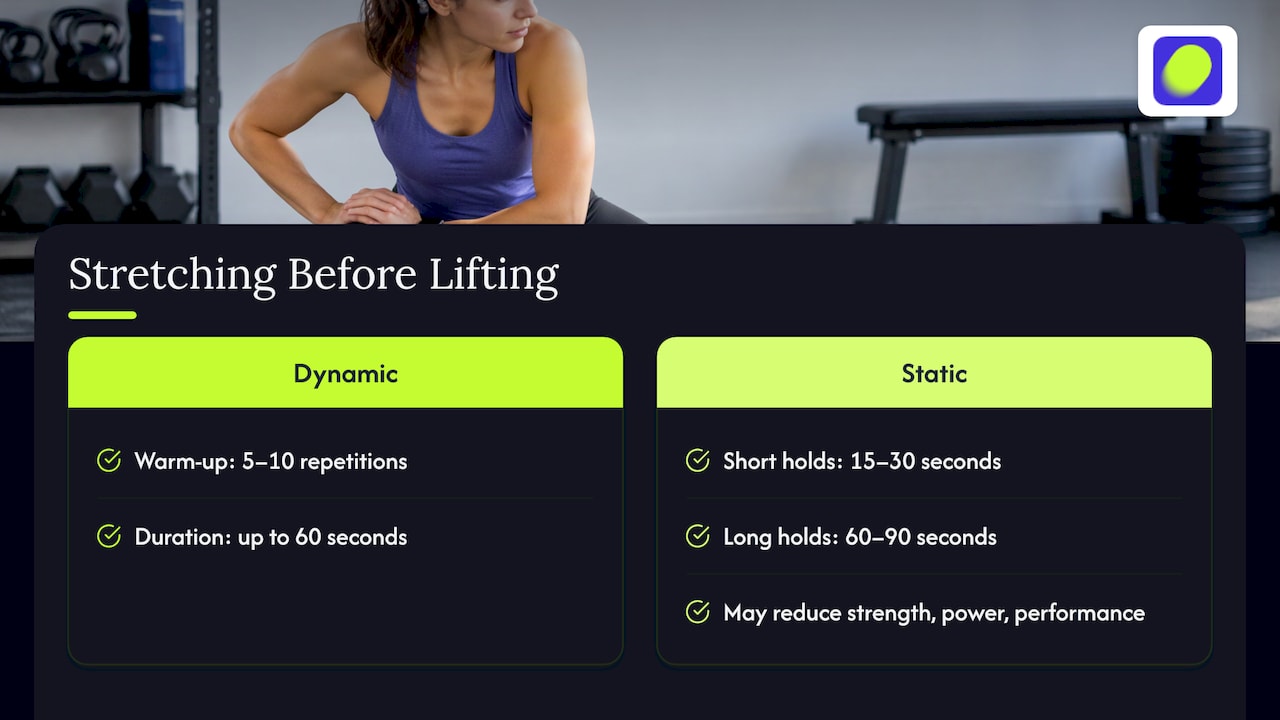
That doesn’t mean static stretching has to be off the table before training. If you include it in a full dynamic warm-up, Cleveland Clinic suggests keeping holds to 15-30 seconds instead of 60-90 seconds. Short and light is the key.
Here’s the quick comparison:
Want lasting flexibility? Be patient. The AOSSM recommends stretching at least every other day for at least six weeks for long-term improvements. That fits nicely with a 2-3 day training week: stretch after each session, plus a short routine on a rest day.
One honest note on soreness: Mayo Clinic says studies haven’t consistently shown that stretching prevents muscle soreness or injury. So think of stretching as a way to feel looser and move better, not a guarantee. For sore days, our guide to DOMS relief covers what helps.
These words get tossed around like they mean the same thing. They don’t, quite.
In plain terms: flexibility is how far you can go, mobility is how well you can use that range. A deep squat needs both. If you want to practice, our 10-minute beginner mobility routine and yoga for mobility flows are easy places to start.
If you’re stretching with extra caution because of bone health, stretching with low bone density needs its own approach, and your doctor is the right person to check with first.
For a normal workout, go in this order:
That’s it. Moving first, holding last.
A routine only helps if you actually do it. That’s where structure matters. Onemor guided sessions walk you through sets, reps and rest timers, with workouts led by expert coaches, and streaks, XP and tribe challenges keep you coming back. You can start on the free plan, and Pro is also available. See the Pro plan details when you want more. Onemor is available on iOS.
Building good habits also means training safely, so take a look at these 7 small gym safety habits too.
Walking lunges, leg pendulums, arm circles and high knees are all common examples. Do them in a controlled way for around 5-10 repetitions each, after a few minutes of easy cardio.
Long holds right before lifting or sprinting may reduce strength, power and performance. If you want a few static stretches in your warm-up, keep them to 15-30 seconds after you’ve warmed up with movement.
About 30 seconds works well for most people, and some guidance goes up to 45 or 60 seconds for tight spots. Stretch to tension, not pain, and repeat two or three times.
After waking up, gentle dynamic movement is a comfortable choice, since you’re moving your joints. If you do hold stretches, warm up with a short walk first, and keep the holds easy.