A beginner mobility routine takes 5 to 10 minutes and covers the ankles, hips, spine, and shoulders in six to eight moves: ankle rocks, hip circles, cat-cow, world’s greatest stretch, thoracic rotations, and shoulder rolls. Do it daily for maintenance, or 2 to 3 times a week for longer, more focused sessions. Either way, you’ll notice looser joints, easier squats, and less stiffness within a couple of weeks.
TL;DR:
You don’t need a gym, a foam roller, or an hour to spare. Just a patch of floor and about 10 minutes. Here’s the order that works, moving from the ground up so your body warms up progressively.
Total time lands around 8 to 10 minutes depending on transitions. If your knees or hips complain about the floor, a mat softens the ground contact, a chair can replace the deep squat hold for balance support, and a light resistance band adds tension to hip switches once the bodyweight version feels too easy. None of that gear is required to start.
Doing a mobility drill badly for two weeks teaches your body the wrong pattern just as effectively as doing it well. Here’s how to get each move right, plus a regression if it’s too much and a progression once it feels too easy.
Ankle rocks
Purpose: restores ankle dorsiflexion for squatting, lunging, and walking downhill without knee strain.
Regression: hold onto a wall or chair for balance while you rock. Progression: elevate the front foot slightly on a book to deepen the range.
90/90 hip switches
Purpose: builds the hip rotation you lose from sitting most of the day.
Common mistake: using momentum to fling the legs over. Slow the tempo and the switch gets harder and more useful. Regression: assisted switches using your hands to guide the top leg. Progression: pause for two seconds in each 90/90 position before switching.
Cat-cow
Purpose: keeps the spine moving segment by segment instead of as one rigid block.
Regression: smaller range, focusing only on the lower back. Progression: add a slow count of four on each direction to increase control under range.
World’s greatest stretch
Purpose: opens the hip flexor and thoracic spine in a pattern close to real movement.
Regression: drop the rotation and hold just the lunge portion. Progression: add a reach toward the ceiling at the top of the rotation to challenge shoulder mobility too.
Thoracic rotations
Purpose: this is often the single biggest upgrade for people who feel “locked up” through the upper back.Common compensation: rotating from the lower back instead of the thoracic spine, which cancels the benefit. Fix it by keeping your hips still and only letting the shoulders and rib cage turn.
Deep squat hold with reach
Purpose: trains the ankle, hip, and shoulder together, which mimics how mobility actually gets used in daily life.Regression: hold a doorframe or sturdy chair for support at the bottom. Progression: remove support and add a slow overhead reach on each arm.
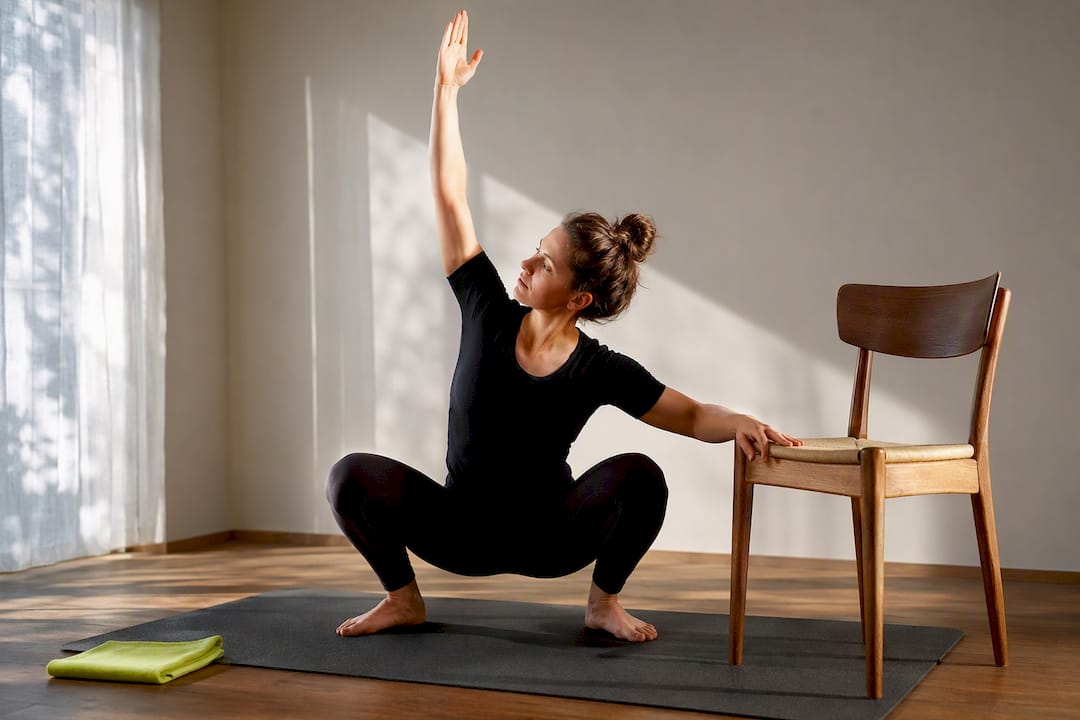
Pro Tip: On the toughest holds, like the deep squat, breathe slowly through your nose and let each exhale sink you slightly deeper. Rushing your breath tightens the exact muscles you’re trying to loosen.
Skipping the warm-up is the fastest way to make mobility work feel worse instead of better. Spend 3 to 5 minutes walking in place, marching with high knees, or pacing around your living room before you start any of the drills above. Raising your body temperature first improves both safety and how far you can comfortably move, a point Harvard Health makes central to how it defines a mobility workout.
Once you’re moving, know the difference between productive discomfort and a warning sign.
Harvard Health is direct about this line: mobility should stay controlled and pain-free, never forced past a sharp signal. If you experience an acute injury, worsening neurological symptoms like spreading numbness, or severe pain that doesn’t ease within a day or two, that’s a job for a licensed clinician, not another round of stretching. A number of adults report mobility-limiting conditions serious enough to affect daily tasks, according to national health surveys, which is exactly why this routine leans on control rather than pushing range at all costs.
Frequency depends on your goal, not on how sore you feel. Houston Methodist recommends short sessions daily, or slightly longer ones 2 to 3 times a week, and both approaches work depending on what you’re chasing.
Track it simply so progress doesn’t stay invisible. Test squat depth (how low you sit before your heels lift), overhead reach (how far your arm travels without your ribs flaring), and single-leg balance time (how long you hold before wobbling). Log a baseline this week, then retest every 2 to 4 weeks. Small, measurable wins are what keep a mobility habit alive past the first month.
A 2024 systematic review found that structured mobility training supports maintained or improved performance with minimal injury risk compared to staying inactive, which is a strong case for beginners who worry that stretching-adjacent work is a waste of gym time. Mobility isn’t the same thing as passive stretching. It’s active control through a range of motion, built from strength, balance, coordination, and joint control working together, not just muscle length.
Physical therapists frame the real goal as functional movement: being able to reach a top shelf, tie your shoes, or catch your balance without compensating, rather than chasing splits or extreme flexibility. PMC reviews on mobility interventions back this up, showing that dynamic, active drills done consistently improve range of motion and, in some cases, performance markers too.
Consistency is the actual variable that matters here, more than any single exercise choice. That’s where a structured app helps:
Reading a routine and actually doing it on a random Tuesday are two different problems, and the second one is the harder one to solve. Onemor is built to close that gap: instead of remembering sets, reps, and rest periods on your own, you open the app and follow a guided beginner mobility flow with a coach talking you through every cue in real time. Streaks and XP turn a 10-minute habit into something you don’t want to break, and tribe-based challenges mean you’re not doing this alone in your living room. Coaches like Coach Kayla and Coach Branden run beginner-friendly sessions that mirror exactly the kind of joint-by-joint routine covered here, just with someone guiding your pace and form. If you want to try it before committing to anything, start with the free workouts on the Onemor app or check the tribe page to find a coach-led beginner flow that fits your schedule.
Start with a 5 to 10 minute full-body sequence covering ankles, hips, spine, and shoulders, done at a slow, controlled pace, and repeat it most days of the week to build the habit before adding complexity.
A short sequence hitting the major joints, ankle rocks, hip switches, cat-cow, a rotational lunge stretch, thoracic rotations, and a deep squat hold, covers the body in under 10 minutes and works well as a daily default.
Ankle rocks, 90/90 hip switches, cat-cow, the world’s greatest stretch, quadruped thoracic rotations, and a deep squat hold with an overhead reach form a well-rounded set that most beginners benefit from immediately.
Do it daily for 5 to 10 minutes if your goal is general maintenance, or 2 to 3 times a week for 15 to 20 minutes if you’re targeting a specific tight area like your hips or ankles.
Mobility training includes active control through a range of motion, not just passive muscle lengthening, so it covers what stretching does while also building strength and balance around the joint.