Yes, as a beginner you can lose fat and build muscle at the same time. This is called body recomposition, and it works best when you lift 2–3 times a week, eat enough protein, keep your calorie deficit small and give your body time to recover. You don’t need a perfect routine. You need a repeatable one.
If you’ve ever stared at the scale wondering why it won’t move, this guide is for you. The scale can stay put while your body changes. Here’s how to set it up.
Body recomposition is about changing the ratio of fat to muscle rather than chasing a lower number on the scale. Healthline describes it as a lifestyle where fitness and nutrition lead to less fat and more muscle.
Why are beginners the lucky ones? Your body responds quickly to a brand-new challenge. An NSCA Strength & Conditioning Journal review notes that the novelty of starting resistance training directly affects how fast muscle is gained, which is why recomposition is most accessible to untrained people. The same review points out that sleep, hormones and metabolism shape the results too.
It’s not magic, though. Cleveland Clinic says there is no quick fix and that results vary with your starting point, genetics, diet, exercise and rest. That’s good news in disguise: most of those levers are yours to pull.
You don’t need six days in the gym. Cleveland Clinic’s guidance is to train major muscle groups two to three times a week with moves like squats, deadlifts, presses and rows, using three sets of eight to 12 reps at a weight that challenges you while keeping good form. Leave about 48 hours between lifting sessions.
Here’s a simple full-body structure you can run at the gym or at home:
Do this on two non-consecutive days, or three if your schedule and recovery allow. Not sure how many sets and reps to pick? Our guide on starting with 8–12 reps breaks it down. No barbell nearby? The dumbbell plan for absolute beginners works at home.
Cardio supports recomposition without replacing lifting. The Physical Activity Guidelines for Americans recommend 150 to 300 minutes of moderate aerobic activity (or 75 to 150 minutes of vigorous activity) per week, plus muscle-strengthening work on at least two days. Brisk walks, cycling or a short HIIT session all count. If you’re currently inactive, the same guidelines suggest starting at lower intensity and building up gradually.

Progress is the engine of recomposition. If your body never gets a new challenge, it has no reason to change.
Want a structured way to do this? Our 6-week progressive overload plan shows exactly when to add weight or reps. Prefer to have someone guide you? Our 3x a week guided strength workouts walk you through every set.
This is where many beginners get stuck. Cutting calories hard feels productive, but it works against you.
Cleveland Clinic advises avoiding too large a deficit: a slight deficit may support fat loss without interfering with muscle building. The National Athletic Trainers’ Association position statement agrees that body-composition changes should be gradual, avoid excessive restriction and combine diet with exercise.
Protein matters most. In a randomized trial of 40 young men eating about 40% below their needs while training, the group on 2.4 g of protein per kg of body weight daily gained lean mass and lost fat, while the 1.2 g/kg group barely gained muscle. That was a very demanding program in young men, so treat it as proof that protein helps, not as a target to copy. Cleveland Clinic gives 110 to 150 grams a day as an example for a 165-pound person.
Practical ways to get there:
Late-night hunger trips up a lot of people. If that’s you, these healthy late-night meal ideas can help you choose something that fits your goals instead of defaulting to whatever is closest.
If your weight barely changes, you may still be winning. Cleveland Clinic points to clothes fitting differently, walking farther and better sleep, mood or energy as signs of progress.
Try this simple tracking routine:
Keep your numbers to yourself if comparing stresses you out. The NATA statement treats body-composition data as confidential medical information, so you decide who sees it.
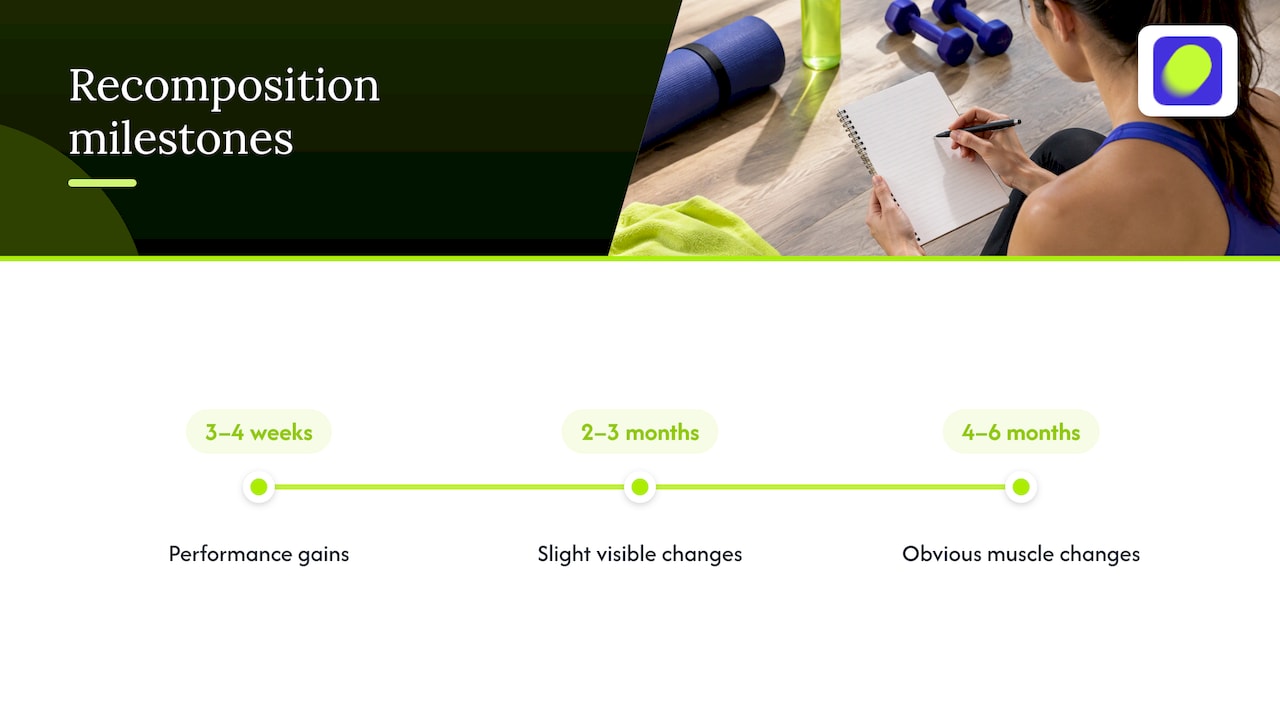
Patience is part of the plan. Cleveland Clinic reports performance improvements in three to four weeks, slight visible changes in two to three months and obvious muscle changes in four to six months. Early strength gains partly come from your nervous system learning the movements, not from big jumps in muscle size.
Genetics, age, sleep and medical history all play a part, so your timeline won’t match anyone else’s. Stay consistent for 12 weeks before you judge the plan.
Are you 16 or 17? Strength training can be a great fit. The NSCA position statement on youth resistance training says properly designed and supervised programs are relatively safe and can improve strength, fitness and psychosocial well-being. It points to qualified supervision, sensible progression, safe equipment and adequate recovery as the safeguards. If you’re under 18, train with a qualified coach or adult and talk with your doctor before changing how you eat.
The hardest part of recomposition is showing up with a plan. With Onemor, you get coach-led workouts, guided sessions with sets, reps and rest timers, plus streaks, XP and tribe challenges with friends to keep you coming back. It’s built for training at the gym or at home, with beginner-friendly programs.
Start with the Onemor Free plan, or see what Pro adds. Prefer a gentle on-ramp first? Read how to start strength training with 2–3 coach-led sessions. For a deeper dive, see our evidence-backed recomposition guide for new lifters.
Yes. Beginners respond quickly to new training, which makes this the easiest time to do it. Keep the calorie deficit small, lift consistently and eat enough protein.
Two to three full-body sessions a week is a solid start. Mayo Clinic recommends working all major muscle groups at least twice a week, with rest between sessions for the same muscles.
Not necessarily. Focus first on protein at each meal, whole foods and a modest deficit. If you do track, use it to stay consistent rather than to cut hard.
Fat loss and muscle gain can offset each other on the scale. Check your waist measurement, photos, strength numbers and energy instead.