Progressive overload means steadily raising the demand you place on your muscles so they keep adapting instead of plateauing. The easiest place to start this week is the 2-for-2 rule: once you can comfortably do two extra reps above your target on two straight sessions, add a small amount of weight. The ACSM overview of reviews backs this approach, and a structured app can track it for you automatically.
TL;DR:
- Increasing load by 2 to 10 percent after maintaining two extra reps for two sessions is supported by research and helps prevent stalls.
- Varying progression methods, such as adding reps, sets, or reducing rest, keeps training challenging without relying solely on weight increases.
- Tracking weekly volume and aiming for 8 to 12 sets per muscle group supports hypertrophy, with deloading every 4 to 6 weeks to manage fatigue.
- Beginners can typically progress every one to two weeks using the 2-for-2 rule, but pushing beyond this often leads to stalled progress or technique issues.
- Automated apps like Onemor implement these principles, removing guesswork and ensuring consistent, safe progression tailored to individual ability.
Your muscles are smart. They adapt to whatever load you consistently ask of them, and then they stop improving unless you ask for a little more. That’s the whole engine behind progressive overload: a slightly bigger demand, applied regularly, keeps your body responding instead of coasting.
We don’t have to take this on faith. A recent ACSM overview of reviews, which synthesized 137 systematic reviews covering over 30,000 participants, found that resistance training reliably improves several things at once, and the gains line up with specific variables you control:
That’s the reassuring part: you don’t need a perfect program. You need a plan that nudges the demand upward, week after week.
Adding weight is the most obvious way to overload a muscle, but it’s far from the only one, and leaning on it exclusively is how a lot of beginners stall out or get discouraged when the plates don’t move. Think of these as a toolkit you can pull from depending on your week, your energy, and what equipment you have in front of you, as explained in detail in Why Use Progressive Drills in Basketball Training – Hoop Mentality.
Pro Tip: Rotate between two or three levers each week so you’re never stuck waiting on one kind of progress.
You don’t need a spreadsheet full of formulas to progress well. You need a couple of simple rules and a way to notice when you’re ready for more.
The 2-for-2 rule is the easiest one to apply: if you hit two reps above your target rep range for two consecutive workouts, it’s time to add load. This keeps you from guessing and protects you from adding weight before your body is ready.
Once you do add weight, progression research supports a 2 to 10 percent load increase. If your gym’s plates jump too far, a double-progression approach works well: build up reps first, then add weight once you’re at the top of your range.
For rep ranges, 8 to 12 reps is a solid baseline for most beginner lifts, striking a balance between manageable loads and enough volume to trigger growth. On weekly volume, the ACSM overview found that an appropriate weekly volume of sets per muscle group supports meaningful hypertrophy, so a reasonable beginner target is building from 8 to 12 sets and working toward that range over several weeks.
Our RPE training guidance walks through this kind of monitoring step by step if you want more structure, and our sets and reps breakdown covers rep-range choices in more depth.
Here’s a compact plan built around compound lifts, something you can start this week and adjust as you go.
If you’re training at home with dumbbells or bands instead of a gym, the same week-by-week logic applies: progress band tension or dumbbell weight using the same 2-for-2 cue. Our beginner dumbbell program lays out a no-gym version with equivalent progression steps.
A stalled lift is frustrating, but it’s rarely a sign you’re built differently from everyone else. It’s almost always one of a handful of fixable things.
If none of this moves the needle after a few weeks, a coach can spot what a mirror or a log can’t.
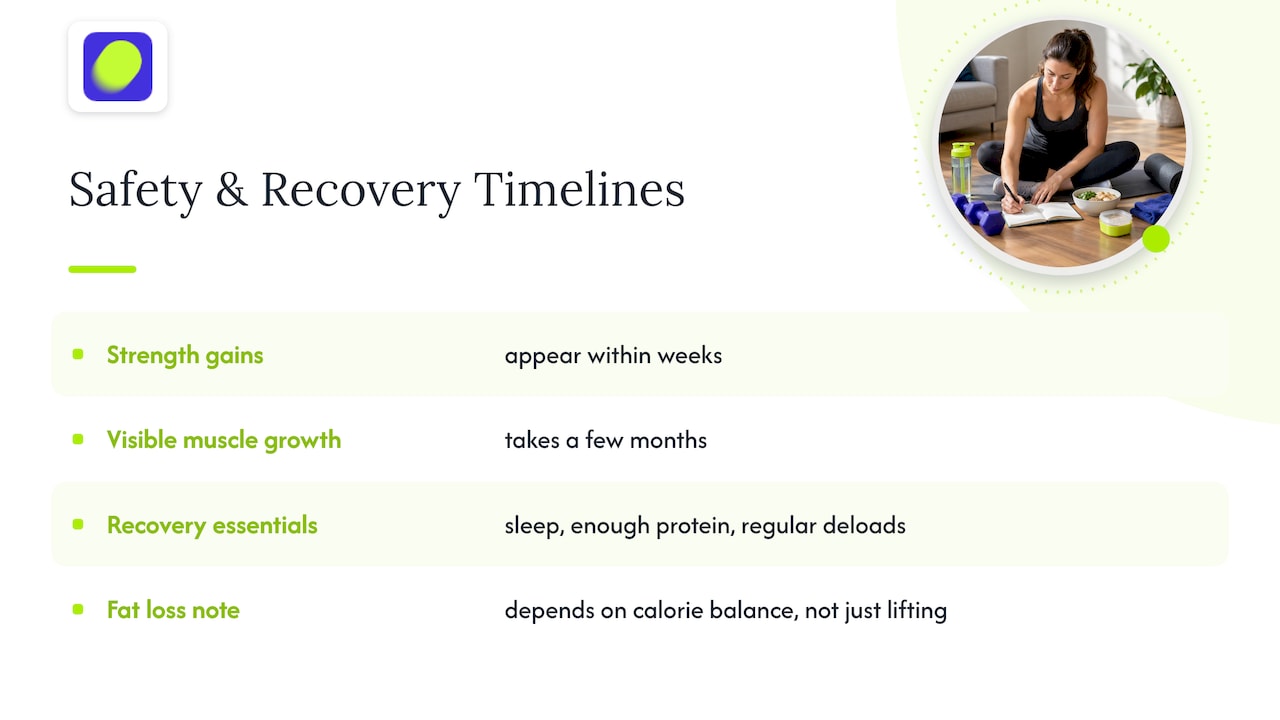
Strength gains usually show up within a few weeks of consistent training, while visible muscle growth tends to take a few months of steady effort and adequate nutrition. Neither happens overnight, and that’s normal.
Recovery is what makes continued progression possible: prioritize sleep, eat enough protein, and build in a deload every several weeks rather than pushing every single session. Gradual load increases, not big jumps, are what keep joints and connective tissue safe over time.
One honest note: progressive resistance training supports a healthier body composition, but fat loss specifically depends on calorie balance, not the lifting program alone.
The app is built around exactly this kind of structured progression: guided sessions with built-in sets, reps, and rest timers that apply these rules automatically so you’re never guessing what comes next. This guidance draws on the ACSM overview of reviews and the classic progression models research, alongside day-to-day coaching experience from trainers involved in the app’s guided programs.
We know tracking every rep, set, and load jump manually gets old fast, which is exactly why we built Onemor to do it for you. Our guided sessions apply the 2-for-2 rule and small load increases automatically, so you always know what to change and when.
Start with our Free plan today, or explore Pro if you want the full coaching experience.
The 6-12-25 rule is a bodybuilding technique involving three back-to-back sets of the same exercise with increasing reps, usually with decreasing weight, to combine strength and metabolic stress in one sequence. It’s an advanced volume technique rather than a beginner starting point.
The 5-3-1 method is a strength program structure where lifters cycle through sets of 5, 3, and 1 rep over a training block, increasing load as rep targets drop. It’s built for intermediate and advanced lifters focused on maximal strength rather than someone just starting resistance training.
Progressive overload builds strength and lean muscle, and resistance training combined with calorie control is effective for reducing fat mass. Lifting alone, without attention to diet, mainly builds muscle rather than driving fat loss on its own.
Most beginners can add small amounts of weight or an extra rep every one to two weeks once they consistently hit the top of their rep range, following the 2-for-2 rule. Trying to progress faster than that often leads to stalled lifts or technique breakdown rather than quicker gains.