RPE is a 1–10 effort rating tied to how many reps you had left in the tank. For most working sets, aim for RPE 7–8, which typically corresponds to having a few reps left in reserve. That single number gives you enough stimulus to grow stronger without wrecking your recovery. The rest of this guide shows you how to map it, program with it, and improve your accuracy over time.
TL;DR:
Rating of Perceived Exertion started as a much older idea. Gunnar Borg built a 6–20 scale decades ago for endurance and clinical exercise testing, and you’ll still see it in cardiac rehab settings today. Strength coaches later adapted it into a simpler 1–10 version tied directly to reps in reserve (RIR), which is the version almost everyone means when they say “RPE” in a gym context now.
Here’s what the key numbers on the 1–10 scale feel like in practice:
There’s also a difference between per-set RPE and session-RPE. Per-set RPE rates a single working set right after you finish it. Session-RPE rates your entire workout on the same 1–10 scale, which coaches use to track overall weekly load and catch burnout before it happens. Cleveland Clinic notes that RPE lets you adjust intensity around daily readiness instead of forcing a fixed number every session.
Most lifters also log half-points, like 8.5, once they get comfortable to provide finer detail. It’s a small habit that makes your training log far more useful six months from now.
RPE and RIR are two labels for the same underlying idea, just read in opposite directions. Here’s the direct conversion:
RIR tends to feel more intuitive when you’re new, because “leave 2 reps in the tank” is a concrete instruction, while “rate this an 8” is abstract until you’ve built experience with it. That’s why RIR often works better for machine work and straightforward hypertrophy sets, where counting reps left is simple. RPE tends to shine in conditioning work or on days when your energy is unpredictable, since it captures how hard something feels, not just a rep count.
A PMC review of RIR-based scales found that experienced lifters rate their reps in reserve far more consistently than beginners do. If you’re new to structured training, that’s worth taking seriously.
Pro Tip: Pick one system, RPE or RIR, and stick with it for 8 to 12 weeks before switching. Bouncing between the two before either becomes second nature just slows down your calibration.
Getting RPE right in the moment is simpler than most people make it. Follow this sequence:
For session-RPE, rate the entire workout right at the end, factoring in every exercise, not just your heaviest lift. Coaches use this weekly to see if your total training stress is climbing faster than your recovery can handle, a pattern that NASM’s guidance on autoregulation flags as an early warning sign for burnout.
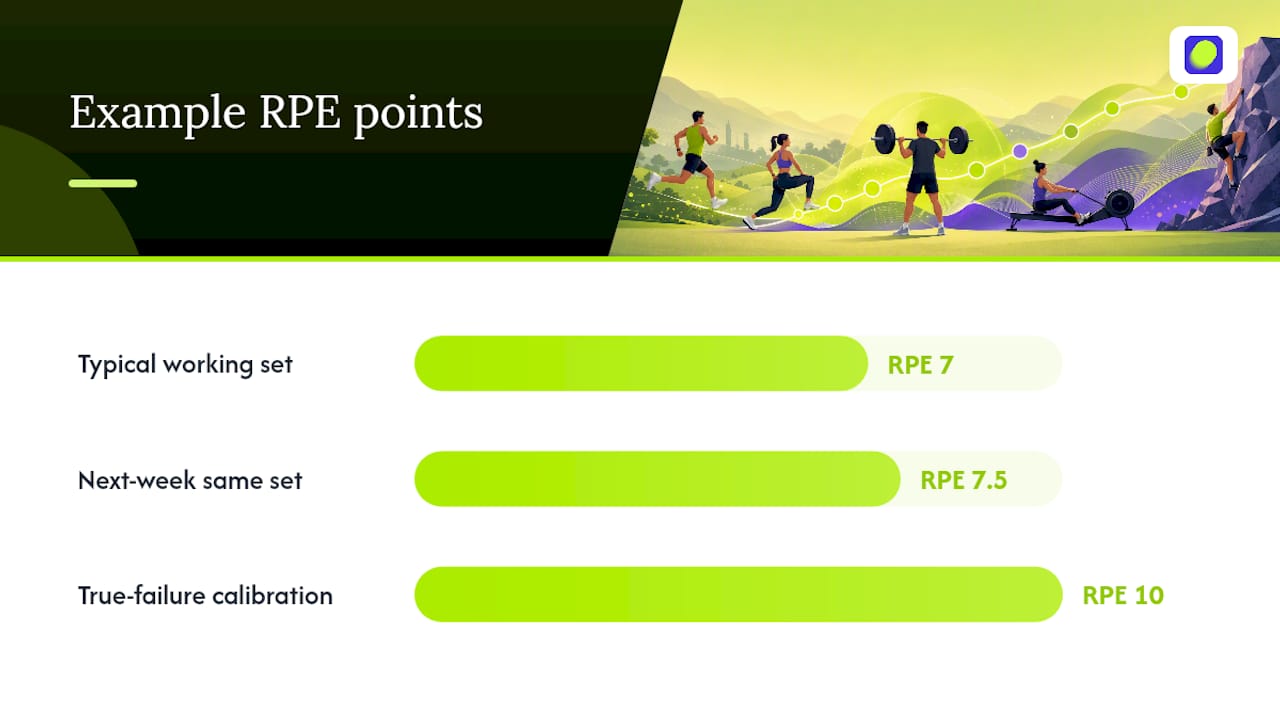
To actually calibrate what RPE 10 feels like, run an occasional set to true failure on something low-risk, like a leg extension or a cable row, rather than a heavy barbell squat. A quick example log might read: “Leg Press, 225 lbs x 10, RPE 7” followed the next week by “Leg Press, 235 lbs x 10, RPE 7.5.” That small shift tells you the weight jump was appropriately dosed.
Pro Tip: Run your calibration sets on isolation exercises after a proper dynamic warm-up, never as your very first set of the day when your joints and nervous system aren’t primed yet.
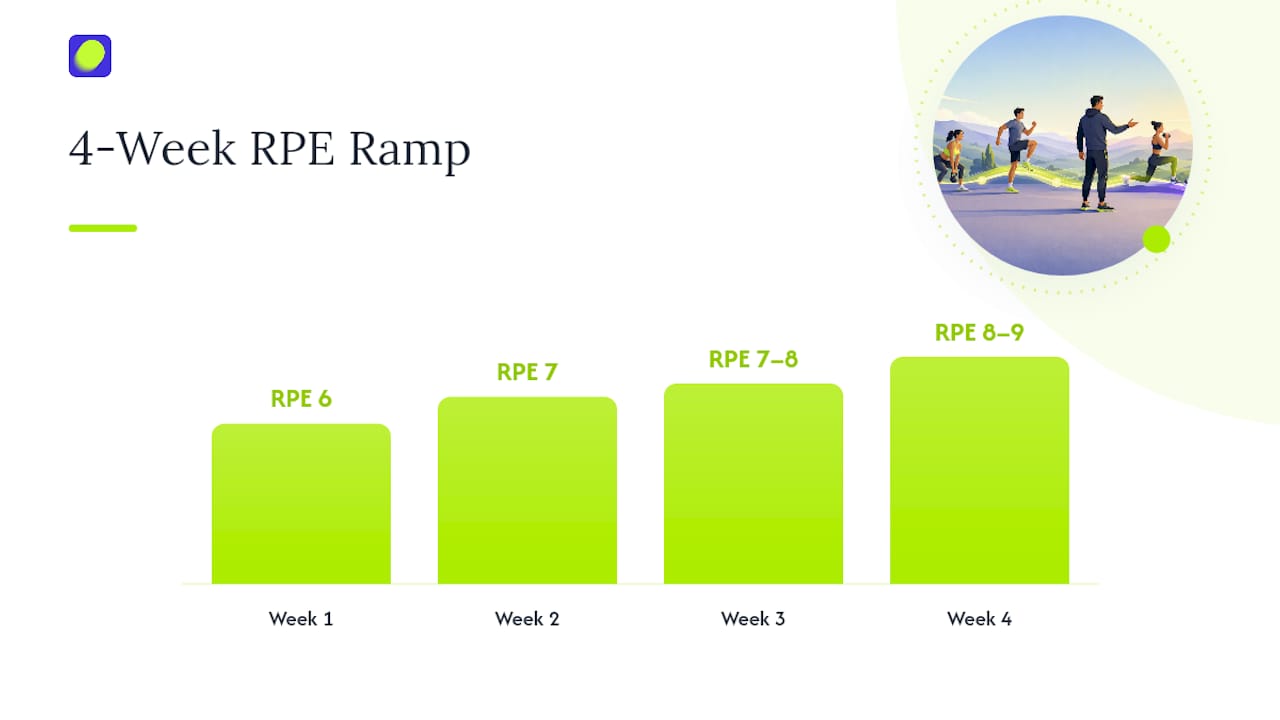
Structured RPE progression is one of the cleanest ways to build a training block without overanalyzing every session. A simple 4-week ramp looks like this:
This kind of ramping structure is common in powerlifting-style programming, where a top set anchors the day’s intensity and back-off sets fill in volume at a slightly lower RPE.
Your rep range matters here too. Strength-focused blocks generally sit in the 3 to 6 rep zone at these RPE targets, while hypertrophy work stretches into 8 to 15 reps at the same effort levels. If you’re chasing muscle growth specifically, pairing RPE targets with sensible weekly set volume matters just as much as the intensity number itself.
During stressful stretches, whether that’s finals week, a demanding travel schedule, or just poor sleep, cap your sessions at RPE 7 rather than chasing your usual 8 or 9. That single adjustment keeps you training consistently instead of skipping sessions altogether. Save true RPE 10 sets for rare testing days. Coaches generally recommend against hitting true failure often, since training to failure too frequently adds recovery cost that outweighs the extra stimulus.
RPE is only useful if your numbers are honest, and most people’s aren’t at first. The two biggest biases run in opposite directions: you’ll underestimate how hard a set was when you’re tired or stressed, and overestimate it when you’re fresh, caffeinated, or just excited about a new program.
Beginners are especially prone to this. One practical breakdown from BarBend points out that novice lifters routinely underpredict how many reps they actually have left by two or more reps, meaning what feels like an RPE 9 might genuinely be a 7.
A few habits fix this faster than time alone:
Barbell Medicine’s writing on autoregulation makes this point well: one off-day rating tells you almost nothing, but a pattern across weeks tells you almost everything.
Pro Tip: Keep a running note of your RPE at the same weight over 4 to 6 weeks. A falling number at a constant load is one of the most reliable signs your training is actually working.
Some coaches build RPE into the workout itself instead of leaving it as an afterthought you’re supposed to remember on your own. Guided sessions prompt you to log a rating right after each working set, while the cue is still fresh, which is exactly the timing accuracy research points toward.
A few common coaching approaches lean on:
Coach-led cueing matters here because apps that support per-set RPE logging tend to speed up how fast lifters learn to rate effort accurately, especially when the logging happens in the moment rather than from memory afterward.
Figuring out RPE on your own from a spreadsheet is doable, but it’s slow, and most people give up on logging it consistently within a few weeks. Some fitness apps solve that friction point directly: every guided workout includes built-in rest timers, set-by-set prompts, and coach cues that ask for your effort rating right when it matters most, not after you’ve already forgotten how the set felt.
That in-session structure is what turns RPE from a nice idea into an actual habit. Instead of trying to remember to check your notes app between sets, the logging happens as part of the workout flow itself, alongside your reps, your rest periods, and your streaks. Real coach-led programs, like the ones led by Coach Kayla and Coach Wilbert, build these calibration habits into your first few weeks so your RPE numbers actually mean something by the time you’re programming your own progressions.
If you’re ready to stop guessing your way through working sets, explore Onemor’s tribe-based programs and start a guided session that tracks your effort automatically from day one.
For readers who want to go deeper than this guide, these sources back the guidance above:
RPE, or rate of perceived exertion, is a 1-to-10 scale that rates how hard a set felt based on how many reps you had left before reaching failure.
RPE 7 means you finished a set with about three reps left in reserve. It’s challenging but controlled, not a grinding, near-failure effort.
Definitions of this rule vary across sources, and it isn’t a standard, universally agreed-upon RPE concept, so it’s best treated as informal gym shorthand rather than an established training principle.
RPE 10 is far harder. RPE 1 barely registers as effort, while RPE 10 means a set taken to complete muscular failure with zero reps left in reserve.
Many coaches suggest several weeks of consistent logging, paired with occasional calibration sets to failure on safe exercises, before ratings become reliably accurate.