Unilateral Training Benefits: Why One Side at a Time Works
Add Onemor as a preferred source on Google
Unilateral training means working one arm or one leg at a time, and its biggest benefits are balanced strength, better balance, extra core work and a smarter way to spot weak sides. You don’t have to give up your squats and presses to get them. You just add a few single-side moves, and we’ll show you exactly how to do that in two or three sessions a week.
Onemor
Build Balanced Strength With Structure
Onemor offers guided strength, HIIT, and bodyweight workouts, with sets, reps, and rest timers to help you train each side deliberately.
Unilateral exercises are single-leg or single-arm movements, like split squats, single-arm rows and step-ups.
They help you use both sides equally, so your dominant side stops doing the lion’s share of the work.
For muscle size, research reviews found no significant difference between unilateral and bilateral training, so you can pick what you enjoy and can load well.
Most beginners do best using both styles: a bilateral lift to start, then one or two unilateral moves.
Two or three sessions a week is plenty to start.
What unilateral training actually is
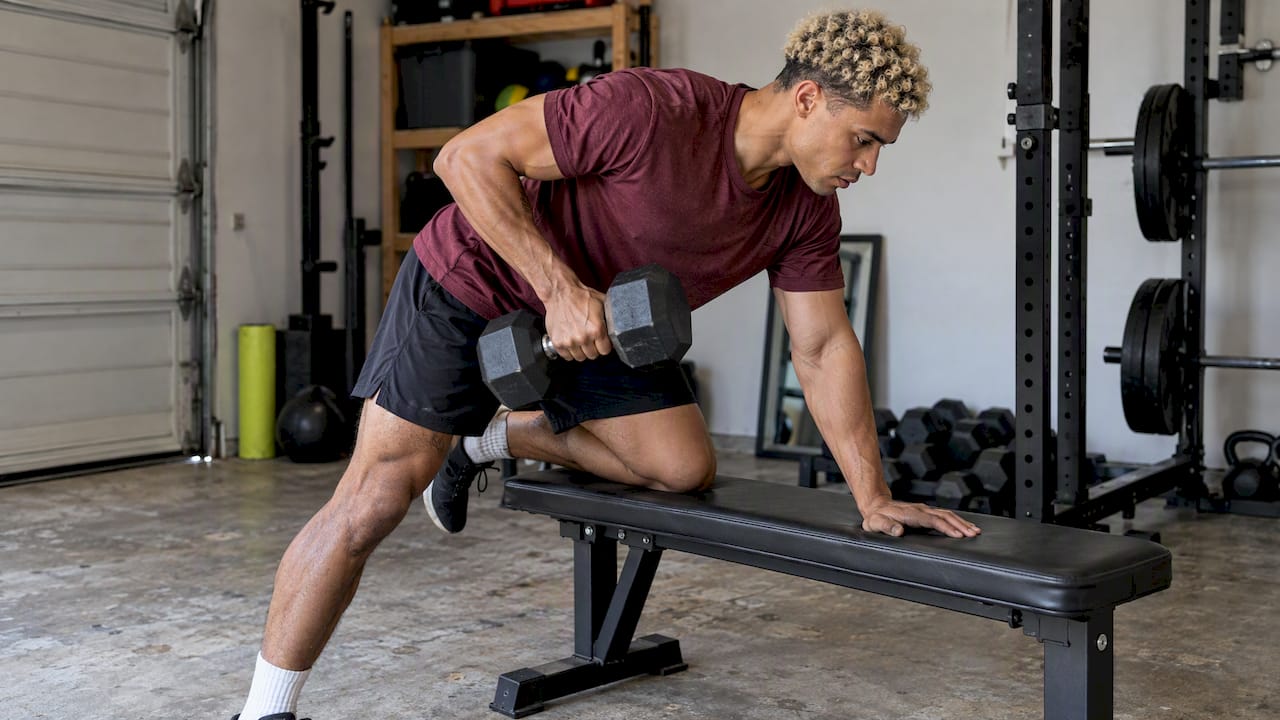
Unilateral exercises are single-leg or single-arm movements. Think of a lunge versus a barbell squat, or a one-arm dumbbell row versus a two-handed barbell row. In the first, each side works on its own. In the second, both sides share the load.
So if you’ve searched for single leg training benefits, you’re asking the same question. Single-leg work is simply the lower-body half of unilateral training, and single-arm work is the upper-body half.
Here’s the good news: you probably already do some of it. Walking up stairs, stepping off a curb and carrying a grocery bag in one hand are all one-sided jobs. Training just makes them deliberate and progressive.
The main benefits of unilateral training
Why bother? Coaches and researchers point to a handful of practical payoffs. According to ACE’s expert article on unilateral training, unilateral exercises help you avoid overusing your dominant side, isolate and correct muscle imbalances, improve balance, use your core muscles, and support injury prevention and rehabilitation.
Here’s what that looks like day to day:
Even use of both sides — A primary benefit is that you use both sides of the body equally, which helps you avoid overusing the dominant one.
Imbalance spotting and fixing — When each limb works alone, the weaker one can’t hide behind the stronger one. You see the gap right away.
Better balance — Standing on one leg or holding a single weight asks your hips, ankles and trunk to keep you steady.
More core engagement — Your midsection works to keep your body from tipping or twisting. If you want to get better at that bracing, our guide to core bracing basics for young adults is a good next step.
More focus — Unilateral moves may require more concentration, which can increase engagement during a workout. Anyone who has ever zoned out between sets knows why that helps.
Notice what’s missing: magic. These are useful, realistic benefits, not a promise that one exercise will transform your body.
Do your first set on the weaker side, then match the reps on the stronger side.
Choose a weight you can control on both sides.
Keep reps the same on both sides, even if the stronger side could do more.
A small difference between sides is normal. Almost everyone has a dominant hand and leg. If you notice a big gap, or you feel pain on one side, a doctor or physical therapist is the right person to see rather than an app or an article.
Unilateral vs bilateral training: which is better?
Neither wins outright, and that’s freeing. Here’s what the research says:
Strength — A review of muscle growth and strength adaptations found bilateral training produced greater bilateral strength gains, while unilateral training produced greater unilateral strength gains.
Muscle size — The same review found no significant difference in muscle hypertrophy. If you’re curious about how size and strength differ, this explainer on muscle mass versus strength is a good read.
Jumping and power — A meta-analysis found unilateral training more effective for jumping in unilateral power patterns, while bilateral training had a greater effect in bilateral ones.
Sports that run on one leg — The same paper notes unilateral training may be more specific to actions like sprinting and changing direction.
There’s also something called the bilateral force deficit: the sum of force from two single-limb contractions can be greater than the force from one two-limb contraction. An NSCA article says this should influence exercise selection only to a limited extent. What matters more is the effect on actual physical performance.
Why do unilateral exercises if you already squat and press?
Fair question. Here are the situations where we’d say it’s worth it:
You feel one side working harder — One knee caves, one shoulder drops or one hand feels stronger. Single-side work gives you a chance to even things out.
You train at home with limited gear — One dumbbell is enough for a split squat or a one-arm row. Our beginner dumbbell program shows how far a pair of dumbbells can take you.
You play a sport — Running, cutting and kicking all happen one leg at a time.
You’re returning after a break — Lighter single-side moves can be an easier on-ramp. If you’ve been through an injury, check with your clinician first.
And if your goal is simply to show up and get stronger, that’s a great reason too. Consistency beats a perfect plan every time.
How to add unilateral moves to a 2-3 day routine
You don’t need a new program. Take what you already do and swap or add one or two moves per session. Our own start strength training guide covers the basic structure of 2-3 sessions a week.
Here’s a simple template:
Start with one main bilateral lift — A goblet squat, deadlift variation or push-up. This is your heavy, big-effort move.
Add one single-leg move — Try split squats, reverse lunges, step-ups or single-leg Romanian deadlifts.
Add one single-arm move — A one-arm dumbbell row or single-arm overhead press works well.
Finish with a core move — A suitcase carry or side plank trains your trunk to resist tipping.
For each unilateral move, try 2 to 3 sets of 8 to 12 reps per side, with about a minute or so of rest. Start light. Your balance will probably feel wobbly in week one, and that’s normal.
A sample 3-day week
Day 1 — Goblet squat, one-arm dumbbell row, reverse lunge, side plank.
Day 2 — Push-up, single-leg Romanian deadlift, step-up, farmer carry.
Day 3 — Split squat, single-arm overhead press, glute bridge, dead bug.
On a two-day week, combine Days 1 and 2 into two full-body sessions. If you’re deciding how to split your week, our guides to push pull legs for beginners and the hip hinge versus squat can help you place these moves.
Common mistakes to avoid
Going too heavy too soon — Your balance is the limiting factor at first. Drop the weight until the movement feels steady.
Skipping the weaker side’s first set — Lead with it so the stronger side doesn’t set the bar.
Dropping bilateral lifts entirely — Unilateral training is usually used in addition to bilateral training, since using only one type may mean losing potentially advantageous outcomes.
Rushing the reps — Slow, controlled reps make single-side work count.
Make it stick with Onemor
Knowing what to do is one thing. Showing up is another. In Onemor, you get coach-led workouts with guided sets, reps and rest timers, so you don’t have to plan single-leg and single-arm work yourself. Streaks, XP and tribe challenges with friends help keep you coming back, and sessions are built to be efficient. You can start on the free plan and see if it fits, or look at what Pro adds.
FAQ
Do unilateral exercises fix muscle imbalance?
They can help. Working each side on its own lets you isolate and correct imbalances and keeps your dominant side from taking over. Treat them as one tool alongside good technique. If you have pain or a large difference between sides, see a physical therapist or doctor.
Is unilateral training better than bilateral training?
Not across the board. Research found bilateral training gives bigger gains in bilateral strength, unilateral gives bigger gains in unilateral strength, and muscle growth didn’t differ significantly. Most people do best combining both.
Can beginners do unilateral exercises?
Yes. Start with bodyweight split squats, step-ups or a light one-arm row, and add weight slowly. Expect some wobble early on. It usually settles as you practice.
How often should I train unilateral moves?
You can include one or two in every session. For a 2-3 day routine, that’s plenty. Pair them with a main bilateral lift each day.