The hip hinge biases your hip extensors (glutes and hamstrings), while the squat shifts more load to your knee extensors (quads). Favor hinges when you want posterior-chain strength and power for sprinting or jumping, and favor squats when quad-dominant strength and overall leg size are your priority. Most of us get the best results training both every week.
TL;DR:
- A study found hip extensor moments of 3.59 Nm per kilogram for deadlifts and 2.98 for squats; knee moments favored squats, 2.14 to 1.18.
- Stop a hinge descent when your lower back begins to round; extra depth shifts work from the glutes and hamstrings onto passive spinal tissue.
- For lower back sensitivity or injury return, try goblet squats and trap bar deadlifts, which tend to feel more forgiving on the spine.
- Schedule two weekly strength sessions around separate hinge and squat days, then add small loads every one to two weeks only when repetitions stay clean.
- Hip thrusts can build glutes, but evidence that they improve sprint times remains mixed, so do not rely on them alone for sprint gains.
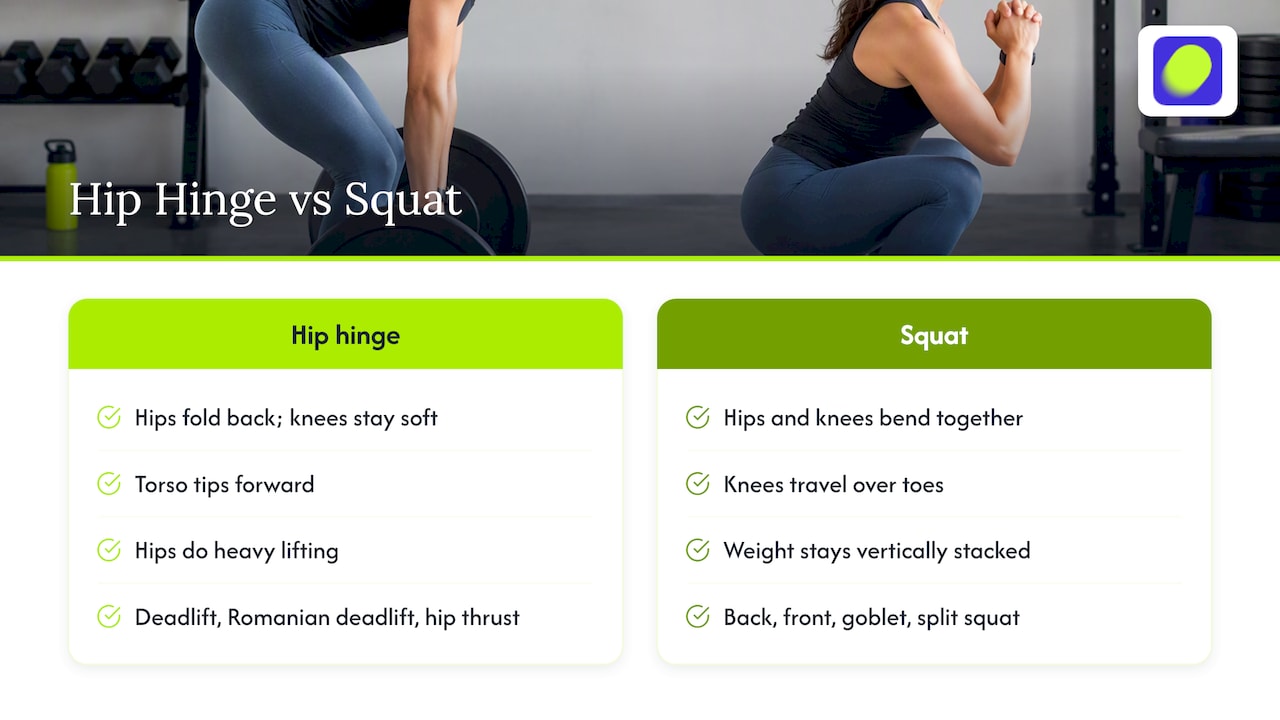
A hip hinge is any movement where your hips fold backward while your knees stay relatively soft, so your torso tips forward and your hips do the heavy lifting. The deadlift, the Romanian deadlift, and the hip thrust all live in this family, even though they look different from each other.
A squat, on the other hand, sends your knees traveling forward over your toes while your hips and knees bend together, so your weight stays stacked more vertically. Back squats, front squats, goblet squats, and split squats are all variations on this same theme, just with different load placement or stance.
The real difference comes down to your trunk-to-tibia angle. The more your torso leans forward relative to your shin, the more your hips take over, and the more upright your torso stays, the more your knees get involved. A good coach can nudge a squat toward being more hip-dominant or more knee-dominant just by adjusting stance width or how far forward the bar sits, as research on squat mechanics shows. That is why “hip-dominant” and “knee-dominant” are useful labels, but never rigid categories.
We do not have to guess which pattern works which muscles harder. Researchers have measured it directly, and the numbers are consistent enough to shape how we train.
The deadlift puts dramatically more demand on your hips than the back squat does. A joint-kinetics study comparing the two found the deadlift produces a hip extensor net joint moment of 3.59 Nm per kilogram of body weight, compared with 2.98 Nm per kilogram for the back squat. Flip that around at the knee, and the back squat generates a knee extensor moment of 2.14 Nm per kilogram versus just 1.18 for the deadlift, confirming the squat’s quad bias.

Muscle activation data tells a similar story at the hip. The hip thrust elicits greater glute max activation than the rear-foot-elevated split squat, especially near the top of the movement where your hips are fully extended, which is exactly the range where glutes do their most specialized work.
Zooming out, the picture holds across multiple studies:
The practical takeaway is about force direction. A hinge produces more horizontal force through your hips, which lines up closely with how your body generates force during sprinting and jumping. A squat produces more vertical force through your knees, which builds the raw quad strength that supports everything from stair climbing to standing up from a deep squat position. Neither one replaces the other, because they are solving different mechanical problems.
Good technique is what turns these biomechanical differences into real results instead of real injuries, as explained in Maximizing Results: How Muscle Activation Technique Can Take Your Workouts to the Next Level. Here is how to execute each pattern cleanly.
Hip hinge checklist:
Squat checklist:
The most common hinge mistake is rounding the lower back to chase more range of motion. Forcing extra depth this way shifts load onto passive spinal tissue instead of your glutes and hamstrings, which defeats the purpose of the exercise entirely. The fix is simple: stop the descent the moment your lower back wants to round, even if that means stopping well short of the floor.
The most common squat mistake is letting the knees collapse inward under load, which strains the knee joint instead of your muscles. Practicing goblet squats with a lighter load while consciously pushing the knees outward helps rebuild that pattern before adding heavier weight.
Pro Tip: Film your hinge and squat from the side once a week. A flat back during the hinge and a stacked torso-over-midfoot position in the squat are the two visual checkpoints that matter most.
For runners and anyone prioritizing hip drive, a short glute activation warm-up before hinge work helps wake up the right muscles before you load the pattern.
Choosing between a hinge and a squat gets a lot easier once you know what you are actually training for.
A simple way to structure a week is to treat hinge and squat work as separate training days rather than cramming both into one session at low intensity. Two strength sessions per week, each anchored by one pattern, lines up with general resistance training guidance on frequency and gives each movement enough dedicated effort to progress.
Checking whether your split is actually working does not require fancy testing. If your squat numbers are climbing but your hamstrings feel chronically undertrained, or vice versa, that imbalance usually shows up within four to six weeks as a sticking point or nagging soreness. Adjusting set volume on the underperforming pattern, rather than abandoning it, is usually the better fix than cutting it altogether.
Once you know your goal, picking the right variation is straightforward.
Hinge variations:
Squat variations:
Strength day (gym): Back squat 4 sets of 5, Romanian deadlift 3 sets of 8, split squat 3 sets of 10 per leg.
Posterior-focus day (home or gym): Hip thrust 4 sets of 10, single-leg Romanian deadlift 3 sets of 8 per leg, goblet squat 3 sets of 12. Bodyweight versions of these work well for a home glute workout when equipment is limited.
Progress either session over four to eight weeks by adding small load increases every one to two weeks once every rep looks clean, rather than jumping weight before your form is ready.
Our coach-led plans sequence hip hinge and squat training the same way a good coach would in person: movement quality first, then load. Each guided session comes with sets, reps, and rest timers built in to guide your workout.
Yes, the hip thrust is a hinge-pattern exercise because it isolates hip extension with minimal knee joint movement. It consistently shows strong glute activation at the top of the range, which is why it is often paired with deadlifts and Romanian deadlifts in posterior-chain programming.
There is no single best exercise, since the hip hinge and squat each train different muscles and movement patterns. A balanced program uses both rather than crowning one as universally superior.
Consistent squatting can improve movement quality and build some strength, especially for beginners, but meaningful strength gains depend more on progressively increasing difficulty than on a fixed daily rep count. Pairing squats with adequate recovery and occasional load or variation changes matters more than any specific rep count.
Squats do involve the hips, but joint kinetics research shows they place a smaller hip extensor demand than hinge movements like the deadlift. Squats remain primarily knee-dominant, while still contributing some hip extensor work, particularly at the bottom of the range.
Prioritize hip hinge work when your goal is sprint speed, jumping power, or hamstring and glute development, since these movements produce larger hip extension forces. Squats remain the better choice when your focus is quad strength or overall lower-body size.
Figuring out the right balance of hinges and squats on your own takes trial and error, and most of us would rather spend that time actually training. Our coach-led plans build both patterns into your week automatically, with guided sets, reps, and rest timers so you always know what to do next, and streaks and tribe challenges encourage consistency. Our free plan gets you started with structured sessions right away, and our Pro tier adds deeper coaching features for anyone ready to push further. Open the app and find your next session today.