The best teen workout plan is simple: two or three short strength sessions a week on non-consecutive days, built on bodyweight moves first, plus active time on the other days. Pediatric sports medicine groups back this setup, and you can start it at home with no equipment. Below you’ll get the weekly layout, the exact sets and reps, a no-gym version and the safety rules that keep you progressing. If you’re 16 or older and want coach-led sessions with timers that guide you through each set, Onemor’s free plan is a good place to begin.
Teens need about an hour of movement every day, but that does not mean an hour of lifting. The CDC says ages 6 to 17 need at least 60 minutes of physical activity daily, with muscle-strengthening and bone-strengthening activity on at least 3 days each week. Most of that hour can be sports, walking to school, biking or playing with friends.
The structured part is smaller. Nemours KidsHealth suggests 20 to 30 minutes of strength work, 2 or 3 days a week, with at least a day off between sessions. Nationwide Children’s Hospital adds that training children more than 4 times a week brings no extra benefit.
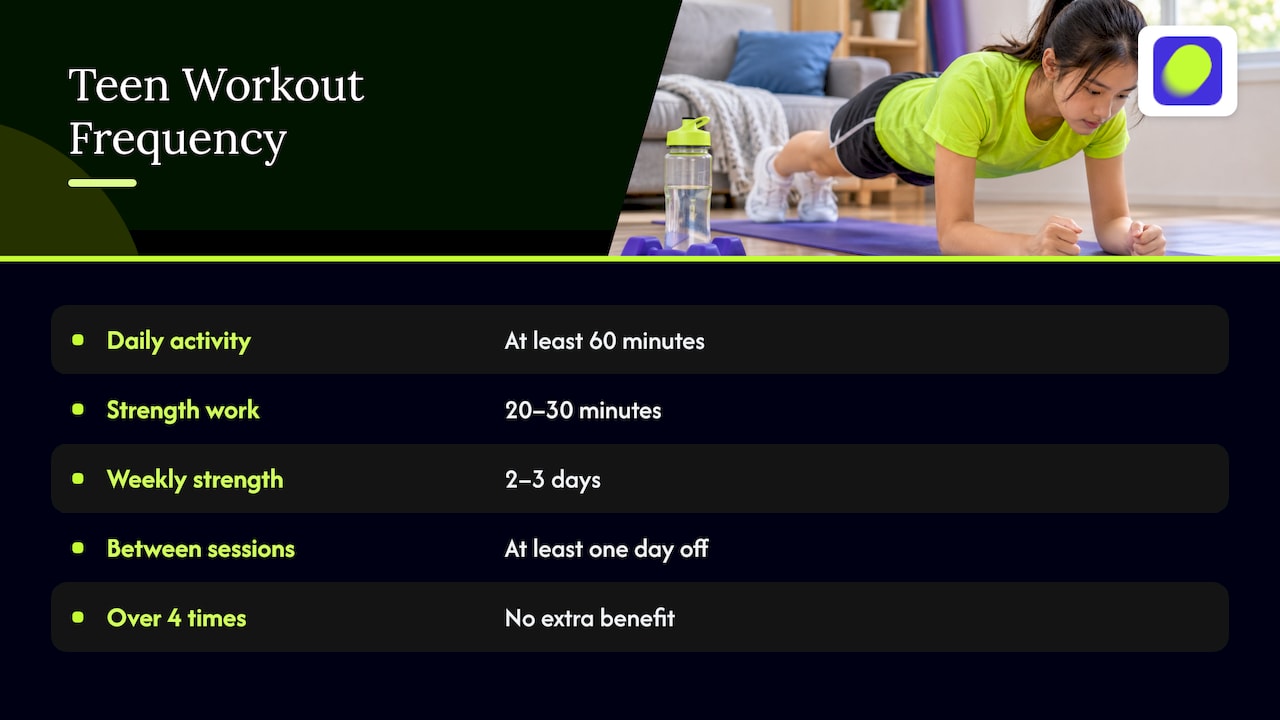
More is not better. Healthline notes that overtraining can cause injury, lower immunity, poor sleep and disordered eating, and that only about a quarter of American teens hit the daily guideline. So consistency beats intensity every time.
Here is a simple week that fits school, practice and a social life:
Two strength days is enough to see progress. Add the third only when the first two feel easy and you’re sleeping well. The gap between sessions is when your body actually adapts.
Warm up first. HSS recommends 5 to 10 minutes of dynamic stretching before lifting: leg swings, arm circles, bodyweight squats, easy jumping jacks.
Then pick one move for each area, and rotate between A and B days:
The American Orthopaedic Society for Sports Medicine recommends 8 to 12 exercises across the upper body, lower body and midsection, starting with one light set of 10 to 15 reps and progressing to 2 or 3 sets of 6 to 15 reps. A shorter 20-minute session with 5 or 6 moves is a great starting point.
Nemours KidsHealth suggests beginning with 1 to 2 sets of 8 to 12 reps. Rest long enough to breathe normally and keep your form crisp. Our guide to rest between sets explains how timing changes with your goal.
The rule is easy: HSS says you should be able to finish three sets of 10 to 15 reps at each weight. If you can only manage three to five, it’s too heavy and raises your injury risk.
Progress in this order:
A tracker that handles this progression is useful. If your gym has a chest press machine, here’s how the chest press machine works and which muscles it trains, once a coach or gym staff member has confirmed the setup fits your body.
One firm rule: never max out. CHOC warns that teens shouldn’t attempt a max lift, and that muscle strains are the most common injury, usually when someone is unsupervised or goofing around. Nationwide Children’s also says teens should skip competitive powerlifting, bodybuilding and maximal lifts until skeletal maturity.
You don’t need a weight room. Nationwide Children’s says strength work can use body weight, rubber tubing, medicine balls or free weights in a safe, hazard-free space. Nemours KidsHealth lists easy no-equipment moves such as chair squats, starting at 10 reps, adding sets of 10 as comfortable and resting 30 seconds between sets.
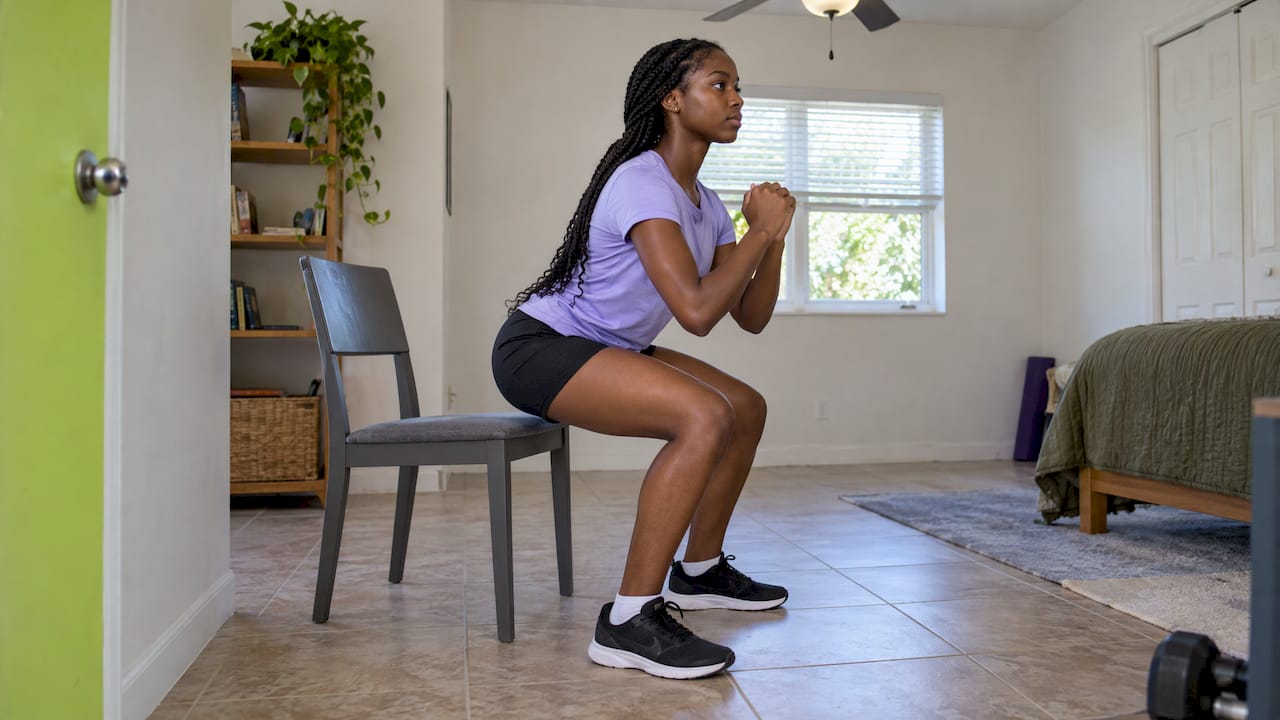
A home session might be: 10 chair squats, 8 incline push-ups, 10 glute bridges, a 20-second plank, repeated for 2 rounds. Want more ideas? Our bodyweight strength program shows how to build muscle without equipment, and our beginner dumbbell plan is a natural next step when you pick up a pair of weights.
Heading into a gym? Use equipment sized for you. CHOC notes that teens shouldn’t use machines designed for adults, and that a teen program is not just a scaled-down adult plan. Our beginner gym workout is a good picture of what a first month can look like.
Yes, when it’s done with good technique. The American Academy of Pediatrics reports that injury rates in supervised, properly designed youth resistance training are lower than in other sports or school recess play, with no apparent negative effect on growth or the cardiovascular system. HSS’s Joseph Molony calls the belief that teens shouldn’t strength train a myth when it’s done safely with proper technique.
Check in with a doctor first if any of these apply:
Stop and tell a parent or coach if you feel sharp pain, dizziness or chest pain.
Progress happens on rest days. Keep at least a day between strength sessions, eat regular meals and protect your sleep. Mind-body work like yoga may also help reduce anxiety and support mental health.
Skip the supplement aisle. Nemours KidsHealth notes that creatine hasn’t been tested in people under 18, so the risks are unknown, and some supplements contain hormone-related ingredients such as DHEA. Real food and good sleep do the heavy lifting.
The hardest part of any plan is showing up the third week. Onemor is a fitness app built for Gen Z, with workouts led by expert coaches, guided sessions that walk you through sets, reps and rest timers, and streaks, XP and tribe challenges with friends. It covers strength, HIIT, bodyweight and beginner-friendly programs for home or the gym, and it’s available on iOS with free and premium options.
If you’re 16 or older, start with the free plan, meet the coaches, or see what Pro adds. Our start strength training guide walks through 2 to 3 coach-led sessions a week. And if you’re younger, share this plan with a parent and loop in your doctor first.
Strength sessions should run about 20 to 30 minutes, according to Nemours KidsHealth and Nationwide Children’s. Your total daily activity should still add up to about 60 minutes, counting sports and play.
Yes, with the right setup. Use equipment sized for your body, keep weights light enough for 10 to 15 clean reps and train with supervision when possible. Avoid adult machines that don’t fit you.
No. The AAP found that appropriately designed resistance training has no apparent negative effect on linear growth or growth plate health. Good technique and sensible loads are what matter.
Two days is enough. Choose a full-body session on non-consecutive days and stay active on the other days. It matches what AOSSM and HSS recommend.