Yes, teens can lift weights safely. The big medical groups agree on how: qualified coaching, light loads, good form, steady progress and rest days. Lifting itself isn’t the risk. Lifting without guidance, ego or a plan is. If you’re 16 or older and want to train two or three times a week, this guide gives you the rules to follow and a simple way to start. Onemor’s guided strength sessions, led by real coaches, give you sets, reps and rest timers so you never have to guess.
There isn’t a magic birthday. The American Orthopaedic Society for Sports Medicine says there is no minimum age. A young person may be ready if they’re ready for organized sport (around age 7 or 8), mature enough to accept and follow directions, and physically fit without a condition that would raise injury risk.
For teens, that bar is easy to clear. Children’s Health says the focus can shift toward actual weightlifting around age 14, under professionals with credentials such as NSCA-CSCS or NASM-PES. Before that, the work is bodyweight moves like squats, lunges, push-ups, planks and resistance bands.
So if you’re asking whether 14, 16 or 18 is old enough, the honest answer is yes, as long as you learn properly and have someone qualified guiding you.

This is the most common worry, and the guidance is reassuring. Nemours KidsHealth says strength training done properly is generally safe and won’t hurt growing bones. A pediatrician answering on the American Academy of Pediatrics’ parent site says light, supervised repetitions are great for teens, helping build bone density and balance.
The real concern is how you lift. The AAP lists the risks of unsupervised training as injury to spinal discs and growth plates, plus serious accidents from weights landing on the chest. In other words, the risk comes from poor setup and no spotter, not from lifting.
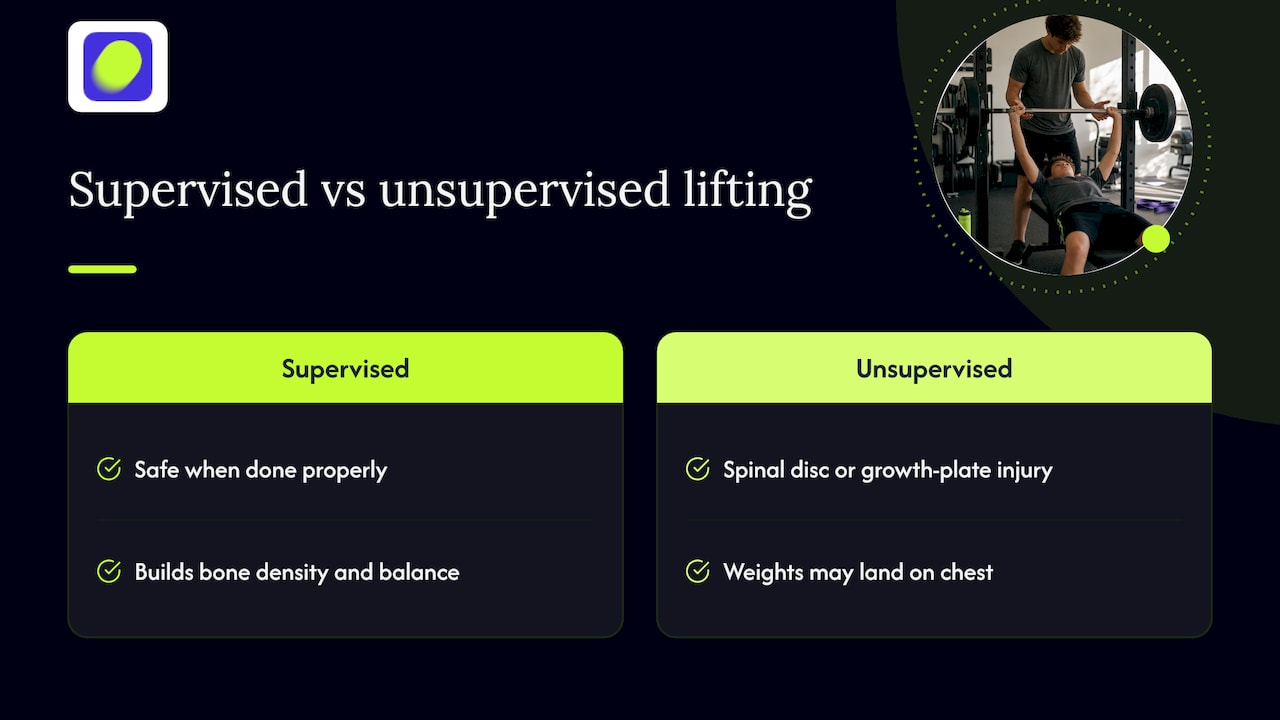
Three things show up again and again.
Notice what’s missing: no one blames lifting itself. AOSSM stresses that it is the structure of the program, your effort and qualified instruction, not the act of lifting, that shapes the outcome.
Here’s a short checklist built from the major guidance. Save it, screenshot it, send it to your lifting buddy.
Good news for busy schedules: you don’t need more. Nationwide Children’s Hospital says 20 to 30 minute workouts two or three times a week work, and there’s no added benefit to training more than four times a week.
AOSSM’s beginner guidelines give a clear template:
The AAP’s Ohio chapter suggests adding 5 to 10 percent more resistance as you get stronger. That’s small on purpose. A “marathon, not a sprint” is how a Children’s Health sports physician describes development, and multiple quality reps beat maximal loads done with sloppy form.
New to the rep language? Our guide to sets and reps for new lifters breaks it down. When you’re ready to build week by week, the progressive overload plan for beginners shows how to add load without rushing.
The hardest part of safe lifting is rarely motivation. It’s knowing what to do next without someone looking over your shoulder. Onemor gives you guided sessions with sets, reps and rest timers, led by real trainers, so each workout has a clear structure. Streaks, XP and tribe challenges with friends help you keep showing up two or three times a week.
The app covers strength training, HIIT, bodyweight and beginner-friendly programs for the gym or home, and you can start on the free plan on iOS. If you want a ready-made weekly layout, check the safe 3-day teen workout plan or the 4-week beginner gym starter plan. Whatever you pick, lift with a qualified adult or coach nearby when you’re working with a barbell, and talk to your doctor if you have a health condition.
Keep it simple and a little boring on purpose. That’s how strong lifters are built.
If you want to compare lifting styles before deciding, our breakdown of HIIT versus strength for beginners helps you choose what you’ll actually stick with.
Yes, with the right setup. Children’s Health says the focus can shift toward weightlifting around age 14 under credentialed professionals, starting with form and light loads. Get a doctor’s okay first, learn each exercise without weight, and always train with qualified supervision.
There’s no strict minimum. AOSSM says a young person may be ready once they’re mature enough to follow directions and have no condition that raises injury risk. Starting with bodyweight moves and bands comes before heavier lifting.
Two to three non-consecutive days is the standard guidance from AOSSM, Nemours and the AAP’s Ohio chapter. Sessions of 20 to 30 minutes are enough for beginners, with at least one rest day between workouts.
Not at first. Guidance recommends lighter weights with higher reps, and no one-rep maxes or max-weight attempts before skeletal maturity. Build heavier loads gradually, adding about 5 to 10 percent as your form and strength improve.