Newbie gains are the fast early progress you see when you start lifting. Most of it shows up as strength first, and visible muscle follows. The fastest phase usually runs through your first several months, then progress slows but doesn’t stop. Here’s what that looks like, and how to make the most of it on 2-3 sessions a week.
“Newbie gains” is a casual term, not a clinical one. It describes the unusually quick improvements people get after starting resistance training. If you’ve ever added weight to the bar two weeks in and wondered what’s going on, that’s it.
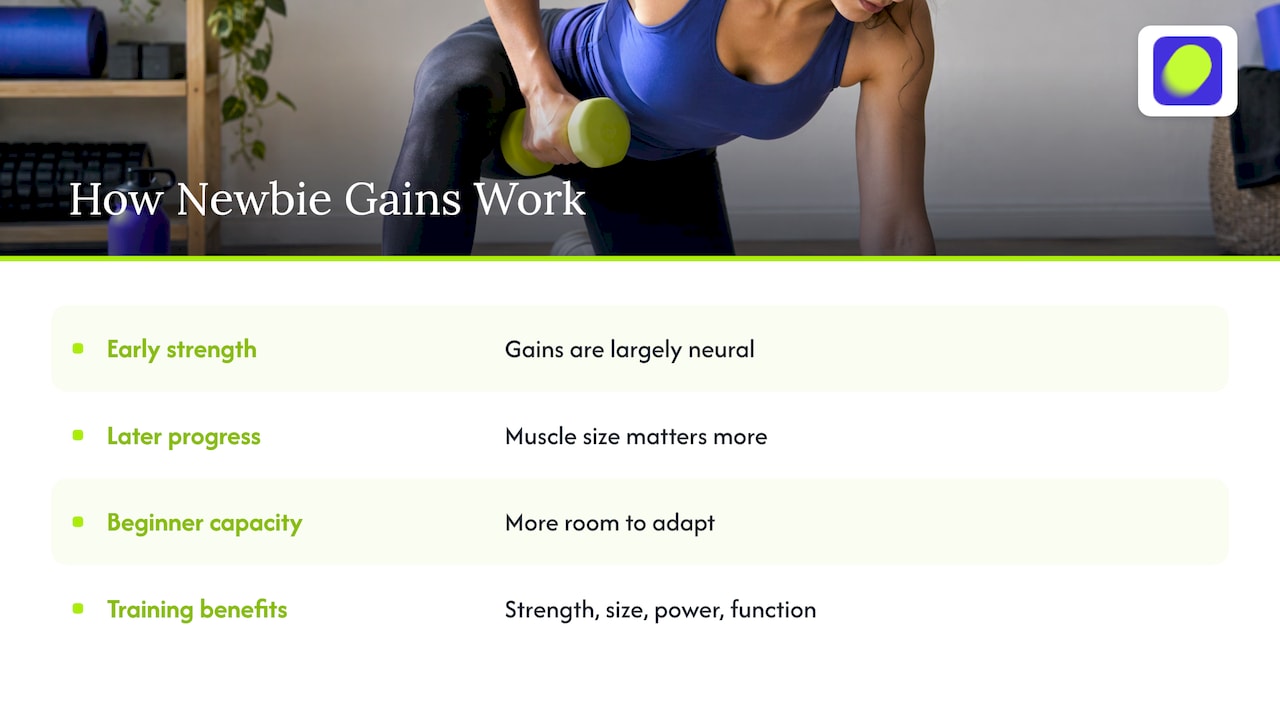
The reason is partly your brain, not your biceps. A 2025 review on muscle growth explains that early strength gains are largely neural: your body gets better at recruiting muscle fibers, coordinating movement and learning the exercise. Muscle size becomes a bigger part of the story later. Beginners also have far more room to adapt than experienced lifters.
The good news is that it works for nearly everyone who shows up. A 2026 American College of Sports Medicine position stand pulled together 137 systematic reviews covering more than 30,000 people and found that resistance training improved strength, muscle size, power and physical function compared with no exercise. A separate 2023 analysis found every training prescription it tested beat doing nothing for both strength and muscle size.
So you don’t need the perfect plan. You need a decent one and the habit of showing up.
Individual results vary with training, nutrition, recovery, age, genetics and medical history. Still, Cleveland Clinic gives a useful rough map:
The 2025 hypertrophy review puts realistic expectations at roughly 1 to 2 kg of fat-free mass after 8 to 12 weeks, with gains slowing as you gain experience. That’s a quieter number than social media suggests, and it’s a real one.
If the mirror hasn’t changed yet but your squat has, you’re not behind. You’re right on schedule.
There’s no universal end date. Think of newbie gains as the steepest part of a longer curve, not a switch that flips off in a particular month.
Here’s what the research shows:
That second point is encouraging. Progress after the honeymoon is slower, but it’s real.
You stop adding weight every session, and that’s normal. The same review points to progressive overload, enough weekly volume, adherence and training reasonably close to failure as what moves the needle, not novelty or the pump.
In practice that means smaller steps: one more rep, a little more weight, an extra set. Judge progress over weeks, not workouts. Our 6-week progressive overload plan shows how to do this without overthinking it.
Not really. Mayo Clinic says that if you stick with strength training, you can keep getting stronger no matter where you started.
What you can do is make them smoother. The things that slow beginners down are usually boring: skipping weeks, changing programs every few days, or never increasing the challenge.
Taking a break isn’t a disaster either. A 2022 detraining review found strength gains were maintained after 16 to 24 weeks without training in the limited evidence available, though strength was similar to non-trainers by 32 and 48 weeks. The authors noted the evidence couldn’t settle how long muscle size is retained. Missed a few weeks? Just restart lighter and build back.
Two or three sessions is plenty to start. Here’s a simple framework built on the evidence.
Wondering whether two days or three is better? A 2018 meta-analysis found that more frequency helped strength, but the effect disappeared when total volume was equal. If three days fits your life, great. If two is what you can keep up, you’re still in the game.
Need help with the numbers? Our guide to sets and reps for new lifters starts you at 8 to 12 reps, and the push pull legs for beginners split makes 10 weekly sets simple. Prefer to size up your goal first? See hypertrophy vs strength for starter templates. Training at home? Try the resistance band beginner plan.
You can do everything right in the gym and leave progress on the table in the kitchen and bed.
If you have a medical condition, are pregnant, or take medication, check with your doctor or a registered dietitian before changing your protein intake.
Most newbie gains are won by people who simply keep going. That’s where structure helps. Onemor gives you coach-led workouts with guided sessions, sets, reps and rest timers, plus streaks, XP and tribe challenges with friends, so you’re not planning every workout yourself. It’s built for training at the gym or at home, 2-3 times a week.
Start with the free plan and see how a guided session feels, or explore Pro when you want more. Want a place to begin today? Read our guide to starting strength training with 2-3 coach-led sessions.
There’s no fixed endpoint. Muscle growth tends to be fastest in the first three to six months, and strength can keep climbing for one to two years before the curve flattens. Even then, progress continues at a slower rate.
Most beginners see quick early improvement, but the speed varies. Genetics, age, sleep, food, training consistency and medical history all play a part. Compare yourself with your own starting point, not someone else’s.
Not entirely. The first few weeks are largely your nervous system learning the exercise, so you get stronger before you look different. Visible size changes generally take several weeks to months.
Yes, for a beginner. Mayo Clinic suggests at least two sessions a week covering all major muscle groups, and research shows total volume matters more than frequency alone. Three sessions gives you more room to spread that volume out.