October 15, 2026
7 min read

Hypertrophy vs Strength: 3 Starter Templates for Size, Force, or Both

Add Onemor as a preferred
source on Google

If your priority is muscle size, bias your weekly volume and stack up multiple sets per muscle group. Consistent resistance training improves your results, and you can absolutely blend them, but your weekly structure should lean toward whichever result you want most.


TL;DR:

  • For strength, center sessions on a compound lift near 80% of your one rep max, with multiple sets and 3 to 5 minute rests.
  • For muscle growth, target about 10 weekly sets per muscle group, train each major group at least twice weekly, and take most sets near failure.
  • For both goals, pair a heavy main lift with higher volume work, or alternate focused blocks; add load when you exceed your target reps.
  • Protect progress with 7 to 9 hours of sleep, daily protein, and rest days; ease off if soreness lasts beyond 72 hours or performance falls.

Onemor
Train for Size or Strength
Onemor offers guided strength workouts with sets, reps, and rest timers, so you can follow structured training at the gym or at home.
Explore Onemor

What do hypertrophy and strength actually mean?

Hypertrophy is the growth of your muscle fibers, measured as an increase in muscle cross-sectional area. It’s what shows up as visible size and shape change, and it also supports everyday strength and metabolic health as you build more tissue over time.

Strength is your capacity to produce maximal force, typically tested through your one-rep max (1RM) on a given lift. Early strength gains often come more from your nervous system learning to recruit muscle fibers efficiently than from the muscle itself getting bigger.

These two adaptations overlap more than people expect. Almost any resistance training builds some of both. But specificity still rules: a program weighted toward heavy, low-rep work will produce a stronger lifter, while one weighted toward higher total volume will produce more visible size. Knowing which outcome you want lets you tilt your programming on purpose instead of training by accident.
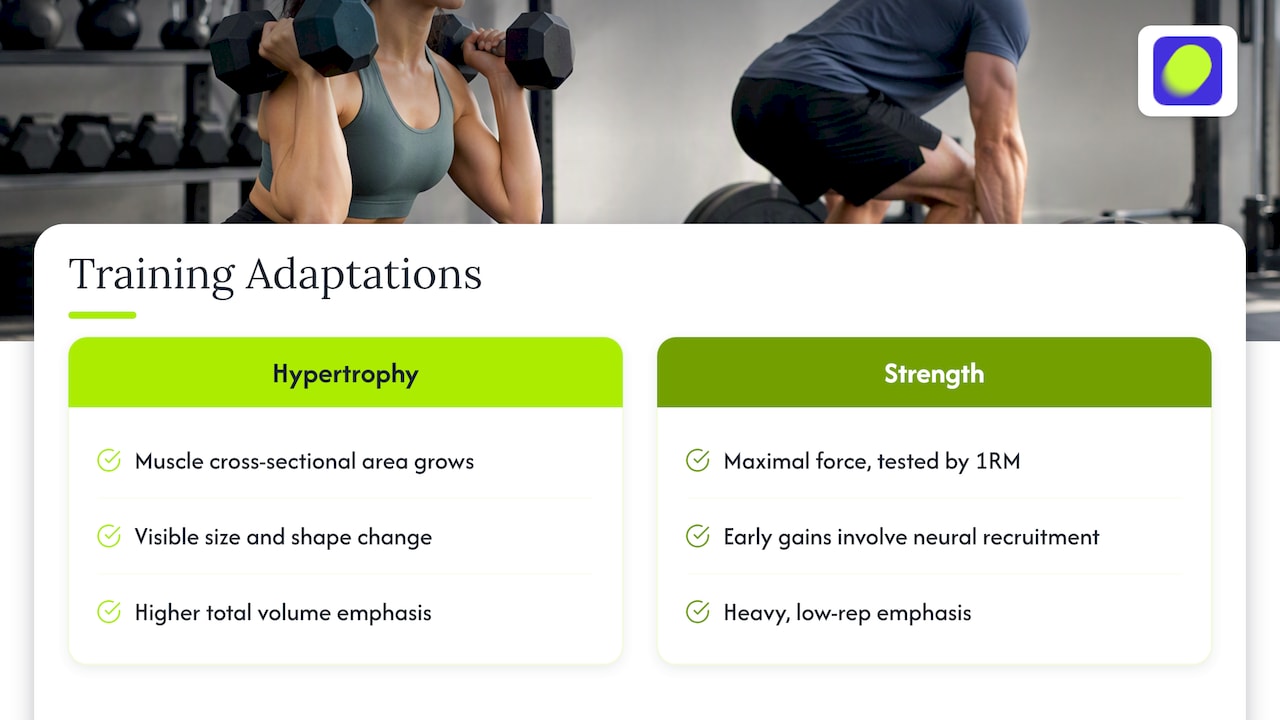
Comparison of muscle size and maximal strength

How do hypertrophy and strength programming actually differ?

Once you know your goal, a handful of variables determine how your sessions should look.

  • Load and reps: heavier loads (generally 80%+ 1RM) are more specific to building maximal strength, while hypertrophy can happen across a wide range of loads as long as sets are taken close to failure.
  • Volume and sets: hypertrophy tracks closely with total weekly sets per muscle group, while strength programs often prioritize fewer, heavier sets on the main lift.
  • Frequency: hitting each major muscle group at least twice a week tends to work better than cramming everything into one session, mostly because it spreads volume out more manageably.
  • Rest between sets: heavy strength work benefits from longer rests, generally 3 to 5 minutes, so you can produce maximum force on the next set, while hypertrophy work commonly uses 60 to 120 seconds, with evidence-backed rest guidance showing the picture is more flexible than many people assume.
  • Technique and tempo: both goals depend on progressive overload and a full range of motion. Controlled tempo matters more than chasing speed.

A 2023 Bayesian network meta-analysis of 178 strength studies and 119 hypertrophy studies found that higher-load, multiset training performed three times weekly ranked highest for strength, while higher-load, multiset training twice weekly ranked highest for hypertrophy, according to research published through the University of Bristol. That single finding sums up the whole comparison: load and frequency matter for strength, while total multiset work matters more for growth.

What does the research and ACSM guidance actually show?

The strongest case for how to train comes from a handful of well-designed reviews, not from gym folklore.

  • A 2023 systematic review and Bayesian network meta-analysis, covering nearly 300 studies combined, found that loads above 80% 1RM maximized strength gains, while a wide variety of resistance-training prescriptions produced comparatively similar hypertrophy results, according to research from the University of Bristol.
  • A 2020 network meta-analysis of 28 studies and 747 participants reported that muscle hypertrophy did not differ significantly across low, moderate, and high loads when sets were taken to volitional failure, but strength gains clearly favored moderate and high loads over low loads, per research from the University of Western Australia.
  • The American College of Sports Medicine’s 2026 position stand, built from 137 systematic reviews covering more than 30,000 participants, recommends around 80% 1RM for strength work and roughly 10 sets per muscle group weekly for hypertrophy, training major muscle groups at least twice a week, according to ACSM’s published guidance.

An umbrella review of 44 systematic reviews backed this up, confirming that resistance training consistently builds both muscle mass and strength, and that weekly volume, specifically around 10 sets per muscle group, is one of the clearer predictors of hypertrophy, per research summarized on PubMed. None of this means you need to overhaul your routine every few weeks. It means the two outcomes respond to different dials, and once you know which dial to turn, your training time stops feeling wasted.

How should you program for your goal, or both?

Here’s how to translate the research into something you can actually follow this week.

  1. Strength sessions: build around a main compound lift (squat, bench, deadlift, or overhead press) for multiple challenging sets, followed by lighter accessory work.
  2. Hypertrophy sessions: pick several exercises per muscle group and perform multiple sets, keeping most sets close to failure.
  3. Combining both: use phase blocks focused on one goal at a time, a concurrent model with a heavy day plus higher-volume days, or a priority system where your main lift is heavy and everything after it trains for size.
  4. Progression: add load once you exceed your target reps, and track weekly volume as sets times reps times load so you can see real trends, not guesses. Low-tech 1RM estimation methods let you gauge strength without grinding through a true max every few weeks.

Pro Tip: Pick one priority per training block instead of chasing size and max strength in the same session. You’ll progress faster on both over the course of a year.

Recovery ties it together: consistent sleep, enough protein, and steady progressive overload matter more than any single programming tweak.

What do beginner-friendly hypertrophy, strength, and hybrid templates look like?

You don’t need a complicated spreadsheet to start. These three templates work for a gym or a minimal home setup.

  1. Hypertrophy (3 days/week): train each major muscle group twice weekly, totaling around 10 to 12 sets per muscle group, with rep ranges of 8 to 15 and rest around 60 to 90 seconds. Training three days a week is enough frequency to hit this target without burning out.
  2. Strength: structure each session around a heavy compound lift for multiple sets, resting enough between sets to maintain your effort, with lighter accessory work after.
  3. Hybrid: include a heavier session focused on your main lifts and a higher-volume session spread across major muscle groups, prioritizing consistency over perfect programming when your schedule is tight.

What nutrition, recovery, and tracking habits actually move the needle?

Programming only works if the basics around it hold up.

  • Protein: aim for a steady daily intake spread across meals rather than one large serving, and if you’re chasing hypertrophy, a modest calorie surplus, as outlined in this repeatable meal plan, may support growth while limiting excess fat gain.
  • Recovery: prioritize 7 to 9 hours of sleep, build in rest days, and back off if soreness lingers past 72 hours or performance starts dropping.
  • Measurement: track estimated 1RM for strength and use tape measurements, photos, or weekly set logs to monitor size over time.
  • Common mistakes: chasing extreme loads or extreme volume instead of consistent progressive overload, and letting form break down as weight goes up.

Pro Tip: Film yourself periodically on your main lifts. It’s a useful way to catch form drift before it becomes a habit.

How does Onemor help you train for strength or size?

Following a plan is one thing, sticking with it is another. We built Onemor around guided, coach-led workouts with built-in sets, reps, and rest timers, so you can train toward strength or hypertrophy without building a spreadsheet from scratch. Our structured programs, from coaches like Xhenis, Phil, and Denis, map directly to these goals, and features like streaks, XP, and tribe-based challenges make showing up three times a week feel a lot less like a chore. Start with our Free plan, explore Pro for deeper structure, or download the app and get your first session scheduled today.

FAQ

Why am I getting stronger but not bigger?

Early strength gains often come from your nervous system learning to recruit muscle more efficiently, not from muscle growth itself. If your training stays low in weekly volume per muscle group, you may need more total sets to drive visible size, even at the same loads.

What is the 2 2 2 rule in the gym?

This isn’t a standard term defined in strength or hypertrophy research, so definitions vary depending on where you heard it. If someone mentioned it to you, ask what specific structure they mean rather than assuming a universal rule.

Does hypertrophy make you leaner?

Building muscle can change your body composition over time, since more lean tissue raises your resting energy needs, but hypertrophy training alone isn’t a direct fat-loss method. Nutrition and overall activity still drive whether you lose fat alongside any size gains.

Is 20 reps still hypertrophy?

Yes, research shows hypertrophy can occur across a wide range of rep ranges and loads, as long as sets are taken close to failure, according to a 2020 network meta-analysis. Twenty reps with enough effort can build muscle just as lower-rep sets can, though it may feel more demanding on conditioning.

Sources

FIND YOUR FREE PLAN
Make Fitness a Lifestyle
You’ll always know exactly what to do, when to do it, and you’ll have friends and coaches pushing you along the way.
Designed and built by Onemor Inc.
Copyright © 2026
Onemor green/yellow icon
Designed and built by Onemor Inc.
Copyright © 2025