Skip the max-out. The three approaches that actually work are submaximal rep formulas like Epley and Brzycki, RPE or reps-to-failure tracking for day-to-day trends, and velocity-based two-point methods if you’ve got a way to measure bar speed. Formulas tend to run a little hot on accuracy, velocity-based training (VBT) typically overshoots by a few percent, and RPE varies a lot person to person. Whatever you pick, stop the set the moment your form starts falling apart.
TL;DR:
- Submaximal formulas like Epley and Brzycki provide fairly accurate 1RM estimates when used with 10 or fewer reps, especially if averaged.
- Velocity-based two-point methods offer higher precision but require measuring bar speed at two different loads and ideal spacing between them for reliable results.
- RPE and reps-to-failure tracking are effective for monitoring training trends over time but are less precise for daily single estimates due to variability and calibration needs.
- Each method has a predictable bias: velocity overestimates by around 3.7%, while formulas and RPE vary widely in individual error, making consistency vital for accurate programming.
- Building an individual velocity profile or regularly testing with a coach can significantly improve estimate accuracy for serious lifters.
You don’t need a barbell-only max attempt to know your strength. You need the right tool for where you’re training and what gear you’ve got in your pocket.
Here’s how the main options stack up:
If you’re new to lifting, start with formulas or RPE. You’ll build a feel for effort without extra equipment. If you’re already comfortable tracking sets and have a velocity app on hand, the two-point method is worth the extra five minutes. And if you’re coaching others or just love data, individualized load-velocity profiles give you the sharpest read.
One practical note: VBT gets shaky without a phone or app handy, and any formula loses accuracy once you push past 10 reps. Match the method to what you actually have access to that day.
The Epley and Brzycki formulas turn a submax set into a usable strength number, and both have held up well in research when the rep count stays low.
Epley formula: 1RM = weight × (1 + reps ÷ 30)
Brzycki formula: 1RM = weight × (36 ÷ (37 − reps))
Lombardi and Mayhew formulas exist too and follow similar logic, weighting reps slightly differently, but Epley and Brzycki cover the vast majority of practical use cases.
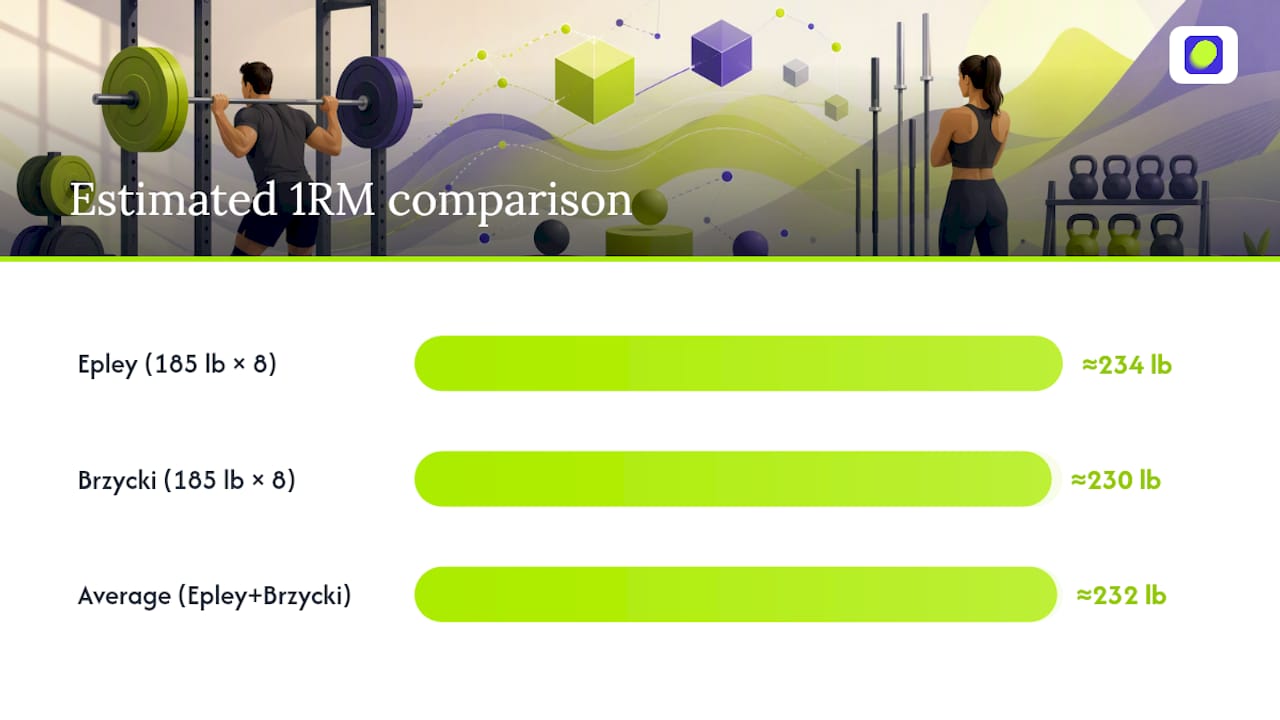
Here’s a worked example. Say you bench 185 pounds for 8 reps.
Notice how close these two land. That consistency tends to hold when your rep count stays at 10 or under. Push into the 15 to 20 rep range and the formulas start drifting apart, partly because fatigue and muscular endurance start influencing the number more than raw strength does.
Pro Tip: Log your weight, reps, and the date every time you test. A simple notebook or the notes app works fine, but seeing your estimated 1RM trend over months tells you far more than any single number ever will.
Velocity-based training turns bar speed into a strength prediction, and it’s become one of the more precise ways to estimate 1RM without a true max attempt.
Here’s the basic workflow:
Spacing the two loads far apart matters more than people expect. Loads that sit too close together make the line unstable and the resulting estimate less trustworthy.
A systematic review and meta-analysis found load-velocity approaches carry a small systematic overestimation, averaging around 3.7%, or roughly 4 to 4.5 kilograms. That’s a consistent enough pattern that you can plan around it rather than get surprised by it.
There’s also a real difference between using a generic minimum velocity threshold shared across a whole group versus building your own individual profile. Research on trained female athletes found individualized thresholds cut absolute error meaningfully compared to group-based numbers, sometimes down to the 2 to 5 kilogram range for bench press.
Pro Tip: If your gym has a shared VBT app or sensor, spend one full session just building your own velocity profile before trusting the numbers for programming. That single session of calibration pays off for months.
Rate of Perceived Exertion turns “how hard did that feel” into a usable number, and it’s one of the most practical tools for tracking strength without ever touching a true max.
The basic idea: after a working set, you rate the effort on a 1 to 10 scale, or estimate how many more reps you had left, known as reps in reserve (RIR). A weight that feels like an RPE 8 for 5 reps maps to a rough percentage of your 1RM, and you can look that up on any standard RPE chart or reps-to-failure table.
Where this method earns its reputation is consistency over time, not pinpoint accuracy on any single day. Research on predicting 1RM from submaximal lifts found individual error in these models runs wide, with standard deviations often exceeding 10 kilograms. That’s a big enough range that treating any single RPE-based number as gospel would be a mistake.
Here’s how to use RPE without getting burned by that variability:
Pro Tip: RPE takes practice to read accurately on yourself. Our guide to RPE training breaks down how to calibrate your own perceived exertion so the numbers actually mean something.
You can walk out of a single gym session with a usable 1RM estimate, as long as you follow a sequence instead of just guessing at a heavy weight.
Stop immediately if your form breaks down, if anything feels sharp or painful, or if you’re testing solo near anything close to failure. A spotter or coach changes the risk profile entirely.
Pro Tip: Never skip the warm-up progression to save time. A rushed warm-up is the single fastest way to turn a clean submax test into a bad one.
Every estimation method carries some built-in bias, and knowing which direction that bias runs helps you program smarter instead of getting surprised at the rack.
The fix for all of this is consistency. Use the same method every time you test, build an individual profile if you have the tools, and keep a 3 to 5% buffer whenever you’re programming a heavy single off an estimate rather than a verified number. If your training is getting serious enough that precision really matters, a supervised direct test with a coach or spotter is worth scheduling periodically.
Doing the math by hand works, but it’s one more thing to remember between sets. The app builds guided sessions with sets, reps, and rest timers already dialed in, so tracking your progress toward a stronger lift happens automatically instead of living in a separate notebook. If you’re working with a coach inside the app, programs from trainers like Coach Branden or Coach Kayla build in the kind of progressive overload that makes trend-tracking your estimated strength actually meaningful. You can start with the free plan and see how guided programming feels before deciding if Pro is worth it for your training.
For deeper reading, the ACSM’s Guidelines for Exercise Testing and Prescription covers safe testing standards and why submaximal methods are widely accepted. The velocity-loss threshold review explains how VBT ties into fatigue management, and the study on repetitions-to-fatigue explains why keeping reps low improves prediction accuracy.
Most rep charts put 90% of your 1RM at around 3 to 4 reps before form breaks down. That number shifts slightly person to person, which is exactly why formulas like Epley and Brzycki exist to translate your actual rep performance into an estimate rather than relying on a fixed chart alone.
The 5/3/1 program is a strength-training structure where you work up to sets of 5, 3, and 1 reps across a training cycle, using percentages of a training max rather than a true tested 1RM. It’s built specifically around the idea that an estimated max, kept slightly conservative, is safer and more sustainable to program from than chasing a real max every cycle.
Using formulas like Epley and Brzycki, you can estimate your 1RM from submaximal reps by plugging in your lifted weight and rep count, producing close and reasonable working estimates for your strength.
Take a weight you can lift for a clean 10 reps or fewer, then plug that weight and rep count into the Epley or Brzycki formula. For daily tracking without redoing the math each time, RPE or reps-in-reserve estimates work well too, especially when logged consistently over weeks rather than judged from one session alone.