A circuit is about what you do: a lineup of exercises you move through back to back. An interval workout is about how hard and how long you go: harder efforts alternating with easier recovery. They aren’t opposites, and one workout can be both. If you train two or three times a week, the better choice is the one you’ll keep showing up for.
Let’s break down how each works, where each shines, and how to start without overthinking it.
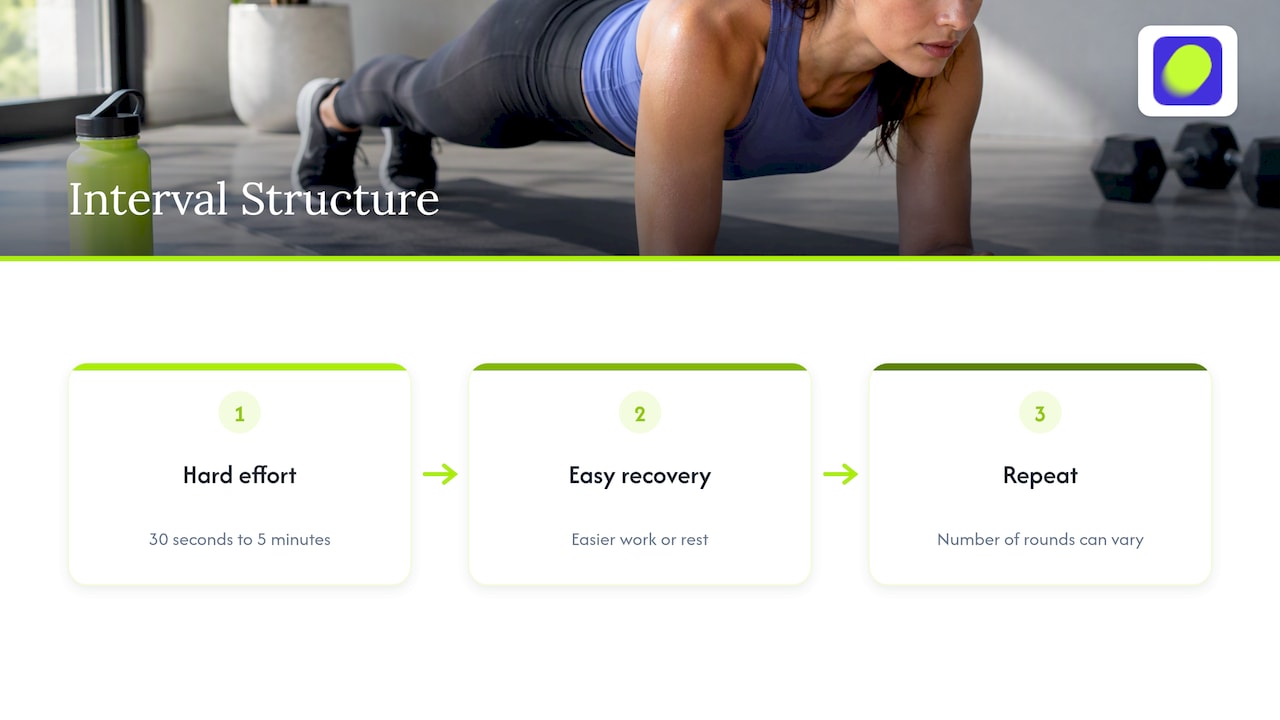
Intervals are repeated stretches of harder effort mixed with easier work or rest. Mayo Clinic Press gives a simple example: ride harder for 30 seconds, then ease off. Then you repeat.
The exact recipe is flexible. The American College of Sports Medicine says the work length, recovery length, intensity and number of rounds can all vary. New Mexico State University’s guidance notes the hard periods commonly run from 30 seconds to five minutes.
So “intervals” describes a pattern of effort, not a particular exercise. You can do them running, cycling, rowing, or with bodyweight moves. The recovery half matters as much as the hard half, and learning active recovery techniques helps you decide what those easy stretches should look like.
You’ll also see “HIIT” (high-intensity interval training). Exercise scientist Martin Gibala points out that HIIT has no single standard definition. In health settings it generally means intermittent work above moderate intensity. Sprint intervals are the extreme, near all-out version.
A circuit moves you through a series of stations with little or no rest. Cleveland Clinic explains that you do each exercise for a set time or number of reps, finish every station, then repeat the whole sequence for more rounds.
A typical circuit might include:
The American Council on Exercise says circuits typically use four to eight exercises that mix strength and cardio, with work followed directly by rest or active recovery.
The big draw is variety and efficiency. You hit several muscle groups in one session, and your heart rate stays up while you do it.
Think of it this way: a circuit is organized by exercises, and intervals are organized by effort.
They blend easily. In the American Heart Association’s 10-minute workout, you do different exercises for 30 seconds, with 30 seconds of cardio between them. That’s a circuit and an interval session at once.
Match the format to what you want. Mayo Clinic’s fitness guidance says adults should combine aerobic activity with strength training, working all major muscle groups at least twice a week. HIIT, in that guidance, is short bursts of high intensity mixed with low-intensity recovery.
If you want strength plus cardio in one session, circuits are a great pick. Cleveland Clinic says they build strength and endurance and can be modified for your level, goals and equipment.
If you want to boost cardio fitness, intervals are the sharper tool. Gibala explains they can raise VO2 max (how well your body uses oxygen) and let you accumulate more high-intensity work than steady exercise would.

If you’re short on time, both work. A 2025 study of trained women found that eight weeks of high-intensity circuits and traditional strength training gave similar gains in strength and lean mass, training three days a week with sets near failure. The circuit sessions took less time. The authors say time, exercise choice, preference and your ability to sustain the work-to-rest ratio should guide the choice.
Still torn between HIIT and lifting? Our guide on picking HIIT or strength based on what you’ll actually do walks through it.
You don’t need a perfect plan. You need a gentle start you can repeat. Here’s a simple way in.
Mayo Clinic Press lays out a beginner template: warm up five minutes, do four rounds of 30 seconds harder and two minutes easier, then cool down five minutes. It also advises avoiding interval training on back-to-back days.
Once that feels comfortable, progress one thing at a time. Add a round, a few reps, a bit more weight, or lengthen the work periods. Our 6-week progressive overload plan shows how to do it without guessing. If joints are a concern, try the low-impact HIIT guide or the 10 to 15 minute beginner HIIT workouts.
Harder isn’t automatically better. ACSM says injuries and other activity-related problems are likely higher with HIIT than with lower-intensity exercise, though reported injury rates have been small and the evidence is limited. Gibala adds that too much high-intensity work can raise the risk of overreaching, injury and illness.
So keep it practical:
Our gym safety basics cover the small habits that keep you training.
Then there’s the part nobody can program for you: showing up. ACSM puts it plainly, the best routines are the ones people can and will keep doing. If motivation is your sticking point, ideas on how to build exercise habits can help you make training feel automatic. Swapping between a circuit day and an interval day also keeps things fresh.
Planning sets, rounds and rest timers is where many beginners stall. In Onemor, you open a coach-led workout and follow it, with sets, reps and rest timers built in. Strength, HIIT and bodyweight options work at home or at the gym, and streaks, XP and tribe challenges with friends help you come back. If you want a steady rhythm, our guided strength workouts for 3 days a week are a good place to begin.
Start with the Free plan on Onemor or download the app and pick your first session today.
Yes. Do each station for a set time, like 30 seconds, then follow it with a short burst of cardio or rest. The American Heart Association’s 10-minute workout uses this exact setup. It’s a good way to get strength and cardio together.
Not necessarily. In a 2025 study of trained women, high-intensity circuits and traditional sets produced similar strength and lean-mass gains over eight weeks, and the circuits took less time. Your schedule and preference should decide.
Start short. Mayo Clinic Press suggests 15 to 30 seconds of faster effort at first, with longer easy periods in between. Lengthen the hard periods or shorten the recovery only after the basics feel manageable.
Two or three sessions fits most beginner schedules. Mayo Clinic Press advises against interval training on consecutive days, so leave a rest day or an easy day between harder sessions.