Low-impact HIIT is high-effort interval training that keeps at least one foot on the ground at all times, driving your heart rate into a hard zone without the pounding that jumps and plyometrics put on your knees, hips, and ankles. Research confirms it can raise cardiorespiratory fitness and match longer steady-state cardio while reducing joint stress. Want to try it right now? Here’s a five-minute starter circuit:
Marching high knees — 40 seconds on, 20 seconds rest
Step-back lunges — 40 seconds on, 20 seconds rest
Modified mountain climbers — 40 seconds on, 20 seconds rest
Box squats — 40 seconds on, 20 seconds rest
Inchworms — 40 seconds on, 20 seconds rest
That’s it. No jumping, no equipment, and your heart rate will tell you everything you need to know. For a fully coached version of this kind of session, Onemor’s guided HIIT programs walk you through every interval with trainer cues and built-in rest timers.
What does low-impact HIIT actually mean?
The phrase gets misunderstood constantly. “Low-impact” describes the force your joints absorb, not how hard you’re working. “High-intensity” describes your effort level, measured by heart rate or perceived exertion. The two are completely independent variables, and that’s the whole point.
In a standard high-impact session, moves like box jumps and burpees create ground-reaction forces that multiply your body weight several times over on landing. Low-impact formats eliminate that landing force entirely. As trainer Layne Nordquist explains, “intensity is effort level while impact refers to joint forces” — you can absolutely hit a high-intensity stimulus without a single jump.
Practitioners have started calling this approach HILIT: High-Intensity Low-Impact Training. Here’s how the two formats compare:
Low-impact HIIT (HILIT) — At least one foot contacts the ground at all times; heart rate still reaches a hard zone (roughly 80–95% of max); joint stress stays low; suitable for beginners, people with knee or hip issues, and return-to-training phases.
High-impact HIIT — Includes jumps, plyometrics, and hard landings; higher ground-reaction forces; greater bone-loading stimulus; demands more joint resilience and recovery time.
Low-impact cardio (steady-state) — Walking, cycling, swimming at a moderate pace; low joint stress but also lower intensity; takes longer to produce similar cardio adaptations.
What counts as a low-impact format? Cycling, rowing, elliptical intervals, step-based circuits, swimming sprints, and machine-based work like air bike sprints all qualify. So do bodyweight circuits built around squats, lunges, and plank variations, as long as you remove the jump.
Why low-impact HIIT works just as well as you’d hope
Skeptics assume that if it doesn’t hurt, it isn’t working. The physiology disagrees.
Your cardiovascular system responds to effort, not impact. When you push a step-back lunge or an air bike sprint to near-maximal effort, your heart rate climbs, your muscles demand oxygen, and your body triggers the same metabolic adaptations it would from a jump squat. ISSA outlines that HILIT delivers strong cardio gains and efficiency while preserving joint integrity, making it a sustainable long-term strategy rather than just a beginner compromise.
The cortisol picture is worth understanding too. A single intense HIIT bout does spike cortisol acutely. But a 2022 Springer review found that regular high-intensity interval exercise training lowers basal cortisol concentrations as an adaptive response over time. Consistency is what produces the hormonal benefit, not any single session.
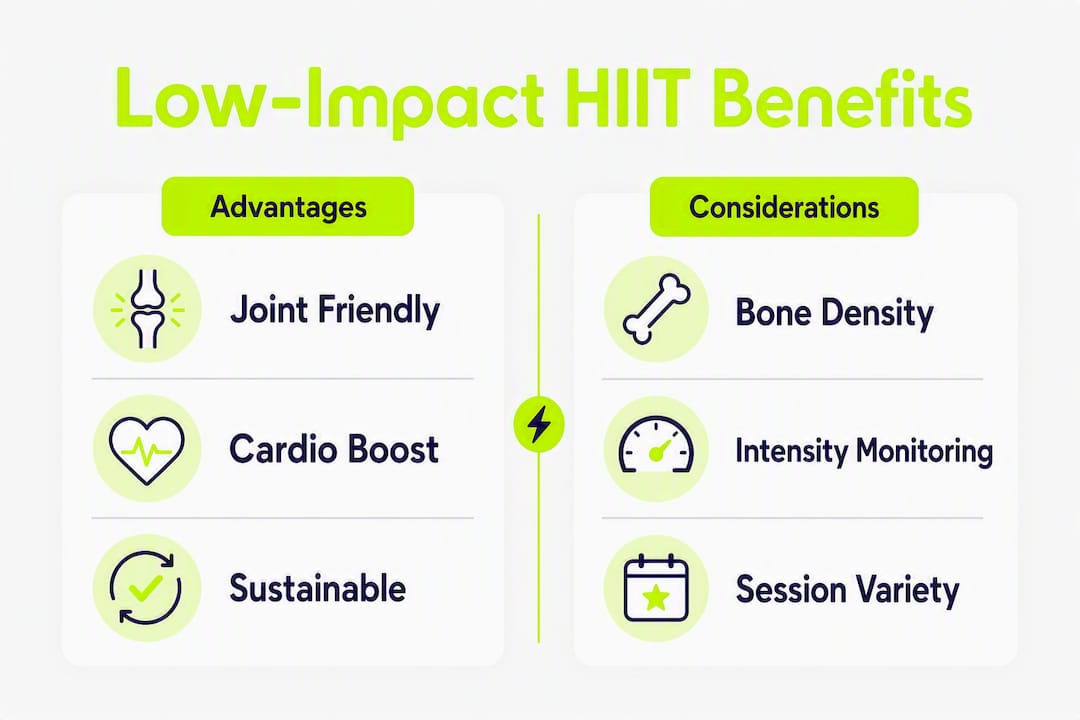
Key benefits, summarized:
Cardio improvement — Regular sessions raise VO2 max and cardiovascular efficiency comparably to longer steady-state workouts.
Strength and muscle endurance — Resistance-based low-impact moves (squats, lunges, rows) build functional strength alongside the cardio stimulus.
Joint protection — Removing impact forces makes training accessible for people with knee, hip, or ankle sensitivities.
Hormonal adaptation — Consistent training lowers resting cortisol, making each subsequent session feel more manageable.
Time efficiency — Sessions of moderate duration produce meaningful cardio and metabolic results.
One honest caveat: low-impact work is gentler on bones than high-impact training. If long-term bone density matters to you (and it should), pairing your low-impact sessions with some weight-bearing exercise or resistance training is a smart complement.
The 10 best low-impact HIIT exercises, with cues and progressions
These moves form the core toolbox for any joint-friendly circuit. Mix and match based on your template and equipment.
Marching high knees — Drive knees to hip height, arms pumping. Tempo: 40s on / 20s off. Regression: slow the march and reduce knee height. Progression: add a resistance band around ankles. Common error: leaning back; fix by keeping your core braced and chest tall.
Step-back lunges — Step one foot back, lower the back knee toward the floor, return. Tempo: 30s on / 15s off per side. Regression: reduce range of motion. Progression: hold dumbbells. Common error: front knee caving inward; cue: push the knee out over the second toe.
Box squats — Sit back to a chair or box, pause briefly, stand. Tempo: 40s on / 20s off. Regression: use a higher surface. Progression: add a weighted vest or hold a dumbbell at your chest. Common error: knees shooting forward; cue: push hips back first.
Modified mountain climbers — From a plank, drive one knee toward your chest slowly, alternate. Tempo: 30s on / 15s off. Regression: elevate hands on a bench. Progression: add sliders under feet for more core demand. Common error: hips rising; cue: keep hips level with shoulders.
No-jump burpees — Walk hands out to a plank, hold one second, walk hands back, stand. Tempo: 30s on / 15s off. Regression: use a bench for the plank position. Progression: add a push-up at the bottom. Common error: sagging lower back in the plank; cue: squeeze glutes and brace abs.
Plank knee drives — In a high plank, draw one knee toward the same-side elbow. Tempo: 40s on / 20s off. Regression: drop to forearms. Progression: slow the tempo to a 2-second drive. Common error: rotating the hips; cue: keep both hips square to the floor.
Inchworms — Stand, hinge forward, walk hands out to a plank, walk them back, stand. Tempo: 30s on / 15s off. Regression: bend knees generously. Progression: add a push-up at the extended position. Common error: rushing through the hinge; cue: feel a hamstring stretch on the way down.
Lateral step squats — Step wide to one side, sit into a squat, step feet together, repeat. Tempo: 40s on / 20s off. Regression: reduce squat depth. Progression: add a resistance band above the knees. Common error: letting the stepping knee collapse; cue: push the knee out.
Air bike sprints(machine option) — Drive hard for the work interval, pedal easy for rest. Tempo: 20s on / 10s off. Regression: reduce resistance. Progression: increase resistance or extend the sprint. Common error: pulling only with arms; cue: push and pull equally with both arms and legs.
Rowing intervals(machine option) — Drive through the legs first, then lean back, then pull. Tempo: 30s on / 15s off. Regression: slow the stroke rate. Progression: increase damper setting or stroke rate. Common error: rounding the lower back on the drive; cue: keep a tall spine throughout.
Ready-to-use low-impact HIIT routines for every schedule
Pick the template that fits your day. All three include a warm-up and cooldown.
Warm-up (3–5 minutes, always):
Leg swings (front-to-back and side-to-side), 10 reps each leg
Hip circles, 10 reps each direction
Arm circles and shoulder rolls, 10 reps
Slow bodyweight squats, 10 reps
Cat-cow spinal mobility, 8 reps
Cooldown (3–5 minutes, always):
Standing quad stretch, 30 seconds each side
Seated hamstring stretch, 30 seconds each side
Hip flexor lunge stretch, 30 seconds each side
Child's pose, 60 seconds
Slow diaphragmatic breathing, 5 deep breaths
Routine 1: 10-minute express (beginner)
Marching high knees — 30s on / 15s off
Step-back lunges — 30s on / 15s off
Modified mountain climbers — 30s on / 15s off
Box squats — 30s on / 15s off
Inchworms — 30s on / 15s off
Complete 2 rounds. Rest 60 seconds between rounds.
Routine 2: 20-minute standard (beginner to intermediate)
Marching high knees — 40s on / 20s off
Step-back lunges — 40s on / 20s off
No-jump burpees — 40s on / 20s off
Lateral step squats — 40s on / 20s off
Plank knee drives — 40s on / 20s off
Box squats — 40s on / 20s off
Complete 3 rounds. Rest 60–90 seconds between rounds.
Step-back lunges with dumbbells — 40s on / 20s off
No-jump burpees with push-up — 40s on / 20s off
Rowing intervals — 30s on / 15s off
Plank knee drives with sliders — 40s on / 20s off
Air bike sprints — 20s on / 10s off
Inchworms with push-up — 40s on / 20s off
Complete 3 rounds. Rest 90 seconds between rounds.
Frequency guidance: Aim for a few low-impact HIIT sessions per week. Pair them with 1–2 resistance or dumbbell-focused sessions to support bone health and overall strength. Leave at least one full rest day between sessions.
How to scale intensity without ever adding a jump
The secret to progressing in low-impact training is manipulating variables other than impact. You have four levers:
Add external load — A weighted vest or a pair of dumbbells raises metabolic demand on any bodyweight move without changing joint forces. REP Fitness highlights this as one of the most effective ways to increase challenge while staying low-impact.
Shorten rest periods — Moving from 20-second rests to 10-second rests increases density and keeps heart rate elevated longer.
Lengthen work intervals — Progressing from 30 seconds to 40 to 50 seconds of work raises total volume without adding impact.
Increase cadence — Moving faster through a step-back lunge or a marching knee raise raises intensity while keeping both feet close to the ground.
Add time-under-tension — Slowing the lowering phase of a squat or lunge to 3–4 seconds increases muscle demand significantly.
Form mistakes that limit progress (and how to fix them):
Knees caving on squats and lunges — Cue: push knees outward actively; strengthen glutes with banded lateral walks.
Losing hip hinge on inchworms and no-jump burpees — Cue: initiate the movement by pushing hips back, not rounding the spine.
Spinal alignment breaking in planks — Cue: squeeze glutes, brace the core, and keep ears, hips, and heels in one line.
Red flags to watch: sharp joint pain (not muscle burn), clicking or locking in a joint, dizziness, or chest discomfort. Stop immediately and consult a healthcare professional if any of these appear. General muscle fatigue and a burning sensation in working muscles are normal and expected.
Also worth noting: low-impact training is gentler on bones than high-impact work. Pairing your HIIT sessions with bone health strategies and some resistance training keeps your skeleton as strong as your cardiovascular system.
Pro Tip:If you’re not sure whether you’re working hard enough, you probably aren’t. The “low-impact” label can trick beginners into going too easy. Use a heart-rate monitor or RPE scale during work intervals — you should be at a 7–9 out of 10 effort, not a comfortable 5.
What equipment do you actually need?
The honest answer: nothing. Every routine in this article can be done on a clear patch of floor. That said, a few small additions make a real difference.
No equipment — Bodyweight circuits using the moves above work well at home, in a hotel room, or outdoors. You need roughly 6 feet by 6 feet of clear space.
Resistance bands — A set of loop bands costs $10–$25 and adds meaningful load to squats, lateral steps, and glute work without taking up drawer space.
Dumbbells — A pair of adjustable dumbbells ($30–$150 depending on weight range) opens up loaded lunges, goblet squats, and upper-body intervals.
Sliders or paper plates — Under $15 (or free, if you use paper plates on a hard floor), these add a core challenge to mountain climbers and reverse lunges.
Weighted vest — $40–$120 for a basic model; raises the metabolic cost of every move without changing the movement pattern.
Air bike — $300–$1,000+ for a quality machine; delivers one of the highest-intensity low-impact stimuli available and is worth the investment if you train at home regularly.
Rowing machine — $400–$1,500+ for a mid-range model; excellent full-body low-impact option and a staple in HILIT programming.
Elliptical — Common in most gyms; a solid machine-based option for interval work with zero impact.
If you train at a gym, the air bike, rower, and elliptical are all you need to build a complete low-impact cardio HIIT program alongside the bodyweight circuit moves.
A 4-week plan to build real capacity safely
This progression assumes you’re starting at 2 sessions per week and building toward 3. Use RPE (Rate of Perceived Exertion, 1–10) or a heart-rate monitor to gauge intensity during work intervals.
Week 1 — Use the 10-minute express routine twice per week. Work intervals at RPE 6–7. Focus on form over speed. Rest fully between rounds (60–90 seconds). Goal: learn the movement patterns and establish consistency.
Week 2 — Move to the 20-minute standard routine twice per week. Work intervals at RPE 7–8. Reduce rest between rounds to 60 seconds. Add a third optional session using the 10-minute express.
Week 3 — Continue the 20-minute routine three times per week. Work intervals at RPE 8. Shorten work-interval rest to 15 seconds where the plan shows 20 seconds. Add light dumbbells to squats and lunges.
Week 4 — Introduce the 30-minute strength-focused routine once per week alongside two 20-minute sessions. Work intervals at RPE 8–9. Use a weighted vest or heavier dumbbells. Monitor recovery: if sleep quality drops or resting heart rate rises noticeably, dial back to Week 3 volume.
One critical monitoring note: ISSA and practitioner guidance specifically flag that beginners can underdose intensity in low-impact formats because the usual impact feedback is missing. Without the jarring sensation of a jump, it’s easy to coast. A heart-rate monitor or consistent RPE check during every work interval keeps you honest.
Pro Tip:Track your resting heart rate each morning. After 3–4 weeks of consistent training, a downward trend (even 2–3 beats per minute) is one of the clearest signs your cardiovascular system is adapting. No wearable? Just count your pulse for 60 seconds before getting out of bed.
Key Takeaways
Low-impact HIIT delivers genuine cardio and strength gains by keeping effort high and joint forces low, making it a sustainable training method for beginners and intermediates alike.
Intensity ≠ impact. You can hit RPE 7–9 and a hard heart-rate zone without a single jump, using tempo, load, and rest as your tools.
Start with 10–20 minutes. The 10-minute express and 20-minute standard routines are the right entry points; build to 30 minutes over 4 weeks.
Monitor your effort. Use a heart-rate monitor or RPE scale during work intervals — low-impact formats make it easy to accidentally go too easy.
Complement with resistance work. Pair 2–3 low-impact HIIT sessions per week with 1–2 weight-bearing or dumbbell sessions to support bone health.
Onemor for guided sessions. Onemor’s coached HIIT programs include built-in timers, trainer cues, and tribe challenges to keep intensity and consistency on track.
The case for low-impact HIIT that most guides miss
Most articles on this topic frame low-impact HIIT as a consolation prize: something you do when you can’t handle “real” training. That framing is wrong, and it quietly discourages the people who would benefit most.
The truth is that HILIT is a legitimate long-term strategy, not a stepping stone. Practitioners who work with athletes returning from injury, older adults, and high-volume trainers managing fatigue all use low-impact interval formats deliberately, not reluctantly. The goal is always the same: keep intensity high, keep joint stress low, and keep showing up consistently. Consistency beats any single session format.
What most guides also miss is the psychological dimension. When training doesn’t leave you limping or dreading the next session, you actually come back. That’s the compounding effect nobody talks about. A 20-minute low-impact session three times a week, done consistently for 12 weeks, produces far better results than an aggressive high-impact program that burns you out after three weeks.
If you’re early in your fitness path, or coming back after a break, the smartest thing you can do is pick a format you can sustain. Low-impact HIIT is that format for a lot of people. The intensity is real. The results are real. The joints just don’t pay the price.
Onemor makes guided low-impact HIIT simple to start
Knowing the moves is one thing. Having a coach tell you exactly what to do, when to rest, and how hard to push is something else entirely.
Onemor is built for exactly this. The app gives you coach-led low-impact HIIT sessions with built-in interval timers, trainer video cues, and rest countdowns so you never have to guess whether you’re working hard enough or resting too long. Coach Phil and Coach Xhenis lead structured programs that fit beginners and intermediates, covering bodyweight circuits, machine intervals, and progressive strength work. The tribe challenges and XP system mean you’re not grinding through sessions alone. You’ve got a crew keeping you accountable.
Free and premium options are both available on iOS. If you’re ready to stop piecing together workouts and start following a plan that actually progresses you, join the Onemor community and try your first coached session today.