February 7, 2024
2 min read

Beginner Kettlebell Workout: Build Strength Fast

Scoop, blend, freeze: Check out this homemade high protein pistachio ice cream for a tasty twist on healthy treats!

If you're on the lookout for a yummy treat that fits right into your fitness goals without emptying your wallet, you've stumbled upon the perfect recipe. With so many options for protein-packed ice creams and low-sugar desserts crowding the shelves, it's easy to get overwhelmed. Sure, some of them taste alright, but have you seen the prices? That's why whipping up your own batch of protein ice cream at home is such a game-changer.

Not only does it hit the spot when you're craving something sweet, but it's also a fun twist on the usual protein shake. Plus, you get to say goodbye to all those extra additives and sugars that sneak into store-bought versions.

This homemade pistachio ice cream with vanilla protein powder is the perfect mix of tasty and healthy as well as a great way to cool down after a workout.

Watch the full video: High-Protein Pistachio Ice Cream Recipe

onemor logo blue box
onemorapp
Follow
Original audio
onemor logo blue box
onemorapp We’d love to share with you a yummy and healthy High-Protein Pistachio Ice Cream Recipe made with love. Check-out the easy and step-by-step instructions down below to recreate it and comment if you liked it. 👇🏻

The Ingredients:

-120g unshelled and unsalted pistachios
-280ml milk
-200ml full fat canned coconut milk
-2 tbsp of raw honey
-1/8 tsp salt
-1 tbsp melted coconut oil
-1 scoop of vanilla protein powder
-1 tbsp of melted chocolate

1️⃣ Begin by adding the pistachios to your blender. Change the speed, starting from low and gradually increasing to medium and high until the pistachios break down into small bits.

2️⃣ While blending, slowly pour in the milk. Continue blending until the mixture achieves a smooth and creamy consistency, free of any chunks.

3️⃣ Incorporate all the remaining ingredients, except for the chopped pistachios, and blend until everything is thoroughly combined.

4️⃣ If you have an ice cream machine, transfer there.

5️⃣ In case you don’t have an ice cream machine, here’s what to do: Place the mixture into a metal or glass container, and cover it with parchment paper. Gently press the parchment paper down onto the ice cream to prevent any air from getting in during the freezing process. Then, put it in the freezer.

6️⃣After about 2 hours, take the container out of the freezer and give the mixture a good stir. Add in the chopped pistachios during this mixing step, as it will help prevent ice crystals in the final product.

7️⃣ Cover the container again and return it to the freezer for a 24-hour freeze.

8️⃣ The following day, remove the ice cream from the freezer and let it thaw for approximately 15 minutes, until it’s easy to scoop and dip it in somemelted chocolate

Enjoy your homemade pistachio ice cream! 🍨🥄

Follow @onemor.app for more nutrition content.


#onemor#friday#healthy#recipe
#icecream#nutrition#foryoupage
#trending

3w

Let’s get to it:

Ingredients:
-120g unshelled and unsalted pistachios
-280ml milk
-200ml full fat canned coconut milk
-2 tbsp of raw honey-1/8 tsp salt
-1 tbsp melted coconut oil-1 scoop of vanilla protein powder
-1 tbsp of melted chocolateInstructions:

1️⃣ Begin by adding the pistachios to your blender. Change the speed, starting from low and gradually increasing to medium and high until the pistachios break down into small bits.

2️⃣ While blending, slowly pour in the milk. Continue blending until the mixture achieves a smooth and creamy consistency, free of any chunks.

3️⃣ Incorporate all the remaining ingredients, except for the chopped pistachios, and blend until everything is thoroughly combined.

4️⃣ If you have an ice cream machine, transfer there.

5️⃣ In case you don’t have an ice cream machine, place the mixture into a metal or glass container, and cover it with parchment paper. Gently press the parchment paper down onto the ice cream to prevent any air from getting in during the freezing process. Then, put it in the freezer.

6️⃣ After about 2 hours, take the container out of the freezer and give the mixture a good stir. Add in the chopped pistachios during this mixing step, as it will help prevent ice crystals in the final product.

7️⃣ Cover the container again and return it to the freezer for a 24-hour freeze.

8️⃣ The following day, remove the ice cream from the freezer and let it thaw for approximately 15 minutes, until it’s easy to scoop and dip it in some melted chocolate.

There you have it: delicious, healthy and protein-packed homemade pistachio ice cream! The best part about this recipe is that you can customize it with whatever flavors you’d like. Whether you're in the mood for something fruity, chocolatey, or even more nutty, you can tweak this base to suit your cravings. It's a wonderful way to enjoy a treat that's not just good, but also good for you. After all, who said healthy eating couldn't be fun and delicious?

download for free

Beginner Kettlebell Workout: Build Strength Fast

Check out this healthy and nutritious high-protein smoothie recipe to keep your day going right.

Hey there! Ready to whip up something super tasty and good for you?

If you were looking for a sweet and healthy snack to keep you full throughout the day or something to have after a workout, then you’re in the right place. High-Protein smoothies and shakes are not just delicious, but they’re also great for your health. It's all about mixing some cool ingredients like banana, avocado, blueberries, and a bit of protein powder to keep you powered up.

Whether you're looking to get more muscles or just want a sweet treat that's good for you, this protein packed smoothie has got your back.

Why You'll Love This Smoothie

  • Protein Powder: With whey protein in the mix, this smoothie is perfect for keeping your muscles happy, especially after a workout.

  • Good Fats: That creamy avocado? It's full of healthy fats that are great for your heart.

  • Berry Goodness: Blueberries aren't just tasty; they're full of antioxidants that keep your body feeling great.

  • Energy Boost: Bananas are awesome for a quick energy pick-me-up, plus they make your smoothie sweet and smooth.

WATCH THE FULL VIDEO: High-Protein Smoothie with Banana, Avocado and Blueberries

Ingredients:
- 250 ml whey
- 1 ripe banana
- 1/4 avocado
- 30g blueberries
- 1 scoop vanilla whey protein
- 1 scoop hazelnuts

Instructions:
Begin with 250 ml of whey in your blender.
Add a ripe banana and a quarter of an avocado for sweetness and smoothness.
Include a generous portion of blueberries for a flavor kick.
Mix in a scoop of vanilla whey protein and a scoop of hazelnuts to enhance the nutty, creamy texture.
Blend until smooth and enjoy the rich, satisfying taste!

Customize Your Smoothie

The beauty of this smoothie lies in its versatility. Here are a few ways to tweak it to your liking:

Vegan-Friendly: Substitute whey protein with a plant-based protein powder and use almond milk or coconut water as the liquid base.
Boost Fiber: Add a tablespoon of chia seeds or flaxseeds to increase fiber content, which can aid in digestion and keep you feeling full longer.
Increase Antioxidants: Swap blueberries for mixed berries or add a handful of spinach to pack in more antioxidants without compromising taste.

This banana and avocado protein smoothie is more than a tasty drink; it's a way to fuel your body right, whether you're hitting the gym hard or just need a healthy snack.

So, blend it, sip it, and enjoy the good vibes it brings to your day!

download for free
June 5, 2025
1:30 min read

Beginner Kettlebell Workout: Build Strength Fast

Let’s settle the debate: does the time of day you work out actually matter?

We all have our preferences—some people jump out of bed ready to train fitness, while others don’t hit their stride until after sunset. But when it comes to getting real resultsmuscle, weight loss, strength, or overall wellness—does the time of day you workout actually matter?

Whether you're squeezing in dumbbell workouts before your morning coffee or closing the gym with a post-dinner grind, this guide will help you decide what works best for your lifestyle and your goals.

Let’s settle the debate once and for all: early morning vs. late night workouts—which one wins?

🌅 The Case for Morning Workouts

✅ Boosts Energy for the Day

Starting your day with a workout can increase focus, productivity, and overall mood. Morning sessions help you feel accomplished before most people are even awake.

✅ Improves Consistency

Fewer distractions = fewer excuses. Morning routines tend to be more repeatable and easier to stick to long term.

✅ May Help With Weight Loss

Some studies show fasted training may boost fat burning (if done safely and under guidance from a coach or personal trainer).

💡 With the Onemor app, you can schedule your morning training sessions in your planner, follow short routines, and even track performance before breakfast.

Download for free
Download for free

🌙 The Case for Late Night Workouts

✅ Strength Peaks Later in the Day

Your body is naturally warmer and looser in the evening, which can improve performance and reduce injury risk during exercise—especially workouts for men focusing on power and muscle gains.

✅ Great for Stress Relief

After a long day, a workout can help you decompress, clear your mind, and sleep better.

✅ Flexibility for Busy Schedules

Not everyone can rise at 5 AM. Night sessions allow more time to warm up, fuel properly, and really commit to your fitness goals.

💡 Use Onemor to find a suitable evening workout app routine from the comfort of your living room, office, or even hotel room.

Download for free
Download for free

🧠 So… Which One Is Better?

The truth is - the best time to workout is the time you can consistently stick to.

🌞Morning Workouts

Best for :

Habit-building, discipline, early energy

Downside :

Early wake-up, colder joints

Ideal for :

Busy professionals, parents, early risers

🌜Night Workouts

Best for :

Strength training, flexibility, stress relief

Downside :

Can disrupt sleep if done too late

Ideal for :

Night owls, shift workers, gym closers

🌞Morning Workouts

🌜Night Workouts

Best for:

Habit-building, discipline, early energy

Strength training, flexibility, stress relief

Downside:

Early wake-up, colder joints

Can disrupt sleep if done too late

Ideal for:

Busy professionals, parents, early risers

Night owls, shift workers, gym closers

Need help choosing? Let Onemor personalize your schedule. Whether you train at 6 AM or 9 PM, you can find the right exercise, log it with a tracker, and follow a trainer plan based on your goals.

Download for free
Download for free
March 24, 2026
5 min read

Try Not to Cry Week Is Here — and Onemor Is Daring You to Show Up

Seven days. Six workouts. One habit. And if you finish — 70% off a year of having a real coach plan your training for you.
That's the Onemor Try Not to Cry Week. Running from March 30th to April 5th, it's not a marketing gimmick or a sponsored post. It's a real challenge, with a real reward, designed for the people who've been saying "I'll start this week" for the last four months.
This week, the starting line is right in front of you. Here's everything you need to know.

🔥  THE CHALLENGE: Train 6 times between March 30 and April 5. Complete all 6 and unlock 70% off Onemor's annual plan — that's areal coach planning your workouts every week for just $4.5/month.

What Exactly Is the Try Not to Cry Week?

The name says it all — this is a week of training that's going to push you. Six sessions in seven days is not easy. It's not supposed to be. The point is to do something your past self would have quit, and your future self will thank you for.

Here's the structure:

  • Dates: March 30 (Sunday) through April 5 (Saturday), 2026

  • Challenge: Complete 6 workouts within that 7-day window

  • Reward for finishing all 6: 70% off Onemor's annual plan

  • Price after discount: $4.5/month — with a real coach planning your workouts every single week

  • Platform: Onemor app —available free on iOS

You can train in the morning, at night, at home, at the gym, or wherever you do your thing. The only rule is that you show up six times. That's it.

📲  Download Onemor free at onemor.com and join the challenge before March 30. Your plan, your coach, your tribe — ready and waiting.

Why 6 Workouts in 7 Days Actually Changes Something

This isn't random. There's real science behind why a week-long challenge structured like this is one of the most effective ways to build a habit that sticks.

It's long enough to feel different

One workout doesn't change your body or your mindset. But six consecutive days of showing up — of making a decision before you feel ready, of doing it tired, of doing it when your schedule is messy — that starts to rewire something. By day six, you're not the same person who almost skipped day one.

It's short enough to commit to

Seven days is a container your brain can wrap itself around. "I'll do this for a week" is a completely different mental agreement than "I'll be consistent forever." One of those feels possible right now. The other feels exhausting before you even start.
That's the genius of the Try Not to Cry Week — it's an invitation, not a life sentence. Start here. See how it feels. Then decide what comes next from a position of strength instead of avoidance.

Discipline compounds

Day 1 you train because of the challenge. Day 3 you train because you don't want to break the streak. Day 6 you train because you've become someone who trains. That's the shift. The challenge is just the door — you have to walk through it.

The Reward: What 70% Off Actually Means

Let's talk about what's on theother side of completing this challenge, because it's worth being specific.

Finishing all 6 workouts unlocks 70% off Onemor's annual plan. That brings the price down to $4.5 per month —which, for context, is less than a single gym class, less than a coffee, and a fraction of what a personal trainer costs in any city in the world.

What you get for $4.5/month:

  • A real coach — not an algorithm — planning your workouts every week

  • A personalized program matched to your goals via Onemor's quiz

  • Follow-along workout videos with pro demonstrations so you always know exactly what to do

  • Access to strength, HIIT, pilates, yoga, and mobility programs

  • Streak tracking, XP, and a leaderboard that makes showing up actually fun

  • A tribe — a community of people training alongside you and keeping you accountable

  • Smart reminders that fit your schedule, not the other way around

Most people spend more than $4.5/month on apps they barely open. This is a coach-built training plan for less than a dollar a week more. The math doesn't need a calculator.

💸  Complete the Try Not to Cry Week and lock in 70% off Onemor Pro — just $4.5/month for a full year of coach-planned workouts. The offer is exclusive to challenge completers. Join at onemor.com.

Who Is This Challenge Actually For?

The Try Not to Cry Week is built for people who are done with the cycle of starting and stopping. Specifically:

  • The person who's been "about to start" for weeks and needs something external to actually begin

  • The person who trains solo and struggles with consistency because there's no accountability

  • The person who keeps paying for fitness apps they don't open

  • The person who knows they'd train more if they had a real plan — not just random YouTube videos

  • The person who wants to see if they can actually do something hard

  • Anyone who's ever thought "I just need to get into a routine" and never did

If any of that sounds familiar —this is quite literally designed for you. Not for the person who's already training six days a week. For the person who needs one good week to prove to themselves they can.

How to Make It Through All 6 Days — Practically

Wanting to complete the challenge and actually completing it are different things. Here's how to make the gap smaller:

  1. Map your 6 sessions before March 30. Look at your calendar right now. Pick 6 slots. Put them in. Don't decide each day — decide once and execute.

  2. Make day 1 non-negotiable.The hardest session is always the first one. If you do day 1, the momentum of not wanting to waste it carries you to day 2.

  3. 1Lower the bar for hard days. A 20-minute session still counts. Showing up at 60% is infinitely better than not showing up at all. Done beats perfect every time.

  4. Tell at least one person. Social accountability is the most underrated consistency tool in existence. Text a friend. Post it. The act of saying it out loud creates a commitment that silence doesn't.

  5. Use Onemor's follow-along player. You don't need to decide what to do — the coach has already decided.Open the app, press play, do the thing.

  6. Remember what's on the other side. 70% off isn't just a discount — it's a year of having someone else handle the planning so you can just show up and train.

This Week Is Bigger Than the Discount

Let's be honest: $4.5/month is a great deal. But the real prize of the Try Not to Cry Week isn't on your credit card statement.

It's the version of you who finishes. The one who proved — not to anyone else, but to themselves — that they can do hard things when they decide to. The one who no longer says "I want to get into a routine" from a place of wishful thinking, but from a place of recent evidence.

That version of you is available.It's one week away. The week starts March 30th. The challenge is on.

❤️🔥  The challenge is on. Will you accept it?Train 6 times between March 30–April 5 on Onemor. Finish all 6 and unlock 70%off — $4.5/month for a coach who plans your workouts every week. DownloadOnemor free and start your journey at onemor.com.

JOIN THE CHALLENGE

Frequently Asked Questions

What is the Onemor Try Not to Cry Week?

The Try Not to Cry Week is a 7-dayfitness challenge run by Onemor from March 30 to April 5, 2026. The challenge requires participants to complete 6 workouts within that window. Users who complete all 6 workouts unlock an exclusive 70% discount on Onemor's annual Pro plan.

What do I get if I complete the challenge?

Completing all 6 workouts unlocks 70% off Onemor's annual subscription plan, reducing the price to $4.5 per month. This gives you 12 months of access to coach-planned workout programs,follow-along training videos, community features, and Onemor's full Pro suite.

How much does Onemor cost after the discount?

After the 70% discount unlocked by completing the Try Not to Cry Week, Onemor Pro costs $4.5 per month (billed annually). This is one of the lowest price points available for an app that provides real coach-planned workouts.

When does the challenge start and end?

The Try Not to Cry Week runs from Sunday, March 30, 2026 to Saturday, April 5, 2026. Participants must complete 6 workouts within this specific 7-day window to be eligible for the reward.

Do the 6 workouts have to be done on specific days?

No. The 6 workouts can be completed on any 6 of the 7 days between March 30 and April 5. The only requirement is completing all 6 within the challenge window.

What kind of workouts are included?

Onemor offers strength training, HIIT, pilates, yoga, mobility, and home workout programs. All workouts are led by real coaches and include follow-along video demonstrations. Programs are personalized based on your goals through Onemor's quiz.

Is Onemor free to download?

Yes. Onemor is free to download on iOS (App Store). The app offers a free tier with daily workout access and a 21-day Pro trial with no credit card required. The Try Not to Cry Week challenge is available within the app.

Who is the Try Not to Cry Week challenge designed for?

The challenge is designed for people who want to build a consistent workout habit, especially those who struggle with motivation or accountability. It is particularly suited to Gen Z users and fitness beginners who want structure, community, and a reward for showing up.

How is Onemor different from other fitness apps?

Onemor is built around a tribe model — members join communities led by real coaches, rather than following generic workout libraries. The app includes gamification (XP, streaks, leaderboards), social accountability features, and personalized program matching. It is specifically designed for Gen Z users who want fitness to feel engaging and social, not transactional.

JOIN THE CHALLENGE
July 16, 2026
6 min read

Beginner Kettlebell Workout: Build Strength Fast

A beginner kettlebell workout is a full-body strength and conditioning routine built around foundational movements that develop functional strength, stability, and endurance safely. Kettlebell training sits at the crossroads of strength work and calisthenics for beginners, making it one of the most efficient tools for young adults who want real results without complicated equipment. Experts recommend starting with two to three sessions per week, each lasting 20–30 minutes, to build consistency without burning out. Whether you are training in a Florida gym or in your living room, this guide gives you everything you need to start strong and stay safe.

What equipment do beginners need for a kettlebell workout?

Choosing the right weight is the first decision that separates a productive session from a frustrating one. Most men should start with a 16kg kettlebell and most women with an 8kg kettlebell for foundational exercises. Those numbers are starting points, not rules carved in stone. If 16kg feels too heavy to control with good posture, drop down without hesitation.

You do not need a full rack of equipment to get started. Here is what actually matters:

One detail most beginners overlook: different exercises require different weights. Your goblet squat weight will likely be heavier than your press weight. Using one weight for everything is a shortcut that leads to poor form on harder movements. Owning two kettlebells at different weights gives you far more flexibility from day one.

ExerciseSuggested starting weight (women)Suggested starting weight (men)Goblet squat8–12kg16–20kgKettlebell swing8kg16kgStrict press6–8kg12–16kgBent-over row8–12kg16–20kgFarmer carry8–12kg16–20kg

As your form improves, increase weight in 2–4kg increments rather than jumping straight to the next size up. Small jumps protect your joints and keep your technique clean.

Which kettlebell exercises should beginners master first?

Coach John Wolf identifies five core movement patterns that form the foundation of safe and effective kettlebell training: pressing, rowing, hip hinging, squatting, and carrying or resisting rotation. Mastering these five patterns gives you a complete, balanced routine without needing to learn dozens of exercises. Think of them as the alphabet before you write sentences.
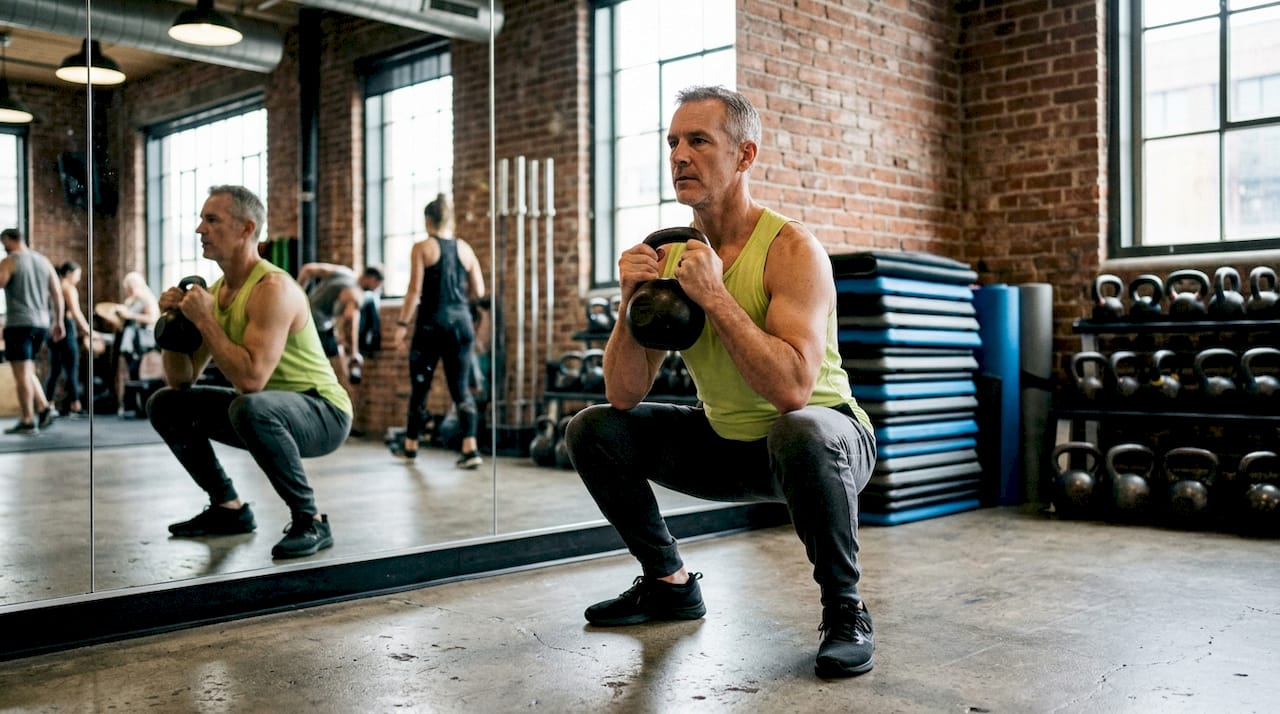
Man performing kettlebell goblet squat side profile

The hip hinge: the most important skill to learn

The hip hinge is the single most critical movement in kettlebell training. Physical therapists warn that many beginners treat the kettlebell swing like a squat, which puts unnecessary stress on the knees and lower back. The hip hinge is different. You push your hips back, keep your spine neutral, and load your glutes and hamstrings. Practice it without a weight first by standing a foot from a wall and tapping your hips back to touch it.

The five foundational movements

Pro Tip: Before loading any of these movements, master the bodyweight version first. A bodyweight hinge and a bodyweight squat teach your body the correct pattern without the added challenge of controlling a moving weight.

These five movements build balanced strength across your entire body. They also carry over directly to sports, daily movement, and any beginner calisthenics routine you might already be following.
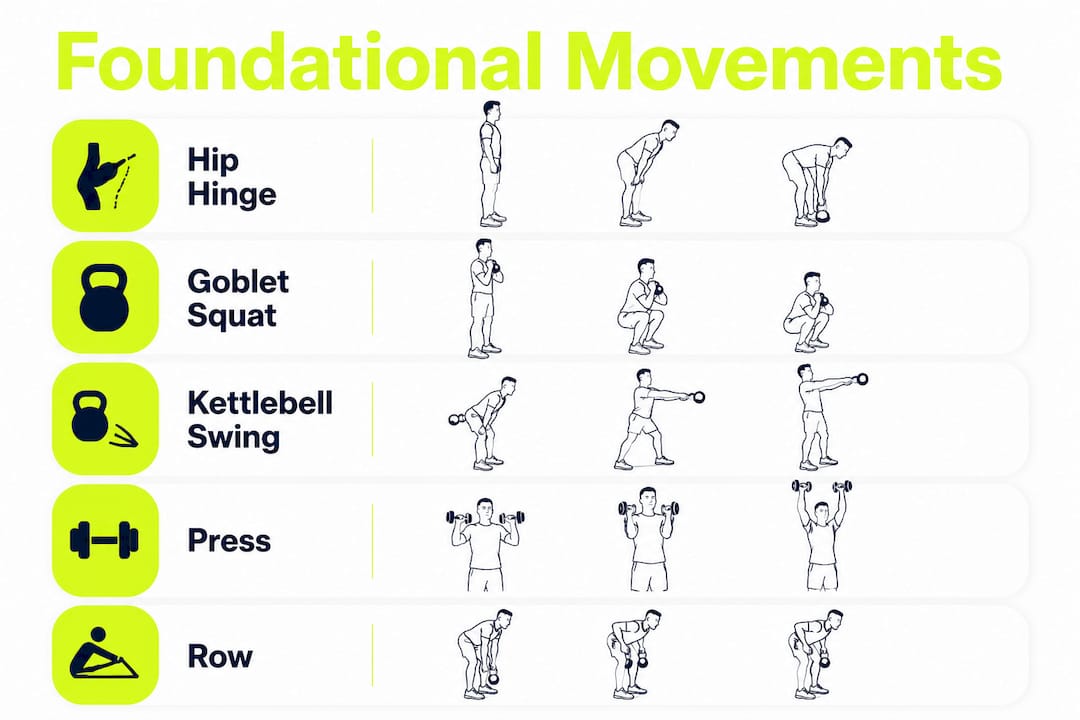
Infographic showing five foundational kettlebell movements

How should you structure a beginner kettlebell routine?

Structure is what turns a collection of exercises into a program. Without it, you either do too much too soon or not enough to see progress. A solid beginner kettlebell routine follows a simple, repeatable format.

Consistency beats intensity every time at this stage. Showing up three times a week for six weeks will produce more visible results than going all-out for two weeks and then stopping.

What mistakes do beginners make with kettlebell workouts?

Most beginner setbacks come from a handful of repeated errors. Knowing them in advance puts you ahead of the curve.


“The challenge of exercise should be muscular fatigue, not joint pain. If any movement causes sharp pain, stop immediately and consult a certified professional before continuing.”

That last point is worth taking seriously. Florida has no shortage of certified personal trainers and physical therapists who specialize in movement quality. If something feels wrong, get it checked before it becomes a real problem.

How can beginners progress safely in their kettlebell training?

Progression is not just about adding weight. The most effective beginner kettlebell program for beginners builds progress in layers, starting with control before adding load.

The first layer is tempo. Slowing your movement down, such as taking 3 seconds to lower the bell on a press or row, increases time under tension and builds muscular strength without requiring heavier weight. This approach lets your muscles adapt before your joints are asked to handle more load.

Pro Tip: Try a 3-second lowering phase on your goblet squat for two weeks before adding weight. You will feel the difference in your quads and glutes without changing a single number on the bell.

The second layer is complexity. Once you can perform all five foundational movements with clean form for 3 sets of 12 reps, you are ready to introduce combinations. A swing into a clean into a press, for example, chains movements together and challenges your coordination and conditioning simultaneously.

The third layer is weight. Increase by 2–4kg only when you can complete all planned sets and reps with full control and no form breakdown. Rushing this step is the most common reason beginners plateau or get hurt. Tailoring progression to your own strength, rather than following a generic timeline, keeps you moving forward without setbacks.

Recovery matters as much as the training itself. Sleep, hydration, and rest days are not optional extras. They are where your body actually gets stronger.

Key Takeaways

A beginner kettlebell workout builds lasting strength by mastering five foundational movement patterns, training 2–3 times per week, and progressing through tempo control before adding weight.

PointDetailsStart with the right weightWomen begin at 8kg, men at 16kg, and increase by 2–4kg as form improves.Master five movement patternsPressing, rowing, hip hinging, squatting, and carrying build balanced full-body strength.Train 2–3 times per weekSessions of 20–30 minutes with 2–3 sets of 8–15 reps deliver consistent, sustainable gains.Prioritize form over loadSharp joint pain is a stop signal. Muscle fatigue is normal and expected.Progress through tempo firstSlow the lowering phase before adding weight to build strength without injury risk.

Why the hip hinge changed how I think about training

I have watched a lot of beginners pick up a kettlebell for the first time, and almost every single one does the same thing: they squat the swing. It is not their fault. The movement looks like a squat from a distance. But the moment someone learns the hip hinge correctly, something clicks. Their posture improves. Their lower back stops aching. Their glutes actually fire. That one correction changes everything.

What I find most underrated about kettlebell training is what it does beyond strength. After a few months of consistent work, people move better. They carry groceries without thinking about it. They sit at a desk for hours and feel less stiff. The mobility and stamina gains are quiet but real, and they compound over time in a way that flashy routines rarely do.

My honest advice: resist the urge to chase heavier weights or more complex movements before you are ready. The goblet squat and the swing will humble you at the right weight. Master those two movements until they feel automatic, and the rest of the program falls into place naturally. Kettlebell training rewards patience in a way that most fitness trends do not. Show up consistently, focus on the basics, and the results will follow.

Onemor has your beginner kettlebell plan ready

Starting a new training routine is easier when you have structure, coaching, and people around you who are working toward the same goals. Onemor is built exactly for that.

https://onemor.com

Onemor’s beginner kettlebell programs are led by real coaches who guide you through every set, rep, and rest period. You do not need to plan anything. Coaches like Coach Kayla and Coach Branden specialize in beginner-friendly programming built around the foundational movement patterns covered in this guide. Beyond the workouts, Onemor’s tribe community keeps you accountable through challenges, streaks, and shared goals with people who are on the same path. Download Onemor on iOS and get your first session in today.

FAQ

What weight kettlebell should a beginner use?

Most women should start with an 8kg kettlebell and most men with a 16kg kettlebell for foundational exercises. Adjust down if your form breaks down before completing 8 clean reps.

How often should beginners do kettlebell workouts?

Beginners should train 2–3 times per week, with sessions lasting 20–30 minutes. This frequency builds strength while giving your body enough time to recover between sessions.

What is the most important kettlebell movement for beginners?

The hip hinge is the most critical movement to learn first. Mastering it correctly prevents lower back strain and unlocks the full benefit of swings, deadlifts, and cleans.

Can I do a kettlebell workout at home?

Yes. All five foundational movements require only one kettlebell and a non-slip surface. A rubber mat and enough space to swing freely are all the setup you need.

When should I increase my kettlebell weight?

Increase weight by 2–4kg once you can complete all planned sets and reps with full control and no form breakdown. Try slowing your tempo first before jumping to a heavier bell.

FIND YOUR FREE PLAN
© 2025. All rights reserved. Terms and Conditions  Privacy and Policy
Make Fitness a Lifestyle
You’ll always know exactly what to do, when to do it, and you’ll have friends and coaches pushing you along the way.
Designed and built by Onemor Inc.
Copyright © 2025
Onemor green/yellow icon
Designed and built by Onemor Inc.
Copyright © 2025