Dumbbell Only Workout: Your 5-Day Plan for Real Results
Add Onemor as a preferred source on Google
A dumbbell only workout is one of the most effective ways to build muscle, improve strength, and stay consistent without ever stepping into a gym. Whether you’re training in a Florida apartment, a garage, or a hotel room, a pair of dumbbells covers every major muscle group you need to hit. Here’s your complete 5-day plan, built around compound movements and smart recovery.
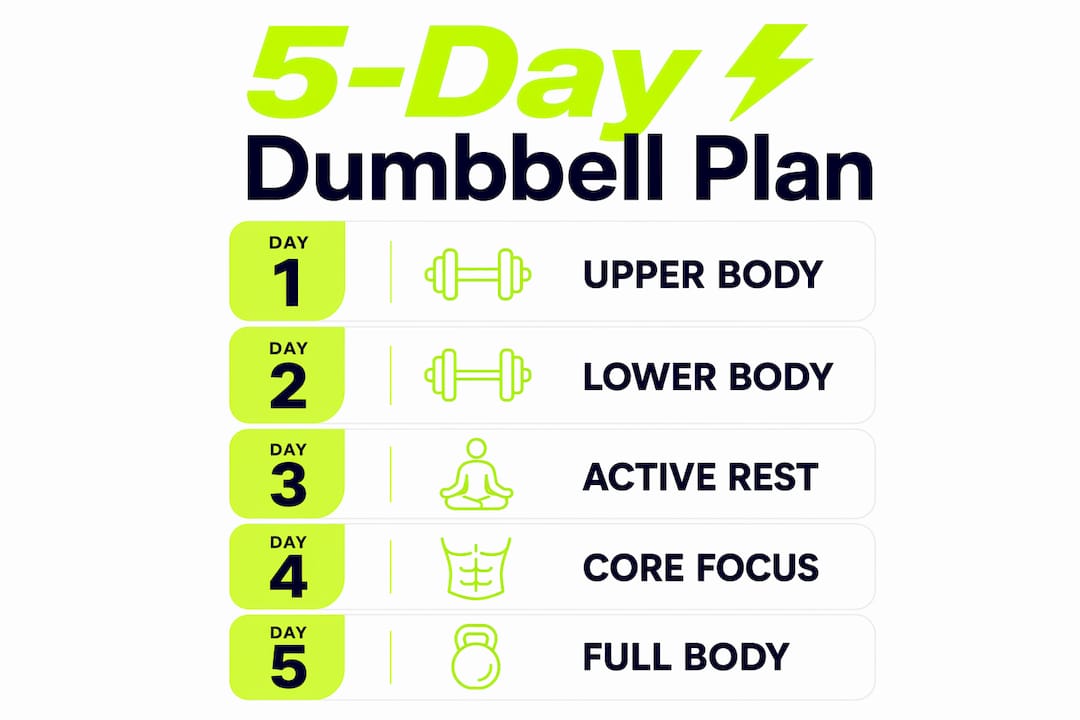
Your 5-day dumbbell split at a glance:
Day 1 — Chest and triceps (push-ups, dumbbell press, overhead triceps extension)
Day 2 — Back and biceps (bent-over rows, dumbbell curls, pullover)
Day 3 — Legs and glutes (goblet squats, Romanian deadlifts, hip thrusters)
Day 4 — Shoulders and core (shoulder press, lateral raises, dumbbell wood chop)
Day 5 — Full body circuit (squat thruster, lunge curl, push-up row)
Each day targets a specific muscle group so you recover properly before hitting that area again. Here’s how to structure each session.
Day 1: Chest and triceps
Dumbbell floor press — 3 sets with a repetition range that supports muscle engagement, rest as needed
Dumbbell chest fly — 3 sets with repetitions designed to balance effort and recovery
Overhead triceps extension — 3 sets with a repetition range supportive of muscle activation and recovery
Close-grip push-up with dumbbell row — 3 sets with repetitions adapted per side
Day 2: Back and biceps
Bent-over dumbbell row — 3 sets with a repetition range that promotes strength development per side, resting as needed
Dumbbell pullover — 3 sets with repetitions designed to balance effort and recovery
Alternating dumbbell curl — 3 sets with repetitions per arm adjusted for muscular endurance
Dumbbell alternating bent-over row with rotation — 3 sets with repetitions targeting strength per side
Day 3: Legs and glutes
Goblet squat — 3 sets with a repetition range optimized for muscle endurance, resting appropriately
Romanian deadlift — 3 sets with a repetition range that supports muscle engagement, rest as needed
Reverse lunge — 3 sets with repetitions per leg designed for balanced strength, resting between sets
Dumbbell hip thruster — 3 sets with repetitions to promote glute and hamstring strength, resting as necessary
Day 4: Shoulders and core
Dumbbell shoulder press — 3 sets with a repetition range that supports muscle engagement, rest as needed
Lateral raise — 3 sets with repetitions that develop shoulder muscle endurance, with sufficient rest
Dumbbell wood chop — 3 sets with repetitions adapted per side, 45 seconds rest
Dumbbell rotational press — 3 sets with repetitions targeting strength per side
Day 5: Full body circuit
ACE Fitness recommends compound movements that hit multiple muscle groups in one exercise for maximum efficiency. Day 5 puts that into practice.
Squat thruster — 3 rounds with repetition range appropriate for whole-body strength
Lunge curl — 3 rounds with repetitions targeting each leg to promote balanced muscle development
Push-up with dumbbell row — 3 rounds with repetitions for each arm designed for muscular endurance
Squat curl — 3 rounds with repetitions intended to increase strength and endurance
ACE Fitness recommends compound movements that hit multiple muscle groups in one exercise for maximum efficiency. Day 5 puts that into practice.
Rest 30–45 seconds between exercises. Move through each circuit with intention, not speed.
Seated and joint-friendly dumbbell exercises you can rely on
Not every day feels like a power session, and that's completely normal. These seated and low-impact variations protect your joints while still delivering real muscle stimulus.
Seated dumbbell shoulder press — Sit upright on a chair or bench, press dumbbells from shoulder height to full extension overhead. Seated positioning removes lower-back strain and isolates the deltoids more directly.
Seated dumbbell curl — Sit with elbows resting on your thighs, curl one arm at a time. Eliminates momentum and forces the biceps to do all the work.
Seated rear lateral raise — Hinge forward at the hips while seated, raise dumbbells out to the sides to target the posterior deltoid. ACE research highlights the rear deltoid as typically the weakest shoulder muscle, making this one worth prioritizing.
Dumbbell hip thruster (floor) — Lie on your back, feet flat, dumbbells resting on your hips. Drive hips toward the ceiling, hold two seconds, lower slowly over four seconds. Excellent for glutes with zero spinal compression.
Pullover to trunk curl — Lie on your back, arms extended overhead holding one dumbbell. Pull arms forward over your chest, then curl your torso up. Targets lats, chest, and core in one movement.
If an exercise causes significant pain, stop and adjust your range of motion. Healthy muscle fatigue feels like a burn; sharp or joint pain is your body asking you to back off.
How often to train and how to keep getting stronger
Consistency beats intensity every time, especially when you’re training with dumbbells at home. Regular sessions spaced to allow for recovery and progression per muscle group is the sweet spot for building strength, with at least 48 hours of recovery between sessions targeting the same muscles.
Session length matters less than effort. Research from Harvard Health confirms that Sessions of moderate duration to balance intensity and recovery are enough for meaningful strength and health gains. On busy days, even a focused Short but intense full-body sessions can also yield effective results also deliver results when intensity is high.
Progression strategies that work with dumbbells only:
Progress by increasing repetitions initially — Before jumping to a heavier weight, complete all sets at the top of your rep range with clean form.
Gradually add sets before increasing weight — Move from 2 sets to 3 sets before adding load.
Control movement tempo to increase time under tension — Count three seconds on the way down, hold, then three seconds on the way up. This increases time under tension without touching the weight.
Incorporate single-limb exercises to increase difficulty without adding weight — Single-arm or single-leg variations dramatically increase difficulty with the same dumbbell.
Gradual load increases — When moving from 5-pound to 7.5-pound dumbbells, do two sets at the lighter weight and one set at the heavier, adding a rep or two each session.
Pro Tip:When a weight starts feeling easy across all three sets, that’s your signal to progress. Don’t wait until it feels effortless for weeks.
Common dumbbell training mistakes and how to fix them
The single most common mistake people make is prioritizing weight over form. Grabbing dumbbells that are too heavy leads to compensations, momentum-driven reps, and a higher injury risk. You can find more on this pattern in our guide to beginner fitness mistakes.
Other mistakes worth knowing:
Skipping the warm-up — Cold muscles are less pliable and more prone to strain. Five to ten minutes of movement before lifting is non-negotiable.
Holding your breath — Exhale during the effort phase (the lift or push), inhale on the release. Holding your breath spikes blood pressure unnecessarily.
Locking out joints — Always keep a slight bend in your elbows and knees at full extension to protect cartilage.
Neglecting the posterior chain — Most people overtrain chest and biceps and underwork their back, glutes, and rear shoulders. Balance your split.
Skipping rest days — Muscle grows during recovery, not during the workout itself. Cutting rest short limits your results.
Pro Tip:Master smooth, slow movement at a lighter weight before adding load. Controlled technique builds the muscle memory that makes heavier training safe later.
Warm-up and cool-down routines for dumbbell sessions
A good warm-up raises your heart rate, loosens your joints, and primes the muscles you’re about to train. Five to ten minutes is all it takes.
Warm-up sequence:
Light walking or marching in place — 2 minutes to raise core temperature
Arm circles and shoulder rolls — 30 seconds each direction
Bodyweight squats — 15 slow reps to open the hips and knees
Hip hinges — 10 reps to activate the posterior chain before any pulling or deadlift work
Light dumbbell practice reps — 1 set of each planned exercise at 50% of your working weight
Cool-downs shift your body from effort to recovery. Walking is a solid way to warm up, and stretching is an excellent cool-down after any strength session.
Cool-down sequence:
Chest opener stretch — Hold 30 seconds, arms wide
Standing quad stretch — 30 seconds each leg
Seated hamstring stretch — 30 seconds each side
Child's pose or hip flexor stretch — 60 seconds total
What to use when you don’t have dumbbells
Living in Florida means you're often traveling, outdoors, or between setups. These substitutes keep your home workout on track when your dumbbells aren't available.
Water jugs — A gallon jug weighs about 8 pounds and has a built-in handle. Use two for rows, presses, and curls.
Backpack loaded with books or canned goods — Adjustable weight, wearable for squats and lunges.
Resistance bands — Not a perfect substitute, but they replicate the tension curve of many dumbbell exercises and travel easily.
Canned goods or laundry detergent bottles — Lighter loads, but useful for shoulder raises and curls when you're in a pinch.
For beginner-friendly exercises that work with minimal equipment, the fundamentals stay the same: control the movement, challenge the muscle, and rest properly.
Nutrition that supports your dumbbell training
Training hard without eating to support it is like filling a car with the wrong fuel. Your muscles need protein to repair and grow after each session.
Aim for protein at every meal, prioritizing whole food sources like eggs, chicken, Greek yogurt, beans, and fish. Carbohydrates fuel your sessions, so don’t cut them entirely, especially before a heavier training day. Hydration matters more in Florida’s heat than most people realize. Dehydration reduces strength output and slows recovery noticeably.
Timing matters too. Eating a protein-rich meal or snack within a couple of hours after training helps your muscles recover faster. You don’t need supplements to get results from a dumbbell program, but a simple protein shake after a session is a practical option when whole food isn’t convenient.
Key Takeaways
A structured dumbbell only workout, built around compound movements and smart recovery, delivers real muscle and strength gains without a gym membership or complex equipment.
Train 2–3 sessions per week. Allow at least 48 hours of recovery between sessions targeting the same muscle group.
Sessions last 20–60 minutes. Even a focused short but intense full-body session can also yield effective results when effort is high.
Form before load. Master slow, controlled reps at lighter weights before increasing dumbbell weight.
Progress gradually. Add reps, then sets, then load. Moving from 5 to 7.5 pounds is a 50% jump.
Warm up and cool down. Five to ten minutes of prep and stretching reduces injury risk and speeds recovery.
Train smarter with Onemor
You’ve got the plan. Now you need the structure that keeps you showing up. Onemor delivers coach-led dumbbell and strength workouts with built-in sets, reps, and rest timers so you never have to guess what comes next. Earn XP, build streaks, and train alongside your tribe. Join the Onemor community and start your first session today, free on iOS.