Yes, most healthy adults can start HIIT right away using short work intervals and generous rest. A simple starter protocol looks like this: a 3 to 5 minute dynamic warm-up, then 20 seconds of work followed by 40 seconds of rest, repeated for 10 to 15 minutes, finished with a 3 to 5 minute cool-down. If you have cardiac risk factors, joint problems, or a chronic condition, check with your doctor before you begin.
TL;DR:
HIIT stands for high-intensity interval training: short bursts of hard effort followed by a recovery period, repeated for a set amount of time. Researchers typically define “high intensity” as roughly 90% or more of your VO2max, or above 75% of your maximal power output, though as a beginner you’ll gauge that by feel rather than a lab test, according to ACE Fitness.
Here’s the part most beginners don’t expect: you don’t need 45 minutes of suffering to get results. Low-volume HIIT, meaning under about 15 minutes of actual work intervals, can improve VO2max and metabolic health markers, according to a review published in PMC. That’s a shorter time commitment than a sitcom episode.
What matters more than intensity is whether you’ll actually do it again next week. A program only works if you stick with it, and that means:
HIIT is intense by design, so a little preparation goes a long way. If you’re an older adult, have heart disease, or you’re returning to exercise after a long break, talk to a doctor before starting. Clinical cardiac rehab programs use HIIT, but only with testing and supervision, according to Harvard Health.
Warm up for 3 to 5 minutes with dynamic movement, arm circles, leg swings, bodyweight squats, and light marching, rather than static stretching, which can temporarily reduce power output right before intense effort, according to the American College of Sports Medicine.
Quick safety checklist:
A useful number to remember: a 30 seconds work to 15 seconds rest ratio, or 30:15, is considered a safe entry point for beginning exercisers, per ACE Fitness.
You don’t need a stopwatch obsession to get this right. A handful of proven templates will carry you through your first month.
Each of these includes a 3 to 5 minute warm-up and cool-down on top of the interval time, so a “12 minute” workout usually takes closer to 20 minutes door to door.
Without a heart rate monitor, use the talk test: during work intervals, you should only be able to speak in short phrases, not full sentences. On a 1 to 10 perceived exertion scale, aim for a 7 or 8 during work periods and a 2 to 3 during rest. If you can’t hold a rough form or you’re gasping to the point of panic, that’s your cue to scale down the movement, not push through it.
Pro Tip: Use active recovery, like slow marching, instead of standing completely still between intervals. It keeps blood moving to your muscles and makes the next burst feel more manageable.
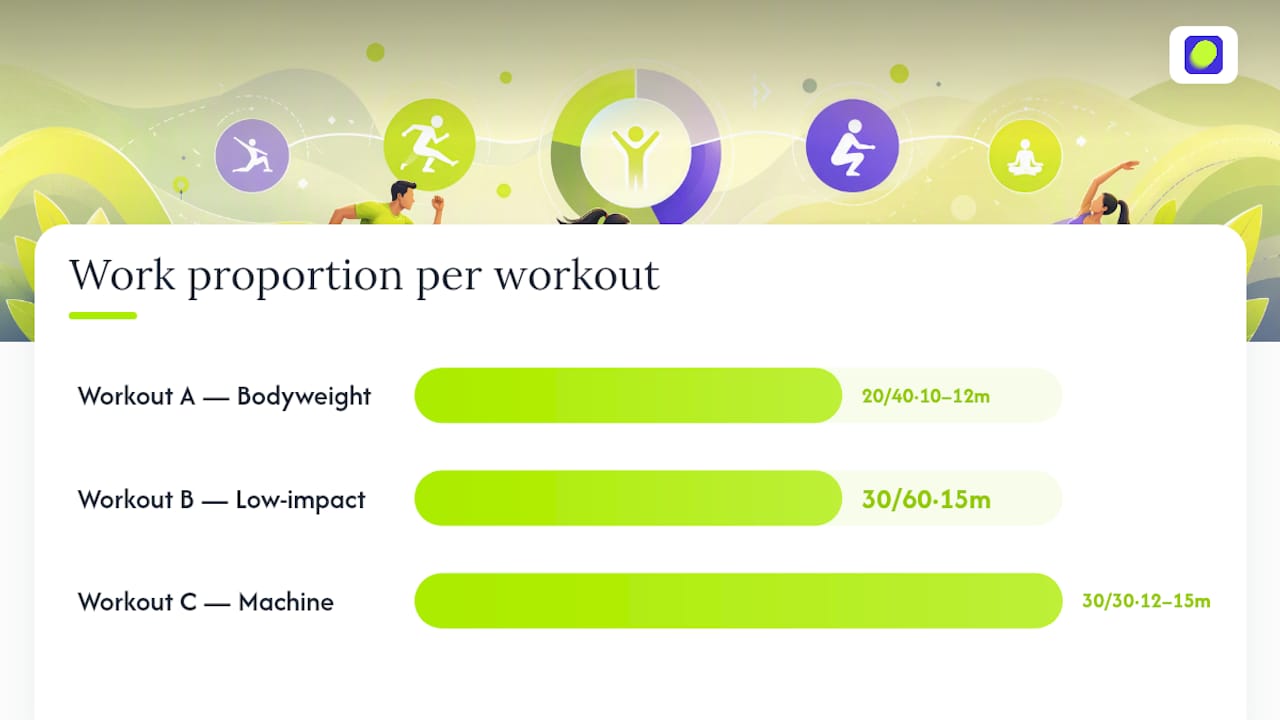
Each of these needs no special gear and roughly 20 minutes including warm-up and cool-down.
Workout A: Bodyweight, no equipment (20:40 ratio, 10 to 12 minutes of work)Alternate 20 seconds each of high march, bodyweight squats, and incline push-ups against a counter or wall, with 40 seconds rest between rounds. Repeat the three-exercise circuit five to six times.
Workout B: Low-impact option (30:60 ratio, 15 minutes of work)Cycle through step-back lunges, glute bridges, and standing mountain climbers (hands on a countertop or bench to reduce impact), 30 seconds each with 60 seconds rest. Swap lunges for seated leg extensions if your knees complain, and swap mountain climbers for standing knee raises if your hips need a break. This routine pairs well with the low-impact HIIT modifications guide if your joints need extra care.
Workout C: Machine-based (30:30 or 30:60 ratio, 12 to 15 minutes)On a stationary bike or elliptical, push hard for 30 seconds, then pedal easy for 30 to 60 seconds. Machines are forgiving on joints and let you dial resistance instead of guessing at impact.
Pro Tip: Rotate between these three workouts across your week instead of repeating the same one. Different movement patterns mean different muscles get the recovery time they need.
You’re ready to progress when the same workout starts feeling noticeably easier, your recovery between intervals feels faster, and your perceived effort drops at the same workload. That’s your body adapting, not a sign you were going too easy.
Make one change at a time:
Keep at least 48 hours between HIIT sessions, and fill off days with walking or light mobility work rather than another hard effort, a pacing pattern echoed in guidance on starting HIIT as a beginner. Your tendons and connective tissue adapt more slowly than your cardiovascular system does, so patience here protects you from overuse injuries down the road.
Most HIIT injuries and burnout come from a short list of avoidable habits, not bad luck.
Swap jumping moves for stepping ones: march instead of jumping jacks, step-back lunges instead of jump lunges, cycling instead of running if your knees are cranky. Former athletes returning after time off deserve an extra note of caution here, since muscle memory can tempt you to jump back to old intensities before your tendons are ready.
Pro Tip: If a movement causes sharp joint pain, dizziness, or chest pain at any point, stop the workout and seek medical attention. Muscle burn is normal; joint pain is not.
This guide draws on contributor Alb’s experience writing beginner-focused workout content for Onemor, including previous guides on warm-ups and joint-friendly training, alongside established research from ACE Fitness, ACSM, Harvard Health, and peer-reviewed exercise science.
One detail worth knowing: perceived competence rises when beginners train with some form of guidance, and that confidence tends to carry over even after they move to training solo, according to research on supervised versus unsupervised HIIT. That’s part of why Onemor builds its programs around:
If early confidence is what’s holding you back, training inside a guided session is a practical way to build it.
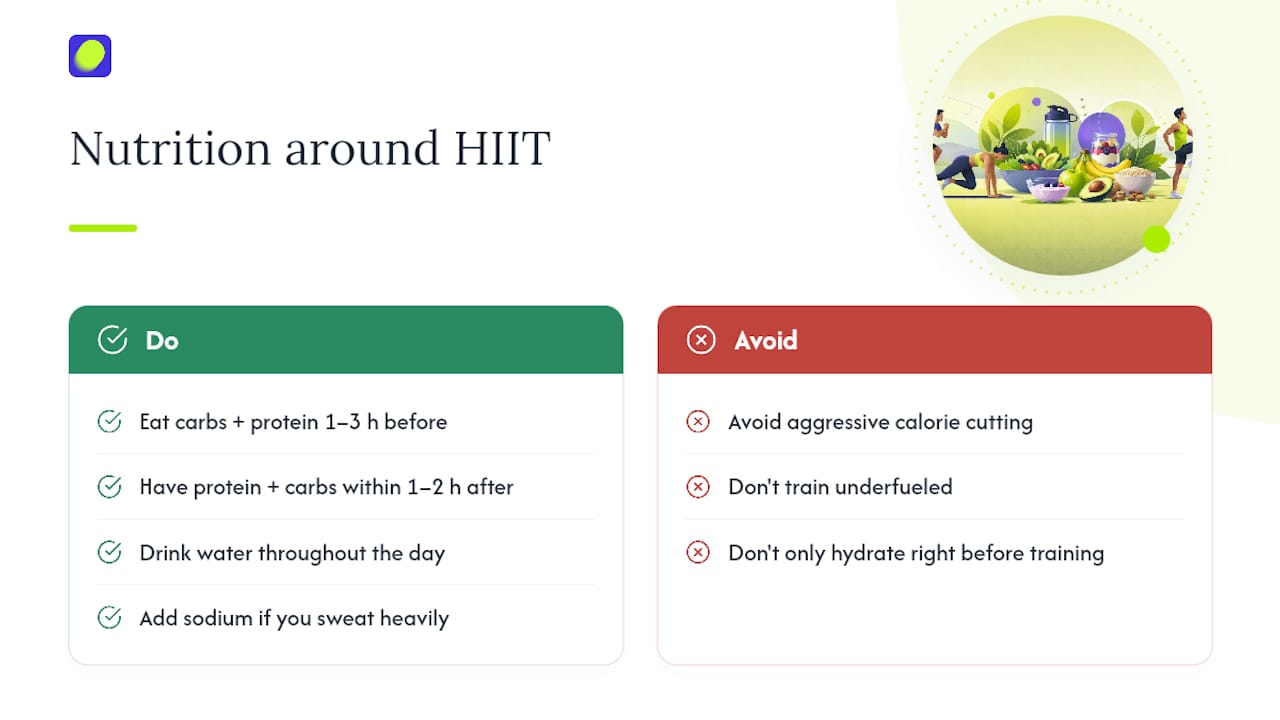
Food won’t make or break a 12-minute workout, but it shapes how you recover and whether you show up for the next one. Eat a small meal with carbohydrates and some protein 1 to 3 hours before training, think oatmeal with fruit, or eggs and toast, so you have fuel for the hard bursts without feeling weighed down.
After a session, protein helps repair the muscle tissue you just worked, and carbohydrates refill the energy stores HIIT burns through quickly. A simple post-workout option is Greek yogurt with fruit, or a turkey sandwich, within an hour or two of finishing. You don’t need a protein shake specifically, whole food works just as well if it’s convenient.
Hydration matters more with interval training than steady cardio because the effort spikes are harder on your system in short bursts. Drink water throughout the day, not just right before you train, and if sessions run in heat or you sweat heavily, a little extra sodium from a normal meal helps replace what you lose.
Beginners sometimes try to pair HIIT with aggressive calorie cutting, expecting faster results. That combination usually backfires. Being underfueled makes intervals feel harder than they should, slows recovery, and raises the odds you’ll skip your next session entirely. Eat enough to support the work you’re doing, and let consistency, not restriction, drive your results.
Reading a workout plan and actually following one under real fatigue are two different things, which is why some apps build HIIT sessions with sets, reps, and rest timers already counted out for you. Instead of watching a clock and guessing whether you’re pushing hard enough, some programs tell you exactly when to work and when to rest, and include features like streaks and tribe challenges to make consistency feel easier to maintain.
Start with a free workout to feel out the pacing, browse Explore all Tribes to find people training at your level, or check out beginner-friendly coaches like Coach Kayla for a structured place to begin. If you want a plan matched to where you’re starting from, visit the Onemor app and find a program built around showing up again next week, not just surviving today’s workout.
For deeper reading, ACE Fitness covers a basic HIIT routine for beginners, ACSM outlines screening and warm-up guidance, Harvard Health explains HIIT and heart health, and PMC reviews HIIT’s effects on fitness. For a warm-up you can follow along with, see Onemor’s dynamic warm-up routine.