Hitting the same weight for the same reps week after week feels frustrating, but it is fixable. Most plateaus on a 2–3 day schedule come down to a few levers: track your lifts, add reps before weight, check sleep and recovery, and take a deload when you are tired. A structured plan with built-in progression takes the guesswork out, and that is what we built Onemor to give you.
One rough workout proves nothing. Strength fluctuates with sleep, stress and illness. One practical approach is to compare roughly 3–6 comparable sessions of the same exercise, with similar order, rep target, rest and technique. It is a rule of thumb, not a scientific cutoff.
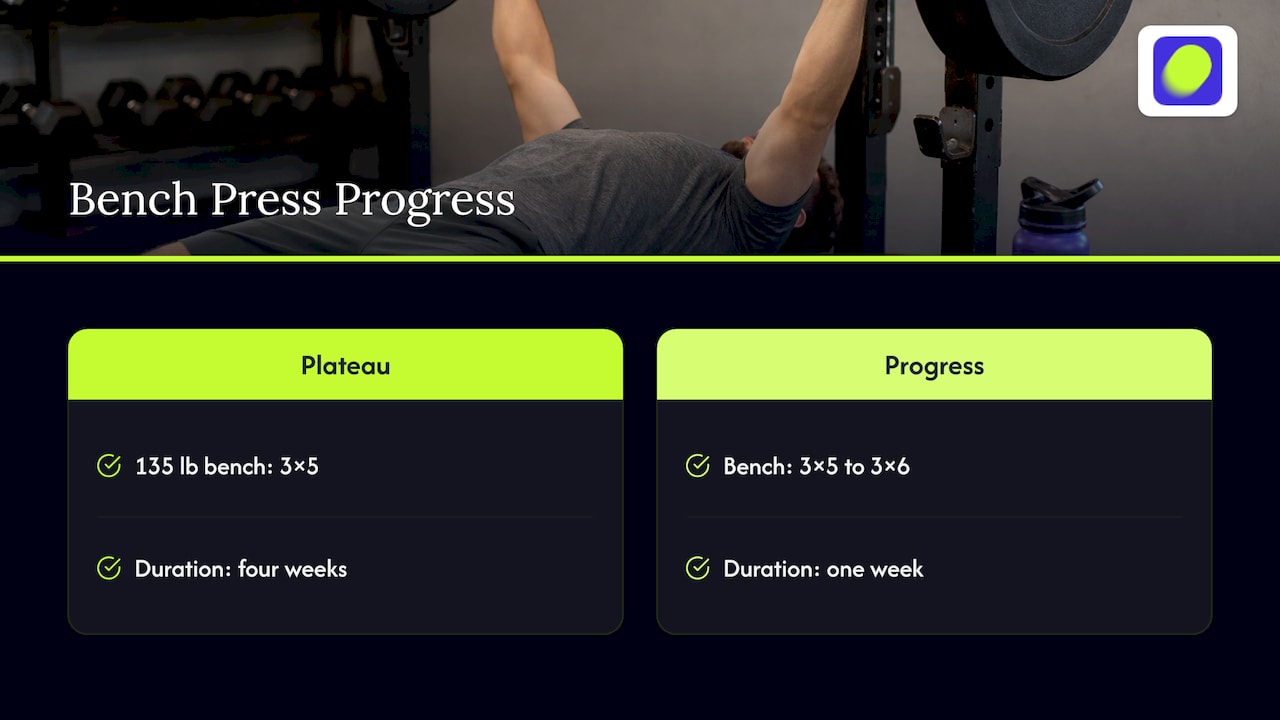
Here is a simple example. If your bench is stuck at 135 lb for 3x5 across four weeks, look into it. If one week goes from 3x5 to 3x6, that is progress.
Beginners should also be patient. Early gains come fast from neural adaptations (your nervous system getting better at using your muscles), then slow down. Adding five pounds over two months can still be meaningful, and treating that as failure leads to program-hopping.
You cannot fix what you cannot see. Record weight, reps and sets for every exercise at each session. Add a note when you slept badly or felt off. After four to six weeks, patterns show up: maybe only your second lower-body day drops, or your body weight is falling while you chase strength.
Onemor’s guided sessions give you sets, reps and rest timers for each workout, so you always know what the day’s target is.
This is the simplest method for a beginner. Pick a rep range like 8–10, choose a weight you can lift for 8 reps with 1–2 reps left in the tank, and add reps across sessions. When you hit 10 on every set, add weight and drop back to 8.
Other levers, in order of how easy they are to try:
Change one thing at a time so you know what worked. Our 6-week progressive overload plan lays this out week by week, and our guide to sets per muscle per week helps you set your volume.
You do not need more gym days. U.S. guidelines, cited by Mayo Clinic, recommend strength training for all major muscle groups at least twice a week. Stuart Phillips, an author of ACSM’s 2026 position stand, says the best program is the one you will stick with, and consistency and effort matter more than a complex plan.
A beginner-friendly setup is two or three full-body workouts a week with form first. If you prefer to split by movement, try push, pull, legs. Form matters before weight too, so see form vs. weight, and rest between sets can help your results: 60–90 seconds for growth, 3–5 minutes for strength.
When progress stalls, the instinct is to do more. But performance dips with fatigue, stress, illness and sleep, and piling on training adds more fatigue that can take weeks to clear.
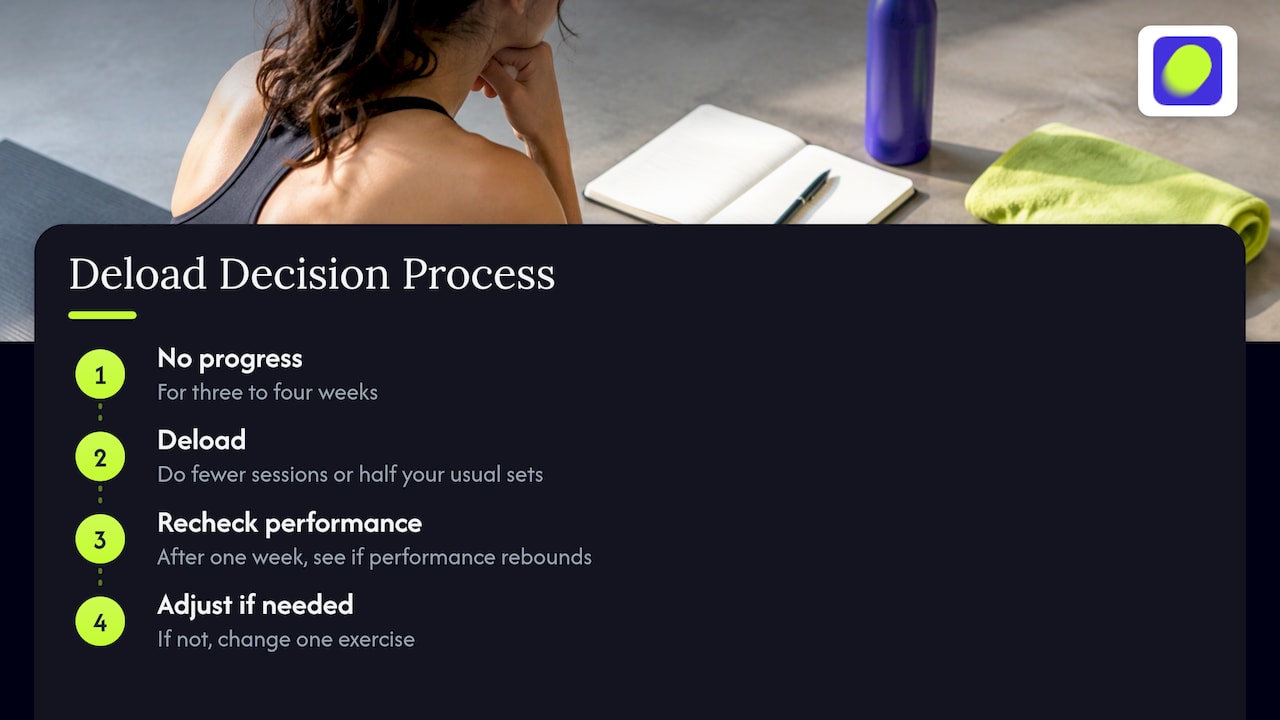
The fix is a deload. If you have had no progress for three to four weeks, do fewer sessions or about half your usual sets for a week. If performance bounces back, fatigue was the issue. If not, change one thing, like one exercise. Here is how to do it: deload week basics.
Sleep is part of the plan. Most adults should aim for seven to nine hours a night, and our sleep for muscle growth guide goes deeper. Recovery time between sessions matters as well, and this guide on recovery times between workouts shows how long muscles need.
Delayed onset muscle soreness, or DOMS, is the ache that shows up after a new or hard workout. Cleveland Clinic says it starts one to three days after intense exercise and rarely lasts more than five days. Early soreness reflects small muscle tears that repair into stronger tissue, so it is a sign of adaptation.
The key difference: DOMS gradually lessens over days, while injury pain often stays the same or gets worse.
If pain lasts more than a week, is sharp and constant, comes with severe swelling, or your urine is unusually dark or bloody, see a healthcare provider. Dark, tea- or cola-colored urine with worsening pain can signal rhabdomyolysis, a rare condition that needs emergency care. If an exercise hurts, stop it, try a lower weight, or retry in a few days.
Plateaus are easier to beat when someone else plans the progression. Onemor offers workouts led by top trainers, guided sessions with sets, reps and rest timers, plus streaks, XP and tribe challenges with friends, for training at home or the gym. You can start on the free plan at onemor.com or look at Pro. New to lifting? Try 3x a week guided strength workouts.
Check consistency, sleep, protein and technique first. Then use double progression, add a set or two toward about 10 weekly sets per muscle, and deload if you have been stuck three to four weeks.
Usually a few days, and rarely more than five. See a healthcare provider if it lasts beyond a week or is sharp and constant.
Not usually. Reducing load makes sense, but stopping entirely does not for moderate soreness. Gentle movement helps. Sharp or worsening pain is a reason to stop and get checked.
A common rule of thumb is three to six comparable sessions with no progress. Some coaches wait six to eight weeks for strong beginners.