A deload week is a planned week of lighter training. You still show up, but you cut your sets, your weights or how hard you push, so your body and mind can catch up with the work you’ve been doing. Most lifters take one every 4 to 6 weeks, and you can do it without losing the progress you worked for.
If you’ve ever felt flat in the gym for no clear reason, this one’s for you. Let’s make it simple.
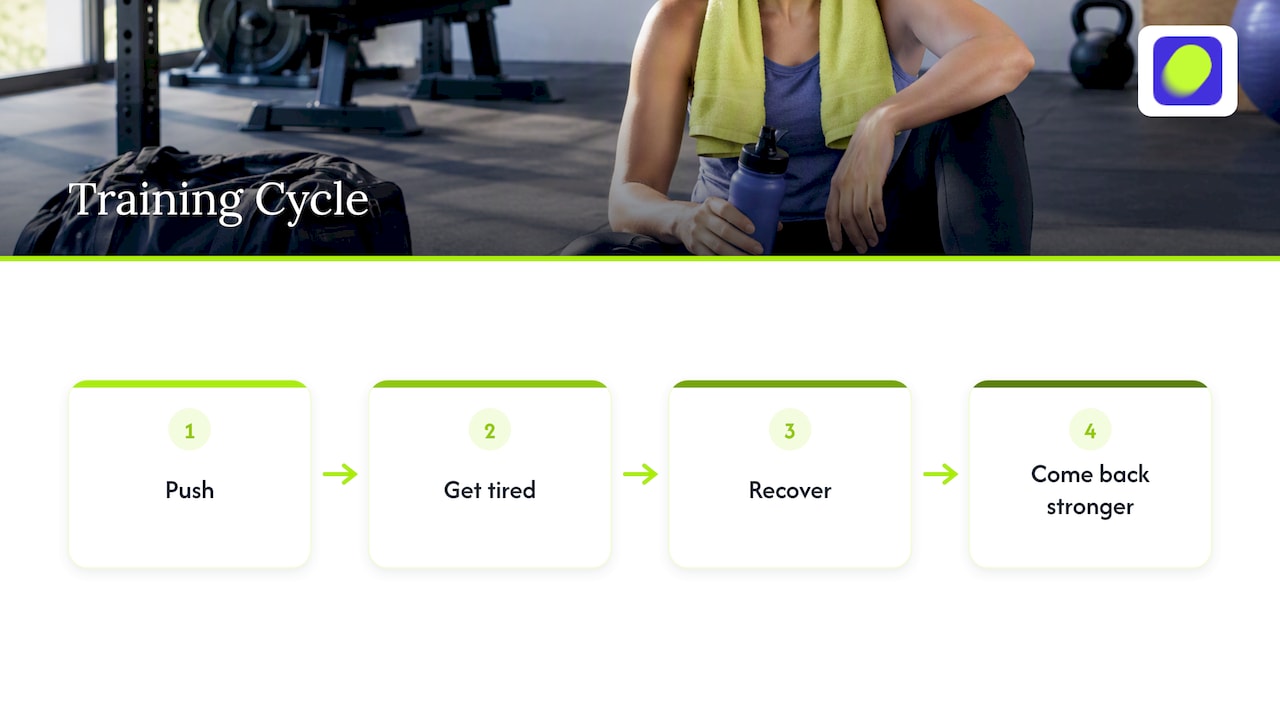
Think of training as a cycle: you push, you get tired, you recover, you come back stronger. A deload is the “recover” part, built into your plan on purpose instead of forced on you by burnout.
Researchers describe a deload as a period of reduced training stress designed to ease physical and mental fatigue and improve how ready you are for the next training cycle. It typically lasts around 7 days.
There’s a nervous system side too. Cleveland Clinic notes that deloading helps refresh your nervous system as well as letting your muscles recover. That’s why a deload can feel mentally good, not just physically good.
One honest caveat: there’s no single agreed method of deloading. Coaches and athletes do it in different ways. So treat what follows as a solid starting point, then adjust to how you feel.
People mix these up all the time, but they’re different tools.
As Cleveland Clinic explains, with a deload you remain active. NSCA guidance says the same: you reduce your usual intensity or volume rather than stopping.
Does a full break ever make sense? Sometimes. One study found that a full week off at the midpoint of a training block produced similar gains in muscle size, endurance and power, while continuous training improved lower-body strength more. So a total break won’t wreck you, but for most people a lighter week keeps the habit and the movement patterns alive.
There are two ways to decide: by the calendar or by your body.
Planned deloads. Deloading is generally done every 4 to 6 weeks for about 7 days, though some deloads last anywhere from a single session to 2 weeks. Pick a rhythm, put it in your calendar and treat it like any other training week.
Reactive deloads. NSCA guidance says deloads can be pre-planned in a structured program or used reactively to deal with unexpected fatigue or performance stalls.
Signs it may be time:
If you’re a beginner training two or three days a week, you may not need a deload as often as someone lifting five days. That’s our practical read, not a hard rule. Lower weekly volume means less fatigue piling up, so many beginners do fine with a lighter week every 6 to 8 weeks, or whenever the signs above show up. Just remember the research range of 4 to 6 weeks was drawn from strength and physique athletes, so listen to your own body first.
Being in a calorie deficit or short on sleep makes fatigue stack up faster. Good sleep is half the recovery equation, and our sleep for muscle growth guide shows how to get more from it.
You have three dials: volume, intensity and effort. Frequency stays put.
Keeping your days the same protects your routine, which is the hardest part to rebuild if it slips.
Should you extend your rest between sets? You don’t need to. Shorter, easier sessions are the point. If you want a refresher on rest times for normal weeks, see our rest between sets breakdown.
Here’s an example for a beginner doing three full-body days. These numbers are a practical illustration built from the 50% guideline above, not a prescription from a study.
Say a normal week is 3 sets of 8 to 10 reps on squats, presses and rows, each taking you close to your limit.
Day 1 — Full body A
Day 2 — Full body B
Day 3 — Full body C
On a 2-day routine, use the same plan with the first two days. Each session should feel like a warm-up with purpose. You should leave feeling better than you arrived, not wiped out. Starting with a 5 to 10 minute dynamic warm up helps keep it crisp, and a short cooldown wraps it up.
Training at home? A bodyweight strength program can slot into a deload week easily: fewer sets, slower reps, plenty of reps left over.
Use the extra energy for recovery, not for squeezing in a second workout. Some athletes in the research used massage, static stretching and foam rolling alongside their deloads. Easy walks and a bit of mobility work help too, and our active recovery plan lays out a full week.
If you’re dealing with a nagging injury rather than general tiredness, a deload alone isn’t a fix. Building a daily routine for injury recovery can help you structure the healing days, and a physical therapist or doctor is the right person to see for pain that sticks around.
When the week is over, return to your normal sets and weights, or nudge them up slightly if the deload did its job. Many lifters find the first session back feels surprisingly strong.
Don’t stretch the deload into a second or third week out of caution. Practitioners suggest keeping it under about a week so you don’t start reversing your adaptations. Then get back to adding small improvements, which our progressive overload plan for beginners walks you through. And if three days a week is your pace, you’re in good company: it builds muscle and fitness.
Planning when to push and when to pull back is the part most beginners find confusing. With Onemor, you train with coach-led workouts and guided sessions that show the sets, reps and rest timers, so you’re never guessing what today looks like. Streaks, XP and tribe challenges keep you showing up, including on lighter weeks.
Ready to try it? Start with the free plan and see how structured training feels, or compare what’s included in Pro.
Research on strength and physique athletes shows deloads generally happen every 4 to 6 weeks. Beginners training two or three days a week may stretch that a little, and anyone can deload sooner if fatigue builds up.
Yes, a full break won’t ruin your progress, and one study found similar muscle size gains with a week off midway. A deload keeps your routine and movement skills active though, which is why most coaches prefer it.
A common guideline is to reduce weight, sets and reps by up to 50%. Keep your normal training days and stop sets well before failure.
About one week is typical. Some last only a session, and some stretch to two weeks, but going longer than a week risks losing adaptations.