A good beginner pull day is six exercises or fewer: one vertical pull, one horizontal row, one rear-shoulder move and one or two curls, done for 2 to 3 sets of 8 to 12 reps. It should take about 45 minutes. Below you’ll find the exact workout, what to do first, how heavy to go and how to build on it week after week.
If walking into the gym and wondering what to do with the cable machines feels familiar, you’re in good company. We built this routine to take the guesswork out.
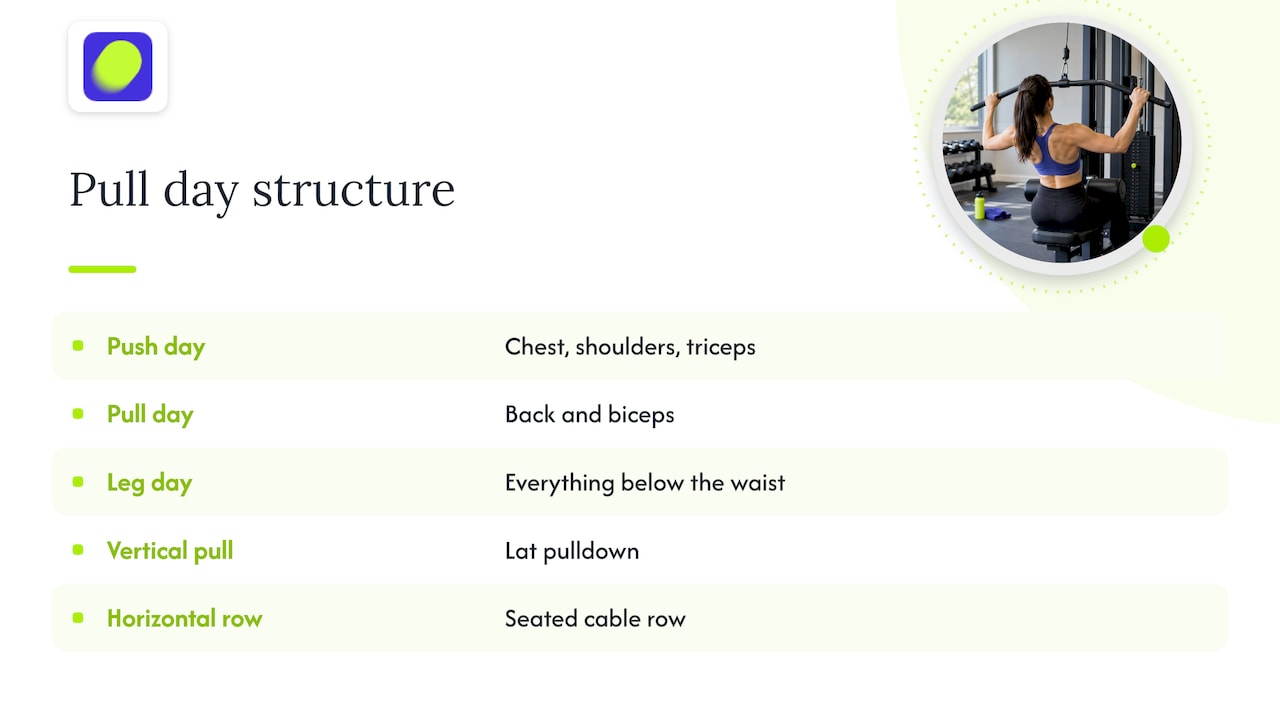
A pull day is one session in a push/pull/legs split. Push day covers chest, shoulders and triceps. Pull day covers your back and biceps. Leg day covers everything below the waist. If you want the full picture of how the three fit together, our guide to push pull legs for beginners walks through it.
Think of it less as a list of muscles and more as two movement patterns. Coaches recommend including both a vertical pull, like a lat pulldown, and a horizontal row, like a seated cable row, so your back gets worked from different angles. That balance also helps with posture, which matters if you spend your day hunched over a phone or laptop.
Here is the whole session in order. Rest 1 to 2 minutes between sets on the lighter moves and 2 to 3 minutes on the big ones, in line with ACSM rest guidance.
That’s about 14 to 16 working sets. With warm-up sets and rests, expect roughly 45 minutes. Is four exercises enough? Yes, for your first weeks. Lat pulldown, row, face pull and one curl is a complete session.
Start with the big, multi-joint lifts while your energy is highest, and save single-joint work like curls for the end. That’s the order ACSM’s progression guidance recommends: large muscles before small, multi-joint before single-joint.
It makes sense when you picture it. If your arms are already tired from curls, your lat pulldown will suffer, because your biceps help on every pull. Do the demanding lifts fresh.
Beginners get more from slow, clean reps than from heavy ones. ACSM guidance points beginners toward mastering form and a controlled tempo before chasing heavier weights.
Sit tall, grip the bar slightly wider than your shoulders and pull it toward your upper chest. Think about driving your elbows down toward your ribs, not yanking with your hands. Don’t lean far back to cheat the weight down.
Keep your chest up and your back long. Pull the handle to your lower ribs and squeeze your shoulder blades together for a beat. Let your arms straighten under control on the way back.
Keep your back flat and pull the dumbbell toward your hip, not straight up to your shoulder. Pause at the top, then lower slowly.
Pin your elbows to your sides and avoid swinging. If you need momentum to lift it, the weight is too heavy.
Want more back-specific coaching? Our first beginner back workout goes deeper on technique.
For beginners, the ACSM position stand recommends 8 to 12 repetitions per exercise at a moderate load, starting at 1 set and moving up to 1 to 3 sets as you progress. If sets and reps still feel like a foreign language, we break them down in sets and reps explained and in what 3 sets of 12 reps means.
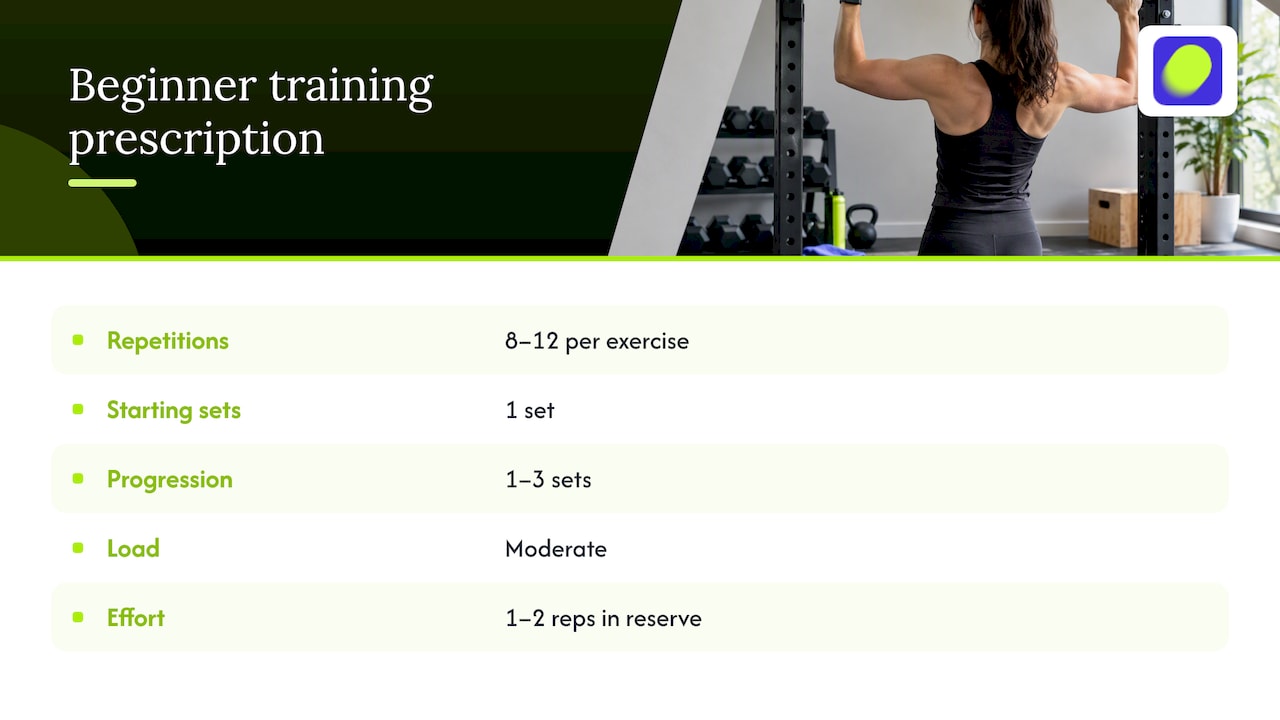
You don’t need to test a one-rep max. Instead, pick a weight that feels challenging but leaves one or two reps in the tank. Research shows trainees left to choose their own loads often pick around 53% of their one-rep max, which is one reason many people are advised to push a bit closer to challenging. A rep range plus that “one or two left” rule is simpler and less intimidating than chasing percentages.
And you don’t need to grind to failure. A scoping review found that training to set failure is likely not superior for muscle growth and may add fatigue and muscle damage. For a beginner, showing up next week matters more than wrecking yourself today.
US guidelines say adults should do muscle-strengthening activity on at least 2 days a week, plus 150 minutes of moderate aerobic activity weekly. For most new lifters, 2 to 3 strength days fits well with recovery.
A simple three-day week looks like this:
Only two days available? Alternate your pull day with a push or full-body session. Our guide to starting strength training with 2 to 3 sessions a week shows how to plan it.
What about the “3-3-3 rule” you may have seen online? It usually means 3 exercises, 3 sets, 3 times a week. It’s social media shorthand, not a clinical guideline, but its value is that it keeps you consistent. Use it as a simple starting frame if it helps.
Progress doesn’t need to be dramatic. Try this four-week pattern:
Write your numbers down or log them in an app. Beating last week by one rep is a real win.
Also, no cable machines at home? A pair of dumbbells goes a long way, and our dumbbell plan for absolute beginners shows how. And if pull-ups are a goal, try the 4-week pull-up progression once your pulldown feels solid.
Knowing the workout is one thing. Showing up and following it is another. In Onemor, you train with coach-led workouts and guided sessions that give you sets, reps and rest timers, so you’re not squinting at a note on your phone between sets. Streaks, XP and tribe challenges with friends help you stay consistent.
You can start on the free plan and see how it feels, or look at what Pro adds. Ready to train with a plan? START YOUR FIRST SESSION and let us do the planning.
About 45 minutes works for most beginners, including warm-up. Some programs run longer, but you don’t need an hour or more to get a productive session. Stop when your planned sets are done and your form is still clean.
Yes, as a beginner. Four well-chosen exercises, like a lat pulldown, a row, a face pull and a curl, cover the main movement patterns. Add a fifth or sixth later as your recovery and confidence grow.
It’s an online shorthand for 3 exercises, 3 sets, 3 times a week. It isn’t a scientific requirement, but it gives beginners a simple structure that’s easy to stick to.
Yes. Dumbbell rows, reverse flies, curls and resistance-band pulldowns cover the same patterns. Choose a weight that leaves you one or two reps short of your limit.