Workout Accountability Group: How to Join or Start One
Add Onemor as a preferred source on Google
A workout accountability group is a small, committed circle of people who help each other show up for workouts through public commitments, recurring check-ins, and shared social rules. It works best for anyone who struggles with consistency when training alone, and the single fastest next step you can take right now is to invite three people to a weekly check-in, even a five-minute voice call on Sunday night.
TL;DR:
Post a public 7-day commitment in a group chat tonight ("I commit to 30 min of cardio 5x this week, reporting daily at 8 PM")
Invite 3–6 people who share your goal and set your first check-in within 48 hours
If you want a ready-made option, Onemor Tribes give you a coached group with built-in streaks and structured check-ins from day one
What to do right now:
Text three people — "Want to do a 30-day fitness check-in group with me?"
Create a group chat and post your first commitment before you go to sleep tonight
Pick a check-in time that works for everyone, same day, same time, every week
Write one sentence describing your goal and share it with the group
Research grounded in Self-Determination Theory and a Nature Human Behaviour meta-analysis of 71 studies confirms that group-based formats produce meaningful advantages, especially when the group uses deliberate social dynamics rather than just exercising side by side.
Why does a workout accountability group actually work?
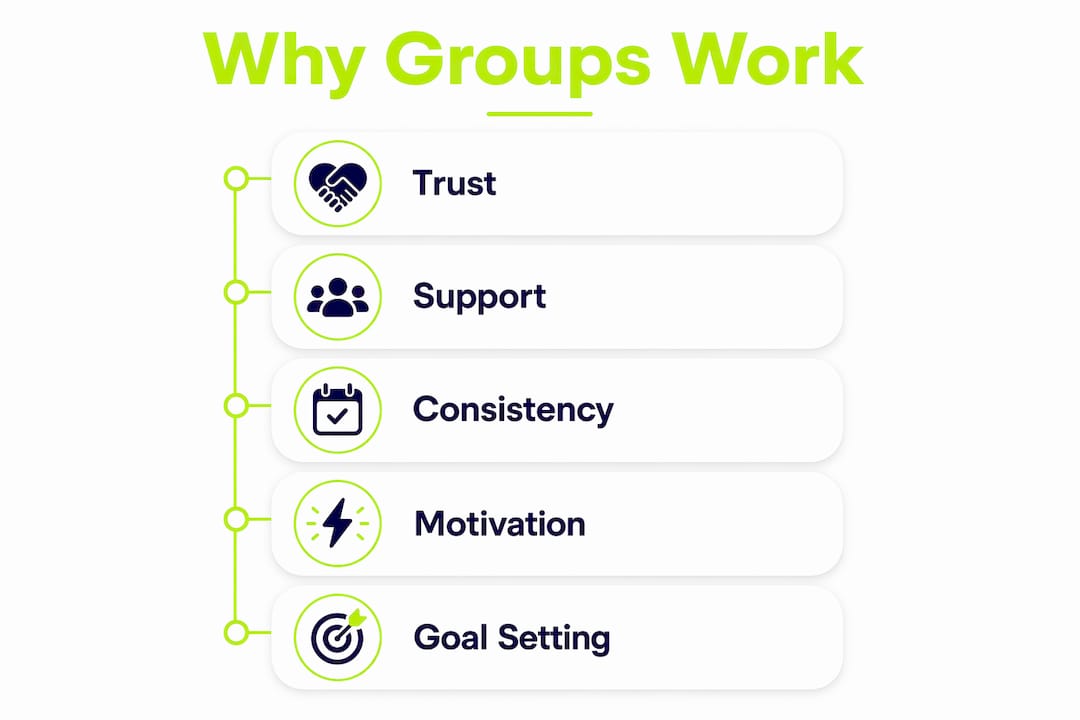
The short answer: group mechanisms, specifically social capital, accountability pressure, and self-efficacy, change the math on whether you show up. Here is what the research actually says.
Social capital, meaning the trust and reciprocity you build with your group, turns out to be one of the strongest predictors of exercise intention. When you trust the people in your group and feel a sense of mutual obligation, you are far more likely to keep coming back. Exercising alongside strangers in a class does not create that bond automatically. You have to build it deliberately.
The distinction between emotional and instrumental support matters here, too. An 8-week intervention study found that received emotional support, things like encouragement and validation, predicted self-efficacy, self-monitoring, and action planning, and indirectly increased actual exercise. Instrumental support, meaning logistics help like ride-sharing or scheduling, showed no measurable effect on its own. In other words, your group's job is to believe in you, not just coordinate with you.
Self-efficacy is the bridge between support and behavior. When your group tells you they believe you can do it, and you see them doing it too, your own confidence in your ability rises. A longitudinal study published in BMC Public Health showed that social support had a significant direct effect on exercise persistence in adolescents, and an even stronger indirect effect through self-efficacy and autonomous motivation. The group does not just push you; it changes how you see yourself as someone who exercises.
The Nature Human Behaviour meta-analysis of 71 studies found that "true groups," those that deliberately use shared goals, group identity, and group feedback, outperformed standard exercise classes on health outcomes. Mode does not matter as much as quality: online and face-to-face groups showed comparable effectiveness when the interaction was genuine.
What types of fitness accountability groups are out there?
Not every format fits every person or goal. Here is a quick breakdown of the main types, with honest pros and cons for each.
One-on-one fitness buddy — Two people check in daily, swap workout logs, and hold each other to a shared schedule. High personal depth and easy to coordinate, but the whole system collapses if one person drops out. Best for habit formation and beginners who want low-pressure accountability.
Small peer group (3–6 members) — The sweet spot for most people. Research consistently points to 3–6 members as the ideal size: small enough for real trust, large enough to survive one person having a rough week. Works well for weight loss, strength training, and endurance goals.
Class or club format — A recurring group fitness class or running club where members see each other regularly. Social depth is lower than a peer group, but the structure is built in. Great for people who need external scheduling rather than self-directed planning.
Virtual or app-based tribe — An online group using a shared channel, app, or platform. Online and face-to-face groups show comparable effectiveness when interaction quality is high. Ideal for people with unpredictable schedules or who live far from their accountability partners. The benefits of accountability in fitness are just as real in a virtual setting when the group commits to daily check-ins.
Coach-led tribe — A trainer or coach facilitates the group, sets the program, and runs structured check-ins. Highest cost, but also the highest structure and the lowest dropout rate. Best for people who want results fast and do not want to figure out the logistics themselves.
How do you find or join a workout accountability group in the U.S.?
Most people find a reliable group through one of five channels: local gyms, community apps, workplace wellness programs, social platforms, or coached app-based tribes like Onemor. Here is a step-by-step approach.
Search your gym's bulletin board or app — Many gyms in Florida post group fitness challenges or small-group training programs. Ask the front desk directly: "Do you have any accountability groups or challenge programs running right now?"
Post in a community group — Facebook Groups, Nextdoor, and Reddit communities (search "r/fitness" or your city's subreddit) are active spots. Use this message: "Looking for 3–5 people for a weekly fitness check-in group. Goal: [your goal]. Commitment: one weekly call and daily text updates. Anyone in?"
Check your workplace — Workplace wellness programs often have walking challenges or step-count competitions. If yours does not, you can start one with a Slack channel and a shared Google Sheet.
Try a coached app tribe — If you want structure without the setup work, Onemor's tribe feature connects you with a coach-led group that has built-in check-ins, streak mechanics, and a ready-made community.
Vet the group before committing — Ask three questions before you join: How often do we check in? What happens if someone misses a week? Is there a written agreement or social contract? A group that cannot answer these clearly will likely fade within two months.
Pro Tip:Try a 30-day trial before making any long-term commitment. Show up consistently for four weeks, then evaluate: Are people engaged? Do you feel accountable? Is the group growing or shrinking? A group that cannot hold attention for 30 days will not hold it for 90.
Free community groups cost nothing but your time, typically 30–60 minutes per week for check-ins plus daily micro-updates. Coached groups or premium app subscriptions usually run on a monthly subscription model, with free tiers available on most platforms.
How do you start and structure an accountability group that lasts?
Start a 4–6 person group with a written social contract and weekly 45–60 minute structured check-ins, plus a daily micro-check-in mechanism in an async channel. That one-line blueprint covers the structure that keeps groups alive past the 60-day mark, when most informal groups collapse without clear expectations.
Recruitment: Invite people who share a specific goal, not just a general interest in fitness. "I want to lose 15 pounds by July" is a group. "People who like working out" is not. Use commitment language when you invite: "I'm looking for people who can commit to one weekly call and a daily check-in message for the next eight weeks. Are you in?"
Written social contract: Put these items in writing before your first meeting.
Attendance rule (e.g., "Miss two consecutive weeks and we check in privately")
Feedback style (supportive only, no unsolicited advice)
Confidentiality (what's shared in the group stays in the group)
Grace rule (everyone gets one "life happens" pass per month, no explanation needed)
Sample weekly meeting agenda (45–60 minutes):
0–10 min: Each member reports out: What did you do? What did you miss? No judgment.
10–30 min: One member in the "hot seat" shares a specific challenge; group offers support and ideas.
30–45 min: Everyone states their commitment for the coming week out loud.
45–60 min: Quick retro every four weeks: what's working, what needs to change.
Between meetings, keep a shared async channel (a group chat, Slack, or Discord) where members post a daily "done" message. Between-meeting mechanisms like a shared channel or a public commitment board dramatically improve consistency compared with weekly meetings alone.
For proof methods, use a written buddy pact that specifies a 4–8 week target window, a proof method (a workout photo or app screenshot), and a grace rule for missed sessions. Written pacts outperform verbal promises every time.
Pro Tip:Give your group a name and a simple ritual. Something as small as a weekly GIF reaction or a shared emoji for "done" builds identity fast. Groups with a shared identity hold together longer than groups that are just a chat thread.
What kills accountability groups, and how do you fix it?
Most informal groups fail within about 60 days without structure, clear expectations, and consequences. Here are the most common failure modes and their fixes.
Vague goals — Cause: members joined with different expectations. Fix: rewrite each person's goal as a specific, measurable commitment at the next meeting.
Commitment mismatch — Cause: one person is all-in, another is casual. Fix: revisit the social contract and ask each member to re-confirm or exit gracefully.
Drift — Cause: check-ins get shorter, then skip a week, then two. Fix: schedule a formal 30-day reset meeting with a new written commitment round.
Missing members — Cause: life disruptions without a grace rule. Fix: add an explicit grace rule to the social contract so members can miss a session without feeling like they've failed the group.
Burnout — Cause: too many check-ins, too much pressure. Fix: reduce daily check-ins to three times per week and remind the group that rest is part of the program.
No consequences — Cause: commitments are made but never tracked. Fix: add a small stakes pool (everyone puts $5 in; whoever hits their weekly goal gets it) or a public commitment board.
Pro Tip:If your group has gone quiet for two weeks, do not let it die silently. Send one message: "30-day reset — who's still in?" A single direct question re-activates more groups than any motivational speech. If fewer than half respond, it's time to rebuild with a smaller, more committed core.
What do coaches and exercise psychologists say makes groups stick?
The single biggest predictor of long-term group adherence is trust and reciprocity, the social capital that builds when members show up consistently, follow through on commitments, and support each other without judgment. Emotional support, not logistics, is what drives self-efficacy and keeps people coming back.
Here are the five research-backed recommendations that group leaders can act on immediately.
Build true group dynamics — Use shared goals, group identity, and group feedback rather than just exercising near each other. True groups outperform standard classes on health outcomes in meta-analytic data.
Prioritize emotional support — Encourage members to validate and cheer each other, not just share schedules. Emotional support predicts self-efficacy; logistics do not.
Use written buddy pacts — A written pact with a timeframe, proof method, and grace rule consistently outperforms verbal agreements.
Keep the group at 3–6 members — Smaller risks collapse; larger lose the personal depth that makes accountability real.
Schedule 30 and 90-day retros — Groups that review and reset their format at regular intervals stay active far longer than those that run on autopilot.
For goal-setting that complements your group's structure, fitness goal-setting best practices recommend pairing specific, measurable targets with a social accountability layer, exactly what a well-run peer group provides.
A field experiment published in Management Science found that gym members who visited with a friend under a tandem reward structure visited about 35% more frequently than those earning an individual reward, even though the tandem condition added a logistical hurdle. Making the behavior social changed the math entirely.
Your copy-and-use checklist to join or start a group
Use this list to get moving today. Screenshot it, copy it to your notes, or share it with your future group.
To join an existing group:
Search your gym, Nextdoor, or a relevant Facebook Group for active fitness challenges
Post a clear message with your goal, commitment level, and preferred check-in format
Ask the three vetting questions (check-in frequency, missed-session policy, written agreement)
Commit to a 30-day trial before deciding if the group is right for you
To start your own group:
Invite 3–6 people with a specific shared goal
Create a group chat and post your first commitment tonight
Write a one-page social contract covering attendance, feedback style, confidentiality, and grace rules
Set a recurring weekly check-in (same day, same time)
Set up a daily async channel for "done" posts
Schedule your 30-day retro before your first meeting
Time and cost:
Weekly time commitment — Roughly 60–90 minutes (45-min check-in plus daily micro-updates)
Free community groups — $0, just your time and consistency
Copy-ready commitment post:"I commit to [workout type] [frequency] this week. I'll report in this channel every day at [time]. My 30-day goal is [specific goal]."
Key Takeaways
A workout accountability group works because trust, emotional support, and shared social rules change how consistently people show up, and the most effective groups are small (3–6 members), structured, and built on written agreements rather than good intentions.
Ideal group size. Keep it at 3–6 members; smaller risks collapse, larger loses personal depth.
Emotional support wins. Encouragement and validation predict self-efficacy and persistence; logistics alone do not.
Written pacts matter. A buddy pact with a 4–8 week target, proof method, and grace rule outperforms verbal promises.
Between-meeting structure. A daily async channel or public commitment board dramatically improves consistency beyond weekly calls.
Ready-made option. Onemor Tribes offer coach-led groups with built-in streaks, check-ins, and tribe challenges for those who want structure from day one.
The part most people get wrong about group accountability
Most people assume that the hardest part of a workout accountability group is finding motivated people. It is not. The hardest part is building enough trust that members feel safe admitting they missed a workout.
Groups that skip the social contract and jump straight to sharing workout logs tend to fall apart around week six or seven. Not because people stop caring, but because one person misses a week, feels embarrassed, and quietly disappears. Without a grace rule and a culture of honest reporting, the group becomes a performance rather than a support system. And performances are exhausting to maintain.
The research on emotional support makes this concrete: what keeps people exercising is not someone tracking their reps. It is someone saying "I know this week was hard, and I'm glad you're still here." That is the thing a well-run group does that no solo fitness app can fully replicate. Structure matters, but belonging matters more.
Onemor Tribes: a coached group that's ready when you are
If building a group from scratch sounds like a project you will start next month and never quite get to, Onemor Tribes are worth a look right now. Instead of recruiting members, writing a social contract, and figuring out a check-in format yourself, you join a coach-led tribe that already has all of that in place.
Onemor connects you with real coaches like Coach Branden, Coach Kayla, and Coach Jahson, each running structured tribe programs with guided workouts, streak mechanics, XP, and in-app check-ins that keep the group honest between sessions. You get the social accountability of a peer group and the structure of a coached program, without the setup work. The app is free to download on iOS, with premium subscription options for full tribe access and coaching features.
Ready to stop planning and start showing up? Explore all Tribes on Onemor and find a group that fits your goal today.
Useful sources and further reading
Nature Human Behaviour meta-analysis (71 studies on group vs. individual exercise interventions) — The strongest available evidence on when group formats outperform individual ones and what "true groups" actually means.
Frontiers in Sports and Active Living: Social capital and exercise motivation — Explains why trust and reciprocity are the most influential predictors of exercise intention in group settings.
British Journal of Health Psychology: Emotional vs. instrumental support — 8-week intervention showing emotional support drives self-efficacy and exercise; instrumental support does not.
BMC Public Health: Social support and exercise persistence — Longitudinal evidence that social support increases adherence primarily through self-efficacy and autonomous motivation.
Management Science: Tandem rewards field experiment — Field experiment (n=774) showing gym members visited 35% more frequently when workouts were made social.
FineStreak: 6 steps to start an accountability group — Practical blueprint covering group size, social contracts, between-meeting mechanisms, and 30/90-day reviews.
The Healthy Habit Hub: Building accountability with workout buddies — Practitioner guidance on written buddy pacts, proof methods, and grace rules.
Onemor Tribes — Onemor's coached tribe feature for readers who want a ready-made, structured accountability group.