Lifting weights will not make you bulky, and yes, women should lift. Major medical and fitness bodies recommend strength training at least twice a week, and the research shows women build strength and muscle just as well as men do. If you train 2-3 times a week and want structure instead of guesswork, our coach-led sessions on Onemor give you sets, reps and rest timers to follow from day one.
Below, we go through the myths that keep people out of the weight room, what the evidence says, and how to start.
This is the big one, and it is false. Harvard Health notes that for most women, muscle adds tone and strength, not appreciable size.
Here is why. Testosterone is the main hormone driving muscle growth, and women have much less of it. The National Strength and Conditioning Association explains that men’s testosterone response to lifting is also much higher, so a very concentrated effort would be needed for women to build the bulk many fear.
It also takes time. NASM says building a large amount of muscle takes years of dedicated effort and extra calories. A few weeks of squats will not change your frame overnight. What you will notice is that stairs, groceries and long days on your feet feel easier.
If “bulky” still worries you, ask yourself what it means to you. Then pick a goal that has nothing to do with size, like your first full push-up.
You have probably seen workouts sold as “toning” with pink dumbbells and endless reps. An exercise physiologist at MD Anderson calls toning a marketing ploy, and says it is no different from regular strength training.
What people call “tone” is muscle you can see and feel. You build it the same way anyone does: challenge the muscle, recover, repeat. That also means you do not need a separate “women’s” program. The same smart training works for everyone.
Women often underestimate their strength and grab lighter weights than they need. ACE suggests choosing a weight you can lift 10 times, where the last two reps are a real challenge, then increasing the load in 5% steps.
Heavy is relative. Harvard Health’s guidance is to lift until six to eight reps feel challenging, and what counts as heavy might be 10 pounds for one person and 40 for another.
A simple way to judge your load:
New to the gym? Start with bodyweight moves like squats, then add light weights or bands after a few weeks, as University Hospitals advises. Our guide on form versus weight shows what to prioritize first.
They can, and the data is encouraging. A systematic review in the Journal of Strength and Conditioning Research found no significant difference between males and females in muscle growth, and none in lower-body strength gains. For upper-body strength, the effect favored females, which suggests untrained women may have a higher capacity to improve there than untrained men.
So pull-ups, push-ups and overhead presses are all fair game. Start where you are. Harvard Health suggests bite-sized goals, like 10 push-ups or a 30-second plank. If you want a place to begin, try our beginner shoulder workout or beginner back workout.

You don’t. Harvard Health calls two days a week of resistance training a good rule of thumb. Mayo Clinic says you may notice stronger muscles with at least two sessions a week of about 20 to 30 minutes each.
That fits real life, whether you are juggling classes, a job or a Florida summer that makes midday outdoor workouts miserable. Here is what a simple week can look like:
NASM calls a simple full-body routine, two to three times a week, the best starting point for beginners. Want it laid out? Try our beginner gym workout or the dumbbell plan for beginners if you train at home.
The payoff goes well beyond the mirror:
So the strength you build now is not just for this year. It is a head start.
UCHealth says weight training does not stunt growth, and there is no evidence for that claim, which is good news if you are 16 and just starting. Cleveland Clinic adds that it is never too late to begin.
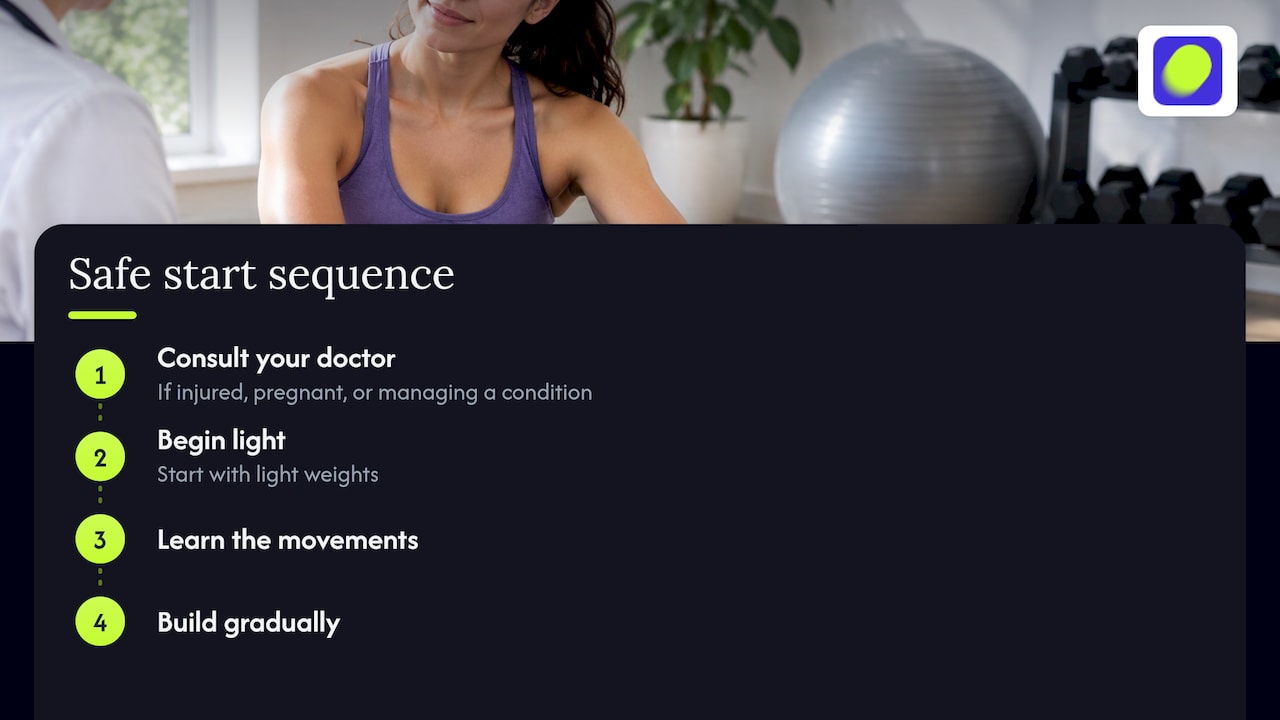
Safety comes down to technique. UW Medicine states that strength training is safe when done correctly. Begin light, learn the movements, then build. If you have a medical condition, an injury or are pregnant, check with your doctor before starting a new program.
Knowing the facts is one thing. Showing up with a plan is another. Onemor is built for Gen-Z and young millennials who want real structure without spending hours planning routines. You get workouts led by coaches, guided sessions with sets, reps and rest timers, and streaks, XP and tribe challenges to keep you coming back. It covers strength training, bodyweight and beginner-friendly programs for the gym or home, on iOS with free and premium options.
Start with the free plan and see how a guided session feels. Looking for a program first? Our guided strength workouts walk you through three sessions a week.
Yes. Heavy means a weight that makes the last few reps challenging with good form, not a number on the bar. Start lighter while you learn the movements, then add weight gradually.
At least twice a week, according to the CDC guidance cited by UCHealth and the Department of Health and Human Services guidance cited by Mayo Clinic. Two to three full-body sessions is a practical routine for most beginners.
More muscle raises your resting energy use and lowers body fat percentage, according to the NSCA. MD Anderson’s exercise physiologist also recommends pairing strength training with cardio and a healthy diet for leaner body composition.
No. MD Anderson’s exercise physiologist says women do not need to train differently from men. The same progressive approach applies: challenge, recover and build gradually.