Guided rest periods are rest breaks that are written into your workout and timed for you, so you never wonder how long to wait before the next set. For most beginners, that means roughly 60 to 120 seconds between sets, a bit longer on heavy lifts and a bit shorter on lighter ones. In Onemor, guided sessions come with sets, reps and rest timers built in, so you can keep your focus on form and effort.
Every set has two parts: the work and the pause that follows. A guided rest period makes the pause part of the plan. Instead of checking messages and wandering back to the bar whenever it feels right, you follow a timer that matches the goal of that exercise.
Why does this matter? Rest changes what a workout does for you. Longer breaks let your muscles and nervous system recover so you can lift heavier. Shorter breaks keep your heart rate up and make a workout feel more like conditioning. Neither is better. They are tools for different goals, and a timer makes sure you are using the right one.
For a newer lifter, there is a second benefit: consistency. When the plan tells you exactly what to do next, showing up two or three times a week feels easier. You are not designing the workout on the fly.
Here is the short version. Healthline notes that people new to lifting, or lifting for under six months, tend to benefit from 60 to 120 seconds between sets, enough to recover and keep good form on the next one.
A slightly more detailed version splits by exercise type. Men’s Health suggests beginners rest 2 to 2:30 minutes between big compound exercises and 60 to 90 seconds between smaller accessory moves. The NSCA (the National Strength and Conditioning Association) says core multi-joint lifts like squats and deadlifts need at least two minutes, while single-joint moves like biceps curls need only 1 to 2 minutes.
Here is how that looks in practice:
If that sounds like a lot of standing around, remember that the rest is part of the work. Skipping it usually means your last sets get sloppy.
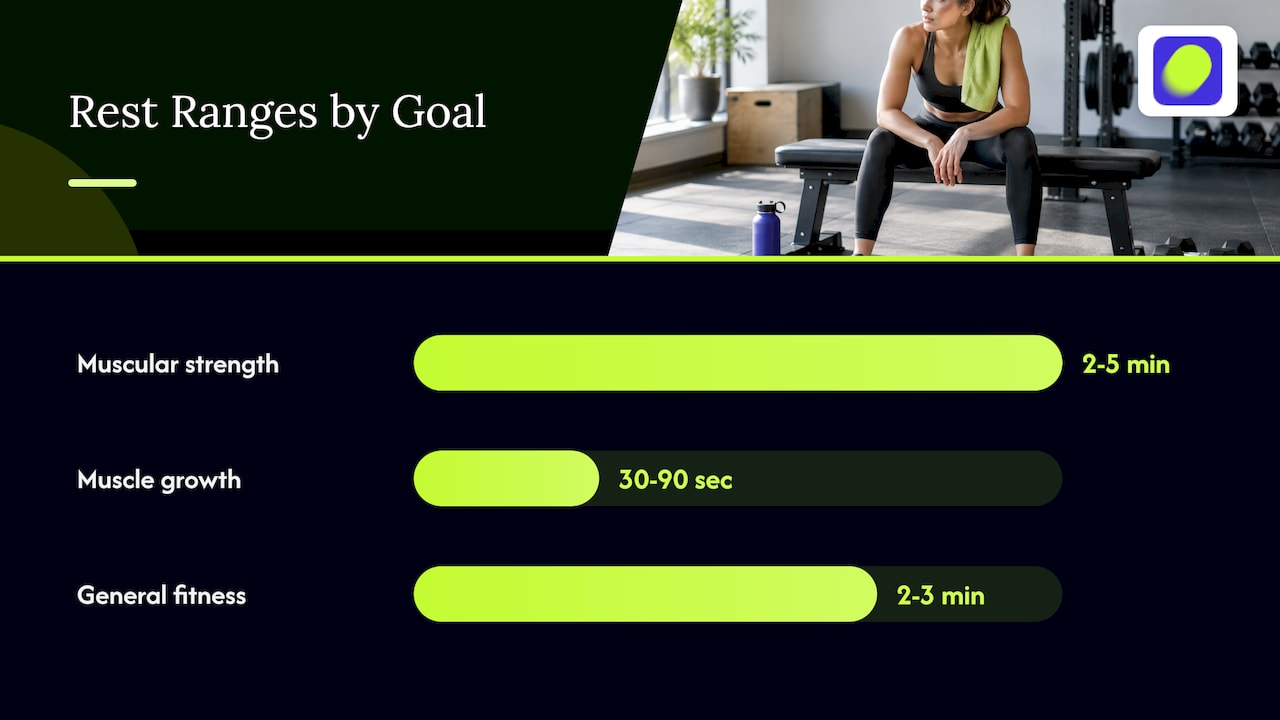
Once you know your goal, the number gets more precise. The American Council on Exercise (ACE) lays out rest by goal in its May 2024 training-variables table:
Sources do not agree to the second, and that is fine. Healthline’s goal-based guidance, for example, also lists 30 to 90 seconds for muscle mass and 3 to 5 minutes for strength and power. Treat these as ranges, start in the middle, and let your sets tell you which way to move.
Want the deeper breakdown? Our guide to evidence-backed rest between sets covers 60 to 90 seconds for growth and 3 to 5 minutes for strength. If you are new to the vocabulary, sets and reps explained walks through what “3 sets of 12” really means.
It feels backwards, but resting longer often lets you do more. In an ACE-supported study summarized in August 2022, three-minute rest intervals produced significantly more total volume lifted and less fatigue than one-minute rests on chest and leg press. The summary recommends three-minute rests for female lifters who prioritize strength or muscle growth at low-to-moderate intensity.

The takeaway for you: if you rush through your rest to “save time,” you may lift fewer total reps. Quality sets beat hurried ones.
Good rest is active in the sense that your mind stays in the session. Try this:
That last point is the heart of training for results instead of content. A few minutes of focus per exercise adds up across a session.
A timer is a starting point, not a rule. The NSCA recommends autoregulation: set rest within the researched range, then lengthen or shorten it from session to session based on how tired your heart and lungs, your working muscles and your mind feel.
A simple version you can use:
Notice what is happening here. You are learning to read your body, which is a skill that stays with you long after the beginner phase.
If you train two or three times a week, full-body sessions are a great fit. NASM recommends two to three full-body sessions per week for beginners, with 1 to 3 sets of 12 to 20 reps and 0 to 90 seconds of rest between sets in the first phase, using slow, controlled tempos to learn the movement patterns.
Beginner NASM-style rest is on the shorter side because the loads are light. As you move toward heavier lifting, rest grows toward the 2 to 5 minute range the NSCA describes for strength work.
A sample week might look like this:
Rest days count too. If your legs feel heavy between sessions, massage for weightlifters is one way people support recovery, alongside sleep and food.
For a ready-made version of this week, see our 3x a week guided strength workouts. Curious about advanced techniques later on? Rest-pause sets are worth reading once the basics feel comfortable.
This is where Onemor helps. Our guided sessions walk you through sets, reps and rest timers in workouts led by coaches, so each break is already part of the plan. You get structure without spending an hour planning, and you can build momentum with streaks, XP and tribe challenges with friends.
Ready to try it? Start with the free plan on iOS, or see what Pro adds when you want more.
Most beginners do well with 60 to 120 seconds. Go closer to two to three minutes on big lifts like squats and deadlifts, and closer to 60 seconds on lighter accessory moves. Adjust by 15 to 30 seconds based on how your form holds up.
No. Research summarized by ACE found that longer rests allowed more total weight lifted with less fatigue. If you need more time to keep your form clean, take it, then shorten rest gradually as you get fitter.
Generally yes. ACE’s table lists 30 to 90 seconds for muscle growth and 2 to 5 minutes for heavy strength work. Beginners can start in the middle of each range.
Yes, and it matters even more. With fewer sessions, you want every set to count, so fully recovering between sets helps you get quality work out of each workout.