Yes, gamification in fitness works, but the effect is modest, not magic. Research shows small-to-moderate boosts in daily steps and light improvements in weight and body fat, with the biggest wins going to people using structured, socially-driven programs rather than solo point-chasing. Younger users tend to respond best. The catch: those gains fade unless the content keeps evolving.
TL;DR:
Gamification in fitness means borrowing the mechanics that make games addictive, streaks, points, badges, leaderboards, challenges, and story-driven missions, and applying them to workouts. It’s not about turning exercise into literal Candy Crush. It’s about tapping into the same psychological wiring that keeps you coming back to a game you already love.
That wiring has a name: self-determination theory. It says humans are driven by three core needs: competence (feeling capable), autonomy (feeling in control), and relatedness (feeling connected to others). Every fitness game mechanic maps to one of these.
Streaks and micro-goals build competence. Hitting a small, achievable target every day, even a five-minute mobility routine, gives you fast proof that you’re capable. That proof compounds. Miss two days in a row, and the psychological letdown is real, which is exactly why streak mechanics are so sticky.
Badges and levels also build competence, but they work best as onboarding tools rather than long-term motivators. A survey of top fitness apps found that goal setting and social features show up in about 78% of gamified apps, while points and levels are less common, mostly reserved for early-stage reward loops that get you hooked before deeper habits form, according to a review of gamification design in popular fitness apps.
Leaderboards and tribe challenges tap relatedness. You’re not just moving for yourself. You’re showing up for a group, and that shifts the psychology from “I should” to “we’re doing this.” Leaderboards work best inside identity-driven communities, where members already feel some connection before the competition starts.
Narrative missions protect autonomy. A weekend step challenge with a story wrapped around it (“reach base camp by Sunday”) gives you a reason to choose the workout rather than feeling assigned to it.
Here’s a distinction that separates good gamification from bad: rewarding showing up versus rewarding elite performance. Systems that only celebrate the fastest times or heaviest lifts quietly punish everyone else by omission. Programs that reward consistency, attendance streaks, completed sessions, logged meals, retain a much wider slice of users because nearly everyone can win at showing up.
Pro Tip: If you only adopt one mechanic, pick a streak with social visibility. Research on daily return behavior consistently shows it outperforms points or badges alone, because someone else sees your streak break adds a layer of accountability that a private score never will.
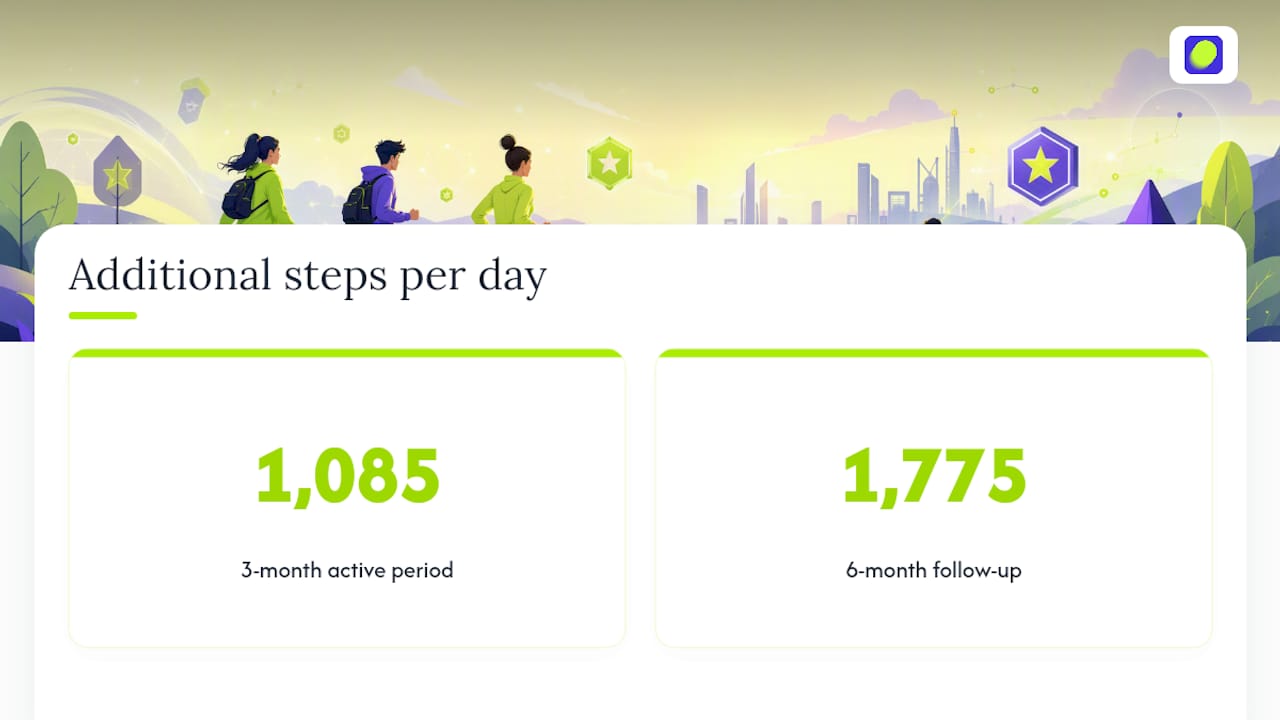
The clearest number in this entire field comes from a randomized controlled trial on a group-based gamified digital health program: participants increased their steps by 1,085 per day during the three-month program and, more strikingly, by 1,775 steps per day at six-month follow-up, according to the randomized controlled trial on gamified physical activity programs. That second number matters more than the first. Most behavior interventions fade once supervision ends. This one grew.
That RCT isn’t an outlier so much as a strong example inside a wider pattern. A systematic review and meta-analysis of gamified digital health apps found average daily step increases typically ranging from several hundred to over a thousand steps, alongside modest but consistent changes in body composition, according to the meta-analysis on gamification and cardiometabolic risk factors. The same review reported:
None of those numbers will replace a structured training block or a nutrition overhaul. They’re not supposed to. What they show is that adding game mechanics to an existing activity plan nudges behavior in the right direction, consistently, across multiple studies, which is a different and arguably more useful claim than “gamification transforms your body.”
A separate meta-analysis of randomized controlled trials pooled the overall effect of gamification on total physical activity and landed on a small-to-medium effect (Hedges g of about 0.42) in the short term. Here’s the part that deserves your attention: at roughly 14 weeks of follow-up, that effect dropped to about g=0.15, according to the meta-analysis evaluating gamification’s effect on physical activity. Motivation from novelty wears off. Programs that don’t refresh their content lose most of their edge within a few months.
Age changes the equation too. Among children and adolescents, a meta-analysis of 16 randomized controlled trials covering 7,472 participants found gamification improved moderate-to-vigorous physical activity (SMD 0.15) and modestly reduced BMI (SMD 0.11), with reward-and-feedback mechanics outperforming social-only designs in that age group, according to research on gamification interventions in children and adolescents. Younger users respond more to immediate feedback loops. Older users, based on broader intervention patterns, tend to respond better when social accountability is layered in alongside the rewards.
One duration finding is worth building your entire strategy around: interventions lasting longer than 12 weeks, especially those grounded in self-determination theory rather than pure reward mechanics, produced larger and more durable gains in moderate-to-vigorous activity, according to research on gamification duration and theoretical grounding.
Put the whole picture together and you get a consistent, if modest, story: gamification works best as a short-to-medium boost that needs renewal, works better past the three-month mark than in week one, and produces bigger numeric wins on activity level than on body composition. None of the effect sizes here are enormous. All of them point the same direction, across different study designs, which is a more convincing signal than any single flashy statistic.
Abstract mechanics only matter once you can picture yourself using them next Monday. Here’s how to turn each one into something you can start today, no third-party app required.
Tailor the mechanic to the goal. Strength goals respond well to points tied to effort and progressive overload. Cardio and step-based goals respond well to narrative missions and streaks. Pure consistency goals, especially for beginners, respond best to badges and simple milestone rewards, since the bar to “win” stays low enough that almost anyone can clear it.
You don’t need a smartphone for any of this. A wall calendar, a shared group chat, and a notebook cover every mechanic above. The practical guide to making workouts fun walks through more low-tech versions of these same systems if you want to build one from scratch before trying an app.
Pro Tip: Start with one mechanic, not five. Layering a streak, a leaderboard, points, and badges all at once at the start of a new habit tends to backfire, because tracking the game becomes its own chore. Add complexity only once the first mechanic feels automatic.
The gamification market is crowded, and not every app that slaps a streak counter on your dashboard has actually thought through the psychology behind it. Before you commit your time (or a subscription), run any app through these checks.
Evaluate onboarding first. A well-designed program eases you into mechanics gradually, starting with simple goal-setting and light feedback, rather than throwing streaks, XP, leaderboards, and badges at you in week one. That gradual rollout isn’t just good UX. A study on feature richness and adherence found the relationship is S-shaped: moderate gamification increases engagement, but piling on too many features at once actually reduces it, according to research on feature richness and adherence in gamified interventions.
Check reward balance. Does the app reward attendance and consistency, or only elite performance? A leaderboard that only ever shows the top five users tells the other 95% of the user base they’re losing, which is a fast way to lose them entirely.
Look for real personalization, not just a fitness-level dropdown menu at signup, but a program that actually adjusts based on what you complete or skip.
Weigh the social features carefully. Community accountability drives real results, but only when the community feels relevant to you, not a generic global chat.
Confirm measurement accuracy. If the app connects to a wearable or phone sensor, check that step counts and activity minutes are reasonably consistent with what you already track elsewhere.
Read the privacy policy on health data before connecting a wearable or logging biometric information.
Look at the content roadmap. Does the program only launch new challenges occasionally, or does it show a pattern of regularly refreshed content?
Watch pricing transparency. A free trial is fine. A free trial that blocks basic progress tracking behind a paywall is not.
Red flags worth walking away from:
A fast 7-point gut check before you sign up:
For a deeper look at how program structure separates a strong app from a flashy one, the breakdown of the best workout program apps covers evaluation criteria in more depth.
The decline is well documented. That drop from a short-term effect size of about g=0.42 down to roughly g=0.15 at 14 weeks isn’t a fluke of one study. It reflects a pattern seen across gamified health interventions generally: novelty wears off, and static content stops delivering the same dopamine hit it did in week one.
Feature overload makes it worse, not better. The S-shaped relationship between feature richness and adherence means there’s a real ceiling: past a certain point, adding more streaks, more badges, more leaderboards, more challenges actually reduces engagement instead of boosting it, according to the same research on feature richness and adherence. More isn’t better. Better-timed is better.
Three remedies show up consistently in stronger-performing programs:
Equity deserves honest attention here too. Gamified fitness assumes a certain baseline: a smartphone, reliable data or Wi-Fi, and often a wearable device to fuel the leaderboard or step count. Not everyone has that baseline, and age gaps matter as much as income gaps. Older users may find leaderboard-heavy designs alienating if they’re competing against younger, more mobile-native users. Younger teens may need stronger parental or coach oversight around notification frequency, since younger users respond more strongly to immediate feedback loops, which cuts both ways: it drives engagement, but it can also drive compulsive checking.
Good programs build in accessibility from the start: adjustable notification frequency, offline-friendly progress logging, and mechanics that don’t assume everyone owns the same devices.
Onemor builds its entire structure around the mechanics that the research actually supports, not the ones that just look flashy in an app store screenshot. Streaks, XP, and tribe-based challenges sit inside structured, coach-led sessions with real sets, reps, and rest timers, which is the combination the evidence keeps pointing toward: reward systems layered onto real programming, not gamification as a replacement for one.
This kind of setup fits a specific person best: someone in the Gen-Z or young millennial range who wants real structure and real coaching, without needing to build a program from scratch or guess at their own progression. If you’ve read this far, you’re probably that person, someone who wants the psychology of gamification working for you, not just a badge collection with no plan behind it.
Coaches like the one profiled on the Coach Phil page bring the human layer the research says matters most once novelty wears off. And if social accountability is the piece you’ve been missing, browsing Onemor’s tribe options shows how group challenges get structured around shared goals instead of a random leaderboard of strangers.
Wearables turned gamification from a manual, honor-system activity into something measured in real time. A step counter on your wrist feeding directly into a streak calendar removes the friction of manual logging, which matters more than it sounds. Every extra step between “doing the workout” and “getting credit for the workout” is a chance for the habit to break.
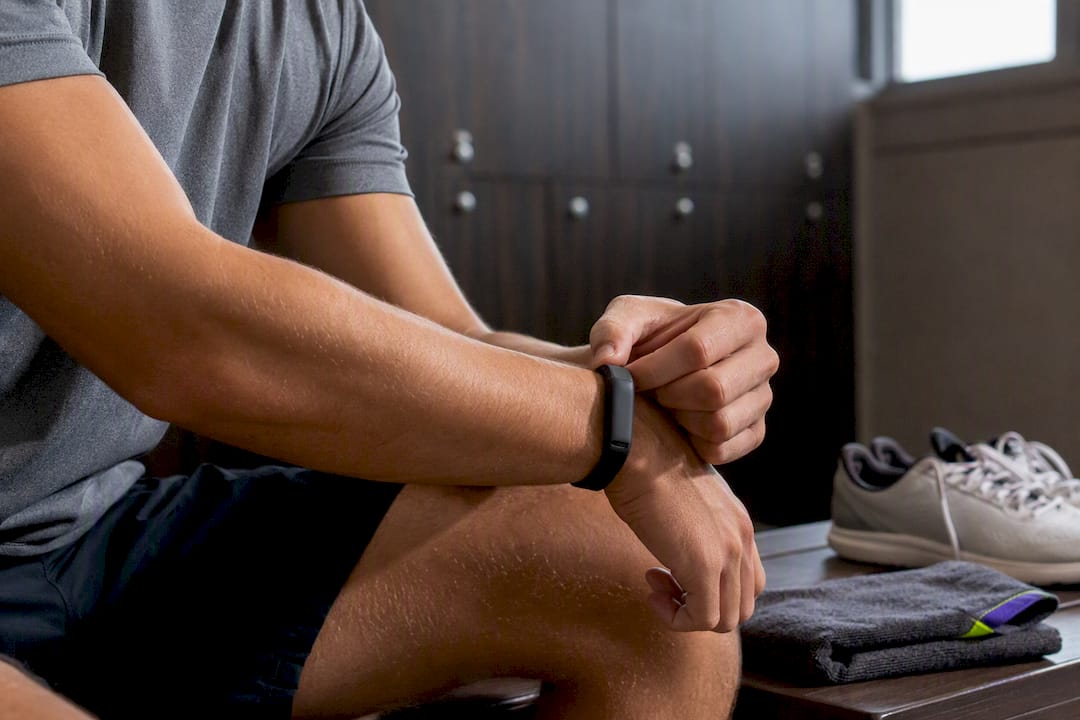
Sensor data also makes reward systems more honest. Heart rate zones, rep-counting accelerometers, and GPS-tracked runs give an app real signal to reward, rather than trusting a self-reported check-in box. That accuracy matters for the “reward showing up” philosophy specifically: a program that can verify a light 15-minute walk actually happened can reward it fairly, instead of only having big, self-reported milestones to celebrate.
The tradeoff is dependency. Wearable-linked gamification works beautifully until the device dies, gets left at home, or simply isn’t something you own. Good programs build in a manual-logging fallback so a dead battery doesn’t break a 60-day streak. Sensor accuracy also varies by device and by activity type, cycling and swimming are notoriously harder to track accurately than walking or running, so treat any single number from a wearable as a solid estimate, not a lab-grade measurement.
The bigger shift is what wearables let a program do with the data: adjust difficulty in near real time, flag when someone’s activity is trending down before a streak breaks entirely, and personalize challenges based on actual patterns rather than a generic template.
Social features aren’t a nice add-on to gamification, as highlighted in the benefits of interactive sports apps for tennis fans, where community engagement significantly boosts user retention and motivation. They’re often the mechanic doing the heaviest lifting on retention. A private streak is easy to quietly let slide. A streak your training group can see is much harder to abandon, because the social cost of visibly dropping off adds a layer of accountability no solo tracker can replicate.
Community structure matters more than community size. A massive global leaderboard with thousands of strangers rarely motivates the way a small, identity-based group does, ten to twenty people who already share a goal or a schedule. Leaderboards work best inside communities where members already feel some connection, which is why tribe-style, small-group structures tend to outperform open, anonymous rankings.

Retention benefits compound over time too. Someone who trains inside a group is harder to lose to a bad week than someone training alone, because the group provides a check-in point that a purely individual streak never can. When one person’s motivation dips, the group’s momentum often carries them through it, and that dynamic works in reverse as well: individual consistency reinforces group cohesion, creating a loop that a solo app experience simply can’t replicate.
The caution here is proportional to the benefit: social features that feel forced, mandatory check-ins, public shaming for missed days, unavoidable comparison, tend to drive people away instead of drawing them in. The sweet spot is visibility that feels supportive, not surveilled.
The honest answer sits between those two extremes. The six-month step increase of 1,775 per day in the earlier-cited RCT shows gamified habits can hold, and even grow, well past the active intervention window. That’s meaningfully different from a short-term novelty spike that collapses the moment the program ends.
What separates lasting change from a temporary bump usually comes down to whether the underlying behavior became self-sustaining before the game mechanics faded. Early on, points, badges, and streaks provide the external push. Over time, if the workout habit itself starts delivering its own reward, better sleep, visible strength gains, a mood lift, the game mechanics become less necessary to keep the behavior going. Programs longer than 12 weeks tend to produce more durable results precisely because they give this handoff time to happen.
Habit formation research broadly supports stacking gamified mechanics on top of small, consistent triggers rather than big, occasional pushes. A daily three-minute streak habit builds a stronger long-term pattern than a single, intense weekly session with a big point payout, even though the weekly session might feel more rewarding in the moment.
The practical takeaway: treat gamification as scaffolding, not the building. Use it hard in the first 8 to 12 weeks to establish the pattern. Then let the mechanics ease into the background as the behavior itself becomes the reward, while keeping enough novelty (new challenges, fresh tribe missions) to prevent total motivational flatline.
The clearest real-world proof point remains the group-based digital health program that produced 1,085 additional steps per day during a three-month active period and 1,775 additional steps per day six months later. What made that program work wasn’t a single flashy feature. It combined structured goals, group accountability, and a gamified feedback loop, then sustained that structure long enough for the habit to outlast the active coaching window.
Broader app-market data tells a similar story from a different angle. Reviews of top-performing fitness apps consistently find that goal setting and social features appear in roughly 78% of gamified apps, far more often than pure points-and-levels systems, which suggests the market itself has converged on the mechanics the research supports rather than the flashiest ones.
The pattern that separates successful implementations from forgettable ones is consistent across these examples: they combine a real structural framework (a program, a coach, a defined goal arc) with game mechanics layered on top, rather than treating the game layer as the entire product. A leaderboard bolted onto an otherwise unstructured app tends to produce a short burst of curiosity and a fast drop-off. A structured program that adds a leaderboard, streak, and tribe challenge on top of real coaching sustains engagement much longer, because the mechanics are reinforcing something substantial rather than standing in for it.
The line between motivating and exploitative comes down to whose interest the mechanic serves. A streak that encourages you to take a five-minute walk on a busy day serves you. A notification designed to trigger guilt if you don’t open the app serves engagement metrics. Both use the same psychological principles. Only one respects the person on the other end.
A few design principles separate the two:
Ethical gamification treats the mechanics as scaffolding for a behavior the user already wants, not as a hook to maximize time in the app. The best test of any system: would it still feel good to use if you knew exactly how it was built to influence you?
If the research has you convinced that streaks, tribe challenges, and structured coaching beat a static workout plan, the next step is simple: try a program built around those exact mechanics instead of piecing one together yourself. Onemor’s sign-up flow takes a few minutes. You pick a training focus (strength, HIIT, bodyweight, or a beginner-friendly track), get matched into coach-led sessions with built-in sets, reps, and rest timers, and start earning XP from your very first workout.
Your first 30 days matter most, since that’s the window where a streak either becomes a habit or quietly dies. Start a 30-day streak challenge from day one so the app’s structure is working for you immediately, not after a week of browsing. Then join a tribe that matches your schedule and goals; group accountability is one of the strongest levers the research points to for turning a short-term boost into a lasting pattern. From there, booking an intro session with a coach, like the programs led by Coach Branden or Coach Kayla, adds the human layer that keeps gamified progress from fading once the novelty of the first few weeks wears off.
Browse Onemor’s tribe options to see which group fits your goals, or head straight to the Onemor app to start your first structured, gamified program today.