Start with three full-body sessions a week, 45 to 60 minutes each, built around 4 to 6 compound exercises plus a short accessory finisher. This structure suits beginners, most women returning to training, and anyone who wants strength and muscle results without living at the gym.
Here’s a 1-week starter you can run this week:
Rest a day between sessions when you can, something like Monday, Wednesday, Friday. Log your weight and reps every session, and use RPE (rate of perceived exertion, basically how hard a set felt on a 1 to 10 scale) to decide when to add weight. If a set feels like a 6 or 7, you have room to progress next week.
A 3 times a week full-body strength training plan, applied with tracked progression and adequate weekly volume, builds strength and muscle as effectively as more complex splits for beginners and most women.
| Point | Details |
|---|---|
| Start with 3 sessions weekly | Use full-body Day A/B/C sessions with 4 to 6 compound exercises and a short accessory finisher. |
| Match sets to your goal | Aim for 3 to 6 reps for strength, 6 to 12 for muscle building, 8 to 15 for general fitness. |
| Target weekly volume | Beginners need roughly 6 to 10 sets per muscle group weekly; intermediates need 10 to 16. |
| Progress with a rule | Use linear progression as a beginner, then switch to double progression once gains stall. |
| Deload every 4 to 8 weeks | Reduce volume by about 40% for one week when lifts stall or fatigue builds up. |
| Let Onemor handle tracking | Guided sessions, built-in timers, and automatic progress logging make following this plan consistent. |
A 2022 randomized trial in BMC Sports Science, Medicine and Rehabilitation put this question to the test directly. Researchers took untrained women, matched their weekly sets and per-muscle frequency exactly, then split them into two groups: one training full-body twice a week, the other running a 4-day upper/lower split. After 12 weeks, strength, muscle mass, and power gains were statistically similar between groups. The split wasn’t better. It was just a different way to organize the same work.
That finding matters because it settles an argument that’s kept beginners stuck in analysis paralysis for years. You don’t need a complicated split to build muscle. You need consistent volume, applied over time, in a structure you’ll actually stick to.
Full-body training carries a few practical advantages that make it the smarter default for beginners and busy women:
The same body of research that supports full-body training also shows frequency has limits. Meta-analytic evidence on training frequency finds that once you’re already hitting your weekly volume target, training a muscle more often adds only a small hypertrophy benefit; total sets per week still drives most of the result. That’s why full-body training works so well early on and why very advanced lifters chasing higher total volumes often shift to a split just to fit all those sets into the week without turning every session into a three-hour marathon.
Every effective full-body workout routine, no matter how it’s organized, comes back to the same handful of movement patterns. Learn these and you can build or adapt any session, whether you’re in a fully equipped gym or working with a pair of dumbbells in your living room.
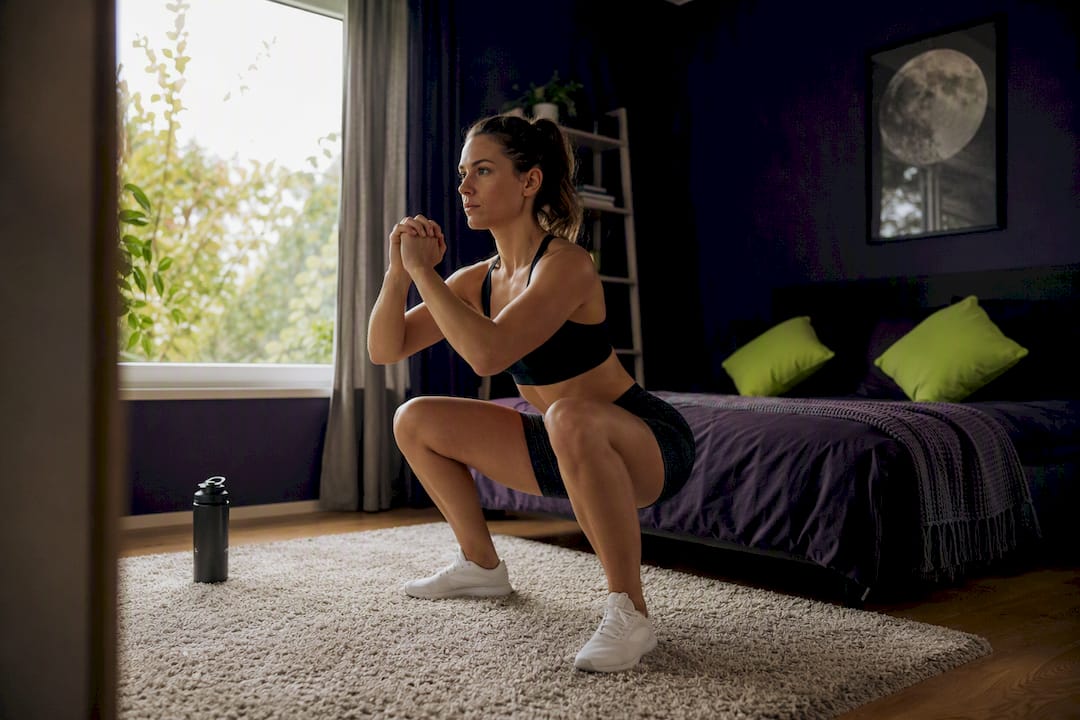
Squat pattern. This trains your quads, glutes, and core while teaching hip and knee coordination you use in daily life, from climbing stairs to picking up a laundry basket. In the gym, the barbell back squat or front squat is the gold standard. A goblet squat, holding one dumbbell against your chest, is a fantastic gym or home alternative that’s easier to learn. At home with no equipment, a bodyweight squat or a chair-assisted squat works the same pattern. Cue to remember: knees track over your toes, not caving inward, and your chest stays tall through the whole rep.
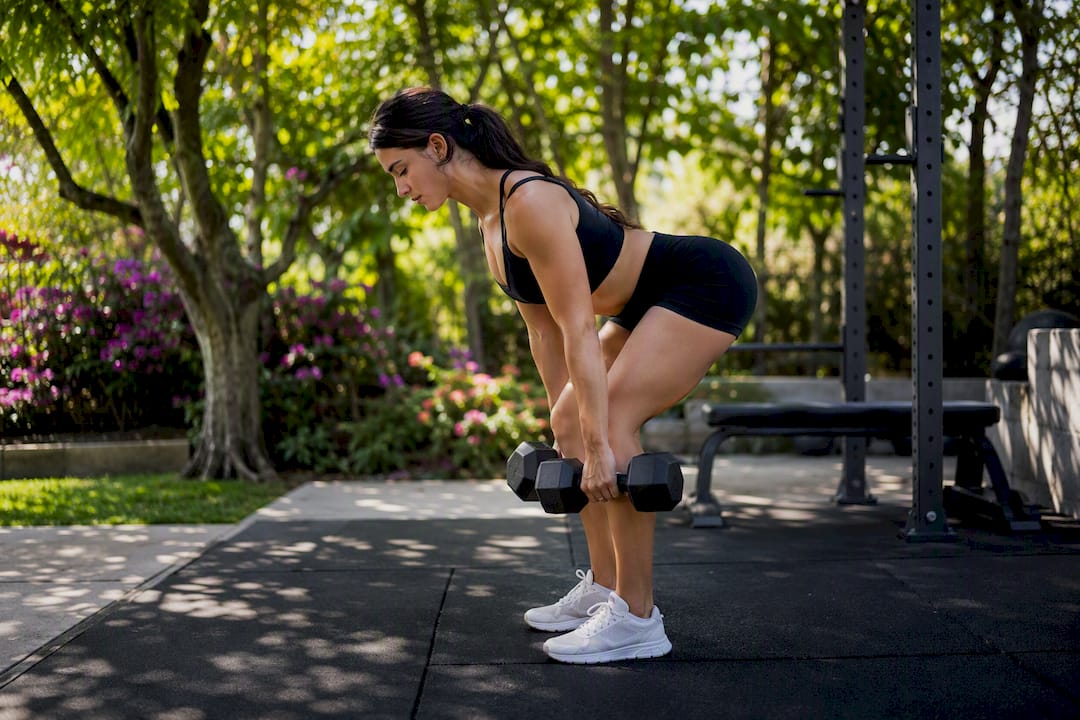
Hinge pattern. This is where your hamstrings and glutes do the heavy lifting, and it’s the pattern most beginners skip because it feels unfamiliar. The barbell deadlift or Romanian deadlift is the primary gym version. A dumbbell Romanian deadlift is an accessible substitute that still loads the hamstrings hard. At home, a single-leg hip hinge or a glute bridge covers the same territory without any weight at all. Cue: push your hips back like you’re closing a car door with them, and keep your spine neutral rather than rounding your lower back.
Horizontal push. Chest, shoulders, and triceps work together here. The barbell or dumbbell bench press is standard in a gym setting. A push-up is the natural home alternative and scales beautifully. Struggling with a full push-up? Elevate your hands on a couch or countertop to reduce the load until you build up strength. Cue: keep your elbows at roughly a 45 degree angle from your torso, not flared straight out, to protect your shoulders.
Horizontal pull. This balances out all that pushing and builds the muscles that keep your posture upright. A seated cable row or dumbbell row covers this in the gym. At home, a resistance band row or an inverted row using a sturdy table works just as well. Cue: squeeze your shoulder blades together at the top of the movement rather than just bending your elbows.
Vertical push and pull. Overhead pressing (dumbbell shoulder press) and pulling (lat pulldown or pull-up) round out shoulder and back development. At home, resistance bands anchored overhead or under your feet can replicate both movements reasonably well. Cue for pressing: avoid arching your lower back excessively; brace your core like you’re about to take a light punch to the stomach.
Carry and core. Farmer’s carries, suitcase carries, planks, and dead bugs train the core to do its real job, which is resisting movement rather than creating it. These are often the most neglected part of a full body strength training plan, yet they’re what keeps your spine safe under load elsewhere. Cue: keep ribs stacked over hips rather than letting your lower back sag.
For sets and reps, match the range to your goal:
Pro Tip: Pick one exercise per pattern per session rather than trying to hit every variation every day. A full body workout with a squat, a hinge, a push, a pull, and a core move covers everything you need in 45 minutes.
These templates are ready to run as written, or adjust the loads to match where you’re starting. Each follows the same skeleton: compound movements first, accessories second, core work to finish.
1. Beginner: 3 days a week
This is the plan most people, especially those new to strength training, should start with. It uses full-body sessions with different exercise emphasis each day so your joints and nervous system get variety without overload.
Progression rule: add 2.5 to 5 pounds to a lift once you complete all sets at the top of your rep range with a set or two left in the tank. This is called linear progression, and it works remarkably well for the first several months of training because your nervous system is still learning efficient movement.
2. Intermediate: 3 to 4 days a week
Once linear progression stalls, which usually happens after 8 to 16 weeks depending on your starting point, it’s time to add volume and accessory work rather than just chasing heavier weight every session.
Use double progression here: pick a rep range like 8 to 10, and only add weight once you can hit the top of that range for all sets. Until then, add reps first. This keeps your joints from taking on new load every single week, which matters more as the weights get heavier.
3. Advanced adaptation: moving toward higher frequency
If you’re training hard and consistently hitting your weekly volume targets, adding a 4th or 5th session lets you spread that volume across more, shorter sessions instead of cramming it into three long ones. This is less about needing more frequency and more about managing fatigue and session length as your total sets climb. At this stage, some lifters shift toward a 4-day workout split that separates upper and lower body work, simply because fitting 20-plus weekly sets per muscle group into three sessions gets impractical. That’s a volume management decision, not proof that full-body training stopped working.
Total weekly volume, meaning the number of hard sets per muscle group, is the single biggest lever in your program. Get this dialed in and the rest of your programming decisions become much easier.
For beginners, aim for roughly 6 to 10 sets per muscle group per week. That’s enough stimulus to drive real adaptation without overwhelming a nervous system still learning how to recover from training. Intermediates can push toward 10 to 16 sets per muscle group weekly, adjusting based on how quickly you recover and what your specific goals are. Program design guidance from established strength coaches consistently points to volume targets in this range, paired with planned progression and periodic deloads, as the backbone of programs that actually produce results over months, not just weeks.
Progression methods worth knowing:
Deloads matter more than most beginners realize. Watch for these signs you need one sooner: your lifts are stalling or dropping across two consecutive sessions, you’re unusually sore for days after normal sessions, or your motivation to train has quietly cratered.
Pro Tip: Write your sets and reps down every single session, even on your phone’s notes app. A program without tracking is just a suggestion; you won’t know if you’re actually progressing without the numbers in front of you.
Getting the weekly rhythm right is what turns a good program on paper into one you’ll still be running in six months.
No two bodies or schedules are identical, so here’s how to bend this plan without breaking it.
If you’re a woman wanting to prioritize glute and lower-body development, swap your squat variation for a hip thrust or add a second hinge movement like a Romanian deadlift on a different day. This doesn’t change your progression principles at all; you’re still adding weight or reps the same way, just directing more volume where you want it.
Absolute beginners should progress through load stages rather than jumping straight to a barbell: start with bodyweight squats, move to a goblet squat once bodyweight feels easy for 15-plus reps, then transition to a barbell once you’re comfortable racking and unracking weight safely. You’re ready to add load when your current version feels genuinely easy, not just doable.
Short on time or equipment? A 30 to 40 minute session built around just 3 exercises, a squat pattern, a push, and a pull, still delivers most of the benefit. Resistance bands and a single pair of adjustable dumbbells cover nearly every substitution in this guide, and a bodyweight strength program can carry you a surprisingly long way before you need any equipment at all.
Knowing the plan is one thing. Actually showing up and logging every set for months is where most people fall off, and it’s exactly the gap Onemor is built to close.
Every guided session inside the app comes with sets, reps, and rest timers built in, so you’re never guessing whether you rested long enough or forgetting what you lifted last week. Progression gets logged automatically, which makes following a linear or double progression rule effortless instead of something you have to track manually in a notes app.
Programs are led by real coaches. Coach Jahson and Coach Kayla both build structured strength programs that follow the exact principles covered in this guide, matched sets and reps, sensible progression, and sessions that fit into a real week. If you’re starting fresh, opening the app, picking a 3 times a week program, and turning on session logging is the fastest way to put everything above into practice.
Most of the advice floating around about workout splits misses the real point. The split you choose matters far less than whether you show up consistently and add a little more work over time. That 2022 trial comparing full-body and split training in untrained women didn’t find a winner because there wasn’t one to find; matched volume produced matched results, regardless of how the sets were arranged across the week.
Where conventional advice falls short is in overcomplicating the beginner phase. Plenty of programs thrown at new lifters, especially women, involve exercise selections and splits designed for people three years into training. That mismatch is often why people quit within a month, not because the program was “wrong,” but because it demanded a level of recovery capacity and time commitment beginners don’t have yet.
What should you prioritize first? Pick a simple 3 day full-body structure, track every session, and add weight only when your form and reps say you’re ready. Everything else, exercise selection, split style, extra accessory work, is a refinement you can make in month three, not a decision you need to agonize over in week one.
— Alb
Reading a plan on a page is one thing; having it walk you through every set, rep, and rest period is another. Onemor turns everything in this guide, the compound lifts, the progression rules, the weekly structure, into a guided session you follow on your phone, so there’s no spreadsheet, no guesswork about what you did last Tuesday, and no wasted minutes figuring out your next exercise mid-workout.
If you want a coach-built starting point, Coach Wilbert’s program offers a structured beginner-friendly path built around the same full-body principles covered here. Prefer training with others for accountability? Explore Onemor’s tribes to find a group tackling the same 3 times a week goal you are. Either way, the fastest way to start is simple: open the Onemor app, complete a baseline workout, and turn on session logging so week one becomes the foundation your progression is built on.