AMRAP means “as many rounds as possible” in a set time, and EMOM means “every minute on the minute,” where you start a fixed task at the top of each minute. Pick AMRAP for conditioning, pacing practice, and benchmarking. Pick EMOM for skill work, strength density, and controlled intensity. Sample workouts and safety notes follow below.
TL;DR:
- Repeat the same 10 to 20 minute circuit later and compare rounds or reps; beginners should use simple movements and scale before form breaks.
- Start EMOMs at six minutes, then add one minute every two weeks before increasing weight or repetitions; finish each set with time left to rest.
- A Frontiers study found lower velocity loss, neuromuscular fatigue, and lactate with EMOM, while AMRAP produced higher overall heart rate responses.
- Limit hard training to two or three sessions weekly, build gradually, and seek care for dark urine accompanied by severe muscle pain.
AMRAP stands for As Many Rounds (or Repetitions) As Possible. You string together a short circuit and repeat it continuously until the timer ends, with no scheduled rest. Sessions often run 10 to 20 minutes, which makes AMRAP a good fit when your calendar is tight.
Because the clock sets the finish line, you set the pace. That makes AMRAP a handy self-benchmark: repeat the same workout weeks later and see whether you finish more rounds or reps as your fitness grows.
Want a no-guesswork way to run these? Our micro workout templates give busy young adults short formats you can drop right in.
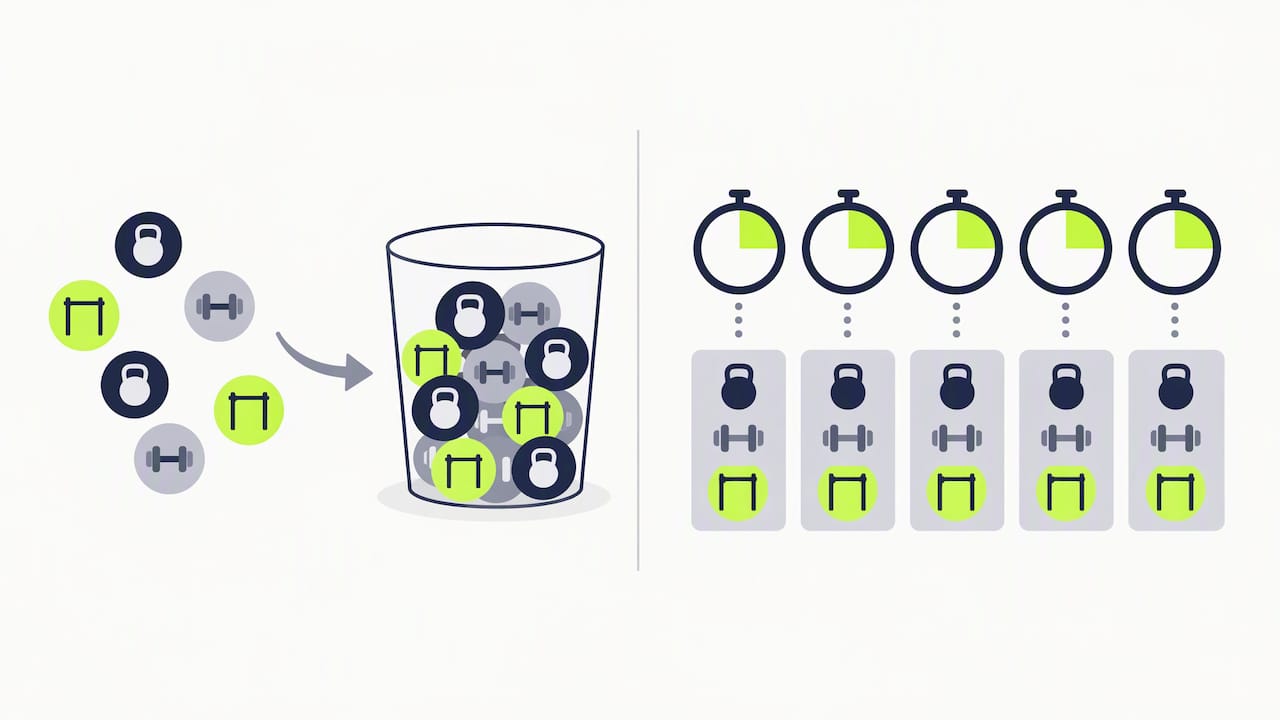
EMOM turns the clock into a metronome. You complete a set number of reps in each minute, then rest for whatever time is left before the next minute starts. Finish fast and you rest longer. Move slowly and you rest less.
That built-in micro-rest is why EMOM suits skill practice and repeated quality efforts. Every minute is a fresh start, so you can keep your technique clean instead of grinding through sloppy reps.
If you want to know how long to rest between harder sets outside these formats, see our guide on rest between sets.
The biggest difference is what you know and when you know it. In AMRAP you only learn your pace at the end. In EMOM you get an endpoint every 60 seconds. Pacing research notes that EMOM gives a one-minute checkpoint each round that can help regulate effort, while AMRAP’s time cap pushes you to self-regulate.
The Frontiers researchers found that AMRAP produced the lowest mean propulsive velocity, and EMOM the least velocity loss within sets. In plain terms, AMRAP tends to feel more taxing, and EMOM tends to keep your reps crisp.
For readers who like to track effort, SnapHRZones offers heart rate zone calculators that pair well with either format.
You do not need to overthink it. Run through this quick checklist and the answer usually appears:
Keep high-intensity sessions to two to three per week and build up gradually, as Mayo Clinic advises. Use effort ratings so you stop short of failure. Our RPE training guide shows you how to use them to guide your training.
Pro Tip: Use AMRAP rounds and reps as your benchmark scores, and use EMOM when you want to repeat the same quality work week after week.
If you have a chronic condition or are new to high-intensity work, check with a health provider first.
Use these as written, then scale as you get stronger. Rest well between sessions.
To log results, note rounds and reps, your effort rating, and the timer settings. Our workout logging guide can help you keep track, and our strength training apps roundup covers tools that run the timers for you.
High effort is the point of these formats, but smart limits keep you training for the long haul. Reviews of interval training note it can bring health benefits comparable to moderate continuous training, though excessive intensity may raise injury and drop-out risk.
Mayo Clinic cautions that rhabdomyolysis can lead to kidney failure, so treat dark urine plus severe muscle pain as a reason to stop training and get checked.
Talk with a healthcare provider before starting if you have a chronic illness or any concerns.
Picking a format is the easy part. Staying consistent is where most people stall. In our app, you train with coach-led workouts, guided sessions with sets, reps, and rest timers, and streaks, XP, and tribe challenges with friends that keep you coming back. It is built for young adults who want real results and clear structure without hours of planning.
Start with our free plan and let us handle the timers while you focus on moving well. Download Onemor free and run your first session today.
EMOM stands for “every minute on the minute.” You start a set task at the beginning of each minute, finish it, and rest for whatever time remains. CrossFit’s glossary lists it alongside terms like AMRAP and Tabata.
EMOM is a form of interval training that can improve cardio fitness in a short time. Mayo Clinic says HIIT can rapidly improve cardiorespiratory fitness, which supports a weight-loss plan. Pair it with consistent training and a sensible eating routine.
A 10 minute EMOM is ten rounds of one-minute windows, with a set amount of work started at the top of each minute. You rest in whatever time is left. It is a common length in beginner kettlebell and bodyweight templates.
Pick a number you can finish quickly with clean form, often 5 to 8 for beginners. If you are using the full minute just to finish, drop the reps. The aim is quality work with a little rest.