The easiest schedule for busy students is three guided full-body workouts a week, each about half an hour to three quarters of an hour, plus a few minutes of daily movement like a walk or stretch. What matters most is showing up consistently, not chasing a perfect split, and a guided app like Onemor can hand you the plan so you spend your time training instead of designing spreadsheets.
TL;DR:
- Beginners can train two or three days weekly with 2 to 3 sets of 8 to 12 reps, after a 5 to 10 minute warm up.
- Students under 18 should train with a knowledgeable adult or coach, starting with bodyweight or bands and mastering form before adding resistance.
- During exam weeks, replace full workouts with 15 minute sessions or daily 10 to 15 minute walks, stretching, or mobility to preserve the habit.
- Schedule training around your energy and workload, shorten sessions or lower weights when mentally drained, and leave at least one full rest day between harder sessions.
- A snack with carbohydrates and protein 1 to 2 hours before training supports energy, while eating within a couple of hours afterward aids recovery.
Pick one of these based on how much time and energy your semester actually allows. Each one is a complete, standalone option, not a starting point you need to build on.
If you are new to structured training, starting with two to three sessions a week gives your body time to adapt without overwhelming your schedule. A full-body plan covers every major muscle group in each session, which is exactly why it works so well for the 3x/week default.
Your calendar already runs your life, so make your workouts live there too instead of floating as a vague intention.
Morning workouts tend to be easier to protect from last-minute schedule chaos, while evening sessions can double as a study break but risk getting bumped by deadlines. Choose whichever slot your actual week makes most reliable.
Pro Tip: Lay out your workout clothes next to your bed the night before. Fewer decisions in the morning means fewer excuses.
You do not need a complicated program to see real progress, just a few fundamentals applied consistently.
These numbers are not arbitrary. They reflect what actually produces results without requiring hours you do not have.
Here are three complete weekly plans, so you can pick the one that matches your access to equipment and your schedule.
A bodyweight-only approach works just as well as a gym plan when consistency is the goal, and research on training three days a week confirms that this frequency builds real strength and fitness without requiring daily gym visits.
Every schedule above becomes simpler when the planning is already done for you. Apps can deliver guided sessions with sets, reps, and rest timers built in, so you follow along instead of calculating anything mid-workout. Many offer both home and gym program options, filters for shorter sessions when your day is packed, and streaks plus tribe challenges that keep you accountable to people training alongside you. Starting a workout program can take about ten minutes: open an app, pick a program that matches your week, and start your first guided session while your streak begins tracking automatically.
Your training intensity should flex with your semester, not fight against it. During lighter weeks, you can push harder, add an extra set, or try a tougher progression. During midterms or heavy project weeks, dialing intensity back to maintenance level protects your energy for studying without losing your fitness base entirely.
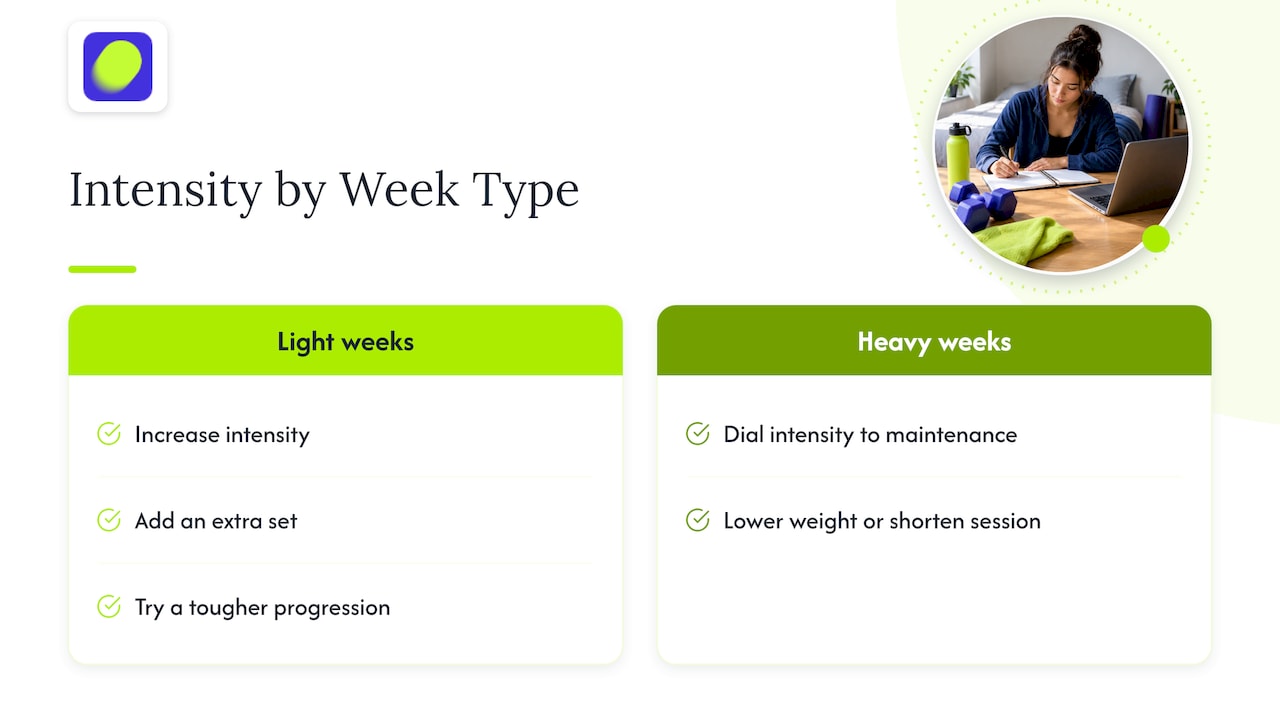
A simple rule: if you are mentally fried, lower the weight or shorten the session rather than skipping it outright. Think of intensity as a dial you adjust weekly, not a fixed setting you force regardless of how your semester is going.
Pay attention to patterns too. If every Tuesday is brutal because of back-to-back classes and a lab, that is not the day for your hardest session. Save your highest-intensity workout for whatever day consistently gives you the most mental bandwidth, and let your lighter days handle the rest.
Eating around your training does not need to be complicated. A light meal or snack with carbohydrates and protein 1 to 2 hours before training gives you steady energy, while a post-workout meal within a couple of hours helps recovery and muscle repair.
For study sessions, the same steady-energy principle applies. Skipping meals before a long study block often leads to the energy crash that makes focusing nearly impossible, so pair your eating schedule with your academic schedule, not just your workout schedule. A piece of fruit and some yogurt before an exam, or a balanced plate before an evening study session, keeps both your brain and your body running on fuel instead of fumes.
Hydration matters just as much as food timing. Dehydration shows up as fatigue and brain fog long before you feel thirsty, so keeping water with you between classes supports both your training and your focus during lectures.
Exam weeks are exactly when workouts tend to disappear, which is unfortunate since movement is one of the better tools for managing exam stress. The key is lowering the bar, not abandoning it. A 15-minute session still counts, and showing up briefly protects the habit you have built all semester.
Tie your workout to something you are already doing, like training right after your last class or right before you start a study block, so it becomes part of your day rather than one more decision to make. Tracking a streak, through an app or even a simple calendar checkmark, gives you a visual reason to keep going even when your energy is low. A tribe or workout partner also helps enormously during exam weeks, since checking in with someone else creates a gentle pressure that your own willpower alone might not provide on a rough day.
Give yourself permission to scale down intensity during this stretch. The goal during exams is maintaining the habit, not setting personal records.
Rest days are not time off from progress. They are when your body actually adapts and gets stronger, and for students juggling sleep deprivation, caffeine, and academic stress, recovery deserves even more attention than it does for people with lower daily stress loads.
Research on movement and well-being in young people links regular exercise to better sleep quality, and that relationship works both ways: poor sleep also makes workouts feel harder and recovery slower. Building a consistent sleep routine, not just a workout routine, supports everything else on this list. If your sleep environment is part of the problem, something as simple as an old, unsupportive mattress can quietly undermine your recovery even when your training is on point.
Aim for at least one full rest day between harder sessions, and treat sleep as part of your training plan rather than an afterthought. Students who skip rest in favor of cramming in extra workouts often end up more fatigued, not more fit.
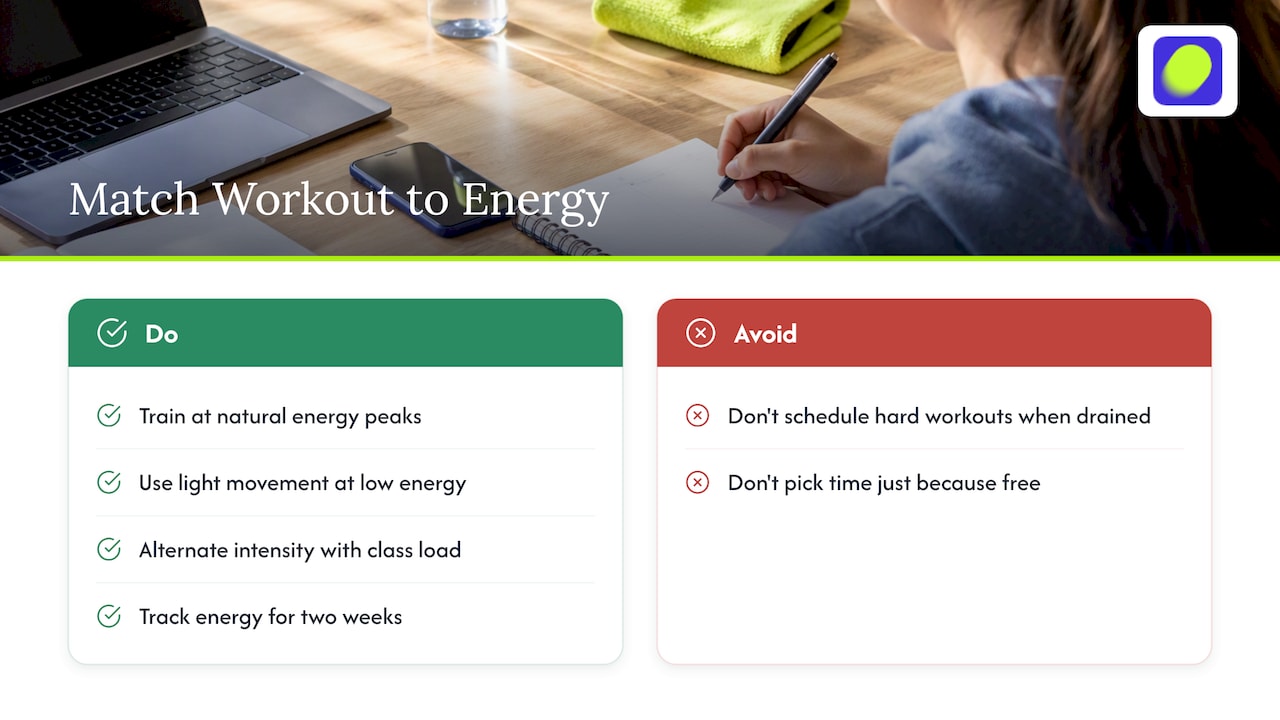
Your energy is not the same at 8am as it is at 8pm, and your workout should account for that instead of ignoring it. Morning sessions tend to work well for students who are naturally alert early or who want to protect their workout from the chaos of a busy day. Afternoon or early evening sessions often suit students whose energy builds throughout the day or who use exercise as a release after classes.
Notice your own patterns over a week or two. If you consistently feel drained after your 2pm class, that is not the time to schedule your toughest session, even if it is the only open slot on paper. Shift your hardest training to whenever your natural energy peaks, and save lighter movement, like a walk or stretching session, for your low points in the day.
Some students also do better alternating intensity with their class schedule: a lighter, shorter session on heavy class days and a fuller workout on lighter days. There is no universal right answer here, only the pattern that keeps you showing up most often.
You already have the schedule. What you need now is a program that removes the guesswork, and that is exactly what we built. Our free plan gives you guided sessions with timers, coach-led structure, and streaks that make consistency feel doable instead of forced, so you can pick a template from this article and start training today.
The 3-3-3 rule generally refers to training three days a week, doing three main exercises per session, and resting for three minutes between sets. It is a simple framework for beginners who want structure without a complicated program.
The 3/2/1 rule typically describes a weekly split of three strength days, two cardio days, and one flexibility or mobility day. Definitions vary across sources, so treat it as a flexible template rather than a fixed standard.
For younger students, bodyweight exercises and light resistance training done a few times weekly with adult supervision is considered safe and effective. Form should always come before adding any weight or resistance.
This is not a standard, widely recognized fitness guideline, and definitions of it vary depending on the source. Stick to established frameworks instead, like training a few times weekly with proper warm-ups and supervised technique for younger students.