If you're on the lookout for a yummy treat that fits right into your fitness goals without emptying your wallet, you've stumbled upon the perfect recipe. With so many options for protein-packed ice creams and low-sugar desserts crowding the shelves, it's easy to get overwhelmed. Sure, some of them taste alright, but have you seen the prices? That's why whipping up your own batch of protein ice cream at home is such a game-changer.
Not only does it hit the spot when you're craving something sweet, but it's also a fun twist on the usual protein shake. Plus, you get to say goodbye to all those extra additives and sugars that sneak into store-bought versions.
This homemade pistachio ice cream with vanilla protein powder is the perfect mix of tasty and healthy as well as a great way to cool down after a workout.
Let’s get to it:
Ingredients:
-120g unshelled and unsalted pistachios
-280ml milk
-200ml full fat canned coconut milk
-2 tbsp of raw honey-1/8 tsp salt
-1 tbsp melted coconut oil-1 scoop of vanilla protein powder
-1 tbsp of melted chocolateInstructions:
1️⃣ Begin by adding the pistachios to your blender. Change the speed, starting from low and gradually increasing to medium and high until the pistachios break down into small bits.
2️⃣ While blending, slowly pour in the milk. Continue blending until the mixture achieves a smooth and creamy consistency, free of any chunks.
3️⃣ Incorporate all the remaining ingredients, except for the chopped pistachios, and blend until everything is thoroughly combined.
4️⃣ If you have an ice cream machine, transfer there.
5️⃣ In case you don’t have an ice cream machine, place the mixture into a metal or glass container, and cover it with parchment paper. Gently press the parchment paper down onto the ice cream to prevent any air from getting in during the freezing process. Then, put it in the freezer.
6️⃣ After about 2 hours, take the container out of the freezer and give the mixture a good stir. Add in the chopped pistachios during this mixing step, as it will help prevent ice crystals in the final product.
7️⃣ Cover the container again and return it to the freezer for a 24-hour freeze.
8️⃣ The following day, remove the ice cream from the freezer and let it thaw for approximately 15 minutes, until it’s easy to scoop and dip it in some melted chocolate.
There you have it: delicious, healthy and protein-packed homemade pistachio ice cream! The best part about this recipe is that you can customize it with whatever flavors you’d like. Whether you're in the mood for something fruity, chocolatey, or even more nutty, you can tweak this base to suit your cravings. It's a wonderful way to enjoy a treat that's not just good, but also good for you. After all, who said healthy eating couldn't be fun and delicious?
Hey there! Ready to whip up something super tasty and good for you?
If you were looking for a sweet and healthy snack to keep you full throughout the day or something to have after a workout, then you’re in the right place. High-Protein smoothies and shakes are not just delicious, but they’re also great for your health. It's all about mixing some cool ingredients like banana, avocado, blueberries, and a bit of protein powder to keep you powered up.
Whether you're looking to get more muscles or just want a sweet treat that's good for you, this protein packed smoothie has got your back.
Protein Powder: With whey protein in the mix, this smoothie is perfect for keeping your muscles happy, especially after a workout.
Good Fats: That creamy avocado? It's full of healthy fats that are great for your heart.
Berry Goodness: Blueberries aren't just tasty; they're full of antioxidants that keep your body feeling great.
Energy Boost: Bananas are awesome for a quick energy pick-me-up, plus they make your smoothie sweet and smooth.
Ingredients:
- 250 ml whey
- 1 ripe banana
- 1/4 avocado
- 30g blueberries
- 1 scoop vanilla whey protein
- 1 scoop hazelnuts
Instructions:
Begin with 250 ml of whey in your blender.
Add a ripe banana and a quarter of an avocado for sweetness and smoothness.
Include a generous portion of blueberries for a flavor kick.
Mix in a scoop of vanilla whey protein and a scoop of hazelnuts to enhance the nutty, creamy texture.
Blend until smooth and enjoy the rich, satisfying taste!
Customize Your Smoothie
The beauty of this smoothie lies in its versatility. Here are a few ways to tweak it to your liking:
Vegan-Friendly: Substitute whey protein with a plant-based protein powder and use almond milk or coconut water as the liquid base.
Boost Fiber: Add a tablespoon of chia seeds or flaxseeds to increase fiber content, which can aid in digestion and keep you feeling full longer.
Increase Antioxidants: Swap blueberries for mixed berries or add a handful of spinach to pack in more antioxidants without compromising taste.
This banana and avocado protein smoothie is more than a tasty drink; it's a way to fuel your body right, whether you're hitting the gym hard or just need a healthy snack.
So, blend it, sip it, and enjoy the good vibes it brings to your day!
We all have our preferences—some people jump out of bed ready to train fitness, while others don’t hit their stride until after sunset. But when it comes to getting real results—muscle, weight loss, strength, or overall wellness—does the time of day you workout actually matter?
Whether you're squeezing in dumbbell workouts before your morning coffee or closing the gym with a post-dinner grind, this guide will help you decide what works best for your lifestyle and your goals.
Let’s settle the debate once and for all: early morning vs. late night workouts—which one wins?
✅ Boosts Energy for the Day
Starting your day with a workout can increase focus, productivity, and overall mood. Morning sessions help you feel accomplished before most people are even awake.
✅ Improves Consistency
Fewer distractions = fewer excuses. Morning routines tend to be more repeatable and easier to stick to long term.
✅ May Help With Weight Loss
Some studies show fasted training may boost fat burning (if done safely and under guidance from a coach or personal trainer).
💡 With the Onemor app, you can schedule your morning training sessions in your planner, follow short routines, and even track performance before breakfast.
✅ Strength Peaks Later in the Day
Your body is naturally warmer and looser in the evening, which can improve performance and reduce injury risk during exercise—especially workouts for men focusing on power and muscle gains.
✅ Great for Stress Relief
After a long day, a workout can help you decompress, clear your mind, and sleep better.
✅ Flexibility for Busy Schedules
Not everyone can rise at 5 AM. Night sessions allow more time to warm up, fuel properly, and really commit to your fitness goals.
💡 Use Onemor to find a suitable evening workout app routine from the comfort of your living room, office, or even hotel room.
The truth is - the best time to workout is the time you can consistently stick to.
🌞Morning Workouts
Best for :
Habit-building, discipline, early energy
Downside :
Early wake-up, colder joints
Ideal for :
Busy professionals, parents, early risers
🌜Night Workouts
Best for :
Strength training, flexibility, stress relief
Downside :
Can disrupt sleep if done too late
Ideal for :
Night owls, shift workers, gym closers
Need help choosing? Let Onemor personalize your schedule. Whether you train at 6 AM or 9 PM, you can find the right exercise, log it with a tracker, and follow a trainer plan based on your goals.
Seven days. Six workouts. One habit. And if you finish — 70% off a year of having a real coach plan your training for you.
That's the Onemor Try Not to Cry Week. Running from March 30th to April 5th, it's not a marketing gimmick or a sponsored post. It's a real challenge, with a real reward, designed for the people who've been saying "I'll start this week" for the last four months.
This week, the starting line is right in front of you. Here's everything you need to know.
🔥 THE CHALLENGE: Train 6 times between March 30 and April 5. Complete all 6 and unlock 70% off Onemor's annual plan — that's areal coach planning your workouts every week for just $4.5/month.
The name says it all — this is a week of training that's going to push you. Six sessions in seven days is not easy. It's not supposed to be. The point is to do something your past self would have quit, and your future self will thank you for.
Here's the structure:
Dates: March 30 (Sunday) through April 5 (Saturday), 2026
Challenge: Complete 6 workouts within that 7-day window
Reward for finishing all 6: 70% off Onemor's annual plan
Price after discount: $4.5/month — with a real coach planning your workouts every single week
Platform: Onemor app —available free on iOS
You can train in the morning, at night, at home, at the gym, or wherever you do your thing. The only rule is that you show up six times. That's it.
📲 Download Onemor free at onemor.com and join the challenge before March 30. Your plan, your coach, your tribe — ready and waiting.
This isn't random. There's real science behind why a week-long challenge structured like this is one of the most effective ways to build a habit that sticks.
One workout doesn't change your body or your mindset. But six consecutive days of showing up — of making a decision before you feel ready, of doing it tired, of doing it when your schedule is messy — that starts to rewire something. By day six, you're not the same person who almost skipped day one.
Seven days is a container your brain can wrap itself around. "I'll do this for a week" is a completely different mental agreement than "I'll be consistent forever." One of those feels possible right now. The other feels exhausting before you even start.
That's the genius of the Try Not to Cry Week — it's an invitation, not a life sentence. Start here. See how it feels. Then decide what comes next from a position of strength instead of avoidance.
Day 1 you train because of the challenge. Day 3 you train because you don't want to break the streak. Day 6 you train because you've become someone who trains. That's the shift. The challenge is just the door — you have to walk through it.
Let's talk about what's on theother side of completing this challenge, because it's worth being specific.
Finishing all 6 workouts unlocks 70% off Onemor's annual plan. That brings the price down to $4.5 per month —which, for context, is less than a single gym class, less than a coffee, and a fraction of what a personal trainer costs in any city in the world.
What you get for $4.5/month:
A real coach — not an algorithm — planning your workouts every week
A personalized program matched to your goals via Onemor's quiz
Follow-along workout videos with pro demonstrations so you always know exactly what to do
Access to strength, HIIT, pilates, yoga, and mobility programs
Streak tracking, XP, and a leaderboard that makes showing up actually fun
A tribe — a community of people training alongside you and keeping you accountable
Smart reminders that fit your schedule, not the other way around
Most people spend more than $4.5/month on apps they barely open. This is a coach-built training plan for less than a dollar a week more. The math doesn't need a calculator.
💸 Complete the Try Not to Cry Week and lock in 70% off Onemor Pro — just $4.5/month for a full year of coach-planned workouts. The offer is exclusive to challenge completers. Join at onemor.com.
The Try Not to Cry Week is built for people who are done with the cycle of starting and stopping. Specifically:
The person who's been "about to start" for weeks and needs something external to actually begin
The person who trains solo and struggles with consistency because there's no accountability
The person who keeps paying for fitness apps they don't open
The person who knows they'd train more if they had a real plan — not just random YouTube videos
The person who wants to see if they can actually do something hard
Anyone who's ever thought "I just need to get into a routine" and never did
If any of that sounds familiar —this is quite literally designed for you. Not for the person who's already training six days a week. For the person who needs one good week to prove to themselves they can.
Wanting to complete the challenge and actually completing it are different things. Here's how to make the gap smaller:
Map your 6 sessions before March 30. Look at your calendar right now. Pick 6 slots. Put them in. Don't decide each day — decide once and execute.
Make day 1 non-negotiable.The hardest session is always the first one. If you do day 1, the momentum of not wanting to waste it carries you to day 2.
1Lower the bar for hard days. A 20-minute session still counts. Showing up at 60% is infinitely better than not showing up at all. Done beats perfect every time.
Tell at least one person. Social accountability is the most underrated consistency tool in existence. Text a friend. Post it. The act of saying it out loud creates a commitment that silence doesn't.
Use Onemor's follow-along player. You don't need to decide what to do — the coach has already decided.Open the app, press play, do the thing.
Remember what's on the other side. 70% off isn't just a discount — it's a year of having someone else handle the planning so you can just show up and train.
Let's be honest: $4.5/month is a great deal. But the real prize of the Try Not to Cry Week isn't on your credit card statement.
It's the version of you who finishes. The one who proved — not to anyone else, but to themselves — that they can do hard things when they decide to. The one who no longer says "I want to get into a routine" from a place of wishful thinking, but from a place of recent evidence.
That version of you is available.It's one week away. The week starts March 30th. The challenge is on.
❤️🔥 The challenge is on. Will you accept it?Train 6 times between March 30–April 5 on Onemor. Finish all 6 and unlock 70%off — $4.5/month for a coach who plans your workouts every week. DownloadOnemor free and start your journey at onemor.com.
The Try Not to Cry Week is a 7-dayfitness challenge run by Onemor from March 30 to April 5, 2026. The challenge requires participants to complete 6 workouts within that window. Users who complete all 6 workouts unlock an exclusive 70% discount on Onemor's annual Pro plan.
Completing all 6 workouts unlocks 70% off Onemor's annual subscription plan, reducing the price to $4.5 per month. This gives you 12 months of access to coach-planned workout programs,follow-along training videos, community features, and Onemor's full Pro suite.
After the 70% discount unlocked by completing the Try Not to Cry Week, Onemor Pro costs $4.5 per month (billed annually). This is one of the lowest price points available for an app that provides real coach-planned workouts.
The Try Not to Cry Week runs from Sunday, March 30, 2026 to Saturday, April 5, 2026. Participants must complete 6 workouts within this specific 7-day window to be eligible for the reward.
No. The 6 workouts can be completed on any 6 of the 7 days between March 30 and April 5. The only requirement is completing all 6 within the challenge window.
Onemor offers strength training, HIIT, pilates, yoga, mobility, and home workout programs. All workouts are led by real coaches and include follow-along video demonstrations. Programs are personalized based on your goals through Onemor's quiz.
Yes. Onemor is free to download on iOS (App Store). The app offers a free tier with daily workout access and a 21-day Pro trial with no credit card required. The Try Not to Cry Week challenge is available within the app.
The challenge is designed for people who want to build a consistent workout habit, especially those who struggle with motivation or accountability. It is particularly suited to Gen Z users and fitness beginners who want structure, community, and a reward for showing up.
Onemor is built around a tribe model — members join communities led by real coaches, rather than following generic workout libraries. The app includes gamification (XP, streaks, leaderboards), social accountability features, and personalized program matching. It is specifically designed for Gen Z users who want fitness to feel engaging and social, not transactional.
Most healthy beginners should take creatine, and the starting dose is simple: a moderate daily dose consistent with common recommendations. That’s it. No complicated cycling, no special timing window, no loading phase required. According to Harvard Health, this maintenance dose is effective and generally safe for healthy adults, with research supporting consistent use over a long period. You can expect noticeable performance improvements within a few weeks, and meaningful strength and muscle gains when you pair it with regular resistance training.
Here’s what to know before you start:
Pro Tip: Don’t overthink the timing. Pick a consistent daily moment, whether that’s with breakfast or right after your workout, and stick to it. Consistency beats perfect timing every time.
Creatine is a naturally occurring compound your body produces from amino acids, primarily in the liver and kidneys, and stores in your muscles as phosphocreatine. When you sprint, lift, or do anything explosive, your muscles burn through ATP (adenosine triphosphate) fast. Phosphocreatine’s job is to rapidly regenerate that ATP so your muscles can keep firing through those short, intense bursts.
Think of phosphocreatine as a quick-charge battery. Your aerobic system handles long, steady efforts, but for anything under about 10 seconds of maximum effort, phosphocreatine is what keeps you going. Supplementing with creatine raises the amount stored in your muscles, which means more fuel available for those high-intensity moments.
Your body makes some creatine on its own, and you get more from food. Natural dietary sources include:
Vegetarians and vegans get very little creatine from diet, which means their baseline muscle stores tend to run lower and they often see the most pronounced response to supplementation.
The honest answer: creatine is one of the most well-researched supplements in sports nutrition, and the benefits for beginners are real, though not dramatic overnight. Paired with consistent training, you can expect a meaningful edge in the gym within weeks.
A systematic review and meta-analysis found that creatine supplementation produces small but consistent increases in body mass (weighted mean difference of approximately 0.86 kg) and fat-free mass (approximately 0.82 kg), with larger effects when combined with resistance training. Those numbers sound modest, but for a beginner, even small improvements in strength and recovery compound quickly.
The primary evidence-backed benefits include:
Realistic expectation: creatine produces small-to-moderate gains in strength and body composition when paired with training. It is not a shortcut, but it is a genuine, research-backed tool.
The ISSN position stand recommends a maintenance dose of approximately 3–5 g per day for most adults, and that recommendation holds for the vast majority of beginners. At this dose, your muscles will reach full saturation in roughly 28 days, and you’ll stay there as long as you keep taking it daily.
A loading protocol, typically 20 g per day split into four 5 g doses over 5–7 days, saturates your muscles faster. According to PMC research on loading protocols, loading reaches the same endpoint as the slow approach, just in less time. The tradeoff: higher single doses increase the risk of GI discomfort, including bloating and loose stools. For most beginners, the extra week or two of waiting is worth skipping the stomach issues.
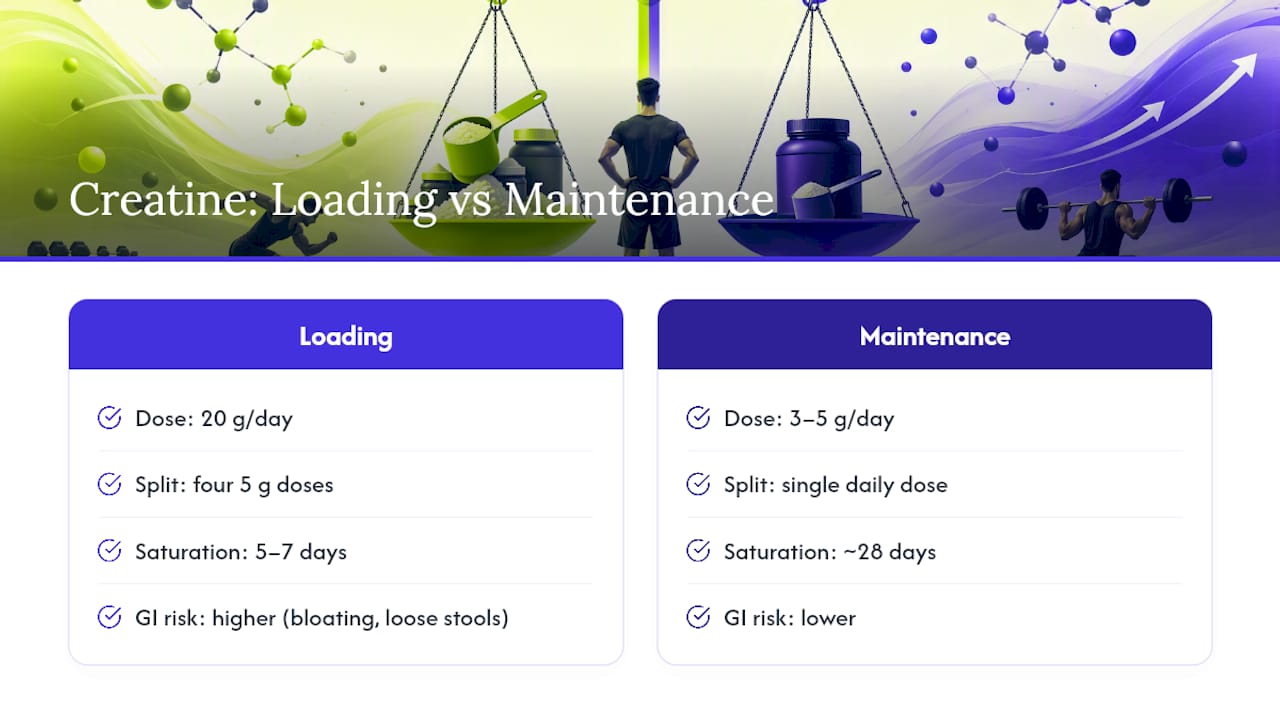
If you weigh significantly more than average, the ISSN also notes a relative loading dose of approximately 0.3 g/kg/day.
Timeline summary:
Pro Tip: Take your creatine with a meal that contains carbohydrates or protein. Research published on PubMed shows that insulin enhances muscle creatine uptake, so pairing your dose with food can modestly improve how much your muscles actually retain.
The most common beginner question is when to take creatine. The honest answer: it doesn’t matter much. Creatine is not like caffeine, where timing directly affects the acute effect. It works by saturating your muscle stores over time, so daily consistency is what drives results, not whether you take it at 7 AM or 7 PM.
That said, a few practical habits make the routine easier:
Both formats deliver the same compound. Powder is cheaper per gram and easier to mix into drinks. Capsules are more convenient for travel and require no measuring, but cost more and require swallowing several at once to hit a 5 g dose. For most beginners, powder is the better starting point purely on cost and flexibility.
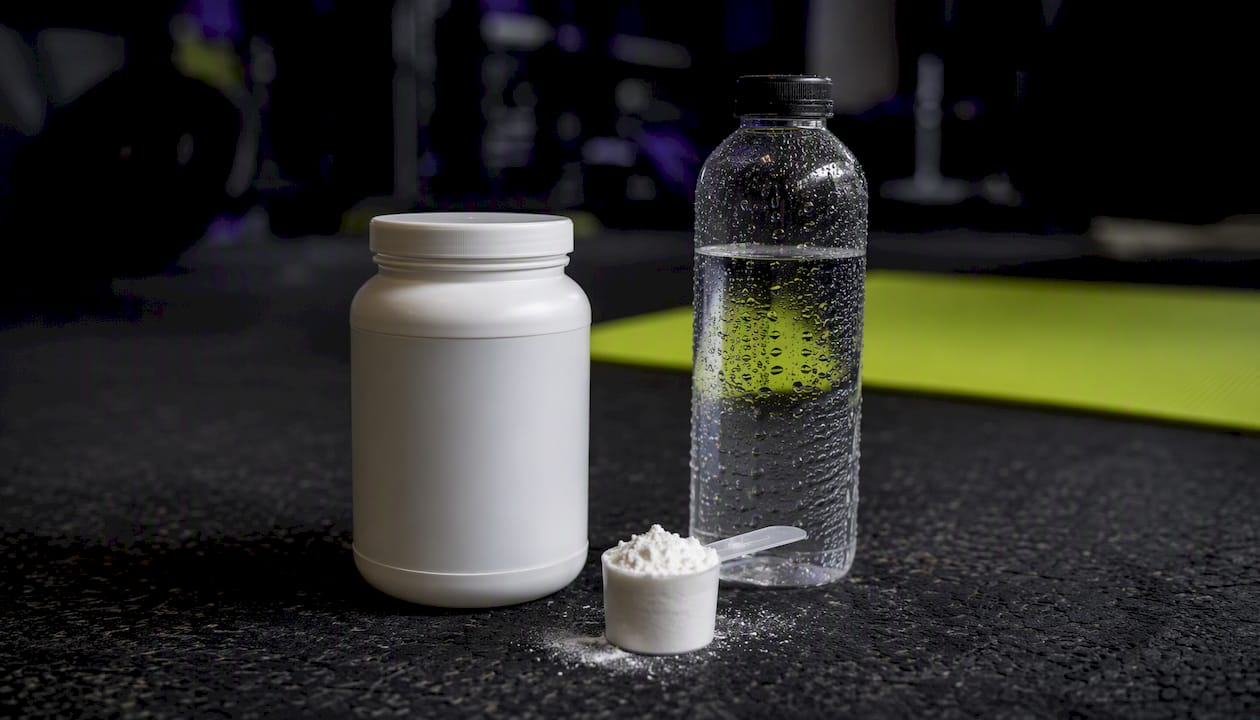
Pro Tip: Use a digital kitchen scale at least once to verify your scoop size. Most supplement scoops are calibrated for 5 g, but they vary by brand. A quick check prevents accidental under- or over-dosing.
Creatine monohydrate. Full stop. The Mayo Clinic identifies it as the most studied form, and decades of research consistently show it to be effective and well-tolerated at recommended doses. Every other form on the market is competing against that track record.
Here’s how the common alternatives compare:
One practical note on quality: the FDA does not regulate supplement purity the way it does prescription drugs. Look for products carrying third-party testing labels such as NSF Certified for Sport or USP to confirm you’re getting pure creatine monohydrate without unlisted contaminants. You can find vetted creatine monohydrate options at Just Move Supplements if you want a straightforward starting point.
Creatine has one of the strongest safety records of any sports supplement. Research supports its use in healthy adults at recommended doses, and the ISSN position stand explicitly states that creatine supplementation does not damage kidney function in healthy individuals. The most common side effects are mild and manageable:
For hydration guidance during this adjustment period, this science-backed hydration guide covers what to drink and when around your sessions.
— Cedars-Sinai Health
What to watch for and when to stop:
A lot of beginner hesitation around creatine comes from misinformation. Here’s what the evidence actually says:
One of the most common beginner frustrations is not knowing what “working” looks like in the first few weeks. Here’s a realistic breakdown:
The early weight bump is almost always water, not muscle or fat. University of Rochester Medicine notes that this initial increase reflects water drawn into muscle cells as creatine stores fill, and it typically stabilizes quickly. Track your real progress through strength numbers, reps completed, and how you feel during sets, not just the scale.
A meta-analysis confirms that meaningful fat-free mass gains require weeks to months of consistent supplementation combined with resistance training, not days.
Not enough to match what studies use. The Mayo Clinic reports that typical omnivorous diets provide roughly 1–2 g of creatine per day from meat and fish. Most supplementation research uses 3–5 g/day as the maintenance dose, meaning food alone leaves you at least 1–4 g short of the studied range.
Approximate creatine content in common foods:
Cooking reduces creatine content in all of these, so the numbers you actually absorb from a cooked meal are lower. For vegetarians and vegans, dietary creatine is essentially negligible, making supplementation particularly worth considering.
These are the practical habits that actually move the needle, based on what the research supports:
Pro Tip: If you weigh significantly more than 80 kg (about 175 lbs), consider dosing toward 5 g/day rather than 3 g/day. The ISSN’s relative loading guidance of 0.3 g/kg/day suggests larger athletes need proportionally more to saturate stores at the same rate.
Recovery matters as much as the supplement itself. Creatine supports performance, but sleep and recovery are what actually convert that performance into muscle. Don’t shortchange either.
We see a lot of beginners treat creatine like the missing piece, the thing that will finally make training click. The truth is more straightforward: creatine is a well-researched tool that gives you a small, consistent edge when you’re already doing the basics right. Consistent training, enough protein, adequate sleep, and progressive overload are what produce results. Creatine makes those results slightly better and slightly faster.
If you’re new to lifting and wondering whether to start creatine now or wait, the honest answer is that starting alongside a structured program makes more sense than starting in isolation. Creatine works best when there’s a training stimulus for it to amplify. Onemor’s beginner programs are built exactly for this moment: guided sessions with sets, reps, and rest timers so you’re not guessing what to do in the gym while also figuring out supplementation.
One more thing worth saying: if anything feels off after starting creatine, whether that’s unusual fatigue, GI issues that don’t resolve, or anything that concerns you, talk to a clinician. Responsible experimentation means paying attention and adjusting, not just pushing through.
Creatine without a training plan is like buying running shoes and staying on the couch. Onemor gives you the structure that makes supplementation actually pay off: beginner-friendly programs led by real coaches, guided sessions with built-in sets, reps, and rest timers, and a community that keeps you consistent when motivation dips.
Here’s what that looks like in practice:
Start free and find the program that fits your schedule and goals at Onemor.
Creatine monohydrate at 3–5 g/day is the most research-backed, beginner-friendly supplement available, and it works best when paired with consistent resistance training and adequate recovery.
PointDetailsDaily doseTake 3–5 g of creatine monohydrate daily; loading is optional and not required for beginners.Timing flexibilityConsistency matters more than timing; take it with a carb or protein-containing meal for better uptake.Timeline to resultsWithout loading, expect full muscle saturation in approximately 28 days; strength gains follow with training.Safety caveatConsult a clinician before starting if you have kidney disease, are pregnant, or take kidney-affecting medications.OnemorPair creatine with a structured beginner program through Onemor to maximize training adaptations and stay consistent.
This article is general information, not a substitute for advice from a qualified doctor. Consult a qualified healthcare professional about your own circumstances before acting on anything here.
The Ingredients:
-120g unshelled and unsalted pistachios
-280ml milk
-200ml full fat canned coconut milk
-2 tbsp of raw honey
-1/8 tsp salt
-1 tbsp melted coconut oil
-1 scoop of vanilla protein powder
-1 tbsp of melted chocolate
1️⃣ Begin by adding the pistachios to your blender. Change the speed, starting from low and gradually increasing to medium and high until the pistachios break down into small bits.
2️⃣ While blending, slowly pour in the milk. Continue blending until the mixture achieves a smooth and creamy consistency, free of any chunks.
3️⃣ Incorporate all the remaining ingredients, except for the chopped pistachios, and blend until everything is thoroughly combined.
4️⃣ If you have an ice cream machine, transfer there.
5️⃣ In case you don’t have an ice cream machine, here’s what to do: Place the mixture into a metal or glass container, and cover it with parchment paper. Gently press the parchment paper down onto the ice cream to prevent any air from getting in during the freezing process. Then, put it in the freezer.
6️⃣After about 2 hours, take the container out of the freezer and give the mixture a good stir. Add in the chopped pistachios during this mixing step, as it will help prevent ice crystals in the final product.
7️⃣ Cover the container again and return it to the freezer for a 24-hour freeze.
8️⃣ The following day, remove the ice cream from the freezer and let it thaw for approximately 15 minutes, until it’s easy to scoop and dip it in somemelted chocolate
Enjoy your homemade pistachio ice cream! 🍨🥄
Follow @onemor.app for more nutrition content.
#onemor#friday#healthy#recipe
#icecream#nutrition#foryoupage
#trending