If your heels pop up, your chest folds forward or your squat stops short, stiff ankles may be the reason. The good news: you can test them in two minutes with a wall, then work on them for 10 to 15 minutes a few times a week. Most people training 2-3 days a week can fit that into the warm-up they already do. We’ll walk you through the test, the drills and how to build them into your week.
Dorsiflexion is the motion of pulling your toes toward your shin. In a squat, your shin has to tilt forward over your foot. If the ankle can’t give that range, your body finds range somewhere else.
That usually looks like heels lifting, your torso leaning forward, feet turning out or knees caving in. A 2025 study of 44 active people found that those with limited dorsiflexion showed more forward trunk lean, pelvis motion and lower-back flexion while squatting than the control group.
How much range do you need? A 2025 simulation study estimated that a deep squat needs at least 35° of dorsiflexion. It also found knee and hip range matter too, so the ankle is one piece of the puzzle, not the whole thing.
There’s a second piece. A 2017 NSCA journal review notes that some lifters have enough ankle range but don’t use it well in the squat. If your test below passes and your squat still struggles, practicing the movement under a coach’s eye is the next step.
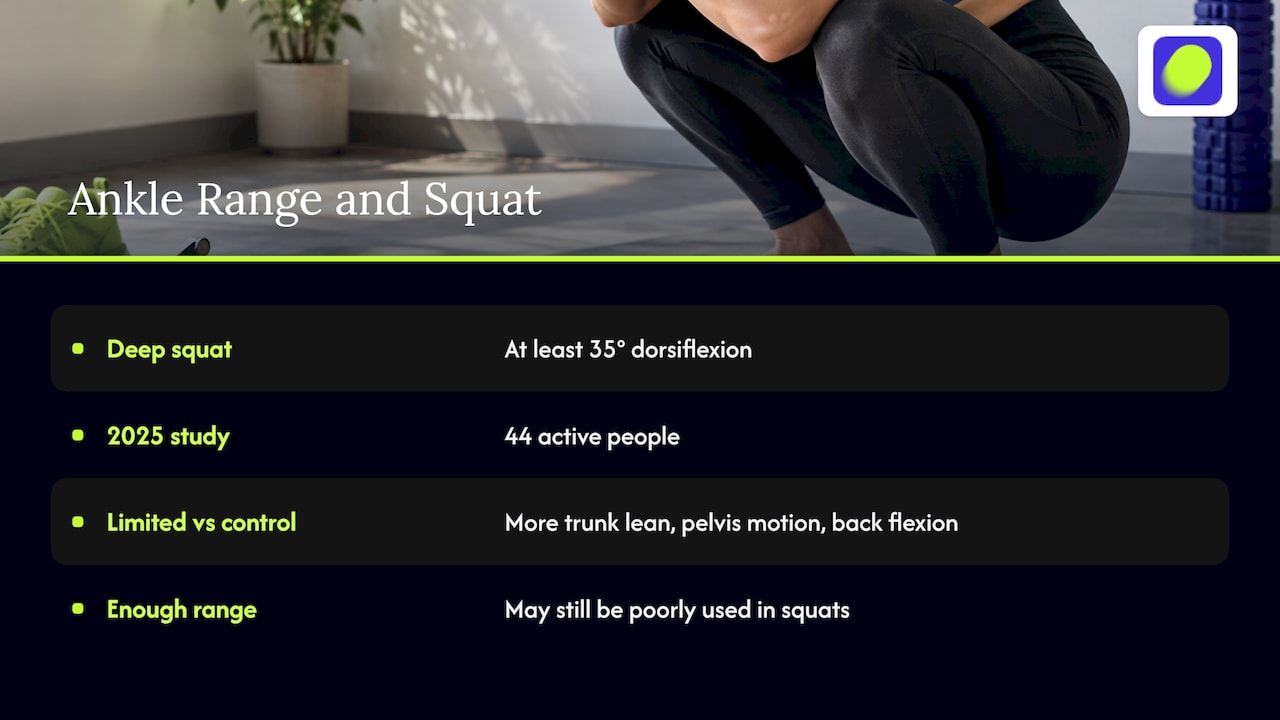
You need a wall, a tape measure or ruler, and about two minutes. This is the half-kneeling version of the knee-to-wall test.
Another clinic suggests a simple read: under 4 inches means your ankles are likely limiting your squat depth, while 4 to 5 inches or more suggests they’re not. The same page offers a quick check: put small plates under your heels and squat. If it suddenly looks and feels better, your ankles are probably the main issue.
Watch for these things during the test:
You don’t need all of them. Choose two or three and do them consistently. These come from a Men’s Health piece on three ankle drills.
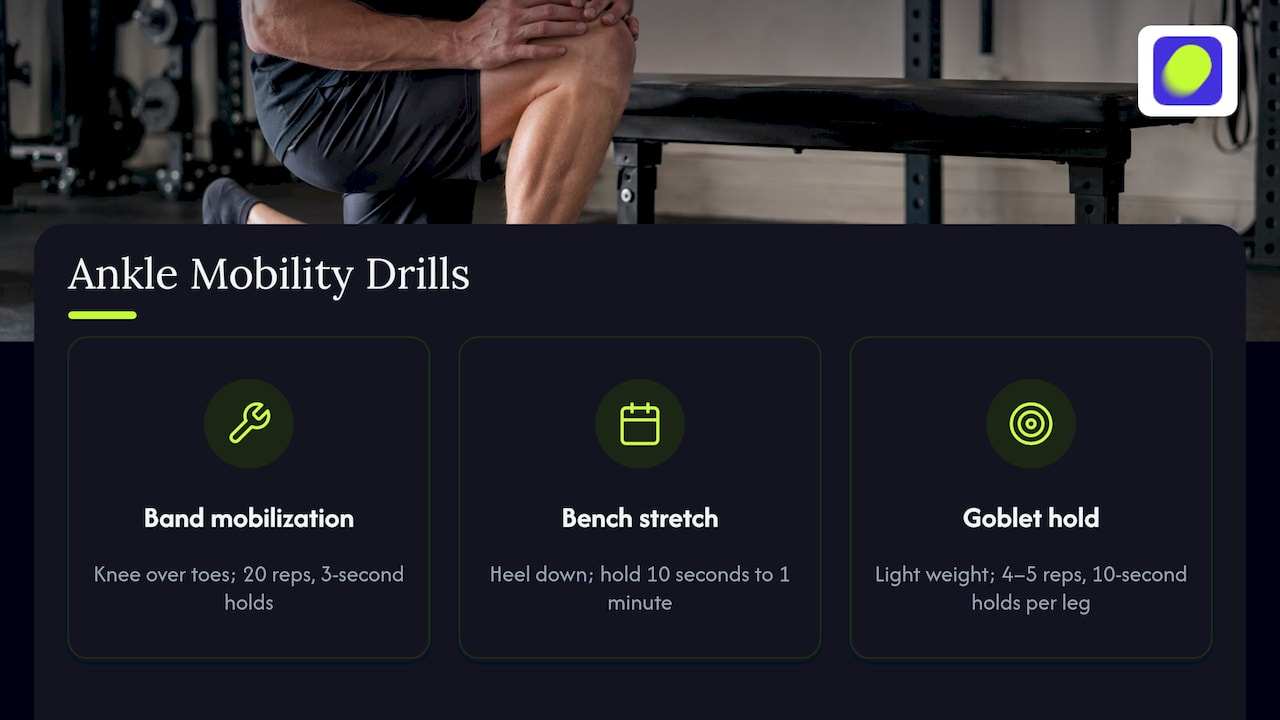
1. Banded joint mobilization. Anchor a 2.5 to 3 inch band to a rig or sturdy post and loop it around the front of your ankle, with your foot slightly elevated. Drive your knee forward over your toes. The article suggests 20 reps with a 3-second hold each. The band pulls the joint gently, which can help if the stiffness feels like pinching rather than stretching.
2. Box or bench stretch. Put your foot on a bench, drive your knee over your toe and hold. Holds range from 10 seconds to a minute. Keep the heel down.
3. Goblet squat hold. Hold a light weight at your chest, sink into a deep squat and gently shift your hips side to side, pushing one knee forward at a time. Try 4 to 5 reps with 10-second holds per leg.
Want a tight calf fix as well? A PT describes a slow bent-knee calf stretch of 10 reps per side daily and a 2 to 3 minute deep squat hold using support or a little weight, from Competitive Edge Therapy. That page also notes that stiffness often comes from calf muscles that rarely work through their full range.
You don’t have to wait for perfect ankles to squat. Small plates or a riser under your heels reduce how much dorsiflexion the squat demands. It’s the same idea behind lifting shoes, as the same PT clinic explains.
Use it as a bridge. Squat with the support while the drills do their work, then re-test every few weeks and see how far you’ve come.
Here’s a simple plan that fits a gym week of two or three sessions.
Women’s Health recommends ankle mobility three to five times a week, with two to three dynamic moves in the warm-up and one to two static drills in the cool-down, for roughly 10 to 17 minutes in total. HSS physical therapists say stretching can be done daily and suggest giving a routine 6 to 8 weeks before judging the difference.
That last point matters. Mobility changes slowly, so measure your progress with the wall test every two weeks rather than checking your squat every session.
Mobility work only helps if you actually do it. At Onemor, we build guided sessions with sets, reps and rest timers, led by coaches, so you don’t have to plan your warm-up or squat days yourself. You can also keep your streak going and earn XP while you train with friends in your tribe.
Start on the Free plan to see how the sessions feel, and look at Pro when you want more structure. If you’d like a squat-specific roadmap, our 4 week beginner plan for squat depth and ankles is a great place to begin. Need a warm-up first? Try the 5 to 10 minute dynamic warm-up or the 10-minute beginner mobility routine.
If your knees complain when you squat, our squat knee pain plan is worth reading too.
Mobility work should feel like a stretch or pressure, not sharp pain. Stop if an ankle hurts during an exercise. According to Mayo Clinic, get care right away for severe pain or swelling after an injury, a deformed ankle, signs of infection or being unable to put weight on it. Book a visit if swelling lasts beyond 2 to 5 days of home care or pain lasts several weeks. Those situations call for a doctor or physical therapist, not another stretch.
A common benchmark is touching the wall with your knee while your big toe is 5 inches away and your heel stays down. Under about 4 inches suggests your ankles may be limiting your depth. Deep squats need more range than everyday movement, so even small gains count.
Yes, they can contribute. Stiff ankles are linked to knees collapsing inward, toeing out and heels lifting as your body finds range elsewhere. Work on the ankle, and keep an eye on hip and knee range too.
Plan for several weeks. HSS suggests 6 to 8 weeks of regular work before judging results. Re-test with the wall test every couple of weeks so you can see the change.
Both can work. Dynamic moves like banded dorsiflexion fit best in the warm-up, and static holds fit well after training, as Women’s Health suggests.