Zone 2 cardio is moderate aerobic exercise performed at roughly 60 to 70% of your maximum heart rate, an intensity where you can still speak in full sentences without gasping for air. It matters because this is the pace where your body builds its aerobic base, the physical foundation behind almost every other fitness goal you have, and it costs you almost nothing in recovery. The talk test is your fastest gut check: if you can hold a conversation but couldn’t sing, you’re probably there. The CDC frames 150 minutes of moderate aerobic activity weekly as the adult baseline, and Zone 2 is exactly that kind of moderate effort.
Zone 2 cardio at 60 to 70% of max heart rate builds your aerobic base, improves fat oxidation, and requires a moderate weekly amount of time for measurable results.
Your body runs on a mix of fat and carbohydrate for fuel, and the ratio shifts depending on how hard you’re working. At Zone 2 intensity, your muscles lean heavily on fat oxidation and aerobic metabolism, the slow, oxygen-fueled energy system that doesn’t leave you wrecked afterward. This is also the intensity range associated with mitochondrial adaptation, meaning your cells get better at producing energy efficiently over time.

Most heart-rate zone models put Zone 2 at 60 to 70% of max heart rate, though that percentage is a starting estimate, not a law carved in stone. Individual variability is real. A 2025 review found that fixed percentage cutoffs don’t map consistently onto true physiological thresholds from person to person.
Here’s how the zones stack up:
Pro Tip: Your smartwatch probably calculates heart-rate zones using your age alone, not your actual fitness level. If you’ve never manually entered a tested max heart rate, your Zone 2 range on the display might be off by five to ten beats.
Start with a formula, then verify it against how you feel. The classic 220 minus your age gives a rough max heart rate, but it’s a population average, not a personal fact. The Tanaka formula (208 minus 0.7 times your age) tends to estimate max heart rate more accurately across a wider age range, especially for people over 40.
For a sharper target, use the Karvonen method, which factors in your resting heart rate:
A 30 year old with a resting heart rate of 60: max heart rate is roughly 187, reserve is 127, and 60 to 70% of that reserve lands Zone 2 between about 136 and 149 beats per minute.
For anyone who wants precision beyond formulas, threshold-based markers like VT1 (first ventilatory threshold) or Fat Max identify your actual aerobic ceiling through lab or field testing. They’re more accurate but less accessible than a simple percentage.
If you’re relying on a wearable, check two things: that you’ve entered a tested or better-estimated max heart rate instead of the device default, and that your heart rate doesn’t creep upward mid-session at the same pace, a sign called heart-rate drift that usually means you started too hot. When in doubt, trust the talk test and a perceived effort of about 3 to 4 out of 10.
The payoff shows up in your engine, not just your muscles. Consistent Zone 2 work builds:
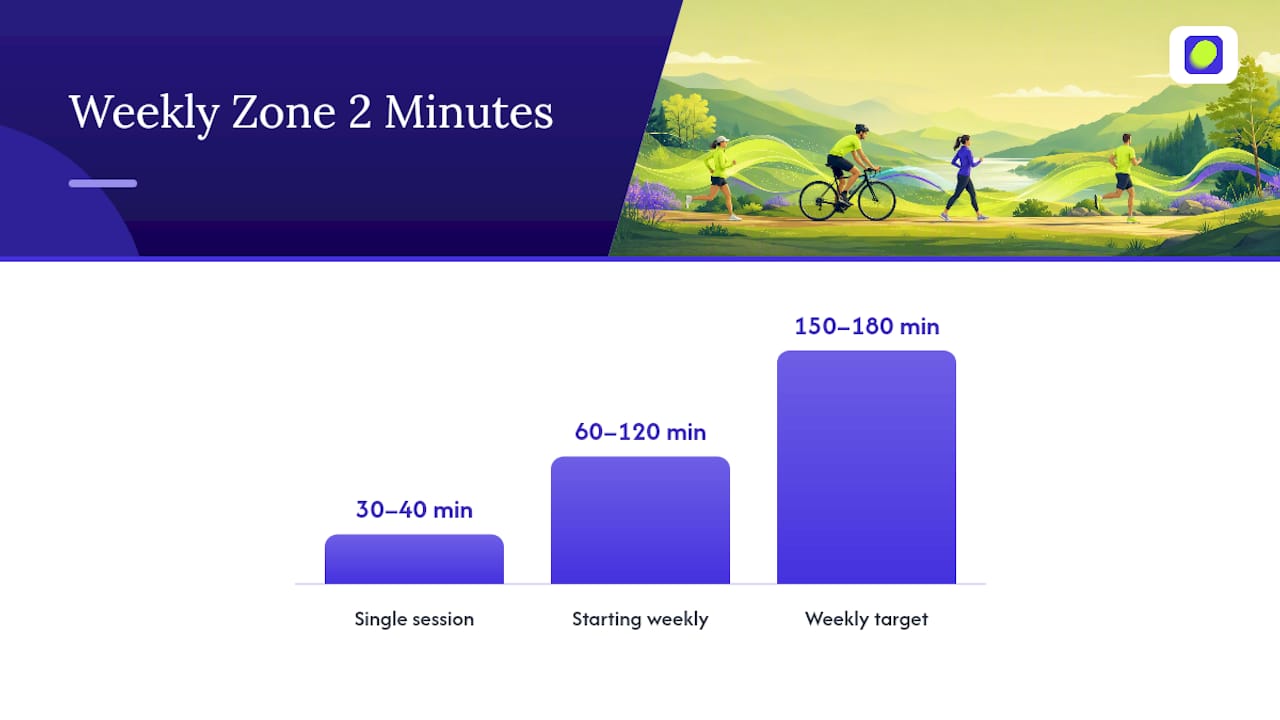
Weekly volume framework: The CDC recommends 150 minutes of moderate-intensity aerobic activity weekly as the adult baseline, and most Zone 2 coaching guides build toward roughly 150 to 180 minutes for meaningful gains.
One nuance worth knowing: a 2025 narrative review cautions against treating Zone 2 as the single best intensity for every adaptation. Some of the research behind that idea comes from elite endurance athletes, and mixing in higher-intensity work still matters for certain fitness goals.
Pick your activity, pick your duration, and let consistency do the heavy lifting. Walking, cycling, swimming, rowing, or an incline treadmill session all work as long as your heart rate and breathing stay in range.
Three sessions to start with:
Weekly volume guidance, based on practical coaching resources: beginners should start with two to three sessions of 30 to 40 minutes weekly, then build toward the 150 to 180 minute range as fitness improves.
Progression works best in this order:
For sessions past 60 minutes, hydrate before you start and consider a light carbohydrate snack beforehand. Our guide on hydration for workouts breaks this down further if you’re stacking Zone 2 with strength or HIIT days, a simple rule is to separate them by at least a few hours or place them on different days entirely.
Pro Tip: Track just one number per session, either your average heart rate or your perceived effort out of 10. Trying to log everything usually leads to logging nothing.
Zone 2’s moderate intensity makes it one of the safer training zones, but a few groups should check in with a clinician before starting: anyone with a diagnosed heart condition, anyone on medication that affects heart rate (like beta blockers), anyone recovering from a recent cardiac event, or anyone experiencing new or severe symptoms during exercise.
If you’re starting from scratch:
Stop and seek care immediately if you feel chest pain, dizziness, fainting, or breathlessness that feels disproportionate to your effort. Worth repeating: medications and certain health conditions can lower your max heart rate, which means simple age-based formulas may not apply to you, so confirm your numbers with a provider if any of this applies.
Each zone plays a different role in a well-built program:
Elite endurance athletes often push that ratio even further toward easy volume, but your personal split should follow what you’re actually training for.
Three shorter Zone 2 sessions a week beat one heroic long one almost every time, mainly because they’re easier to actually schedule. Pair your sessions with something you already do, a commute walk, a podcast you listen to anyway, and the habit builds itself instead of fighting your calendar.

Pro Tip: Track one number weekly, either your average session heart rate or total minutes. That’s enough to see real progress without turning cardio into a spreadsheet project.
Reading formulas is one thing. Actually hitting your Zone 2 range consistently, week after week, is another challenge entirely, and that’s where a guided app changes the equation. Onemor builds pre-set sessions with sets, reps, and timers already mapped out, so you’re not manually calculating heart-rate math before every workout.
Onemor pairs that structure with real coach-led programming and tribe-based challenges, meaning your Zone 2 minutes get tracked automatically and you’ve got other people keeping you accountable, not just a number on a screen. Coaches like Coach Kayla and Coach Jahson build cardio and strength templates specifically for people juggling a busy schedule with a real fitness goal.
If you want your next Zone 2 session already planned for you, check out Onemor’s programs and get started.
What heart rate is considered Zone 2 cardio?Zone 2 typically falls between 60 and 70% of your maximum heart rate, though the Karvonen method using heart rate reserve tends to give a more personalized number.
How long should a Zone 2 session last?Beginners should start with 30 to 40 minute sessions, then build toward longer 60-plus minute sessions as endurance improves.
Can I do Zone 2 cardio every day?Yes, since it's low-impact on your recovery, but most people get better results from three to five sessions weekly rather than daily, especially if you're also lifting.
Is walking enough for Zone 2 cardio?Absolutely, brisk walking is one of the most accessible ways to hit Zone 2, especially for beginners or anyone easing back into training.
How is Zone 2 different from Zone 3 cardio?Zone 2 lets you hold a full conversation, while Zone 3 (tempo pace) makes talking noticeably harder and blends aerobic with anaerobic effort.
This article is general information, not a substitute for advice from a qualified doctor. Consult a qualified healthcare professional about your own circumstances before acting on anything here.