Yes, the Smith machine is a smart place for a beginner to start. It teaches you the squat, bench, and hip thrust patterns inside a fixed, guided bar path, so you get the safety of built-in stops without needing a spotter. It does trade off some stabilizer activation you’d get from a free barbell, but that’s a fair swap while you learn. Your next move: learn the setup (safety stops, wrist-flick unracking) and pick two to four starter exercises below. This is the same approach Onemor builds into its beginner-friendly guided sessions, and it is confirmed by safety basics from the Mayo Clinic.
TL;DR:
A Smith machine is a barbell fixed to vertical (or slightly angled) steel rails, so the bar can only travel straight up and down instead of wobbling in every direction like a free barbell. That fixed path is exactly what makes it approachable if you’ve never touched a squat rack. You hook the bar into place with a quick twist of your wrists, known as the “wrist-flick,” and it locks onto small notches along the rail whenever you need to stop.
Here’s what beginners get wrong most often before they even load a plate:
Once you know your true starting weight, everything else about programming gets a lot more accurate. That single habit, checking the bar before you assume anything, prevents most of the loading mistakes that trip up first-timers.
The Smith machine earns its reputation as a beginner-friendly gym equipment option for a few concrete reasons, but it’s worth knowing what you’re trading away too.
Where it helps you:
Where it falls short:
Here’s the reassuring part: a review of resistance training research found that machine-based and free-weight training can build comparable muscle size when volume and intensity are matched. In plain terms, the tool matters less than your consistency. If you’re just starting strength training, the Smith machine won’t hold back your progress, it’ll just get you there through a slightly different activation pattern than free weights.
Every session should start with the same short checklist, whether you’re benching, squatting, or doing rows. This is where most injuries get prevented before they ever happen.
Pro Tip: Run through your safety-stop and wrist-flick check every single session, even after you’ve done it a hundred times. Gyms rearrange machines, adjust rail angles during maintenance, and swap bars more often than you’d expect, so a five-second check beats a bad surprise mid-set.
These six moves cover your major muscle groups and give you a full-body starting point. For each one, begin with just the empty bar until your form feels solid, then add small plates in 5 to 10 pound increments.
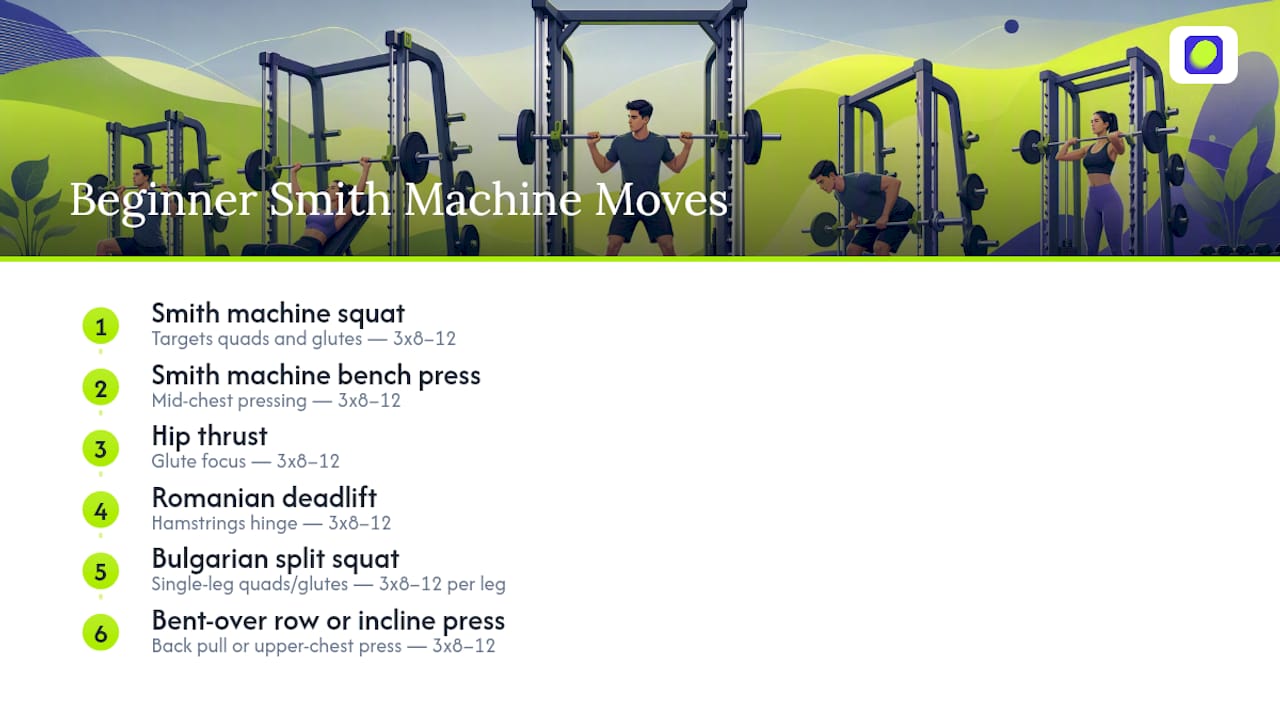
Smith machine squat
Set your feet slightly forward of the bar path, not directly underneath it, since the fixed rail means your torso needs to lean back slightly to stay balanced. Keep your chest up, drive your knees out over your toes, and control the descent rather than dropping into the bottom. Start with 3 sets of 8 to 12 reps.
Smith machine bench press
Position the bench so the bar lines up over your mid-chest when unracked. Squeeze your shoulder blades together before you lower the bar, and control the descent all the way down instead of letting it drop. Aim for 3 sets of 8 to 12 reps.
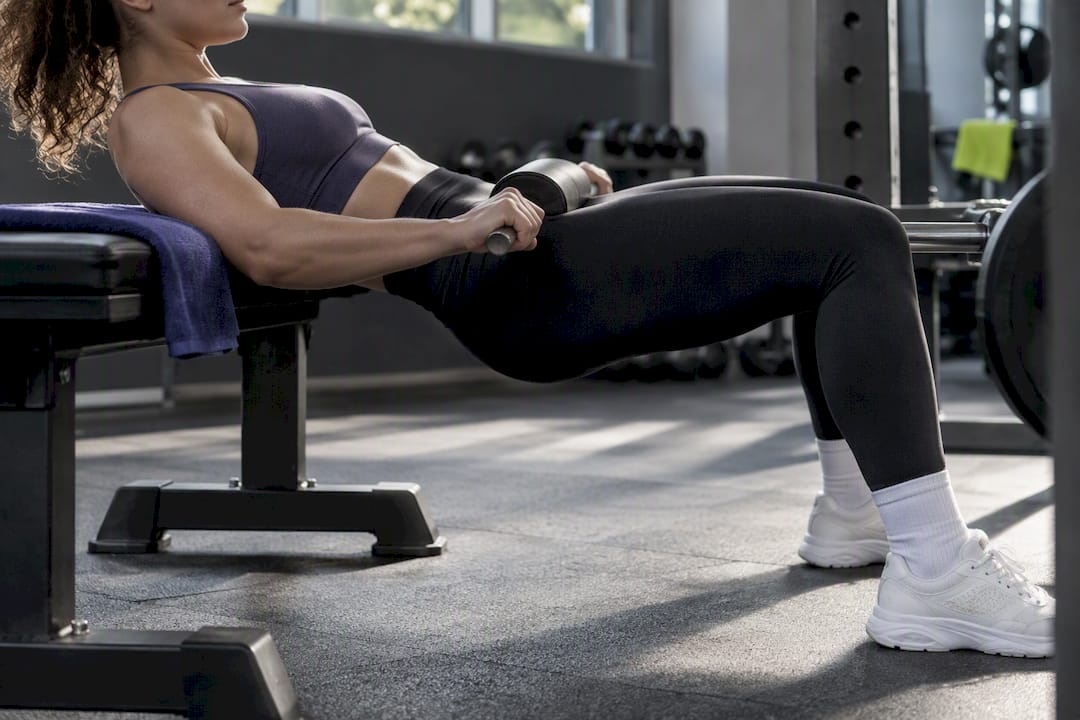
Hip thrust
Sit on the floor with your upper back against a bench, roll the bar over your hips (a pad helps here), and drive through your heels until your hips are fully extended. Squeeze your glutes hard at the top and lower with control. Work up to 3 sets of 8 to 12 reps, a move
Romanian deadlift
Stand with the bar at hip height, hinge at your hips with soft knees, and keep the bar tracking close to your thighs as you lower it. Stop when you feel a stretch in your hamstrings, then drive your hips forward to stand back up. Start with 3 sets of 8 to 12 reps.
Bulgarian split squat
Rest your rear foot on a bench behind you, with your front foot positioned far enough forward that your knee stays stable through the movement. Lower straight down until your rear knee nearly grazes the floor, then push through your front heel. Try 3 sets of 8 to 12 reps per leg.
Bent-over row or incline press
Depending on what your gym layout allows, add one upper-body pulling or pressing variation. A bent-over row on the Smith machine builds back strength to balance out your pressing work, while an incline press shifts emphasis toward your upper chest. Either one works well for 3 sets of 8 to 12 reps.
Pro Tip: Log each Smith machine lift as its own separate entry in your workout tracker, something like “Smith squat, 60 lbs, 3x8,” rather than lumping it in with free-weight numbers. The two aren’t directly comparable, and keeping them distinct makes your progress easier to read week over week.
A simple four to eight week block is enough to build real comfort with these patterns before you think about anything more advanced.
This slow build matters more than it sounds like it should. Beginner strength training research consistently points to progressive overload, small consistent increases over time, as the real driver of results, not how heavy you go in week one.
Neither tool wins outright. The better question is which one fits what you’re training for on a given day.
As a rule of thumb: use the Smith machine to learn a pattern, to train accessory work, or on days you don’t have a spotter. Use the free barbell when maximal strength or sport-specific carryover is your main goal.
A few small habits separate a smooth Smith machine session from a frustrating one.
Pro Tip: If a fix doesn’t stick after a session or two, film yourself from the side. Most Smith machine form issues, foot placement especially, are far easier to spot on video than they are to feel in the moment.
This guide draws on peer-reviewed EMG research, trainer-published setup guides, and safety fundamentals from sources like the Mayo Clinic, combined with the practical, beginner-first approach Onemor builds into its coaching. Onemor’s guided sessions walk you through sets, reps, and rest timers in real time, which maps directly onto the exercises and progression scheme laid out above. If you’re the kind of beginner who wants structure rather than a stack of theory to sort through on your own, that’s exactly the gap this kind of guided program is built to close. For readers who want to go deeper on gym basics, Onemor’s starter plan for gym machines covers additional beginner-friendly equipment beyond the Smith machine.
Reading a form guide gets you halfway there. The harder part is actually showing up consistently and knowing exactly what to do once you’re standing at the machine, and that’s the gap Onemor is built to close. Instead of trying to remember rep ranges and rest periods from an article, Onemor’s guided sessions walk you through your sets, reps, and rest timers in real time, coach-led, with beginner-friendly programs built specifically for people just starting out. You can start with the Free plan to try guided sessions at no cost, or check out Pro if you want expanded coaching features and deeper program structure. Pair that with Onemor’s 4-week starter plan and you’ve got a full beginner routine that goes well beyond the Smith machine alone. A fitness app available on iOS offers guided programs to help users focus on lifting while handling workout planning.
Yes. It’s one of the more approachable pieces of beginner gym equipment because the fixed bar path removes the balance challenge of a free barbell, letting you focus on learning squat, press, and hip hinge patterns safely. Just pair it with the setup checklist above so you’re not skipping safety stops or misjudging the bar weight.
Definitions of this rule vary across fitness sources, and there’s no single standardized version tied to Smith machine training specifically. Rather than guess at a number that doesn’t apply here, focus on the programming approach covered above: 2 to 3 sessions per week, progressing reps before weight.
Start with just the empty bar, since Smith machine bars often weigh less than a standard 45-pound barbell and vary by machine, sometimes landing between roughly 5 and 30 kilograms depending on the counterbalance design, according to GymNotePlus. Once your form feels solid, add small plates in 5 to 10 pound increments rather than jumping straight to a loaded bar.
There’s no universal number, since it depends on your bodyweight, experience, and the specific bar you’re using. A safer approach is to master the empty-bar squat pattern first, then build up in small increments over 3 sets of 8 to 12 reps, adding weight only once you can complete every rep with solid form.