Reps in reserve (RIR) is the number of clean, quality reps you could still grind out before hitting technical failure on a set. Most lifters chasing muscle or strength should train near failure but typically leave a few reps in reserve, not training to absolute failure every set. That leaves enough gas in the tank to protect your joints, your bar speed, and next session’s performance, according to coaching resources from NASM. Think of RPE 9 as roughly 1 RIR, and RPE 8 as roughly 2 RIR.
TL;DR:
RIR asks one question after a set: how many more good reps did you have left? If you rack the bar and know you could’ve squeezed out two more with solid form, that’s 2 RIR. Zero RIR means you couldn’t have done one more rep no matter what. It’s a simple scale, but it takes the guesswork out of “how heavy should this feel?”
RIR and rate of perceived exertion (RPE) describe the same territory from two directions. RPE asks how hard something felt; RIR asks how many reps were left. They line up like this, per NASM’s autoregulation guidance:
Here’s where RIR beats a rigid percentage of your one-rep max: your 80% squat feels different on a night you slept five hours versus eight. RIR adjusts for that in real time, which is why it functions as a built-in readiness check inside your program, not just a labeling system.
Grinding every set to zero RIR feels like proof you’re working hard. It’s often the opposite, a shortcut to burnout. A controlled study on trained lifters found that a 3-RIR bench press strategy kept average bar velocity 0.6 meters per second higher and dropped session RPE to 8.2, compared to a 10 out of 10 for sets taken to true failure.
That’s a real gap in how a workout feels and how fast the bar moves, and it adds up across a training week.
The trade-offs worth knowing:
Occasional trips to true failure still earn a spot in a smart plan, usually on a final set of an isolation exercise, or during a planned testing week. The goal isn’t to avoid failure forever. It’s to stop defaulting to it.
Newer lifters routinely misjudge how many reps they have left, especially in the higher-RIR ranges where fatigue hasn’t built up yet. Research on the RIR-based RPE scale found that accuracy improves closer to failure and with more training experience, which means your estimate at 1 RIR is probably more trustworthy than your estimate at 4 RIR, according to work led by Zourdos and colleagues.
Here’s how to sharpen your internal gauge:
Pro Tip: If you’re new to RIR, don’t hang your entire progression plan on it for the first few weeks. Practice the skill on lighter accessory lifts first, where a miscalculation costs you nothing.
Guided sessions inside Onemor walk new lifters through exactly this kind of rep-range calibration, so the skill builds alongside the workout instead of getting left to guesswork.
Your RIR target should shift depending on what you’re training for. There isn’t one universal number, and treating hypertrophy work and max-strength work the same way is a common mistake.
RIR targets by goal:
Pair your RIR target with a weekly volume target. A common hypertrophy benchmark lands around 10 working sets per muscle group per week, and a simple readiness rule (sometimes called the 2-for-2 rule) says if you beat your rep target by two reps on two consecutive sessions, it’s time to add weight.
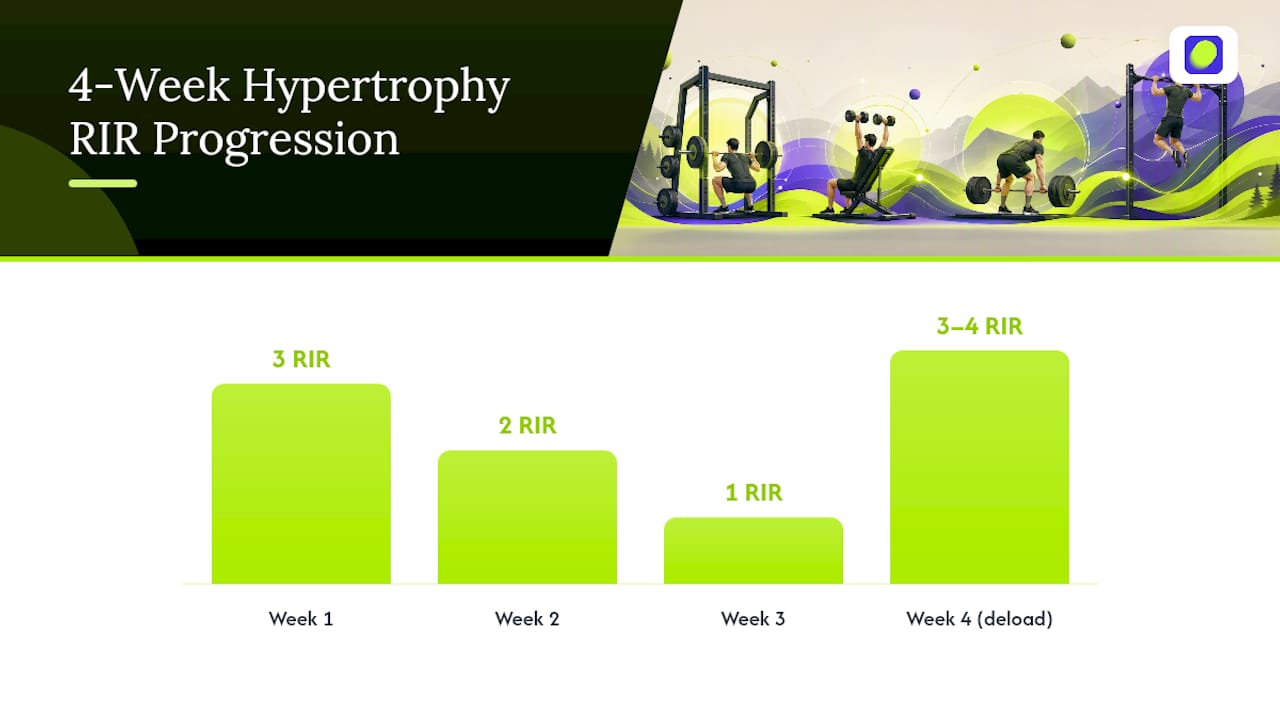
A basic 4-week hypertrophy microcycle might progress like this: Week 1 at 3 RIR to build a base, Week 2 at 2 RIR as loads climb, Week 3 at 1 RIR pushing closer to your limit, then a deload week back at 3 to 4 RIR to let your joints and nervous system reset. Research on varying proximity-to-failure across a training block found that cycling RIR this way produced strength and hypertrophy gains similar to staying at a constant low RIR, but with a noticeably lower session RPE.
The evidence behind RIR isn’t just coaching folklore. Several independent findings point in the same direction:
Put together, this research supports RIR as a legitimate autoregulation tool, not just a subjective feeling you write in a notebook.
Writing RIR next to your sets and reps turns a vague feeling into a data point you can act on. Here’s what that looks like in practice.
Hypertrophy day example: Bench press, 4 sets of 10 at 135 pounds, logged RIR of 3, 2, 2, 1. Since the last set dropped to 1 RIR, the next session either adds 5 pounds or targets 11 reps at the same weight.
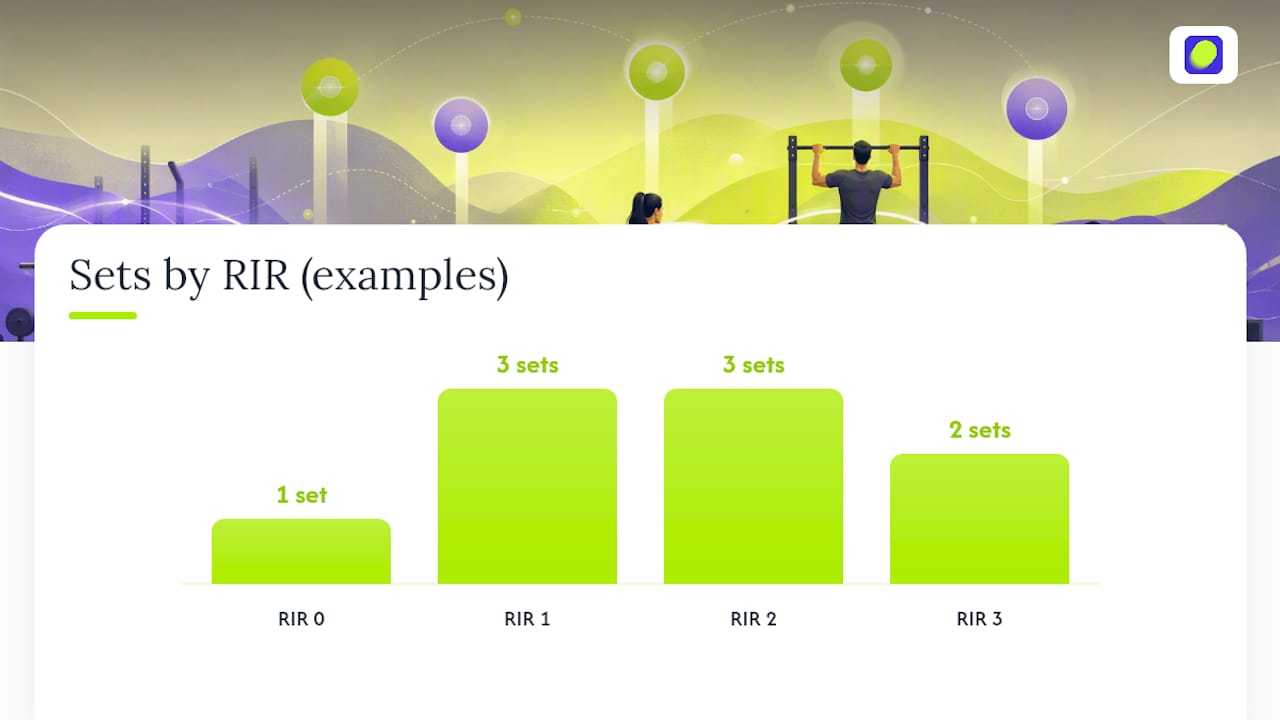
Strength day example: Back squat, 5 sets of 3 at 245 pounds, logged RIR of 3, 2, 1, 1, 0. Pushing the final set to 0 RIR occasionally is fine on a heavy strength day, but it shouldn’t happen on every set or every week.
Use this simple checklist to decide your next move:
Pro Tip: Log RIR the moment you rack the bar, not after the workout. Memory fades fast, and your most honest number is the one you write down in the first ten seconds.
Apps that combine logged RIR with your reps and load can refine your progression far better than raw numbers alone, according to MacroFactor’s breakdown of RIR-based training. Inside some fitness apps, guided sessions build that same logging habit into every workout, so your sets, reps, rest timers, and RIR all live in one place instead of scattered across a notebook and your memory. If you’re ready to stop guessing your intensity and start training with real structure, the free plan gets you into coach-led sessions today, and Onemor Pro unlocks deeper programming for lifters who want to push past the basics.
Leaving 1 to 3 reps in reserve is the better default for most lifters most of the time. A 3-RIR approach preserved bar velocity and produced a lower session RPE than training to failure, while still delivering comparable strength and muscle gains. Occasional failure sets still have a place, just not as your everyday standard.
This isn’t an established RIR or strength training standard, and definitions of it vary widely across fitness content online. If you’ve seen it referenced somewhere specific, treat it as that source’s own framework rather than a universal training rule.
Yes, a target of a certain number of reps means performing the movement that many times with proper form in that set. Where RIR comes in is what happens after those reps: if you could’ve done a couple more with good technique, you finished that set at roughly 2 RIR.
It means stopping your set two clean reps before you’d hit technical failure. If you’re doing squats and you rack the bar with 2 RIR, it means two more solid reps were realistically available to you, which typically lines up with an RPE of about 8.