Yes, the mind muscle connection works, but it depends on your goal and your load. Focusing on the working muscle raised elbow flexor thickness by 12.4% versus 6.9% with an internal focus over eight weeks, and EMG data show higher activation too. It shines for hypertrophy at lighter to moderate loads, not for max force or power. Below, we cover the evidence, when to use it, drills, and programming.
TL;DR:
- Bench press instructions raised anterior deltoid activation from 71.78% to 88.03% of maximal voluntary contraction, but EMG measures activity, not subsequent muscle growth.
- The 2021 analysis found that external focus modestly improved acute strength performance, with a standardized mean difference of 0.34 across included studies.
- Lifters could shift chest and triceps activation below about 60% of one rep maximum, with less consistent selective control at heavier loads.
- Use two or three light sets at 20% to 50% of one rep maximum, then focus on one to three weekly accessories per muscle group.
The best evidence comes from two kinds of studies: short EMG experiments that measure muscle activation, and longer training trials that measure growth. Here is what each one found:
12.4% vs 6.9%: the elbow flexor thickness gain for internal versus external focus after eight weeks. Same program, different attention, nearly double the growth in that trial.
One caution: EMG measures electrical activity, not muscle growth. A higher reading tells you the muscle is working harder in that moment, not that it will grow more. That is why the longer trials matter most, and why we treat the activation numbers as a promising signal rather than proof on their own.
Think of internal focus as a tool, not a rule for every set. The research gives clear guardrails.
Our guide on low-tech 1RM methods shows how.
You do not need special equipment, just intention and a little patience. Try these in order:
Pro Tip: Keep your breathing steady while you focus on a muscle. Holding your breath steals attention from the feel. Our five minute breathing drills can help you stay braced and aware at the same time.
The goal is to put internal focus where it helps and leave it out where it does not. A systematic review of attentional focus in weightlifting frames it as a strategic choice: useful for hypertrophy, potentially limiting for power or maximal strength.
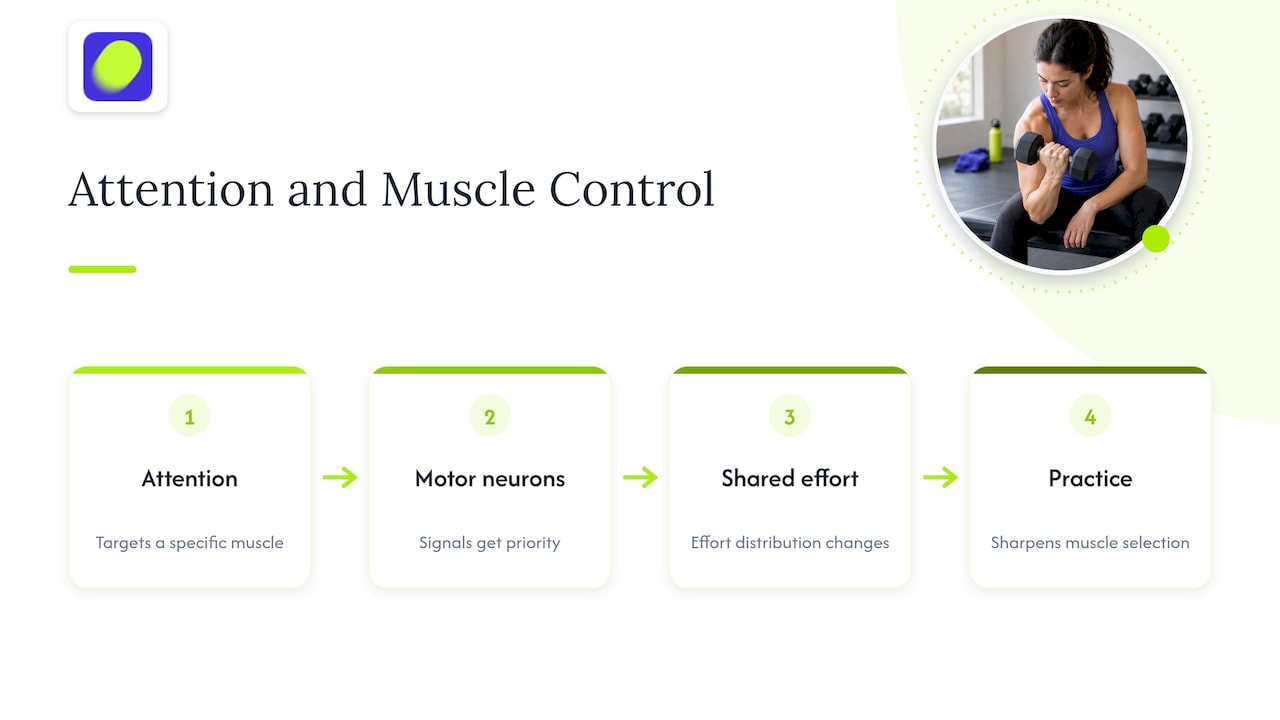
Your brain does not flip a single switch to contract a muscle. It sends signals through motor neurons, and each motor neuron controls a group of muscle fibers. When you direct attention to a specific muscle, you are shaping which signals get priority and how strongly they fire.
The research gives us the outline of this effect rather than a full wiring diagram. EMG studies show that verbal instructions can change activation in particular prime movers, which tells us attention influences how the nervous system distributes effort among muscles that share the work. The finding that experienced lifters select muscles better also hints that practice sharpens this control, much like learning to wiggle a single finger gets easier with repetition.
There is a flip side. During a heavy lift, your nervous system is busy coordinating many muscles at once for stability and force. Pulling attention toward one muscle can interrupt that coordination, which fits with the small edge external focus showed in the acute strength meta-analysis. The takeaway: your attention is a limited resource, so spend it where it pays off.
It does, and you have probably noticed it yourself. Some muscles are easy to feel, like biceps or quads, because they move simple joints in visible ways. Others, like the upper back or glutes, are harder to sense, especially when you are new to training.
The studies we reviewed tested a limited set of muscles: the elbow flexors, the triceps, the pectoralis, and the anterior deltoid during pressing. Those results show activation can be shifted in muscles you can see and move in isolation, and they do not tell us how every muscle behaves. So we should not promise identical results everywhere.
Here is how to work with that in practice:
Be patient with the stubborn muscles. The link between training experience and selective activation suggests this feel improves with time.
Tempo is the easier lever to pull. Slowing the lowering phase and pausing briefly at the point of peak contraction gives your brain more time to register the muscle working. It also keeps momentum from doing the job for you, so the target muscle carries more of the load.
Breathing supports that focus. A simple pattern works well for most lifters: breathe in as you lower, breathe out as you press or pull. Smooth, rhythmic breathing keeps you braced without stealing attention. Holding your breath, on the other hand, tends to pull focus toward tension in your face and neck instead of the muscle you care about.
Try this on your next accessory exercise: lower the weight slowly, squeeze briefly, and exhale in a controlled way on the way up. Do it with a light load so you can put your full attention on the muscle. If you want a structured way to practice, our breathing drills for lifters pair well with slow tempo work.
Keep the same caution in mind: tempo and breathing cues are practice tools for lighter, controlled sets, not instructions for your heaviest attempts.

Knowing the drills is one thing. Doing them consistently is where results come from, and that is where we come in. In the Onemor app, you get workouts led by real coaches, with structure built in so you are not planning on the fly.
Ready to turn these drills into a habit? Download Onemor and start with the free plan to try a guided session today.
Yes, for the right goals. Focusing on the working muscle increased elbow flexor thickness by 12.4% versus 6.9% with an internal focus in an 8-week trial. It works best for hypertrophy at lighter to moderate loads.
Start with light sets in your warm-up, slow the lowering phase, and add a short squeeze at the top of each rep. A mirror, light touch, and simple verbal cues make it easier to feel the target muscle. Begin with isolation exercises, then bring the focus into compound lifts at lighter loads.
You can feel the target muscle working during the rep, and you can contract it on purpose without other muscles taking over. If you can describe where the tension sits and it increases when you focus, the connection is developing. Training experience correlates with better selective activation, so it tends to improve with practice.
It can in some situations. A 2021 meta-analysis found external focus gave a small, significant advantage in acute strength performance. For max-effort lifts, think about moving the bar or the floor rather than the muscle.