Breathe rhythmically, and never hold your breath for more than a second or two unless you’re an experienced lifter grinding through a true maximal attempt. The simplest cue for beginners: inhale as the weight lowers (the eccentric phase), exhale as you push or pull it up (the concentric phase). That single pattern prevents most of the dizziness, blood pressure spikes, and stalled reps that come from breathing wrong under load.
TL;DR:
- Holding your breath during lifts can cause a significant spike in blood pressure, increasing cardiovascular strain and risking fainting, especially during heavy sets.
- Beginners should inhale during eccentric phases and exhale during concentric phases, avoiding prolonged breath-holds, particularly on squats and deadlifts.
- Controlled breathing drills, practiced lying down or with light weights, help transfer proper breath habits into heavier lifts over a four-week progression.
- Individuals with health conditions such as hypertension or pregnancy should prioritize lower-pressure exercises and consult a doctor before attempting maximal efforts.
- Consistent practice with guided cues and built-in timers can improve breath control, reducing dizziness and improving safety during resistance training.
Your breath does more than deliver oxygen. When you hold it against a closed throat, a reflex called the Valsalva maneuver, pressure builds inside your chest and abdomen. That pressure helps brace your spine, but it also spikes your blood pressure fast.
A crossover study on squats found that breath-holding pushed systolic blood pressure up by 16% to 23% compared to controlled breathing, with the heart’s workload (rate-pressure product) jumping 20% to 30%. That’s your cardiovascular system working significantly harder for the exact same set of squats.
The American College of Sports Medicine and the American Heart Association both advise against prolonged breath-holding during resistance training for this reason. They recommend regular, rhythmic breathing through your warm-up, your working sets, and your cooldown.
What does ignoring that advice feel like in the moment? A few common signs show up:
Trained lifters sometimes use brief, controlled breath-holding on true maximal attempts, above roughly 80% of their one-rep max, because a short brace adds real spinal stability. For everyone else, especially in your first months of training, that trade isn’t worth it. You get almost none of the stability benefit and all of the blood pressure spike.
Every lift has its own pressure profile, so the “right” breath depends on what you’re lifting and how heavy it is. Here’s the beginner-friendly version for the exercises you’ll hit most often:
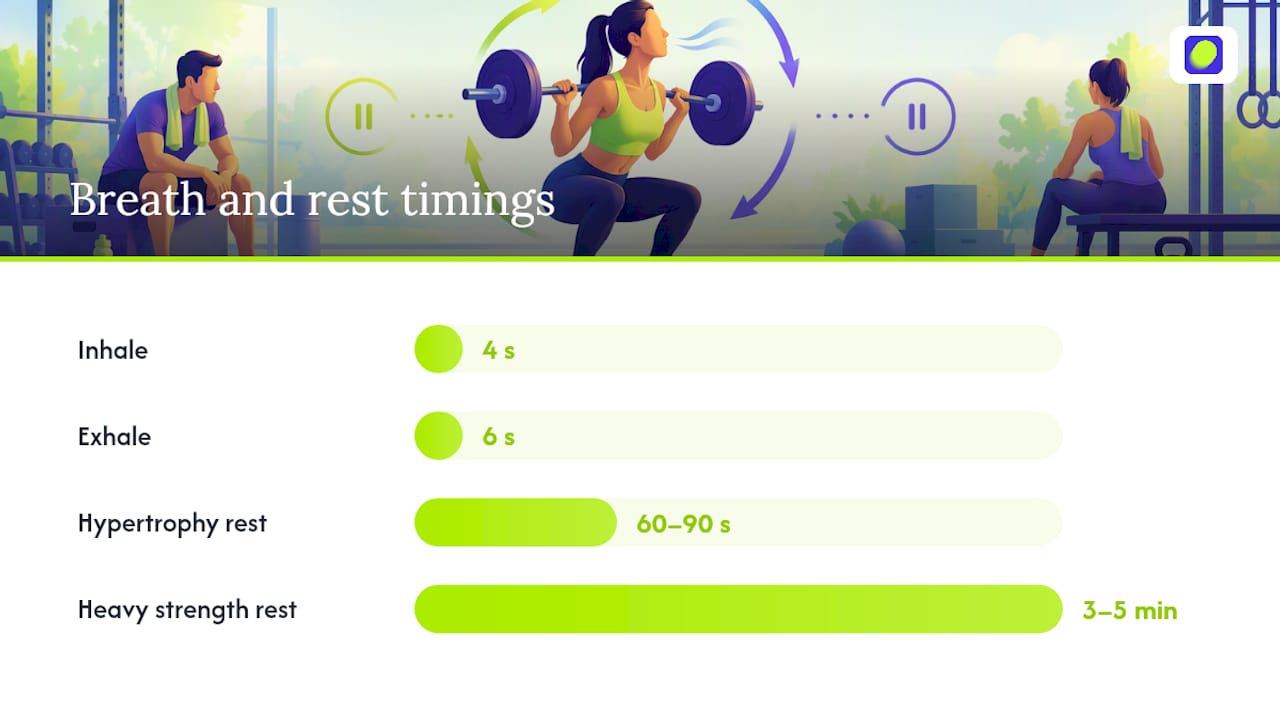
Tempo helps this stick. Try a 2-1-2 count: two seconds lowering (inhale), one second pause, two seconds lifting (exhale). Say it in your head if you have to.
Pro Tip: Put one hand on your belly during your warm-up set. If your hand moves out as you inhale, you’re breathing from your diaphragm. If only your chest rises, you’re breathing shallow, and that’s the pattern that leads to accidental breath-holding once the weight gets heavy.
Breathing technique isn’t something you think your way into under a loaded bar. It has to become a habit you built somewhere else first, then bring with you into your working sets.
Start here, lying down, five minutes, no equipment needed:
Use your rest between sets for this too. A 60 to 90 second break for hypertrophy work, or three to five minutes for heavy strength sets, gives you plenty of time to slow your breathing back down before the next set starts. Built-in rest timers in some fitness apps take the guesswork out of exactly how long you have.
A simple four-week progression works well for most beginners: week one, practice the diaphragmatic drill daily and apply it to machines only. Week two, move to light free weights with a coach or app-guided tempo. Week three, add compound lifts like goblet squats and dumbbell bench press. Week four, layer in your first controlled brace on a moderate squat or deadlift, always inhaling before you brace.
Pro Tip: Short daily breath drills paired with light tempo sets transfer directly to better breathing once the weight gets heavier, especially when a coach can watch your first few reps and call out your breath cue in real time.
Most breathing errors aren’t intentional. They creep in when a lift gets hard and your body defaults to the tightest, most reflexive pattern it knows.
Watch for these patterns in yourself:
If you feel lightheaded, see spots, or your ears start ringing mid-set, stop immediately. Sit down, breathe slowly through your nose, and drop the weight before your next attempt.
Some readers need a modified approach from day one. People managing hypertension, pregnant lifters, and anyone recovering from recent eye or head surgery should lean on lower-pressure exercises, bench press or leg press over squats and deadlifts, machines over free weights, and lighter loads with more controlled exhales rather than any braced hold. This aligns with ACSM’s guidance that untrained or at-risk individuals should build adaptation gradually before attempting near-maximal effort. This is exactly the kind of decision worth a quick check with your doctor or a certified coach first.
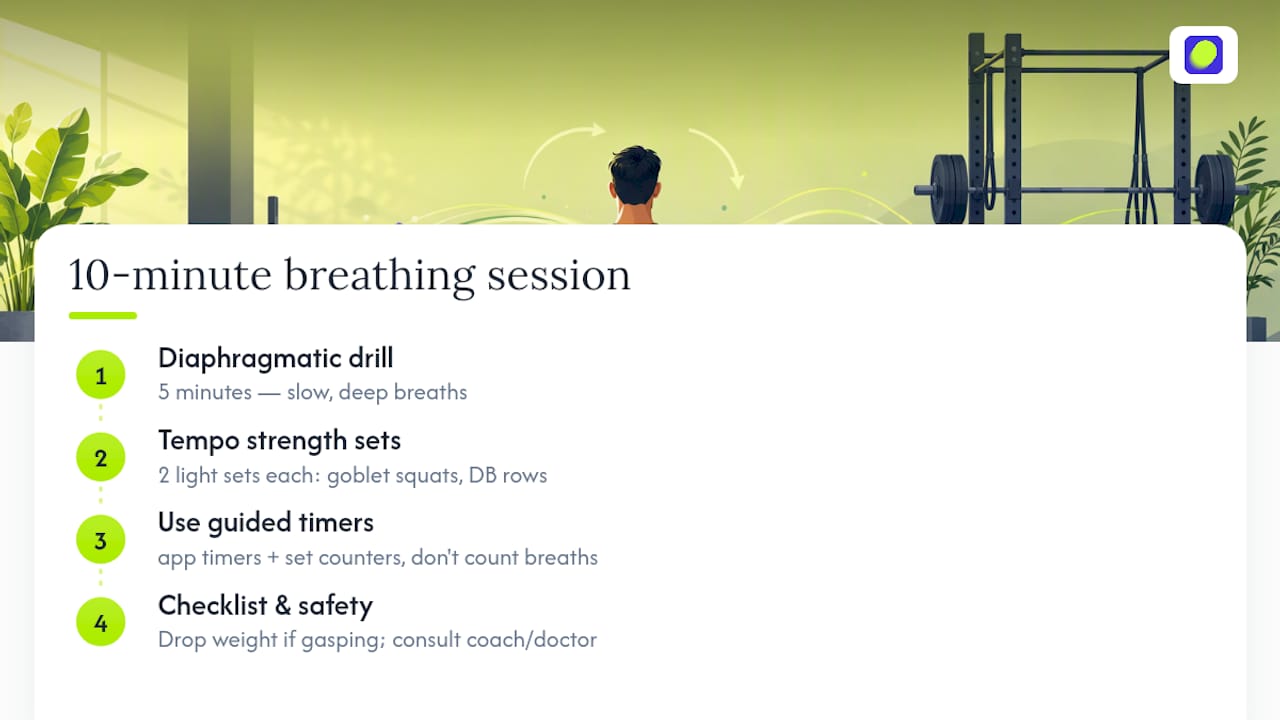
Here’s a ten-minute session you can run tonight: five minutes of the diaphragmatic drill above, followed by two light sets each of goblet squats and dumbbell rows, breathing on tempo the whole time. Guided workout sessions often include rest timers and set counters so you’re not counting breaths and reps in your head at the same time, which is half the battle when you’re new to this.
Coaches often use quick verbal cues like “inhale, brace, press, exhale” paired with a tactile reminder, hand on your belly, to help the pattern click faster. Gamification features such as streaks and experience points exist to encourage consistent practice of breathing control. Breathing mechanics don’t improve from one good set. They improve from showing up and practicing the same cue for two weeks straight.
A short checklist worth tracking: can you complete a full set without gasping at the top? Does your hand-on-belly check still show diaphragmatic movement on rep eight, not just rep one? If either answer is no, drop the weight before you add more. And if dizziness, chest tightness, or unusual shortness of breath shows up during or after training, that’s a conversation for a coach or your doctor, not something to push through.
Ready to build the habit properly instead of guessing your way through it? Onemor’s free plan gets you guided sessions with built-in timers so you can practice breath-synced reps from your very first workout. If you want a coach watching your form and breathing cues directly, Onemor Pro puts you in coach-led programs designed to build that skill week over week. Gyms and studios looking to bring this kind of structured coaching to their members can also check out Onemor’s Free Fitness Platform.
Exhale during the hardest part, the concentric phase, for most lifts and most beginners. This keeps blood pressure more controlled than holding your breath through the sticking point, according to ACSM’s guidance on resistance exercise.
Inhale as you lower the weight and exhale as you curl it up. Curls generate low internal pressure, so there’s no need for bracing or breath-holding at any point in the rep.
Inhale during the eccentric (lowering) phase and exhale during the concentric (lifting) phase. Research on breathing technique confirms there’s no consistent cardiovascular advantage to reversing this pattern, so the priority is staying rhythmic rather than chasing a “perfect” phase match.
For leg-focused movements like leg lifts, leg press, or squats, inhale as the leg lowers or the weight descends, and exhale as you lift or push through the hardest part. Squats and deadlifts specifically produce higher internal pressure than most other lifts, so beginners should favor a controlled exhale over any extended breath-hold.