On your first day at the gym, keep it simple: do a short, full body session that puts form before weight and layout before intensity. Warm up for a few minutes, pick weights you can lift for 8 to 15 reps with control, and walk out knowing exactly what you will do next time. That single combination, movement, moderate reps, and a plan for session two, is what turns a nervous first visit into a habit you actually want to repeat.
TL;DR:
- Beginners should aim to lift weights for 12 to 15 reps using moderate loads that allow control and proper form.
- A total workout of 30 to 40 minutes, including warm-up, main exercises, and cool-down, is sufficient to build the habit without overextending.
- Gradually increase training frequency to two or three sessions weekly, tracking progress and adjusting weights by about 10% to avoid overtraining.
- Focus on performing basic, compound movements like squats, pushes, and rows that target multiple muscle groups, ideally twice a week.
- Starting with a simple, guided program helps maintain consistency and prevents guesswork, especially for those new to gym routines.
Walking into a new gym can feel like landing in a foreign city. A short checklist fixes that fast.
None of this needs to be complicated. You are not there to impress anyone, you are there to learn where things are and how your body responds.
A rushed start is one of the most common first-day mistakes, and it is an easy one to avoid.
A short, structured warm-up and cool-down is one of the simplest ways to prepare your body for exercise and ease it back down afterward, according to Mayo Clinic guidance on warming up and cooling down. Skipping this step does not make your workout shorter in any meaningful way, it just makes the middle part harder than it needs to be.
Nobody hands out a manual for unwritten gym rules, so here is the short version.
Pro Tip: If you are unsure how often you will actually show up, start with a free trial or a short-term membership before committing to anything long.
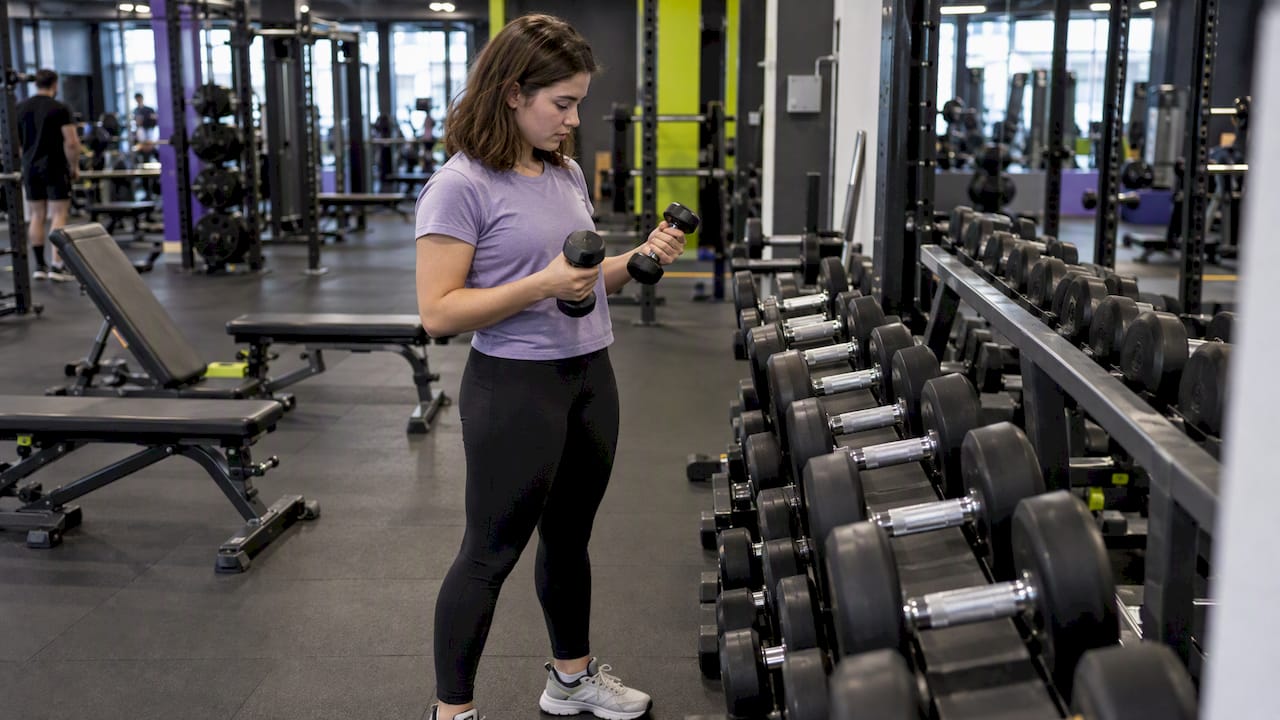
Picking a weight feels like guesswork the first time, but there is a simple rule that removes most of the confusion: choose a load you can lift for 12 to 15 reps while keeping your form clean, as recommended by Mayo Clinic’s warm-up and cool-down guidance. If the last few reps feel impossible or your form falls apart, drop the weight. If you finish the set feeling like you had five more reps left, it is fine to go up slightly next time.
A few more ground rules make the early weeks smoother:
The biggest gains in strength training come from moving off the couch and into consistent movement, not from finding the perfect program on day one, according to the ACSM’s overview of resistance training research.
Here is a full-body session built for your first visit, no guesswork required.
Pro Tip: Keep your tempo slow and controlled on every rep, a two-count down and a two-count up is a good starting pace that keeps form in check.
This whole sequence fits comfortably into 30 to 40 minutes, leaving you time to cool down without feeling rushed.

One good session does not build strength, consistency does. Here is what to focus on next.
If you would rather follow a beginner leg day routine or want more detail on choosing sets and reps, both are natural next steps once your first week is behind you.
Showing up is the hard part, figuring out what to do once you are there should not be. Onemor takes the guesswork out of your next sessions with coach-led programs built for beginners, guided sets, reps, and rest timers so you never have to wonder what comes next, and streaks and tribe challenges that make consistency feel less like a chore and more like something you want to keep up. Instead of building your own routine from scratch, you get structure that adjusts to where you are starting from.
If today’s full-body workout felt good, the Onemor free plan gives you a simple way to keep that momentum going with guided sessions instead of a blank whiteboard. Readers who want more structured progression can also check the Pro subscription for expanded coaching and programming. Download the app and pick your first guided session today.
Start with a short warm-up, then move through 4 to 6 beginner-friendly compound exercises like squats, pushes, and rows using light to moderate weight. Keep sets to 1 to 3 per exercise in the 8 to 15 rep range, and finish with a brief cool-down and stretch.
There is no official fitness body that defines a “3-3-3 rule,” so treat any version you see online as informal advice rather than an established guideline. If you come across it, check the specific source’s definition before applying it, since the term is used differently across fitness content.
Begin with a full-body routine two to three times a week, choosing weights that let you complete 12 to 15 reps with good form, as suggested by Mayo Clinic’s exercise guidance. Focus on learning proper technique before increasing weight or volume.
Like the 3-3-3 rule, the “3/2/1 rule” is not a term defined by major fitness or health authorities, and its meaning varies depending on where you see it used. It is best treated as informal shorthand rather than a guideline to follow strictly.
Around one minute of rest between sets is a reasonable starting point for most beginner exercises, based on Mayo Clinic’s guidance on structuring early workouts. This gives your muscles enough recovery time without letting the session drag on too long.