Motivation gets you started. Discipline keeps you going on the days motivation doesn’t show up. You need both, but if you can only build one, build the habit side, because feelings change by the hour and routines don’t have to. Here’s how the two work, why “just be more disciplined” is bad advice on its own, and how to set up a 2-3 day week you’ll actually keep.
Motivation is the “I want to” feeling. It’s emotional, and it tends to be useful for short-term goals. Think of the Sunday night rush when you picture the new you, buy the shoes and promise Monday will be different.
Discipline is the ability to do the necessary thing whatever your mood says. According to The Conversation, it’s built through consistent, repetitive and sometimes boring action. Muscle Insider makes a similar point: habits are the cornerstone of discipline, formed by practicing the same behavior over time.
Here’s the quick comparison:
Neither one is a personality trait you either have or don’t. Both can be trained, and both can be supported by the way you set up your week.
If your drive vanished by week three, nothing is wrong with you. Motivation is described as a fickle internal process that shifts with fatigue, stress and negative emotions. Expecting it to carry you for months is like expecting a good mood to last all semester.
The numbers back this up. The Association for Applied Sport Psychology, citing CDC data, notes that as many as 80% of people don’t stick with an exercise program once they start. That’s the norm, not a personal failure.
What usually causes the drop? The Cleveland Clinic points to two common culprits: frustration with slow results and doing too much too fast. Their advice is to cut back your frequency rather than quit entirely. Going from zero to six days a week feels heroic on Monday and miserable by Thursday.

Think of motivation as the spark and discipline as the logs. The spark is exciting, but without something steady to burn, it’s gone in a minute.
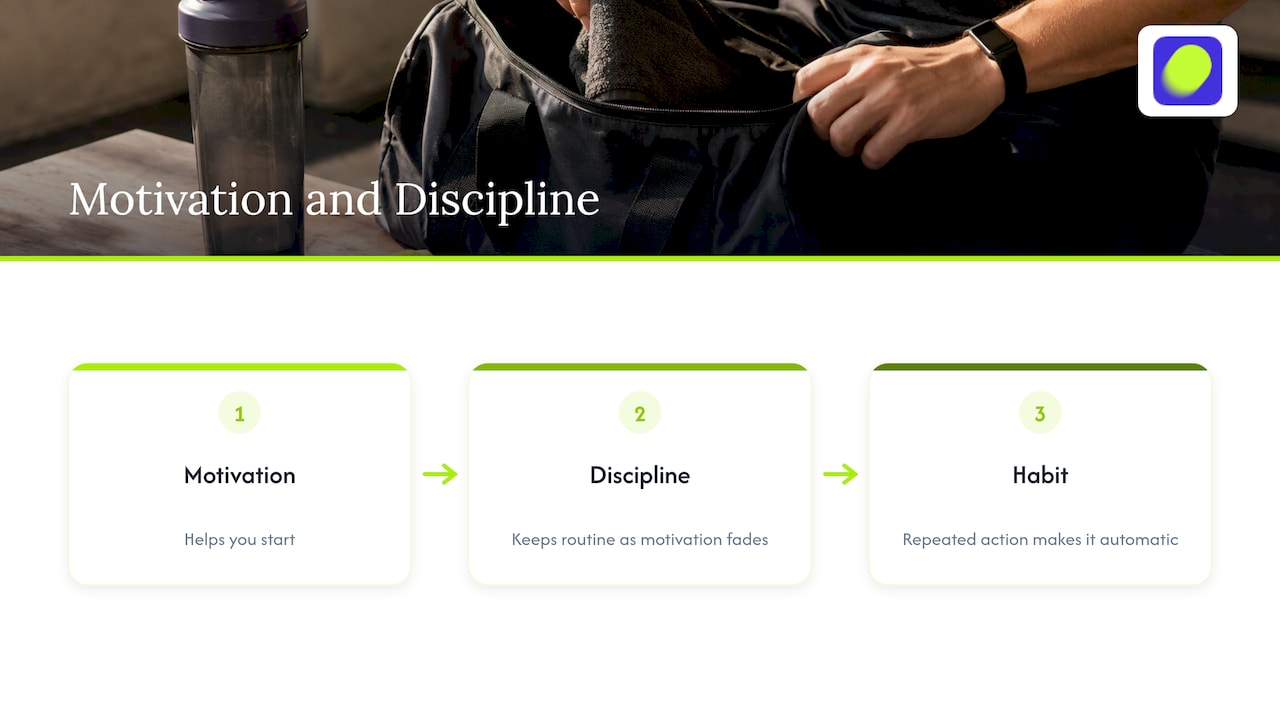
The Conversation describes it this way: motivation helps you start, discipline sustains the routine when motivation wanes, and repeated action eventually turns into habit. A 2024 review on exercise adherence frames it similarly: repeating exercise-related decisions helps make regular activity automatic.
There’s also a two-way street. A 2019 review found that higher self-control and better exercise adherence are linked in both directions. Practicing your routine may build your self-control, and stronger self-control makes the routine easier to keep.
One more piece: the kind of motivation matters. Self-determination theory separates pressure and outside rewards from enjoyment. A systematic review of the research describes the enjoyment-based kind as more effective for lasting behavior. So the goal isn’t to grit your teeth forever. It’s to find training you don’t dread.
Two or three sessions a week is a solid, realistic base for beginners and returning lifters. Here’s a simple way to make it stick.
Discipline gets lighter when your environment does some of the work. Lay out your gym clothes the night before. Choose a time that doesn’t fight your schedule. If you’re thinking about building a daily routine that lasts, the same ideas apply: reminders, a fixed rhythm and someone to share it with.
And if you’re bored, change something. Harvard Health says that if your motivation is slipping, you may just need a different type of exercise. Johns Hopkins Medicine recommends logging your workouts and mixing up activities to keep a program fresh. Swap a gym session for a bodyweight circuit at home, or try a new split.
One of the most underrated tools is another person. Working out with a buddy can make exercise more fun and hold you accountable when you’d rather skip.
You don’t need a gym partner who lives next door. A group chat, a friend you check in with after each session, or a small crew with a shared challenge all do the job. If you want ideas, we put together a guide on how to join or start a workout accountability group, and a look at workout accountability in Florida if you train in the Sunshine State.
The point is simple: when someone expects you to show up, you don’t have to win an argument with yourself every time.
We built Onemor for Gen Z and young millennials who want real structure without spending hours planning. Our workouts are led by coaches, and each guided session walks you through sets, reps and rest timers, so you’re not standing in the gym wondering what’s next. Streaks, XP and tribe-based challenges with friends are designed to make showing up feel rewarding, which is the part motivation alone can’t cover.
You can meet some of the people behind the programs, like Coach Kayla or Coach Jahson. Ready to try it? Start with the free plan on iOS, or see what’s included in Pro.
You need both, but they do different jobs. Motivation helps you start, and discipline keeps you going when the excitement fades. If you have to prioritize, work on habits and structure, since discipline is built through repetition and doesn’t depend on your mood.
Often it’s trying too much too fast, or getting frustrated by slow results. The Cleveland Clinic suggests setting realistic goals, starting small and reducing frequency instead of quitting. Stress and fatigue also lower motivation, which makes a clear plan even more useful.
Shrink the task. The Cleveland Clinic notes that even five minutes a day is better than nothing. Often, starting is the hardest part, and many people keep going once they’ve begun. If a particular workout bores you, try a different activity.
Research cited by Scientific American points to roughly a month of consistent repetition to start building a lasting habit. Keep your schedule realistic, like 2-3 sessions a week, so you can repeat it for those four weeks.