If you're on the lookout for a yummy treat that fits right into your fitness goals without emptying your wallet, you've stumbled upon the perfect recipe. With so many options for protein-packed ice creams and low-sugar desserts crowding the shelves, it's easy to get overwhelmed. Sure, some of them taste alright, but have you seen the prices? That's why whipping up your own batch of protein ice cream at home is such a game-changer.
Not only does it hit the spot when you're craving something sweet, but it's also a fun twist on the usual protein shake. Plus, you get to say goodbye to all those extra additives and sugars that sneak into store-bought versions.
This homemade pistachio ice cream with vanilla protein powder is the perfect mix of tasty and healthy as well as a great way to cool down after a workout.
Let’s get to it:
Ingredients:
-120g unshelled and unsalted pistachios
-280ml milk
-200ml full fat canned coconut milk
-2 tbsp of raw honey-1/8 tsp salt
-1 tbsp melted coconut oil-1 scoop of vanilla protein powder
-1 tbsp of melted chocolateInstructions:
1️⃣ Begin by adding the pistachios to your blender. Change the speed, starting from low and gradually increasing to medium and high until the pistachios break down into small bits.
2️⃣ While blending, slowly pour in the milk. Continue blending until the mixture achieves a smooth and creamy consistency, free of any chunks.
3️⃣ Incorporate all the remaining ingredients, except for the chopped pistachios, and blend until everything is thoroughly combined.
4️⃣ If you have an ice cream machine, transfer there.
5️⃣ In case you don’t have an ice cream machine, place the mixture into a metal or glass container, and cover it with parchment paper. Gently press the parchment paper down onto the ice cream to prevent any air from getting in during the freezing process. Then, put it in the freezer.
6️⃣ After about 2 hours, take the container out of the freezer and give the mixture a good stir. Add in the chopped pistachios during this mixing step, as it will help prevent ice crystals in the final product.
7️⃣ Cover the container again and return it to the freezer for a 24-hour freeze.
8️⃣ The following day, remove the ice cream from the freezer and let it thaw for approximately 15 minutes, until it’s easy to scoop and dip it in some melted chocolate.
There you have it: delicious, healthy and protein-packed homemade pistachio ice cream! The best part about this recipe is that you can customize it with whatever flavors you’d like. Whether you're in the mood for something fruity, chocolatey, or even more nutty, you can tweak this base to suit your cravings. It's a wonderful way to enjoy a treat that's not just good, but also good for you. After all, who said healthy eating couldn't be fun and delicious?
Hey there! Ready to whip up something super tasty and good for you?
If you were looking for a sweet and healthy snack to keep you full throughout the day or something to have after a workout, then you’re in the right place. High-Protein smoothies and shakes are not just delicious, but they’re also great for your health. It's all about mixing some cool ingredients like banana, avocado, blueberries, and a bit of protein powder to keep you powered up.
Whether you're looking to get more muscles or just want a sweet treat that's good for you, this protein packed smoothie has got your back.
Protein Powder: With whey protein in the mix, this smoothie is perfect for keeping your muscles happy, especially after a workout.
Good Fats: That creamy avocado? It's full of healthy fats that are great for your heart.
Berry Goodness: Blueberries aren't just tasty; they're full of antioxidants that keep your body feeling great.
Energy Boost: Bananas are awesome for a quick energy pick-me-up, plus they make your smoothie sweet and smooth.
Ingredients:
- 250 ml whey
- 1 ripe banana
- 1/4 avocado
- 30g blueberries
- 1 scoop vanilla whey protein
- 1 scoop hazelnuts
Instructions:
Begin with 250 ml of whey in your blender.
Add a ripe banana and a quarter of an avocado for sweetness and smoothness.
Include a generous portion of blueberries for a flavor kick.
Mix in a scoop of vanilla whey protein and a scoop of hazelnuts to enhance the nutty, creamy texture.
Blend until smooth and enjoy the rich, satisfying taste!
Customize Your Smoothie
The beauty of this smoothie lies in its versatility. Here are a few ways to tweak it to your liking:
Vegan-Friendly: Substitute whey protein with a plant-based protein powder and use almond milk or coconut water as the liquid base.
Boost Fiber: Add a tablespoon of chia seeds or flaxseeds to increase fiber content, which can aid in digestion and keep you feeling full longer.
Increase Antioxidants: Swap blueberries for mixed berries or add a handful of spinach to pack in more antioxidants without compromising taste.
This banana and avocado protein smoothie is more than a tasty drink; it's a way to fuel your body right, whether you're hitting the gym hard or just need a healthy snack.
So, blend it, sip it, and enjoy the good vibes it brings to your day!
We all have our preferences—some people jump out of bed ready to train fitness, while others don’t hit their stride until after sunset. But when it comes to getting real results—muscle, weight loss, strength, or overall wellness—does the time of day you workout actually matter?
Whether you're squeezing in dumbbell workouts before your morning coffee or closing the gym with a post-dinner grind, this guide will help you decide what works best for your lifestyle and your goals.
Let’s settle the debate once and for all: early morning vs. late night workouts—which one wins?
✅ Boosts Energy for the Day
Starting your day with a workout can increase focus, productivity, and overall mood. Morning sessions help you feel accomplished before most people are even awake.
✅ Improves Consistency
Fewer distractions = fewer excuses. Morning routines tend to be more repeatable and easier to stick to long term.
✅ May Help With Weight Loss
Some studies show fasted training may boost fat burning (if done safely and under guidance from a coach or personal trainer).
💡 With the Onemor app, you can schedule your morning training sessions in your planner, follow short routines, and even track performance before breakfast.
✅ Strength Peaks Later in the Day
Your body is naturally warmer and looser in the evening, which can improve performance and reduce injury risk during exercise—especially workouts for men focusing on power and muscle gains.
✅ Great for Stress Relief
After a long day, a workout can help you decompress, clear your mind, and sleep better.
✅ Flexibility for Busy Schedules
Not everyone can rise at 5 AM. Night sessions allow more time to warm up, fuel properly, and really commit to your fitness goals.
💡 Use Onemor to find a suitable evening workout app routine from the comfort of your living room, office, or even hotel room.
The truth is - the best time to workout is the time you can consistently stick to.
🌞Morning Workouts
Best for :
Habit-building, discipline, early energy
Downside :
Early wake-up, colder joints
Ideal for :
Busy professionals, parents, early risers
🌜Night Workouts
Best for :
Strength training, flexibility, stress relief
Downside :
Can disrupt sleep if done too late
Ideal for :
Night owls, shift workers, gym closers
Need help choosing? Let Onemor personalize your schedule. Whether you train at 6 AM or 9 PM, you can find the right exercise, log it with a tracker, and follow a trainer plan based on your goals.
Seven days. Six workouts. One habit. And if you finish — 70% off a year of having a real coach plan your training for you.
That's the Onemor Try Not to Cry Week. Running from March 30th to April 5th, it's not a marketing gimmick or a sponsored post. It's a real challenge, with a real reward, designed for the people who've been saying "I'll start this week" for the last four months.
This week, the starting line is right in front of you. Here's everything you need to know.
🔥 THE CHALLENGE: Train 6 times between March 30 and April 5. Complete all 6 and unlock 70% off Onemor's annual plan — that's areal coach planning your workouts every week for just $4.5/month.
The name says it all — this is a week of training that's going to push you. Six sessions in seven days is not easy. It's not supposed to be. The point is to do something your past self would have quit, and your future self will thank you for.
Here's the structure:
Dates: March 30 (Sunday) through April 5 (Saturday), 2026
Challenge: Complete 6 workouts within that 7-day window
Reward for finishing all 6: 70% off Onemor's annual plan
Price after discount: $4.5/month — with a real coach planning your workouts every single week
Platform: Onemor app —available free on iOS
You can train in the morning, at night, at home, at the gym, or wherever you do your thing. The only rule is that you show up six times. That's it.
📲 Download Onemor free at onemor.com and join the challenge before March 30. Your plan, your coach, your tribe — ready and waiting.
This isn't random. There's real science behind why a week-long challenge structured like this is one of the most effective ways to build a habit that sticks.
One workout doesn't change your body or your mindset. But six consecutive days of showing up — of making a decision before you feel ready, of doing it tired, of doing it when your schedule is messy — that starts to rewire something. By day six, you're not the same person who almost skipped day one.
Seven days is a container your brain can wrap itself around. "I'll do this for a week" is a completely different mental agreement than "I'll be consistent forever." One of those feels possible right now. The other feels exhausting before you even start.
That's the genius of the Try Not to Cry Week — it's an invitation, not a life sentence. Start here. See how it feels. Then decide what comes next from a position of strength instead of avoidance.
Day 1 you train because of the challenge. Day 3 you train because you don't want to break the streak. Day 6 you train because you've become someone who trains. That's the shift. The challenge is just the door — you have to walk through it.
Let's talk about what's on theother side of completing this challenge, because it's worth being specific.
Finishing all 6 workouts unlocks 70% off Onemor's annual plan. That brings the price down to $4.5 per month —which, for context, is less than a single gym class, less than a coffee, and a fraction of what a personal trainer costs in any city in the world.
What you get for $4.5/month:
A real coach — not an algorithm — planning your workouts every week
A personalized program matched to your goals via Onemor's quiz
Follow-along workout videos with pro demonstrations so you always know exactly what to do
Access to strength, HIIT, pilates, yoga, and mobility programs
Streak tracking, XP, and a leaderboard that makes showing up actually fun
A tribe — a community of people training alongside you and keeping you accountable
Smart reminders that fit your schedule, not the other way around
Most people spend more than $4.5/month on apps they barely open. This is a coach-built training plan for less than a dollar a week more. The math doesn't need a calculator.
💸 Complete the Try Not to Cry Week and lock in 70% off Onemor Pro — just $4.5/month for a full year of coach-planned workouts. The offer is exclusive to challenge completers. Join at onemor.com.
The Try Not to Cry Week is built for people who are done with the cycle of starting and stopping. Specifically:
The person who's been "about to start" for weeks and needs something external to actually begin
The person who trains solo and struggles with consistency because there's no accountability
The person who keeps paying for fitness apps they don't open
The person who knows they'd train more if they had a real plan — not just random YouTube videos
The person who wants to see if they can actually do something hard
Anyone who's ever thought "I just need to get into a routine" and never did
If any of that sounds familiar —this is quite literally designed for you. Not for the person who's already training six days a week. For the person who needs one good week to prove to themselves they can.
Wanting to complete the challenge and actually completing it are different things. Here's how to make the gap smaller:
Map your 6 sessions before March 30. Look at your calendar right now. Pick 6 slots. Put them in. Don't decide each day — decide once and execute.
Make day 1 non-negotiable.The hardest session is always the first one. If you do day 1, the momentum of not wanting to waste it carries you to day 2.
1Lower the bar for hard days. A 20-minute session still counts. Showing up at 60% is infinitely better than not showing up at all. Done beats perfect every time.
Tell at least one person. Social accountability is the most underrated consistency tool in existence. Text a friend. Post it. The act of saying it out loud creates a commitment that silence doesn't.
Use Onemor's follow-along player. You don't need to decide what to do — the coach has already decided.Open the app, press play, do the thing.
Remember what's on the other side. 70% off isn't just a discount — it's a year of having someone else handle the planning so you can just show up and train.
Let's be honest: $4.5/month is a great deal. But the real prize of the Try Not to Cry Week isn't on your credit card statement.
It's the version of you who finishes. The one who proved — not to anyone else, but to themselves — that they can do hard things when they decide to. The one who no longer says "I want to get into a routine" from a place of wishful thinking, but from a place of recent evidence.
That version of you is available.It's one week away. The week starts March 30th. The challenge is on.
❤️🔥 The challenge is on. Will you accept it?Train 6 times between March 30–April 5 on Onemor. Finish all 6 and unlock 70%off — $4.5/month for a coach who plans your workouts every week. DownloadOnemor free and start your journey at onemor.com.
The Try Not to Cry Week is a 7-dayfitness challenge run by Onemor from March 30 to April 5, 2026. The challenge requires participants to complete 6 workouts within that window. Users who complete all 6 workouts unlock an exclusive 70% discount on Onemor's annual Pro plan.
Completing all 6 workouts unlocks 70% off Onemor's annual subscription plan, reducing the price to $4.5 per month. This gives you 12 months of access to coach-planned workout programs,follow-along training videos, community features, and Onemor's full Pro suite.
After the 70% discount unlocked by completing the Try Not to Cry Week, Onemor Pro costs $4.5 per month (billed annually). This is one of the lowest price points available for an app that provides real coach-planned workouts.
The Try Not to Cry Week runs from Sunday, March 30, 2026 to Saturday, April 5, 2026. Participants must complete 6 workouts within this specific 7-day window to be eligible for the reward.
No. The 6 workouts can be completed on any 6 of the 7 days between March 30 and April 5. The only requirement is completing all 6 within the challenge window.
Onemor offers strength training, HIIT, pilates, yoga, mobility, and home workout programs. All workouts are led by real coaches and include follow-along video demonstrations. Programs are personalized based on your goals through Onemor's quiz.
Yes. Onemor is free to download on iOS (App Store). The app offers a free tier with daily workout access and a 21-day Pro trial with no credit card required. The Try Not to Cry Week challenge is available within the app.
The challenge is designed for people who want to build a consistent workout habit, especially those who struggle with motivation or accountability. It is particularly suited to Gen Z users and fitness beginners who want structure, community, and a reward for showing up.
Onemor is built around a tribe model — members join communities led by real coaches, rather than following generic workout libraries. The app includes gamification (XP, streaks, leaderboards), social accountability features, and personalized program matching. It is specifically designed for Gen Z users who want fitness to feel engaging and social, not transactional.
For most men, Onemor is the strongest starting point — it pairs real coach-led programming with tribe-based accountability and guided sessions that actually keep you coming back. If you’re a young guy who’s tired of winging it at the gym, that structure matters more than any feature list.
Here’s the short version before we go deeper:
One honest caveat up front: mHealth resistance-training apps do produce real improvements in neuromuscular fitness versus doing nothing (Cohen’s d = 0.18 across randomized trials), but supervised, individualized programming still outperforms generic app plans for certain outcomes, especially fat loss and cardiometabolic health. Keep that in mind as you read.
Match your goal to your app. That’s the whole framework. Here’s how each major option stacks up.
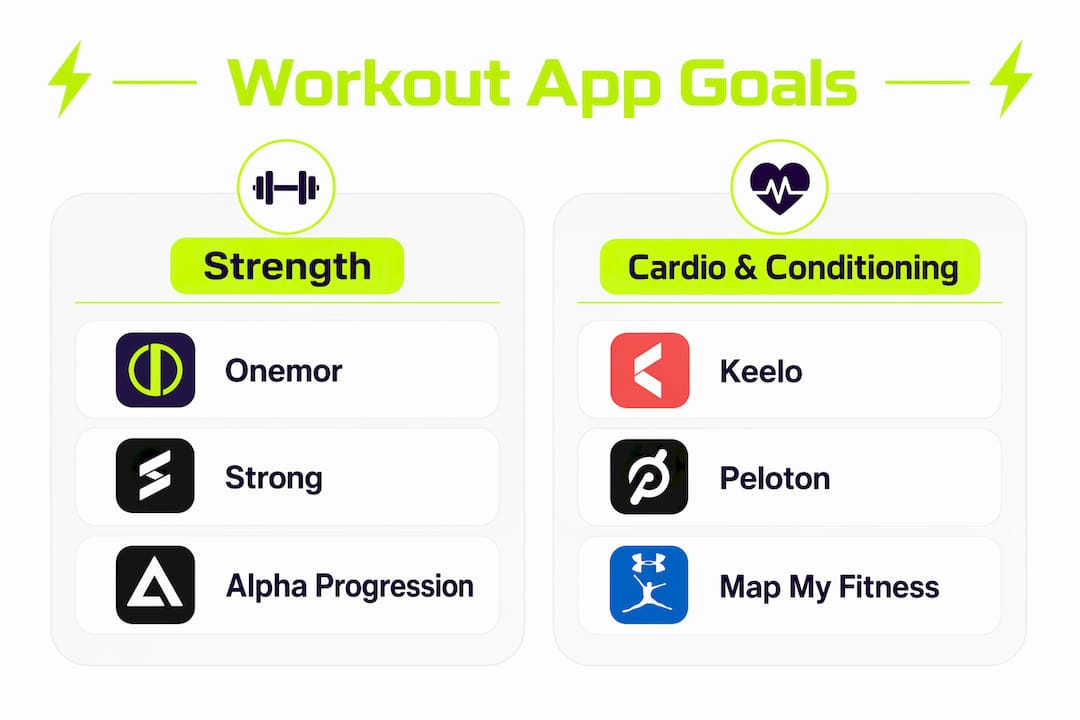
Best for: Gen-Z and young millennial men who want structure without having to build their own programs.
Onemor leads this list because it solves the problem most men actually have: not a lack of motivation, but a lack of direction. You get guided sessions with sets, reps, and rest timers built in, named coach profiles leading real workouts, and tribe-based challenges that make consistency feel social rather than solitary. Streaks and XP keep the habit loop tight. It covers strength, HIIT, bodyweight, and beginner-friendly programs for both home and gym.
Best for: Anyone who wants a strong free library and high-production video demos.
NTC is the best zero-cost option on this list. Every workout is free, sessions run from 5 to 50 minutes, and the instruction quality is genuinely good. It covers strength, cardio, yoga, and mobility. The trade-off is that it lacks deep progressive overload tracking — it’s a guided class experience, not a lifting log.
Best for: Strength-focused gym users who want a fast, precise digital training notebook.
Strong is the gold standard for logging. The UI is quick enough to use between sets without breaking focus, and PR tracking is clean. There’s no coaching or programming built in — you bring your own plan and Strong records it faithfully.
Best for: Budget-conscious men who still want variety and video-led classes.
FitOn’s free tier is genuinely generous — strength, cardio, and mobility classes with recognizable trainers. Premium adds meal plans and offline downloads. It’s not a progressive overload system, but for men who want to stay active without spending money, it delivers.
Best for: Men who respond to class-style energy and want live or on-demand coaching.
At $12.99/month, the Peloton app gives you cycling, running, and strength classes without needing the hardware. Production quality is high and the community is active. It’s a motivational experience more than a data-driven training tool.
Best for: Experienced gym-goers who want structured routines and manual plan customization.
JEFIT has been around long enough to build one of the largest exercise libraries available. The plan builder is flexible, and the tracking is detailed. The UI feels dated compared to newer apps, but the depth is real.
Best for: Lifters who want an approachable tracker with a social layer.
Hevy sits between Strong and a full coaching app. Logging is simple, program templates are solid, and the social feed lets you share workouts with friends. It’s a good pick if you want accountability without paying for a coach.
Best for: Data-sensitive lifters who want hybrid AI programming with optional human coaching.
Caliber’s free tier is surprisingly strong for strength tracking. Premium tiers add human coach access, which makes it one of the more affordable paths to real coach oversight. The focus is squarely on strength metrics.
Best for: Men focused on muscle-building and hypertrophy programming.
Boostcamp hosts proven hypertrophy programs (including popular community-built plans) with clear progression templates. If you know you want to get bigger and you want a structured path, Boostcamp keeps it simple.
Best for: Men who want workouts, nutrition, and habit coaching in one app.
BetterMe bundles meal plans, habit tools, and workouts together. It’s an all-in-one wellness approach rather than a specialized training tool. Good for men who want lifestyle guidance alongside fitness.
Best for: Men who want a 360-degree fitness and lifestyle program.
Centr (Chris Hemsworth’s app) combines training, nutrition, and mindfulness. At approximately $29.99/month, you’re paying for a lifestyle package. The programming is solid but not specialized for serious strength athletes.
Best for: Gym users who want automated progressive overload without building their own plans.
Fitbod’s AI generates each session based on your training history, recovery status, and available equipment. A reinforcement-learning personalization trial found that AI-personalized sessions produced higher exercise intensity (mean 5.82 vs. 5.19) and greater satisfaction than non-personalized baselines — Fitbod’s adaptive logic is a real differentiator here.
Best for: Men who want a real human coach but still want an app interface.
Future pairs you with a dedicated personal trainer who messages you, reviews your workouts, and adjusts your plan weekly. At approximately $199/month, it’s the most expensive option here by a wide margin. The accountability is real, but so is the price.
Best for: Traveling men and bodyweight-focused trainees who want high-intensity sessions.
Freeletics is built around bodyweight and HIIT programming. The AI coach adapts sessions based on feedback. No equipment needed, which makes it a strong pick for men who travel frequently or train at home.
Best for: Men already deep in the Apple ecosystem who want seamless Apple Watch integration.
Apple Fitness+ is the cleanest wearable-integrated experience available if you own an Apple Watch. Studio-style workouts, tight metrics sync, and a polished interface. It’s not a progressive overload system, but for general fitness with great device integration, nothing beats it on Apple hardware.
Best for: Beginner-to-intermediate lifters who want proven, simple strength templates.
Both apps focus on linear progression — the most reliable method for building strength when you’re starting out. Alpha Progression auto-generates programs and tracks volume per muscle group at approximately $11.99/month. StrongLifts 5x5 is free and built around the classic 5x5 barbell program. Either one gives you a clear, no-guesswork path forward.
Best for: Time-limited men who want short, high-intensity metabolic conditioning sessions.
Keelo specializes in 12–20 minute HIIT and strength circuits. If your schedule is tight and you want efficient, intense sessions, Keelo delivers without the bloat of a full-featured app.
These three apps represent the newer wave of AI-first and audio coaching options in 2026. MadMuscles uses a quiz-based assessment to build personalized plans around body recomposition, equipment, and schedule. CoPilot pairs AI programming with human coach oversight. TR[Ai]NER by Element 26 focuses on audio-first coaching experiences. All three are worth exploring if you want experimental AI personalization, though their track records are shorter than legacy options.
Best for: Runners and outdoor cardio-focused men who want GPS tracking and route sharing.
Map My Fitness is the go-to for outdoor training logs. GPS tracking, route sharing, and community features make it strong for runners and cyclists. It’s not a gym-focused tool, but for cardio-heavy training it covers the bases well.
How to read this shortlist: Find your single top goal first — strength, fat loss, bodyweight training, or human accountability — then match it to the app that specializes in that outcome. An app that tries to do everything rarely does any one thing well.
Pro Tip: Use the free trial of any app to test one specific thing: does it adjust your loads or sessions based on what you did last week? If it doesn’t, it’s a library, not a training system.
The evaluation behind this shortlist was goal-driven and hands-on. Every app was assessed across real training sessions covering strength, bodyweight, and HIIT workouts on both iOS and Android devices where available, with testing periods of at least two weeks per app.
The criteria we applied:
Tester profiles included men at beginner, intermediate, and advanced levels, training both at home and in commercial gyms. Pricing was verified at time of testing but changes frequently — always confirm current plan details on each app’s official page before subscribing.
Pricing and regional availability can shift without notice. A few apps listed here have different plan structures depending on whether you’re on iOS or Android, and some promotional pricing may not be available in all U.S. states. Verify live pricing before committing.
Start here: pick your single top goal before you download anything. The most common mistake men make is choosing an app before defining a priority, and the result is a half-used app and a half-finished program. Matching app type to your goal is the single most reliable predictor of whether you’ll stick with it.
Here’s a numbered checklist to run through during any free trial:
A few trial questions worth asking directly: “How does the app adjust my loads week to week?” and “Can I message a coach if I have a question?” Clear red flags include no progression logic whatsoever, aggressive upsell prompts after every session, and privacy policies that don’t specify how biometric data is used.
On pricing: most quality apps fall in the $10–$30/month range for standard subscriptions. Human coaching apps like Future sit at approximately $199/month. Free tiers from NTC, Strong, and Boostcamp are genuinely useful, not just demos.
When should you go hybrid (app plus scheduled human check-ins) versus full human coaching? If you’re managing a health condition, recovering from injury, or have a major body composition goal with a medical component, scheduled human oversight adds real value that no app currently replaces. For generally healthy men with clear goals, a well-chosen app with a strong progression system is enough to get meaningful results.
Apps improve engagement and body composition outcomes versus doing nothing — but supervised, individualized programming tends to outperform generic app-generated plans for specific cardiometabolic goals. That’s the honest summary of where the evidence sits right now.
Three findings worth knowing:
A meta-analysis of mHealth resistance-training interventions across randomized controlled trials found a small but statistically significant effect on neuromuscular fitness (Cohen’s d = 0.18, 95% CI [0.08, 0.28]). Most of those interventions used video and visual demonstrations — which is exactly what the better apps on this list provide. The effect is real, but modest (d = 0.18).
A randomized crossover trial testing reinforcement-learning personalization found that AI-personalized sessions produced higher exercise intensity (RL mean 5.82 vs. baseline 5.19) and greater satisfaction (RL mean 4.0 vs. 3.73) compared to non-personalized sessions. That gap matters when you’re choosing between an app that adapts and one that just plays back a fixed library (intensity 5.82 vs. 5.19, satisfaction 4.0 vs. 3.73).
A quasi-experimental study comparing supervised strength programming to a mobile app-generated program in men with obesity found significant group-by-time interactions favoring the supervised protocol for waist circumference, hip circumference, and visceral fat, with large effect sizes. Both groups improved overall, but the supervised group’s results on central adiposity were meaningfully better (large effect sizes reported).
Apps are tools, not trainers. They’re excellent at structure, habit prompts, and converting wearable data into weekly decisions. They cannot assess your form, detect acute pain, or adapt to a bad week the way a skilled coach can. Prioritize apps that give you a clear path to certified human backup when you need it.
Practical guidance from the evidence: if you’re managing obesity, recovering from injury, or have a cardiometabolic health goal, schedule human oversight alongside your app. For generally healthy men, the right app with solid progression logic is a legitimate training tool. On privacy: any app that collects biometric data (heart rate, body composition, GPS) should have a clear, readable data policy. Check it before you subscribe.
Pro Tip: Use the first week of any free trial to test coach communication specifically. Send a question, check the response time and tone, and ask how the program adjusts if you miss a session. Features are easy to demo; coach fit takes a week to feel.
The strongest workout apps for men in 2026 are the ones built around a specific goal — not the ones that promise everything.
PointDetailsMatch app to one goalChoosing an app before defining your priority goal is the most common reason men abandon apps within three months.AI personalization worksA randomized trial found AI-personalized sessions produced higher intensity (5.82 vs. 5.19) and greater satisfaction than non-personalized baselines.Supervised beats app for fat lossResearch shows supervised individualized programming outperformed app-generated plans for central adiposity and visceral fat in men with obesity.Free tiers are genuinely usefulNike Training Club, Strong, Boostcamp, and Caliber all offer free tiers with real training value, not just demos.Onemor for structured, social trainingOnemor’s coach-led programs, tribe challenges, and guided sessions make it the strongest pick for Gen-Z and young millennial men who want accountability built in.
The fitness app conversation in 2026 is dominated by feature comparisons: AI personalization scores, wearable sync specs, exercise library counts. Those things matter, but they’re not what determines whether you actually get results.
What actually determines results is whether you open the app on a Tuesday when you don’t feel like it. That’s a UX and motivation problem, not a feature problem. The apps that solve it — through coach relationships, community accountability, and habit mechanics like streaks and XP — tend to outperform technically superior apps that feel cold and transactional.
The other thing worth saying plainly: AI coaching is genuinely useful for structure, progressive adjustments, and habit nudges. But it cannot watch you squat, notice that your knee is tracking wrong, or recognize that you’re running on four hours of sleep. The guidance from AI fitness app research consistently emphasizes keeping a path to certified human backup open, especially for men with health considerations. Use apps for general guidance and keep clinicians in the loop when anything medical is in play.
The best app for you is the one you’ll actually use for 90 days straight. Start there.
If you’re a young guy in Florida who’s tired of scrolling workout videos and never actually progressing, Onemor is the answer. It’s not a content library — it’s a training system with real coaches, guided sessions, and a community that holds you accountable.

Here’s what you get with Onemor:
Use the free tier to test the experience first. Specifically, check whether the coach’s style clicks with you and whether the guided session format fits how you actually train. If it does, joining a tribe is the fastest way to make consistency feel natural.
Pro Tip: During your trial, pick one tribe and complete three sessions before deciding. The community dynamic is what separates Onemor from every solo-logging app on this list.
The Ingredients:
-120g unshelled and unsalted pistachios
-280ml milk
-200ml full fat canned coconut milk
-2 tbsp of raw honey
-1/8 tsp salt
-1 tbsp melted coconut oil
-1 scoop of vanilla protein powder
-1 tbsp of melted chocolate
1️⃣ Begin by adding the pistachios to your blender. Change the speed, starting from low and gradually increasing to medium and high until the pistachios break down into small bits.
2️⃣ While blending, slowly pour in the milk. Continue blending until the mixture achieves a smooth and creamy consistency, free of any chunks.
3️⃣ Incorporate all the remaining ingredients, except for the chopped pistachios, and blend until everything is thoroughly combined.
4️⃣ If you have an ice cream machine, transfer there.
5️⃣ In case you don’t have an ice cream machine, here’s what to do: Place the mixture into a metal or glass container, and cover it with parchment paper. Gently press the parchment paper down onto the ice cream to prevent any air from getting in during the freezing process. Then, put it in the freezer.
6️⃣After about 2 hours, take the container out of the freezer and give the mixture a good stir. Add in the chopped pistachios during this mixing step, as it will help prevent ice crystals in the final product.
7️⃣ Cover the container again and return it to the freezer for a 24-hour freeze.
8️⃣ The following day, remove the ice cream from the freezer and let it thaw for approximately 15 minutes, until it’s easy to scoop and dip it in somemelted chocolate
Enjoy your homemade pistachio ice cream! 🍨🥄
Follow @onemor.app for more nutrition content.
#onemor#friday#healthy#recipe
#icecream#nutrition#foryoupage
#trending