A 5 day workout split works best if you are an intermediate lifter, or simply someone who prefers shorter, focused sessions over fewer marathon ones. It lets you spread your training volume across the week, which keeps each workout sharp and recoverable. If you are brand new to lifting, you might actually see faster results from 3 full-body sessions a week. But once you have a few months of consistent training behind you, 5 days start to make a lot of sense.
TL;DR:
- A 5-day split is most beneficial for intermediate lifters with consistent training, as it allows balanced volume distribution and focused recovery.
- Managing weekly volume, with at least 10 sets per muscle group and 6 to 12 reps for hypertrophy, is more important than the number of training days.
- Beginners should prioritize full-body workouts three times a week before transitioning to a 5-day plan for better results and adaptation.
- Progression involves gradually increasing load, volume, or reps weekly, with deload weeks every 3 to 4 weeks to prevent overtraining.
- Customization, such as swapping equipment or adjusting volume based on recovery, along with proper warm-up and cool-down routines, enhances training sustainability.
Choosing a template is less about finding the “perfect” plan and more about picking one that matches your goal and your schedule. Here are three that work for most people.
If you are training at home or in a smaller gym, all three templates adapt well—swap barbell work for dumbbells or a resistance band set where equipment is limited, the dose of training still counts even when the tools change. Swap barbell work for dumbbells or resistance bands where equipment is limited, the dose of training still counts even when the tools change.
Your results depend far more on weekly training volume than on which days you train. A 2016 dose-response meta-analysis found that more weekly sets led to greater increases in muscle size, with each added set producing a small, incremental benefit. That is the foundation worth building your split around.
Statistic: Research analyzing 34 training groups across 15 studies found each additional weekly set was linked to roughly a 0.37% increase in muscle growth, which is why chasing a reasonable volume target pays off more than chasing a specific number of training days.
A few rules make this easier to apply:
In other words, a 5-day split is not inherently better than a 3- or 4-day one for muscle growth. It is simply a tool for distributing your volume into sessions that feel manageable and let you train each lift while still fresh.
A template is only a starting point. Here is how to make it yours and keep it working month after month.
Pro Tip: Keep a simple log of your sets, reps, and how each session felt. Patterns show up fast, and they tell you when to push and when to pull back.
Here is a full sample week using the hypertrophy template, detailed enough to just pick up and go.
Finish each session with 5 minutes of static stretching focused on whatever you trained. If you are short on time, keep the main lift and one accessory movement per muscle group rather than cutting your warm-up, that is what protects your joints long term.
Training hard only pays off if your body gets the chance to rebuild. A few habits make the biggest difference here.
Pro Tip: If 5 days consistently feels like too much, a 3-day routine or a 4-day upper/lower split can deliver similar results with less weekly commitment.
Sticking to a plan is usually harder than writing one. There are fitness apps that provide guided sessions with built-in sets, reps, and rest timers, so you are never guessing what comes next mid-workout. Features like streaks, XP, and group challenges can make consistency more engaging, and coach-led programming can provide structured workouts without the need to plan them yourself. For more on how training frequency fits into your results, our piece on research-backed rep ranges for hypertrophy breaks down the weekly set targets referenced above.
A few patterns show up again and again with 5-day programs. Copying an advanced routine before you have the recovery capacity to support it often leads to missed sessions rather than faster gains. Chasing soreness as a sign of progress, instead of tracking load and reps, tends to cloud whether you are actually improving.
Skipping warm-ups to save time increases injury risk right when your joints need the most preparation. Programming every session at maximum intensity leaves nothing in reserve for the days you genuinely need to push, which flattens progress over a few months. Ignoring sleep and protein intake while expecting the training itself to carry all the weight is another common trap, recovery outside the gym matters just as much as the work inside it.
Finally, treating a 5-day split as permanent rather than adjustable is a mistake in itself. The best program, according to ACSM’s 2026 resistance training guidance, is the one you actually stick with, not the one that looks most impressive on paper.
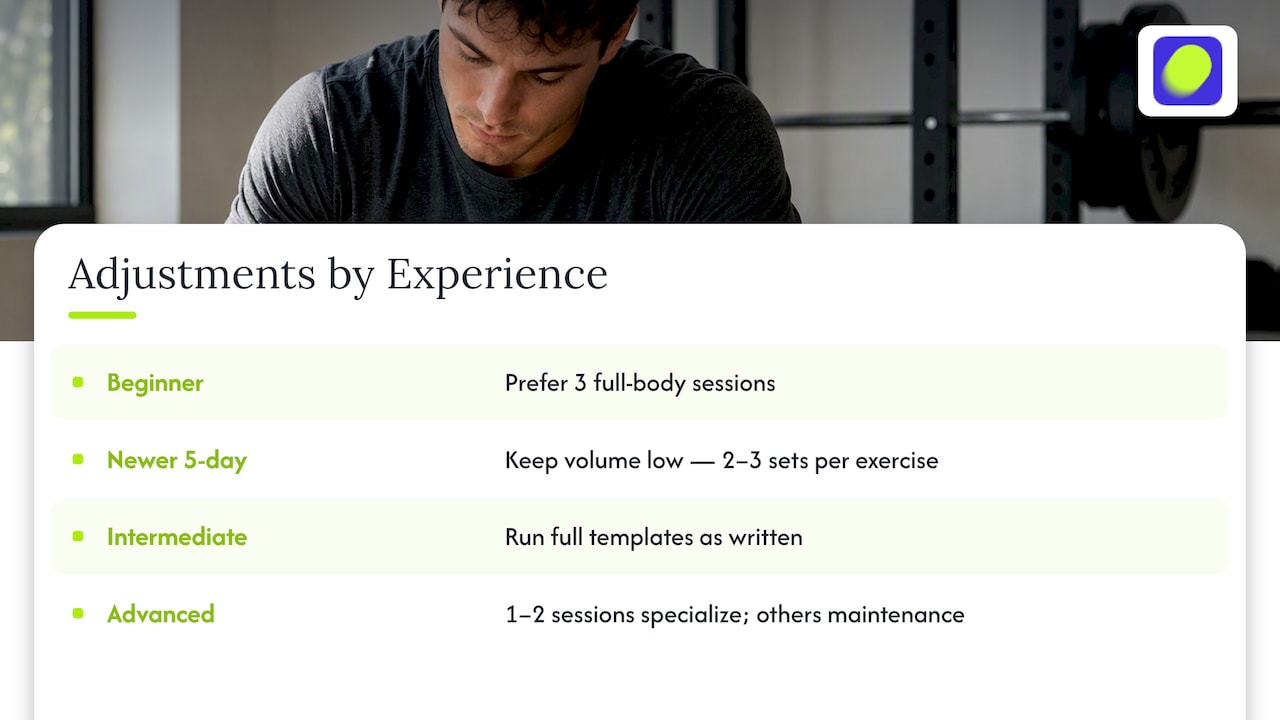
Beginners can absolutely run a 5-day split, but they usually do not need to. ACSM guidance points out that training all major muscle groups at least twice a week matters more than hitting a specific number of training days, so a newer lifter might get just as much from 3 full-body sessions.
If you are newer and still want 5 days, keep volume lower per session, around 2 to 3 sets per exercise, and focus on learning the main lifts with good form before adding intensity. Intermediate lifters can run the full templates above as written, since they have the recovery capacity to handle higher weekly volume. Advanced lifters often benefit from specializing one or two sessions around a weak point, like adding extra shoulder volume if pressing strength has plateaued, while keeping the other days at maintenance volume.
A warm-up should prepare the specific joints and muscles you are about to load, not just raise your heart rate. For upper body days, spend 5 minutes on band pull-aparts, arm circles, and a couple of light warm-up sets of your first main lift. For leg days, bodyweight squats, walking lunges, and leg swings loosen up the hips and knees before you add weight.
Cool-downs matter too, even though they get skipped often. After any session, spend 5 minutes on static stretches targeting the muscles you just trained, hamstrings and hip flexors after leg day, chest and shoulders after push day. This small habit supports mobility over time and gives your nervous system a clear signal that the workout is done.
Cardio and a 5-day lifting split can coexist, but the timing matters. Low-intensity cardio, like a 20 to 30-minute walk or easy bike ride, fits well on rest days or right after a lifting session without competing for recovery resources.

Higher-intensity cardio, such as intervals, is better placed on days separate from your heaviest lifts, since it draws on similar energy systems and can blunt strength performance if stacked too closely. If your main goal is muscle and strength, 2 cardio sessions a week is usually enough to support heart health without cutting into your lifting recovery, in line with general physical activity guidance that encourages regular movement alongside strength work.
Writing a 5-day split is one thing, actually following it week after week is another. Onemor turns the templates above into guided sessions with built-in timers for sets, reps, and rest, so you spend your energy lifting instead of checking a spreadsheet mid-set.
Start with the free plan and run one week of a template from this guide, then compare how it feels against planning everything yourself.
Inconsistent training volume and poor recovery are the biggest culprits, not any single mistake in the gym. Skipping sleep, under-eating protein, and jumping between programs before giving one enough time to work all interrupt the steady progression that builds muscle.
Neither is inherently better. A 2018 systematic review found that when weekly volume is equal, training frequency itself does not significantly change hypertrophy outcomes, so the right number of days depends on your recovery and schedule rather than one being superior.
Definitions of the 3-3-3 rule vary across fitness sources, and no major research body defines it as a standard training principle. If you come across it, treat it as informal guidance rather than an evidence-based framework.
There is no single most effective split, the research points to total weekly volume as the bigger driver of results than any particular schedule. A 2016 dose-response meta-analysis found that higher weekly sets, roughly 10 or more per muscle group, correlate with greater muscle growth regardless of whether that volume is spread across 3, 4, or 5 days.